Make Dark Money Darker? Ctd

A reader suspects that anonymizing political donations wouldn’t do much good:

Ayers’ and Ackerman’s proposal on campaign financing makes sense on its face, but it would be pretty easy to exploit. Quoting Dylan Matthews on the plan:

It sounds batty until you realize the authors’ key insight: for a quid pro quo to work, the paid-off party doesn’t just have to receive a kickback. They have to know they’ve received a kickback.

Hiding who made the donation might work if there was no other way to determine who the donor was. If you have a conversation with a potential donor and they say they are going to send you $100,000 tomorrow, and then you get $100,000, it’s pretty obvious where it came from. Worse, it’s more obvious the larger the donor. Sure, any given $20 donation would get lost in the shuffle. But big money would be quite clear.

Even for smaller amounts, there’s been a long running practice of adding cents at the end of a donation to indicate the source. So if a group tries to put together a big money bomb for a candidate, they could tell donors to add .02 at the end of each donation to indicate where it came from.

Another adds:

It’s not going to help when the “quid pro quo” benefits an entire sector instead of just a handful of company. For example, the coal industry and the oil industry will donate to carbon-friendly groups or PACs, and they will in turn help elect respective politicians that would help further assistance for their particular industry. Do you honestly think it’d make a difference if the Koch Brothers’ money becomes even darker? The grand purpose is still served to help benefit and enrich them. The only thing that they might not get is an ambassadorship from a GOP president.

Update from a reader:

I obviously don’t expect you to embed the entire Dylan Matthews piece on Ayers’ and Ackerman’s proposal, but it does appear as if the readers you quoted expressing skepticism about the idea didn’t click through to get the full picture. Ayers and Ackerman have anticipated the concerns raised by your readers and their plan includes two key provisions to address them.

The first is to distribute donation funds to candidates on a periodic basis (weekly for example) rather than passing them through immediately as they come in.  That process would happen based on:

an algorithm which would smooth out sudden spikes in donations in a given week or month (or whatever other interval at which donations are released to campaigns), so they don’t appear to be spikes to campaigns. “We could just have a randomization algorithm, so that if a huge amount kicks in, you get it over 14 weeks,” Ackerman says.

So no one’s getting a check that says “$100,000.22 Love the Koch Brothers.”

The second idea is basically to use public financing to dilute the proportional influence of private campaign contributions:

every registered voter in America gets $50 per election cycle to give to candidates for federal offices, whether they’re running for president, the Senate or the House. Ackerman and Ayres call these vouchers “Patriot Dollars.”

The goal is for federal elections to be roughly two thirds financed by public dollars, with those funds allocated at the discretion of individual voters.

I’d encourage people to read the whole Matthews piece, because I have to say the idea is pretty damn elegant.  Obviously it won’t fix every problem we’re facing due to money in politics, but the fund distribution algorithm combined with the dilution of private money’s proportional influence would stand a good chance, it seems to me, of meaningfully altering the landscape of campaign finance.

The Best Of The Dish Today

Well, that wasn’t so bad. One polyp, apparently, and not too close in appearance to Leon Wieseltier. No Lemmiwinks. RIP.

Meanwhile, Butters gave a commencement speech! Well, not Butters Stotch as such but Eric Stough, the Colorado University grad on whom the South Park character was roughly based. Stough is a producer and animation director of the show. Life lesson:

Stough described an episode in which Butters experiences a “beautiful sadness” after being dumped. “But how could sadness be beautiful?” he said. “In order to feel something really sad, he had to experience something as equally happy. The key to a great life isn’t just happiness. It would be a boring life if it were.”

Also: don’t forget to bring a towel.

Today, we discovered that “the people of Holland have one of the lowest indexes of anti-Semitic attitudes (5 percent) in the world while also harboring great hostility to Israel.” Plus: Iranians are less anti-Semitic than other Middle Easterners. And Bibi Netanyahu’s head just exploded. We visited the white-hot center of the marijuana revolution – Uruguay –  where fully legal weed is imminent thanks in part to one of the more charming populists on the planet. Oh – and how margarine affects the divorce rate.

The most popular posts of the day: this map; and this monologue. Many posts today were updated with your emails – read all of them here. And you can leave your unfiltered comments at our Facebook page and @sullydish.

See you in the morning.

Poetry In Motion

Colin Marshall captions:

The poetry of Charles Bukowski deeply inspires many of its readers. Sometimes it just inspires them to lead the dissolute lifestyle they think they see glorified in it, but other times it leads them to create something compelling of their own. The quality and variety of the Bukowski-inspired animation now available on the internet, for instance, has certainly surprised me. At the top of the post, we have Jonathan Hodgson’s adaptation of “The Man with the Beautiful Eyes,” which puts vivid, colorful imagery to Bukowski’s late poem that draws from his childhood memories of a mysterious, untamed young man in a run-down house whose very existence reminded him “that nobody wanted anybody to be strong and beautiful like that, that others would never allow it.”

Check out other Bukowski animations here and here. Previous Dish on Bukowski here and here.

Iran: Still Not A Free Country

Sune Engel Rasmussen looks at the state of censorship in Hassan Rouhani’s Iran and finds that, while the restrictive policies of former president Mahmoud Ahmadinejad have been rolled back, much remains the same as always:

Authorities continue to close media outlets with the stroke of a pen. Social media is banned, and millions of websites are still blocked. Scores of political prisoners including the aging Mir-Hossein Mousavi and Mehdi Karroubi, who inspired the 2009 Green Movement, remain locked up. In the first two months of 2014 alone, Iran executed almost 100 people.

The government is not solely to blame.

Executions are administered by the judiciary, which answers to Supreme Leader Ali Khamenei. The same goes for freedom of the press, as [culture minister Ali] Jannati pointed out after the closure of the popular reformist weekly Aseman: “Shutting down the newspapers is out of our hands.” As for opening wide the gates to the internet, the president needs to maneuver the 22-man Supreme Council for Cyberspace, which is dominated by conservatives.

Although it is possible for the government to challenge other pillars of power, Rouhani may gauge that he doesn’t have the political capital to do so, given domestic opposition to the nuclear negotiations. Everyone remembers President Mohammad Khatami’s failed attempts at reform in the late 1990s. Yet, some don’t believe Rouhani had real intentions in the first place. There’s a Persian saying, “The yellow dog is the brother of the jackal,” which means: One ruler is just as bad as the next one.

Getting To Know The Dylanologists

Meet a few of the Bob Dylan obsessives portrayed in David Kinney’s new book:

In quasi-narrative fashion, Kinney begins his story in Dylan’s hometown of Hibbing, Minnesota, then globetrots chapter by chapter through the lives and half-lives of various self-proclaimed Dylanologists. There’s a kind of gradation to the subjects: On the extreme end is a figure like the notorious A.J. Weberman, originator of the term “Dylanologist,” a hippie holdover and hard drug repository, who “‘spent hours and hours listening to Dylan, taking Ritalin, LSD, mescaline, smoking joint after joint trying to figure it out,'” eventually digging through Dylan’s garbage, staging “birthday parties” outside Dylan’s apartment, and essentially stalking the artist with increasing paranoia.

Most of the other subjects aren’t nearly this frightening: They’re restaurant owners (at one establishment, Zimmy’s, one can get a “Simple Twist of” sirloin for $15.99), professional tape collectors/archivists like Mitch Blank (whose apartment is a kind of Dylan museum), bootleggers, PhD’s, academic and popular bloggers, and other fans who’ve sunk into the rich well of Dylan’s music only to never come up. These are the people who camp in general-admission lines for hours or even days on end, then rush the stage to get “on the rail,” that is, front-row center where they can bask or bake under Dylan’s withering disregard.

John MacDonald argues that the drive to decipher the meaning of Dylan’s lyrics sets apart the true Dylanologist from the type of fans many other musicians attract:

It’s only when Kinney turns to the Dylanologists that have devoted their lives to ferreting out the meanings behind Dylan’s music and art — rather than collecting his grandmother’s candy bowls — does he get at what makes Dylan so singularly attractive, and infuriating.

When Dylan arrived in New York in 1961 at the age of 19 (“a rough little pixie runt with a guitar,” according to Ramblin’ Jack Elliott) he was already a shape-shifter — a Jewish kid from nowheresville Minnesota who had transformed himself into Woody Guthrie. By the time people made up their minds about whether Dylan was putting them on, he had donned another mask and released a new batch of songs that suggested hidden truths, a new language to describe the world. But Dylan copped to nothing, gave up no secrets — he was a protest singer one minute and a drugged-out cynic the next.

Such radical transformations, paired with Dylan’s kaleidoscopic poetry, have only fed his myth — and spurred on his most dedicated fans to do what cannot be done: figure him out. “The more people dug into the songs, or into the mysteries of his life,” Kinney writes, “the deeper they went; the deeper they went, the more they dug.”

John Dickerson’s unhappy takeaway from the book:

After reading this series of profiles, it’s hard not to share Bob Dylan’s feelings about his most devoted fans. “Get a life, please,” he told one interviewer about the devotees. “You’re not serving your own life well. You’re wasting your life.” Kinney doesn’t make this argument explicitly. His book is not unlike a Bob Dylan song—he paints a picture and then you’ve got to interpret it yourself—but the conclusion seems plain: The life of the Dylanologist is often a wasted one.

One woman who hitchhikes from show to show winds up the victim of a serial killer. Another superfan commits suicide. Others become disillusioned and wonder what they did with their lives. “Why am I such a mess?” asks Charlie Cicirella during a nervous breakdown in line for a Dylan show in December of 2005. “Why is my life such a mess?” Cicirella tells Kinney that listening to Dylan for the first time “was the first time he could ever remember not feeling alone.” But what did that inspire him to do? Based on the book, the answer is: Attend lots of Dylan concerts and fight for a spot in the front. Others can quote Dylan’s words but don’t have much to say on their own. A.J. Weberman’s dumpster-diving search for the ultimate Dylan sends him off the deep end. He concludes that “Blowin’ in the Wind” is actually a racist screed: “I wasted my fucking life on this shit.”

(Video: A clip from the 1967 documentary about Dylan, Don’t Look Back)

Beautiful Ruins

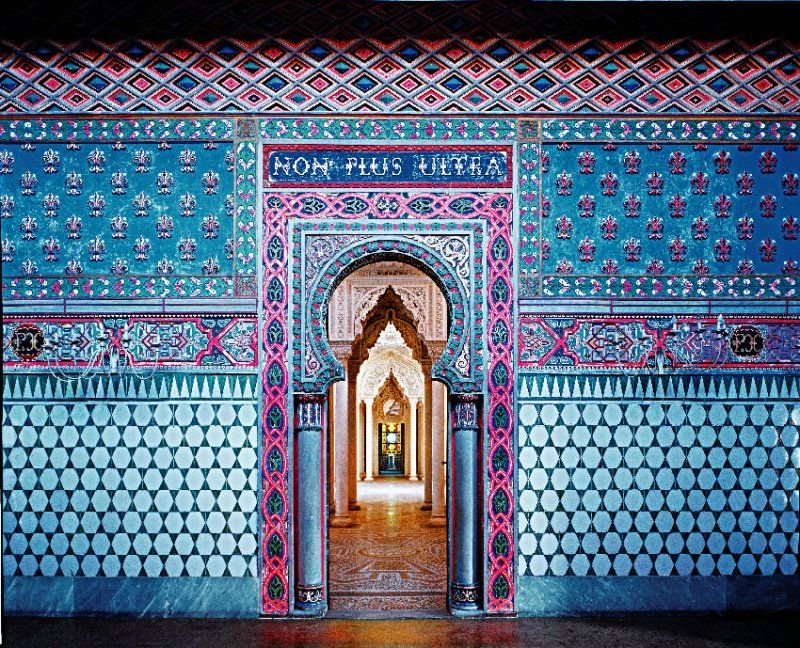
dish_castle1

MessyNessy spotlights photographs of a gorgeous, eccentrically-designed castle that was left abandoned until recently:

The Castello di Sammezzano is a show-stopper, a jaw-dropper. Hidden away in the Tuscan hills of Northern Italy, this electrifyingly beautiful Moorish castle was built a whopping 400+ years ago in 1605, but for more than two decades, it’s been sitting empty, neglected, vulnerable to vandalism and to the elements.

There are 365 rooms in the Castello di Sammazzano, one for every day of the year. The Moroccan-style palatial villa is a labyrinthe of exquisitely tiled rooms, each one intricately unique. Originally built by a Spanish noble, Ximenes of Aragon in the 17th century, it wasn’t until the 19th century that the castle would find its arabian identity and be transformed into the etherial palace it resembles today.

This is all owed to its inheritor, Marquis Ferdinando Panciatichi Ximenes, a largely forgotten but key cultural, social and political figure in Florence when the city was the capital of Italy. Ferdinando, who lived and died at the property, spent 40 years planning, financing and realizing this exotic castle that would become the most important example of orientalist architecture in Italy– only to be left to ruin at the hands of modern-day investors.

A new development group recently purchased the property, but the beauty of its present state lives on in photographs. Another striking picture after the jump:

dish_castle2

(First photo by Massimo Listri. Second photo by Dan Marbaix, whose work is also here and here.)

More Than A Billion Anti-Semites?

Bershidsky looks at a new survey:

It’s hard to believe that in 2014, 26 percent of the world’s population is anti-Semitic. That, however, is one of the findings of a poll the Anti-Defamation League conducted among 53,100 people in 102 countries, who were asked if they agreed with 11 anti-Semitic statements, including nuggets like, “Jews still talk too much about what happened to them in the Holocaust”; “Jews think they are better than other people”; and “People hate Jews because of the way Jews behave.” To be counted among the 26 percent, one had to accept six of the 11.

The general finding is, however, a simplistic reflection of a highly varied global picture of ethnic and religious prejudice. The ADL study, the first one conducted on such a wide scale, picked up indications of anti-Semitism’s antipode, Islamophobia, and other related forms of bigotry, but did not go into too much detail on them. I suspect that if it had, global bigotry levels would have evened out at a higher number than 26 percent.

Jonathan Tobin calls the headline number “hardly remarkable”:

Nor is the fact that this hate is largely concentrated, but not exclusive to the Middle East and North Africa, where 74 percent hold such views, and is most prevalent among Muslims (49 percent worldwide and 75 percent in the Middle East and Africa), who are, ironically, held in even lower esteem by those polled than the Jews.

The survey did not directly establish whether the persistence and widespread nature of anti-Semitic attitudes could be directly linked to hostility to Israel. Indeed, some of the results may point in another direction since the people of Holland have one of the lowest indexes of anti-Semitic attitudes (5 percent) in the world while also harboring great hostility to Israel. Similarly, Iran has become Israel’s most virulent and potentially dangerous foe in the Middle East while actually having the lowest level of anti-Semitic views in the region, albeit a still alarmingly high rate of 56 percent.

But Jesse Singal points out some major flaws in the survey:

According to Ryan D. Enos, a political scientist at Harvard who studies inter-group relations, this sort of binary system is problematic. It “creates strange claims, such as a person that expresses these attitudes on five questions about Jewish stereotypes is okay, but a person that answers six affirmatively is an anti-Semite, same as a person that answers affirmatively on 11,” he wrote in an email. “Most people would think that is [a] strange way to label the people holding those attitudes.” Moreover, he argued, “researchers don’t tend to believe that people can usefully be split into people that simply either do or do not have prejudice against another group.” Prejudice “operates on a continuum, not [as] a yes or no.”

Jeni Kubota, an NYU researcher who studies stereotypes and prejudice (and who praised the report for the impressively large swath of the world it covered), pointed out that researchers generally allow for a range of responses on these sorts of questions so as to build a more nuanced view of respondents’ beliefs. “[A]n individual might STRONGLY support two of these statements,” she said in an email. “Would a score of 2 out of 11 mean that the individual was not anti-Semitic? I would argue no.” That makes it hard to interpret some of the results of the ADL study, she argued.

Making Time For Mother’s Milk

Dana Ben-Ari’s new documentary Breastmilk takes an intimate look at one of the biggest decisions every mother makes about how to care for her baby:

In an interview, Ben-Ari outlines what she would like to change in our culture regarding breastfeeding:

There’s the specifics of legislation that would answer the utopia, but then there’s just the overall feeling and lifestyle philosophy approach to mainstream feminism that needs to change. Mainstream feminists want to say I’m all about work, I have to go to work, and enough about being forced to breast-feed. They question the agenda and is it really best and what about the science. I’m not interested in that question so much, because I think they’re missing the bigger picture, and that is: All women should have it available to them if they want to. We should have more flexibility in the workplace, and we don’t because we’re still stuck in that ’50s, ’60s, ’70s model of being like men in the workplace. But right now mainstream feminism is much more interested in the debate between formula and breast, and I think that’s a big mistake.

Although she says the film moved her to tears, Jessica Grose thinks Ben-Ari’s critique of feminism here misses the mark:

What Ben-Ari seems to be saying here is that “mainstream feminists” are missing the forest for the trees when it comes to breast-feeding. That we—and I assume she would include me, because I am interested in studies that show the benefits of breast-feeding may have been overrated—should stop trying to make formula acceptable and instead, regardless of science, focus on making the culture more open for working women who want to breast-feed. Where Ben-Ari errs is in assuming the two things are mutually exclusive.

I would love nothing more than to live in a country where mothers are actually supported and where breast-feeding could become easier for them. But I don’t, and unfortunately things only seem to be getting worse for working mothers in the U.S. We can both want to change the culture overall and support mothers who are struggling with the culture as it is. Part of that support involves letting women know that studies show formula-fed babies turn out perfectly fine.

Previous Dish on breastfeeding here.

Commencement Speakers Are Dropping Like Flies

IMF Managing Director Christine Lagarde has withdrawn as Smith College’s commencement speaker after students and faculty protested and launched a petition to have her disinvited. Olivia Nuzzi thinks the Smithies’ successful protest says something about millennials’ entitlement:

Millennials have grown up in a world where you are never forced to see, hear or read anything that you haven’t personally selected. 7,000 TV channels, a DVR to skip commercials, millions of websites—we have been able to curate our own little worlds using technology, wherein nothing unpleasant or offensive can creep in. So when we’re forced to sit through a commercial or, heaven forbid, listen to someone talk who isn’t Mary-freakin’-Poppins, we can’t handle it.

The entire point of college is to be exposed to different things: Different types of people, different ideas—and maybe some of those people will hail from organizations that negatively impacted poor countries, or maybe they were partly responsible for a war that ate up the country’s resources and resulted in human rights abuses and lots of needless death. But if, at the end of your time as an undergrad, you haven’t learned that oftentimes you find great wisdom in shitty people, or just that there might be some value in hearing what someone you don’t like or respect might have to say, what on earth have you learned?

Amanda Hess also rolls her eyes at the protesters:

When Smith announced that former president Ruth Simmons would be replacing Lagarde as commencement speaker, some students claimed that the choice of Simmons was equally offensive (when she was president of Smith College in the run up to the financial crisis, Simmons also served on the board of Goldman Sachs). But others expressed disappointment that their commencement had been downgraded to “forgettable.” It’s hard to have it both ways, kids! These recent flare-ups reveal less about the speakers than the students’ own entitlement—students who believe they have paid for the right to a commencement experience that perfectly reflects both the stature and the political values of their elite higher educations. They want their commencements to be both high in profile and rich in personal meaning. That’s not just political correctness gone awry; that’s a bunch of 22-year-olds thinking they are owed exactly the experience they want. On the other hand: A uniquely tailored experience is just what elite schools are promising their students in exchange for their astronomical costs.

Damon Linker chastises the students’ “lazy moralism”:

Could the IMF be improved? Probably. Should it be replaced with another organization that would do a better job of helping the developing world? Perhaps. The point is that getting the IMF’s managing director disinvited from a college commencement ceremony brings us not one millimeter closer to either goal. …

And that’s what might be the most disheartening thing of all about this year’s commencement protests — how each of them grows out of a longing to simplify the world, to wish away our conflicts and deny the need to get one’s hands dirty. Fighting for the rights of women can be morally messy. The same can be said of serving as America’s leading diplomat. And overseeing the global economy. The Smith students haven’t learned this lesson yet. They’re too young to have seen the need to put away their childish things.

Katie Zezima notes that driving away commencement speakers is becoming pretty trendy:

Earlier this month former Secretary of State Condoleezza Rice withdrew her decision to speak at Rutgers University commencement after students and faculty objected to her role in the Iraq war. Some students at Harvard University are opposed to former New York Mayor Michael Bloomberg speaking at graduation, and students and faculty at Rowan University have created a petition protesting that the school is awarding its commencement speaker, New Jersey Gov. Chris Christie, with an honorary degree. Robert J. Birgeneau, the former chancellor of the University of California, Berkeley, declined an invitation to speak at Haverford College’s commencement after students objected to a use of force by police during 2011 Occupy movement protests on campus.

Last year, former Deputy Secretary of State Robert Zoellick didn’t speak at the graduation of his alma mater, Swarthmore College, after students said his involvement in the Bush administration and strong support for the Iraq war conflicted with its Quaker roots. Dr. Ben Carson withdrew from addressing graduates of Johns Hopkins University after students voiced unhappiness about his comments on same-sex marriage.

“Universities,” Greg Lukianoff argues, “have only themselves to blame for this mess”:

—not just for caving to pressure, but for teaching students the wrong lessons about the value of free and robust discourse. The Foundation for Individual Rights in Education (FIRE), of which I am the president, has found speech codes—policies that heavily restrict speech that is protected under the First Amendment—at 59% of the more than 400 colleges we survey, and deals every day with campus censorship of often even mildly offensive speech. Colleges have taught a generation of students that they have a “right not to be offended.” This belief has inevitably morphed into an expectation among students that they will be confirmed in their beliefs, not challenged. It’s no wonder, then, that they apply increasingly strict purity tests to potential campus speakers.