Is The Meth Epidemic Overblown?

After reading Nicholas Parsons’s Meth Mania: A History of Methamphetamine, Sullum believes so:

Although NSDUH data cited by Parsons indicate that monthly meth users never accounted for more than 0.3 percent of the population between 2002 and 2011, the drug in its latest incarnation loomed large in the public imagination. Meth did become the next crack in the sense that it was portrayed as the scariest drug ever, turning its users into hideous, homicidal, zombie-like subhumans who made speed freaks seem attractive and tame by comparison. Popular portrayals of meth’s effects, which Parsons describes in detail with a keen eye for exaggeration and unjustified assumptions, were grossly misleading on two major counts: They presented extreme cases as typical, and they blamed every harm suffered or inflicted by meth addicts, ranging from tooth decay to murderous rampages, on the drug itself.

This sort of pharmacological reductionism is belied by the history of methamphetamine, which shows that the effects attributed to the drug are powerfully shaped by context.

Phillip Smith praises the book for addressing how these myths are made and by whom. He writes that “Parsons is especially interesting in his discussion of law enforcement as a claims maker when it comes to drugs”:

[L]aw enforcement has its own interests to protect. Parsons notes one particularly brazen example of self-interested panic purveying, the “ice” scare of the late 1980s. The DEA jumped all over that — until its annual budget was secured, then not so much.

This leads me to something Parsons didn’t discuss, but which I have long wondered: Why, exactly, are police considered experts on drugs? Because they arrest drug users? Police arrest domestic violence suspects, too, but that doesn’t make them experts on domestic bliss, as their own divorce and domestic assault rates indicate.

Public School Is For The Entire Public

Last week, the Justice and Education Departments issued new guidelines reminding public schools that they are required by law to accept all students regardless of their or their parents’ immigration status:

The guidelines come in response to a number of reports that schools are denying undocumented immigrants entrance on questionable grounds. Undocumented parents living in Butler County, New Jersey were unable to enroll their kindergarten-age children in school because the Butler Public School District had a policy requiring parents to provide state- or county-issued photo identification, a document that requires a social security number and valid immigration status, leading the American Civil Liberties Union (ACLU) to file a lawsuit in March. The ACLU also found that 138 New Jersey school districts asked for documents that indicated immigration status.

Dara Lind looks at some of the ways public schools have evaded that obligation:

When Alabama passed an anti-unauthorized-immigrant bill in 2011, one provision required public school teachers to record the immigration status of their students, and submit it to the state once a year for a “report.”

The Alabama bill didn’t say that anything bad would happen to students who reported that they or their parents were unauthorized. But it didn’t have to. Hundreds of students across the state stayed home from school the day the law went into effect, as families were scared that the results of the “report” would be sent to law enforcement or federal immigration agents.

Book Club: Ask Bart Ehrman Anything II

Below is the second installment of Ehrman’s responses to Dish reader questions (the first part is here):

What do you make of the evangelical response to your book, How God Became Jesus?

For a somewhat fuller response, see my blog post. Here I can say that the five evangelical Christians who responded are all good scholars. The purpose of their book was to engage my historical claims at a number of points. Some of the responses I found to be interesting. I ehrman_bart_12_020didn’t actually find any of them convincing, and on the whole I have to say that I was disappointed by the book. What I had hoped was that the book would provide a different historical narrative from the one that I laid out in How Jesus Became God. The respondents regularly accuse me of engaging in “bad” history, but they don’t themselves engage in any historical reconstruction at all. So how is one supposed to compare their views with mine?

The book really is little more than an attack on this point or the other in my discussion. I would love to see how they can imagine that their thesis, that God became Jesus, can be established on historical grounds, rather than theological or religious grounds . My view is that it is impossible for historians to demonstrate what God has done: that’s the province of theologians. If what they want to do is present a theological perspective that differs from my historical one, I have absolutely no problem at all with that. What I object to is their decision to embrace a theological perspective and claim that it is history.

What if anything might change your mind and cause you to again become a believer?

Hmmm … Good question!

I guess a revelation from the Almighty would do it! I’m actually, personally, prone more to belief than disbelief, and would prefer, at the end of the day, to be a believer. Maybe one day I’ll become one again, even though at this stage of my life, I doubt it. For it to happen, realistically, I would need to come to a more comprehensive, synthetic understanding of how this world makes sense if there is a God who is in some sense (any sense) active in it. For me, right now, that simply doesn’t seem to be the case. So many innocent people suffer unspeakable agony and horrific deaths each and every minute, hour, and day – ravaged by starvation, drought, epidemics, earthquakes, hurricanes, tsunamis, not to mention war and violence. I simply do not see the hand of God in any of this. I do know what the “answers” are that people give – I used to give them myself, all the time. I just can’t believe them anymore. Maybe at some point that won’t matter to me, although I do side more with Ivan in the Brothers Karamazov on this one, as I explain in my book God’s Problem….

Which religions, if any, deal better with the problem of evil and suffering than Christianity?

I’m not sure any of them deal with it in a way that I find intellectually satisfying, although since I wrote my book God’s Problem I’ve had a lot of people tell me that they have found Buddhism to be much better on just this issue.

Given your thesis that Jesus was not buried in a tomb, based on the evidence that the Romans would not have allowed it, what do you make of the archaeological evidence of crucifixion victims in tombs?

Great question! Unfortunately, we have only one piece of archaeological evidence to go on and it simply doesn’t tell us what we would like to know. In 1968 the remains of a crucified man, named Yehohanan, were discovered in Israel. His skeleton – ankle pierced with an iron stake from crucifixion – was decently buried in an ossuary. This shows, it is argued, that it is conceivable that something similar happened with Jesus. I would agree that this makes it conceivable. Unfortunately, as I have also pointed out, we do not have even the slightest bit of evidence to tell us what happened in Yehohanan’s case, and so we have no way of knowing if it is analogous to the case of Jesus.

Why was an exception made in Yehohanon’s case to place his body in a common tomb? Was his family well-connected? Was he an aristocrat? Was he crucified on the birthday of an emperor (Philo says that such persons were allowed burial)? Was he crucified for insurgency against the state (like Jesus) or for a lower crime (it makes a big difference!). Moreover – was he placed in a tomb the very day he was crucified? We have no way to know. Was his body left to decompose and be eaten by scavengers (the usual punishment) before being entombed? We don’t know. In other words, precisely what we would need to know in order to know if Yehohanan’s case was similar to that of Jesus we don’t know.

What we do know is that there is no evidence that Jesus was executed on the birthday of an emperor; he was not an influential person with high connections (he was not even known in Jerusalem before he appeared the week before); he did not have powerful family members who could intercede on his behalf; his own followers had fled from the scene; and he was not crucified for low-level crimes but on political charges of insurgency. Whatever was the reason that Yehohanan was given a decent burial, it is hard to think why an exception to normal Roman practice would have been made in the case of Jesus (especially given what we know about Pontius Pilate).

I should also say that other scholars have pointed out that since there were thousands of crucified victims in antiquity, and these are the only skeletal remains of a crucified victim to survive, it appears that Yehohanan’s case was highly exceptional, not typical.

What do you think of N.T. Wright’s work on the historical Jesus and early Christianity?

Tom Wright is incredibly prolific and is a brilliant spokesperson for traditional, conservative Christianity. He is also an erudite scholar of enormous breadth. But as it turns out, I disagree with him on almost everything! We have only had one real public debate, dealing with the problem of suffering and how it should affect one’s faith in God. We did not at all see eye to eye. Tom has a kind of global vision of Scripture where he makes the entire 66 books add up together to one grand narrative that he sees as a revelation from God. I see 66 different books written by different authors at different times for different reasons with different messages and different understandings of God, the world, the human condition, and so on. Tom and I simply aren’t on the same page.

It’s seems almost impossible, when writing a book like this, to keep personal biases out of the work. Can you describe how you thought about separating the two during the writing of the book?

My view is that everyone has biases, that there is no way to escape having biases, and that the people you need to look out for are the one who claim that they don’t have biases! Those are the people who want you to agree with them since, after all, they are simply being “objective.” But in fact, they have biases like everyone else, so that their claim is simply a rhetorical strategy.

At the same time, I think there are some biases that are more appropriate for some kinds of research than others. The biases of a historian – e.g., that the past did happen, that there is evidence that some things happened and other things didn’t, that some evidence is better than other evidence, and so on – are appropriate for doing history. On the other hand, the biases of a theologian – e.g. (depending on the theologian) that God both exists and is active in the world and has affected the course of historical events – can be very useful for doing theology, but they are not useful for doing history. And so my view is that a person with those theological views needs to keep those views in check when doing history, just as there are probably views of the critical historian that are not useful for those wanting to do theology.

When I wrote How Jesus Became God I tried to be careful not to make theological claims one way or the other. In the book I do not indicate whether Jesus really was / is God or not, whether he really was raised from the dead, whether he really is living today in heaven, and on on. Those are all theological claim. But my book is a historical account. My view is that Christians and non-Christians can agree with the history I lay out, even if they come to different theological conclusions. (I know that’s the case because before I sent the book into my publisher I gave it to four scholars to read for comments about how to improve it; all four were Christians; all four had no problems with its historical views)

Read the entire Book Club discussion of Ehrman’s book here.

The Genetic Basis Of Autism

Michael White examines our still limited understanding of it:

How strong is the genetic basis for autism, anyway? Could it be that researchers are searching for genetic causes that don’t exist? Actually, no. That there is a substantial genetic contribution to autism is well-established, but it has been difficult to pin down just how large it is. Previous studies have estimated the heritability of autism to be as high as 90 percent, or as low as 38 percent. A large study published this week in the Journal of the American Medical Association by researchers at the Karolinska Instutet in Sweden have come up with the most precise estimate yet for the heritability of autism: 54 percent.

The scientists looked at autism diagnoses in a population of more than two million Swedish children born between 1982 and 2006. By looking at rates of autism diagnosis among relatives—specifically identical twins, fraternal twins, full siblings, half siblings, and cousins—the researchers determined that, at least among Swedish families, “genetic and nongenetic influences on the risk for [autism spectrum disorders] and autistic disorder were similarly important.” Strikingly, they found that shared family environmental influences “have only a negligible effect on [autism spectrum disorder] etiology”; only non-shared, individual-specific environmental influences were significant. Just what those influences are remains unknown.

Tweet Of The Day


He had me at “mismanaged carnival of stupidity” … and then I lost the thread:

Mr. Baldwin’s arrest came amid a citywide effort on Tuesday, with another push planned on Friday, by the Police Department to crack down on traffic infractions, especially cellphone usage by drivers and failure to yield to pedestrians.

Well, at least it wasn’t the Idaho Stop.

The GOP Split On The Minimum Wage

Commenting on Romney’s and Santorum’s recent endorsements of a higher minimum wage, Douthat wishes moderate Republicans would fight for more economically sound conservative ways to help low-wage workers:

In fairness to the pro-minimum wage Republicans, there are various nuances here — indexing the wage to inflation, as Rick Santorum has proposed, is better than just having periodic, politically-motivated hikes, and the state-based minimum wage increases favored by some Republican politicians would have fewer perverse effects than a federal increase. And of course the minimum wage is a winning issue in the polls, and you can’t win every policy battle …

… but the case for tactical surrender would be a lot stronger if more Republican politicians, and Republican moderates especially, would first actually try to make the argument for an alternative, right-of-center suite of policies on jobs and wages. That could mean payroll tax cuts, it could mean an expanded Earned Income Tax credit or (as Marco Rubio has proposed) a wage subsidy as a replacement for the EITC, it could mean some of the American Enterprise Institute’s Michael Strain’s proposals to help the unemployed … there’s a whole range of potential policies, and policy combinations, that might deliver some of the minimum wage increase’s benefits with fewer downside risks.

Reihan is on the same page but sees why it won’t happen:

The irony is that the conservatives who might be amenable to something like Strain’s approach — let’s not risk excluding workers from the formal labor market by raising the statutory minimum wage, but let’s spend intelligently to get people back to work — are the ones who are embracing a minimum wage increase as (essentially) a proxy for some better mix of policies, or as a way of signaling that they care about the well-being of American workers and that they’re willing to use the power of government to improve their well-being. And most of the conservatives opposed to a minimum wage increase are also disinclined toward active labor market policies of the kind Strain has in mind, including an expansion of federal wage subsidies, on the grounds that such policies represent big government overreach, or that they involve spending money we don’t have. It’s no wonder that low- and middle-income voters are skeptical as to whether conservatives are doing enough to defend their interests.

The White Liberal Media

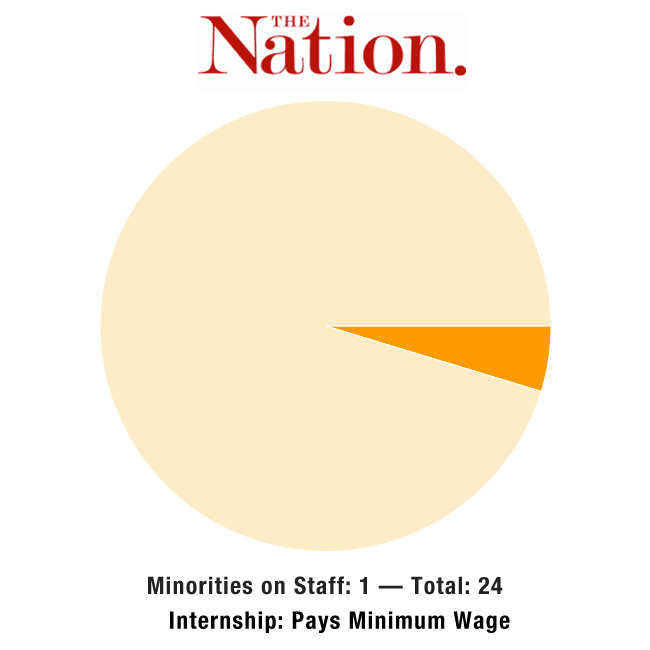
nationchart

Gabriel Arana, the only member of an ethnic minority on the staff of The American Prospect, examines why the newsrooms of progressive publications’ are so monochromatic and how that undercuts their social mission:

Nearly 40 percent of the country is non-white and/or Hispanic, but the number of minorities at the outlets included in this article’s tally—most of them self-identified as liberal or progressive—hovers around 10 percent. The Washington Monthly can boast 20 percent, but that’s because it only has nine staffers in total, two of whom belong to minority groups. Dissent, like the Prospect, has one.

Given the broad commitment to diversity in our corner of the publishing world, why is the track record so poor? …

[T]he primary reason magazine staffs are so white is structural. “We practice fairly specialized form of journalism and the pool of people who do it isn’t terribly large to begin with, and then you look at the group of people who are practicing at a higher level and it’s just not a diverse pool,” [The New Republic editor Franklin] Foer says.

The road that ends with a spot on staff at places like The New RepublicThe Atlantic, or the Prospect is paved with privilege. It starts with unpaid internships, which serve both as training grounds and feeders to staff positions. “Most of our staff comes through our intern program,” says Harper’s editor Ellen Rosenbush. “Do we get as many applicants of color as we’d like? Probably not, but we do get them and we have hired them.” There’s a straightforward reason for the dearth of intern applications: Those who can afford to rely on mom and dad for a summer or a semester tend to be well-off and white.

Alyssa responds:

Relying on your network is a way to speed up the hiring process. You can discard résumés that do not come backed by personal recommendations, or skip reading résumés altogether and just start talking with candidates who have been identified for you.

If organizations could remove time pressure from the hiring process, that network would become less necessary. Hiring managers and editors could take the time to read résumés, cover letters and clips from a much larger pool of applicants. If someone promising does not come in during the initial wave of applications, the publication can repost or revise the job ad and reach out to more potential sources of candidates.