The Compulsion To Create

Rebecca Mead, author of My Life in Middlemarch, considers why George Eliot may have chosen artistic creation over biological motherhood:

Eliot sometimes referred to her books as her children, and the writing of them as a form of parturition. She once wrote in a letter of the experience of completing a novel: “the sense that the work has been produced within one, like offspring, developing and growing by some force of which one’s life has served as a vehicle, and that what is left of oneself is only a poor husk.” The image of a new mother as dried out and used up is one of the few places where Eliot’s comprehension strikes me as limited. There are doubtless many new mothers who do feel this way, but it seems to me that a more typical experience might be that which combines utter exhaustion with an unprecedented sense of vitality. (Nothing has ever made me feel so alive as actually producing a new life.) Perhaps this image of being devoured or despoiled by a voracious, needy infant helps explain why Eliot did not follow a conventional course of motherhood. The way she describes it doesn’t sound particularly appealing. Eliot may have decided that she could meet the needs of only one incessantly demanding voice, and that was the voice of her inner creativity.

Divine Wonders And Horrors

dish_bookofmiracles2

Marina Warner reviews The Book of Miracles, which collects 15th- and 16th-century images of “pious episodes from the Bible … mixed with dazzling, bold paintings that could have come from a scientific treatise on astronomy”:

The Book of Miracles unfolds in chronological order divine wonders and horrors, from Noah’s Ark and the Flood at the beginning to the fall of Babylon the Great Harlot at the end; in between this grand narrative of providence lavish pages illustrate meteorological events of the sixteenth century. In 123 folios with 23 inserts, each page fully illuminated, one astonishing, delicious, supersaturated picture follows another. Vivid with cobalt, aquamarine, verdigris, orpiment, and scarlet pigment, they depict numerous phantasmagoria: clouds of warriors and angels, showers of giant locusts, cities toppling in earthquakes, thunder and lightning. Against dense, richly painted backgrounds, the artist or artists’ delicate brushwork touches in fleecy clouds and the fiery streaming tails of comets. There are monstrous births, plagues, fire and brimstone, stars falling from heaven, double suns, multiple rainbows, meteor showers, rains of blood, snow in summer.

Warner highlights the image seen above:

This tremendous picture of a hailstorm on May 17, 1552, over the town of Dordrecht, gives a terminus post quem for the manuscript, as it is the last dated wonder reproduced in the book. The subsequent pages depict scenes of divine retribution from Revelation; in this way reports of strange phenomena are firmly bookended by scripture, and the possibly profane appetite for bizarre and singular occurrences acquires a degree of legitimacy, being directed at the acts of all-seeing and all-powerful providence, and not at the marvelous vagaries of nature.

Previous Dish on the book here.

(Image courtesy of Taschen)

Taking Notes On The Good Book

For Mother’s Day, Byliner has made available to Dish readers Walter Kirn’s My Mother’s Bible, his commentary on the first two books of the Bible, Genesis and Exodus, which was prompted by the discovery of his mother’s annotated King James Bible after her death. Here Kirn describes his surprise at what he found:

Aside from a brief experiment with Mormonism thrust upon her by my father in his attempt to finesse a fierce depression that afflicted him in the 1970s, my mother wasn’t religious as far as I knew. She was, however, immoderately literate. Between her annual rereadings of her favorite masterworks by Gibbon, Dickens, Tolstoy, Goethe, and Shakespeare, she managed over the years to teach herself at least three modern languages and one ancient one. She also kept abreast of the bestseller lists and the more talked-about novels and biographies in the leading book reviews. The Bible, though? I’d never seen her touch it. It must have been a pastime pursued in private, perhaps in her bedroom after her evening gulp of codeine-laced cough syrup, her pet relaxant. (Perhaps this explained her high tolerance for morphine.) I wished I knew where in her house I’d found the volume. A shelf? Her nightstand? Hidden or in the open?

One night about two months after she died, as I entered that manic stage of grief when even rationalists hire mediums, I opened my mother’s Bible to a blank page on which were copied out thirty or forty passages, most of them from the Old Testament. I knew a few of them verbatim and many others in paraphrase, but some, such as this one, were new to me: “For a bird of the air shall carry the voice, and that which hath wings shall tell the matter” (Eccl 10:20). Why had my mother found this image remarkable? Seeking an answer, perhaps even a sign, I turned at random to a verse in Genesis that she’d underlined and starred. It spoke of two more birds, a raven and a dove, which Noah released from the ark to find dry land. I remembered the dove—it flew back with an olive leaf—but I’d forgotten about the raven “which went forth to and fro” and never returned. How had the raven managed to stay aloft so long, with water still covering even the mountaintops?

For the next day, you can read the rest here. Purchase it as a Kindle Single here. Previous Dish on My Mother’s Bible here and here.

The Monastery Of Prayer

In the wake of the Supreme Court ruling in Town of Greece v. Galloway, Morgan Guyton argues that “prayer as a pro forma function of ‘civic religion'” violates the spirit of Jesus’ teachings:

Nothing is more disrespectful to God than to use our supposed conversation with him as a way of leveraging our own legitimacy. … It’s not only cheap and shallow, but it actively sabotages the secret reward that God wants to give us through prayer. How can I have intimacy with God if my conversation with God is a public performance and an inner farce? There is nothing in the world like the rich intimacy that we receive from a true spiritual connection with God. And the way we gain this intimacy is when we pray in secret. Jesus did this over and over again in his ministry life: he would always retreat to a quiet place to pray.

To me, prayer is primarily about creating a monastery where we can sit and enjoy the presence of God. It’s awesome when we can share that monastery with other people. The world needs that monastery more desperately than ever in our era of spiritually alienating constant “connectivity.” … We can and should bring the monastery of prayer into public, but it must take the form of sharing a secret with others if they are to receive the secret reward that God wants to give them. If praying in public is about marking turf and standing up for the “rights” of “persecuted” Christians, then the secret reward is utterly lost. No inner monastery is created by a prayer that has been clipped onto the beginning of a secular meeting.

Our coverage of Greece v. Galloway is here.

Debating God And The Great War

VERDUN-OSSUAIRE_DE_DOUAUMONT5

Philip Jenkins, author of The Great and Holy War, explains why the First World War, “with the obvious exception of the Turks … was a Christian war”:

With startling literalism, visual representations in all the main participant nations placed Christ himself on the battle lines, whether in films, posters, or postcards. Jesus blessed German soldiers going into battle; Jesus comforted the dying victims of German atrocities; Jesus personally led a reluctant Kaiser to confront the consequences of his evil policies. Apart from the obvious spiritual figures — Christ and the Virgin — most combatant nations used an iconography in which their cause was portrayed by that old Crusader icon Saint George, and their enemies as the Dragon. Death in such a righteous cosmic war was a form of sacrifice or martyrdom, elevating the dead soldier to saintly status.

In every country, mainstream media stories offered a constant diet of vision and miracle, angels and apocalypse. Angels supposedly intervened to save beleaguered British troops, the Virgin herself appeared to Russians, while Germany claimed to follow the Archangel Michael. Those stories circulated in the first days of the war, and they persisted through the whole struggle, long after we might expect the armies to be wholly focused on the grim realities of front-line life. When the Germans launched their last great offensive in 1918, of course it was called Operation Michael. For the Allies, religious and apocalyptic hopes crested in 1917 and 1918, with the great symbolic victories in the Middle East. Most evocative were the capture of Jerusalem from the Turks, and the decisive British victory at — honestly — Megiddo, the site of Armageddon.

George Weigel blames the “century-long assault on the Christian worldview” leading up to 1914 – he points to Darwin, Nietzsche, and Marx, among others – for the Great War’s destructiveness:

[T]he erosion of religious authority in Europe over the centuries—meaning the erosion of biblically informed concepts of the human person, human communities, human origins, and human destiny—created a European moral-cultural environment in which politics was no longer bound and constrained by a higher authority operative in the minds and consciences of leaders and populations. Some will doubtless think it too simple to suggest that the most penetrating answer to these grave questions—Why did the Great War begin and why did the Great War continue?—is the answer suggested by Aleksandr Solzhenitsyn thirty years ago: It was because “Men [had] forgotten God.”

Erasmus responds to Weigel:

It’s true, of course, that in different circumstances religion can either restrain the urge to fight or exacerbate it. Both factors are sometimes underestimated by people of a secular cast of mind. And sometimes, both factors are at work simultaneously. Religion can mitigate conflict within a large group (say, Christendom or the Muslim ummah) but also increase the chances of conflict between those large groups. A century on from the Great War, religion seems in many places to have retained its power to exacerbate strife but lost its capacity to calm and restrain.

(Image: The French military cemetery at the Douaumont ossuary, which contains the remains of more than 130,000 unknown soldiers, via Wikimedia Commons)

Quote For The Day

“The real difference between God and human beings, he thought, was that God cannot stand continuance. No sooner has he created a season of a year, or a time of the day, than he wishes for something quite different, and sweeps it all away. No sooner was one a young man, and happy at that, than the nature of things would rush one into marriage, martyrdom, or old age. And human beings cleave to the existing state of things. All their lives they are striving to hold the moment fast, and are up against a force majeure. Their art itself is nothing but the attempt to catch by all means the one particular moment, one mood, one light, the momentary beauty of one woman or one flower, and make it everlasting. It is all wrong, he thought, to imagine paradise as a never-changing state of bliss. It will probably, on the contrary, turn out to be, in the true spirit of God, an incessant up and down, a whirlpool of change. Only you may yourself, by that time, have become one with God, and have taken to liking it,” – Isak Dinesen, “The Monkey.”

Mercy In The Modern World

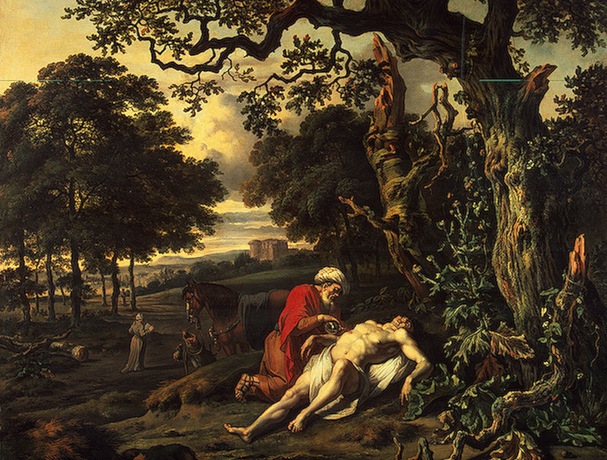
Jan_Wijnants_-_Parable_of_the_Good_Samaritan

Cardinal Walter Kasper, whose new book, Mercy: The Essence of the Gospel and the Key to the Christian Life, is a favorite of Pope Francis, explains why mercy is central to the Christian understanding of God:

The doctrine on God was arrived at by ontological understanding—God is absolute being and so on, which is not wrong. But the biblical understanding is much deeper and more personal. God’s relation to Moses in the Burning Bush is not “I am,” but “I am with you. I am for you. I am going with you.” In this context, mercy is already very fundamental in the Old Testament. The God of the Old Testament is not an angry God but a merciful God, if you read the Psalms. This ontological understanding of God was so strong that justice became the main attribute of God, not mercy. Thomas Aquinas clearly said that mercy is much more fundamental because God does not answer to the demands of our rules. Mercy is the faithfulness of God to his own being as love. Because God is love. And mercy is the love revealed to us in concrete deeds and words. So mercy becomes not only the central attribute of God, but also the key of Christian existence. Be merciful as God is merciful. We have to imitate God’s mercy.

Why we need mercy now more than ever:

The twentieth century was a very dark century, with two world wars, totalitarian systems, gulags, concentration camps, the Shoah, and so on. And the beginning of the twenty-first century is not much better. People need mercy. They need forgiveness. That’s why Pope John XXIII wrote in his spiritual biography that mercy is the most beautiful attribute of God. In his famous speech at the opening of Vatican II, he said that the church has always resisted the errors of the day, often with great severity—but now we have to use the medicine of mercy. That was a major shift. John Paul II lived through the latter part of the Second World War and then Communism in Poland, and he saw all the suffering of his people and his own suffering. For him mercy was very important. Benedict XVI’s first encyclical was God Is Love. And now Pope Francis, who has the experience of the southern hemisphere, where two-thirds of Catholics are living, many of them poor people—he has made mercy one of the central points of his pontificate. I think it’s an answer to the signs of the times.

(Image: Jan Wijnants’s Parable of the Good Samaritan, 1670, via Wikimedia Commons)

Christianity’s Other Sex Abuse Scandal

In a lengthy piece, Kathryn Joyce profiles GRACE (or Godly Response to Abuse in the Christian Environment), an “independent group of evangelical lawyers, pastors, and psychologists” that investigates reports of abuse in Prostestant communities. Joyce reports that GRACE founder (and grandson of Billy Graham) Boz Tchividjian “had become convinced that the Protestant world is teetering on the edge of a sex-abuse scandal similar to the one that had rocked the Catholic Church,” and “believes that Protestant churches, groups, and schools have been worse than Catholics in their response”:

“GRACE is not hired by the weak, the self-protective, the blasphemous institutions who invoke the name of Jesus in their cover-ups,” says Kari Mikitson, founder of [abuse protest group] Fanda Eagles. “There are very few Christian organizations out there who want the truth at all costs. If you as an organization are not brave enough to retain GRACE when your survivors request them, then you are a disgrace. And you aren’t fooling anyone—you are hiding skeletons.”

That’s a hard case to make to churches and missions facing lawsuits and public scrutiny. “One of the dynamics of any institution is to survive, to protect itself,” [psychologist] Diane Langberg says. There is no question that GRACE poses risks to the institutions that hire it for investigations. The publication of GRACE’s findings—the first gesture of repentance—ensures that not only will damaging accounts appear in the media but that some supporters and donors will flee.

Over the next few years and decades, Protestant institutions of every kind—fundamentalist, evangelical, and mainline—will be increasingly faced with a stark choice. One option is to follow the example set by the Catholic Church more than a decade ago: Fight back fiercely, not giving an inch when it comes to admitting you may have been wrong. Everyone knows how well that has worked. The other option is represented, thus far, by GRACE alone: Churches, schools, and groups can heed Tchividjian’s call to make themselves vulnerable, to admit what they’ve done wrong, and—hardest of all—to allow that truth to come to light.

Amanda Marcotte elaborates on the challenges GRACE faces, writing that the organization “appears to be a little too good at its job, and often the institutions that initially hire it end up firing it rather than deal with their own cultures of covering up and minimizing sexual abuse.” She zeroes in on Joyce’s discussion of a case at Bob Jones University:

The famously conservative Christian school brought GRACE in to clean house after 20/20 discovered, in 2011, that one of its graduates, a New Hampshire minister named Chuck Phelps, had, upon discovering that one of his congregants raped and impregnated a teenager, thought it appropriate to shame the victim by making her “confess” her supposed sins in front of the congregation. Bob Jones University didn’t want the story to reflect badly on the school, so it responded by hiring Tchividjian and his staff to interview faculty and students about their experiences with sexual assault. What they discovered was a culture of victim-blaming. …

Tchividjian believes that Christian institutions should be welcoming the news that they’ve failed to support the victims of sexual abuse, so they can repent and learn from their mistakes. The institutions apparently do not agree. Just as other groups, such as an overseas missionary organization, had done before, Bob Jones University fired GRACE before the group had a chance to report its final results.