Bringing A Smart Gun To A Dumb Fight

Emily Bobrow looks at the lengths gun rights activists are going to—including intimidation and outright threats of violence—to keep “smart guns” out of the US:

As it happens, guns that work only when they are in the hands of their legal owners do indeed exist. Armatrix, a German company that makes a .22-calibre “smart gun”, had plans recently to begin selling them in America. But then something odd happened: the very people who were trying to bring these guns to market began receiving threats from gun enthusiasts. Belinda Padilla, the head of the American division of Armatix, no longer picks up the phone if she doesn’t recognise the caller, having fielded too many scary calls. Andy Raymond, a gun-dealer in Maryland, decided not to sell the Armatrix guns after receiving death threats. Both Ms Padilla and Mr Raymond are pro-gun; they simply believe there is room in the market for some with safety mechanisms. But aggressive and antagonistic campaigns from gun-lovers have ensured that not a single American gun-dealer will risk selling Armatrix smart guns.

This is remarkable. It is one thing for gun-rights advocates to quibble over a few paternalistic whistles and bells on some guns for sale; it is quite another for them to prevent these guns from ever reaching store shelves. Gun-lovers argue that the smart guns could pave the way for a host of new safety regulations. These fears are apparently heavy enough to justify manipulating the market.

As it turns out, all the fuss comes down to a law in New Jersey. Adrianne Jeffries explains:

There has been renewed interest in smart guns since the Newtown school shooting, which reinvigorated the gun-control debate. However, there is immense pressure not to be the first to sell them. That’s because of a New Jersey law passed in 2002 known as the Childproof Handgun Law, which says that all guns sold in New Jersey must be state-approved smart guns within three years of a smart gun being sold anywhere in the country.

The goal was to make smart guns mandatory as soon as the technology existed. Officially, no smart gun has been sold in the US yet — meaning if Raymond had sold one, it would have triggered the clause in New Jersey. … Smart-gun advocates say the technology will stop kids from shooting themselves with their parents’ guns, undermine the market for stolen guns, and protect law enforcement from having their guns used against them. “We need the iPhone of guns,” said Ron Conway, a Silicon Valley investor, referring to the phone’s fingerprint unlock. Conway is backing a $1 million contest for smart-gun technology. “We want gun owners to feel like they are dinosaurs if they aren’t using smart guns,” he told the Washington Post.

But David Kopel lays out the arguments against smart guns:

There is an inherent difficulty in making a computer chip, which is supposed to read a radio wave, a palmprint, or some other identifier, function with perfect reliability in an environment a few inches from frequent gunpowder explosions, along with gasses and particles of lead debris.

Persons who own firearms for self-defense (the core of the Second Amendment, according to Heller) would be especially wary, since a gun which works 99.5% of the time is not sufficiently reliable for self-defense. Most people who have experience with fingerprint readers, magnetic key cards, etc., know that these devices are often convenient, but they are not reliable enough to bet one’s life on them. This is one reason why there has been zero adoption of personalized guns by law enforcement, even though the initial impetus for personalized gun research was for law enforcement use. Indeed, the New Jersey law exempts law enforcement; the exemption is an admission that personalized guns are insufficiently reliable for lawful defense of self and others. A recent article on the website of American Rifleman (a NRA member publication) details some potential problems with hacking or jamming of computer-dependent guns.

America Is Getting Old

Population Over 65

Derek Thompson examines the latest numbers:

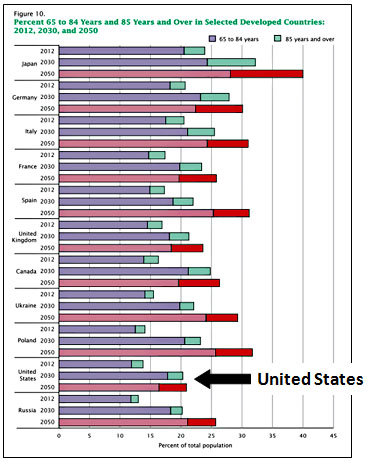
Today, one in seven Americans is over 65. In 15 years, one in five Americans will be over 65. The gray boom is inevitable and it’s happening for two simple reasons. The first reason is that all Americans are living longer (except, for mysterious reasons, poor women). The second reason is that every living member of the baby boomer generation, the largest adult generation in U.S. history (there are actually more Millennials, born between the early 1980s and late 1990s), will be older than 65 in the year 2030. Here, from a new Census report, is a look at the steady growth of 65+ Americans—a population that will double in the next four decades.

Drum shrugs:

Take a look at the red bars in the chart on the right. They show the projected size of the elderly population in various developed countries in 2050, and the United dependencyStates is in by far the best shape. Our elderly population stabilizes in 2030 at about 21 percent of the total population, a number that’s significantly lower than even the second-best country (Britain, at 24 percent). Most other countries not only have elderly populations that are far larger, but their elderly populations are growing. These countries have demographic problems.

It’s worth driving this point home: America doesn’t really have a huge aging problem. We have a very moderate aging problem, which could be handled in the federal budget with fairly modest changes to Social Security and Medicare. What we do have is a health care problem. But that’s a problem for us all.

Ben Casselman joins the conversation:

One reason the U.S. is in better shape is its comparatively high rate of immigration. Since people tend to migrate when they are younger, immigrants tend to bring down the age of the population as a whole. Moreover, at least in the U.S., immigrants tend to have a higher birth rate than the native-born population, although the gap has narrowed somewhatin recent years. The future direction of immigration, therefore, makes a big difference to the age breakdown of the U.S. population. The Census Bureau’s demographic estimates are based on a middle-of-the-road projection of future immigration, but the bureau also publishes alternative scenarios. In the “high immigration” scenario, the U.S. has nearly 22 million more working-age residents in 2050 than in the “low immigration” case.

Lydia DePillis adds:

Even as the elderly population increases, the younger population decreases in relative terms, which leaves the overall dependency ratio relatively stable. In 2050, it’ll even be substantially lower than it was in the roaring 1960s … Of course, youth dependency and old age dependency carry different kinds of burdens — older people require more medical care, while young people carry more educational costs. So the economy will still have to adapt to take care of the shifting load of non-working people. But overall, the picture is a lot less alarming when you know America has borne something similar in the past.

Working Without A Lunch Break

Lizzie Widdicombe tried out the food-substitute Soylent. What living on it felt like:

As [Soylent creator Rob] Rhinehart puts it, you “cruise” through the day. If you’re in a groove at your computer, and feel a hunger pang, you don’t have to stop for lunch. Your energy levels stay consistent: “There’s no afternoon crash, no post-burrito coma.” Afternoons can be just as productive as mornings.

But that is Soylent’s downside, too.

You begin to realize how much of your day revolves around food. Meals provide punctuation to our lives: we’re constantly recovering from them, anticipating them, riding the emotional ups and downs of a good or a bad sandwich. With a bottle of Soylent on your desk, time stretches before you, featureless and a little sad. On Saturday, I woke up and sipped a glass of Soylent. What to do? Breakfast wasn’t an issue. Neither was lunch. I had work to do, but I didn’t want to do it, so I went out for coffee. On the way there, I passed my neighborhood bagel place, where I saw someone ordering my usual breakfast: a bagel with butter. I watched with envy. I wasn’t hungry, and I knew that I was better off than the bagel eater: the Soylent was cheaper, and it had provided me with fewer empty calories and much better nutrition. Buttered bagels aren’t even that great; I shouldn’t be eating them. But Soylent makes you realize how many daily indulgences we allow ourselves in the name of sustenance.

Previous Dish on Soylent here and here.

What Climate Change Will Mean For Us

White House Climate Maps

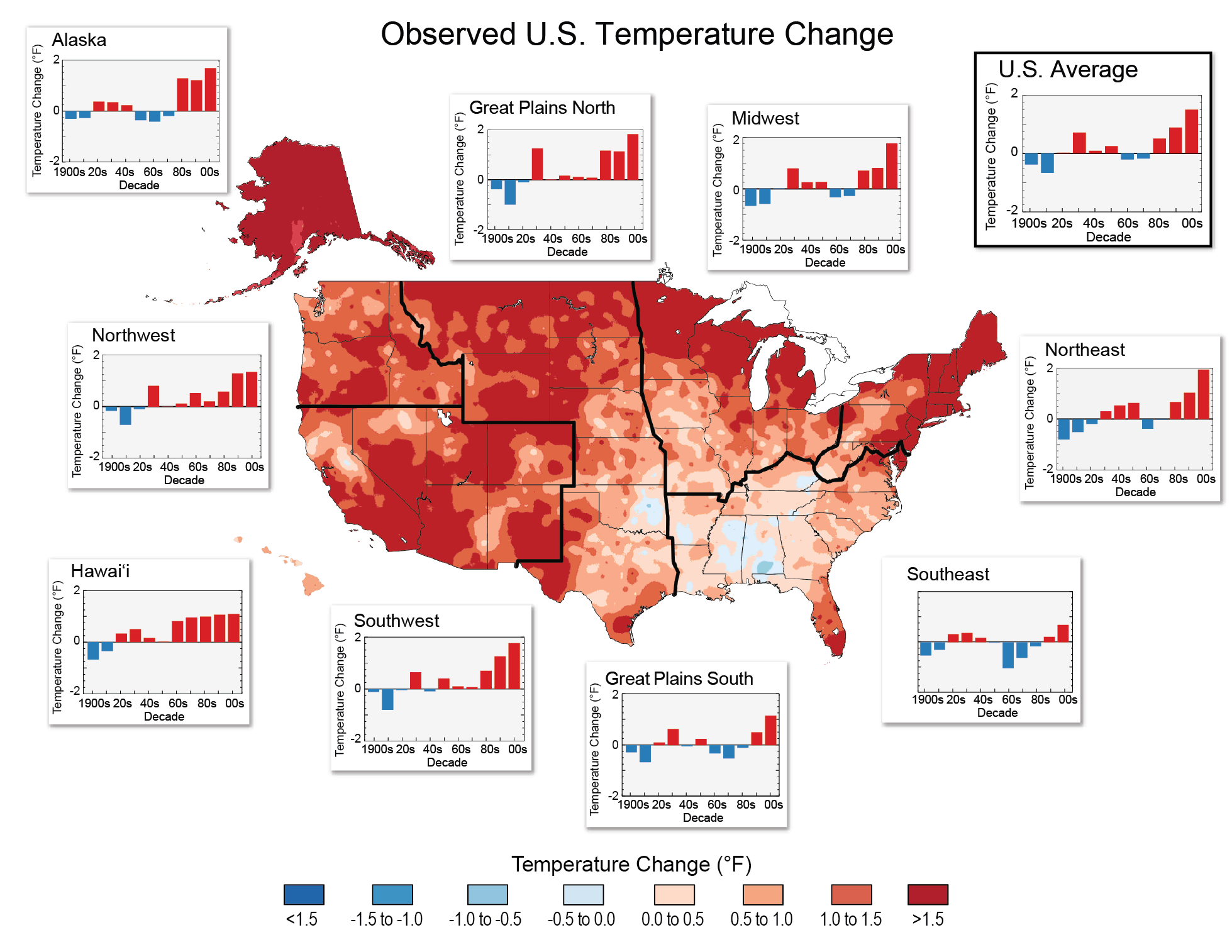
Brad Plumer features maps from the National Climate Assessment, which was released this week:

This map is the simplest way to see global warming in action. Since the 19th century, average US temperatures have risen by 1.3°F to 1.9°F. (Note, though, there have been some fluctuations here and there: in the 1960s and 1970s, temperatures dipped, partly due to the cooling effect of sulfate pollution that was eventually cleaned up.)

Recent decades have been even hotter: since 1991, every region in the United States has been warming, with the biggest temperature increases occurring in the winter and spring.

Peter Coy observes how the report “tries to shake people awake by making climate change up close, personal, and present, rather than abstract and in the future”:

The risk of this up-close-and-personal approach is that it could make some fence-sitters on climate change feel manipulated. The atmosphere is a complex system, and scientists don’t know enough about it to trace every regional variation in climate straight back to global warming.

The benefit is that there’s a strong scientific consensus that on the whole, climate change is causing an increase in extreme weather. The authors of the National Climate Assessment are betting that people will be more impressed by shoreline scouring in the Great Lakes than by the latest prediction regarding average sea temperatures in the western Pacific a century from now.

Chris Mooney looks at specifics:

According to the assessment, the Western drought of recent years “represents the driest conditions in 800 years.” Some of the worst consequences were in Texas and Oklahoma in 2011 and 2012, where the total cost to agriculture amounted to $10 billion. The rate of loss of water in these states was “double the long-term average,” reports the assessment. And of course, future trends augur more of the same, or worse, with the Southwest to be particularly hard hit. As seen in the image at right, projected “snow water equivalent,” or water held in snowpack, will decline dramatically across this area over the course of the century.

And then there is Alaska:

Nowhere is global warming more stark than in our only Arctic state. Temperatures there have increased much more than the national average: 3 degrees Fahrenheit since 1949, or “double the rest of the country.” The state has the United States’ biggest and most dramatic glaciers—and it is losing them rapidly. Meanwhile, storms batter coasts that used to be insulated by now-vanished sea ice.

Ben Adler provides more highlights:

“Heat kills people, and it sends thousands of people to emergency rooms because climate change fuels longer and more severe heat waves,” says Kim Knowlton, a scientist with NRDC’s health and environment program and an author of the Human Health chapter of the NCA. “There will be 10 more days over 100 degrees for the entire country on average from 2021 to 2050,” notes Liz Perera, a federal climate policy analyst at the Sierra Club. “The interesting thing there is that regionally there’s actually quite a distribution difference. It will be worst in the Southwest, Southeast, and Great Plains.” Those, of course, are already the places with the harshest summers. The U.S. has recently seen its worst heat waves in history, and increasing casualties as a result. A study published in the journal Epidemiology found, for example, that in July 2006, “California experienced a heat wave of unprecedented magnitude and geographic extent … Coroners attributed 140 deaths to hyperthermia, and it has been estimated from vital statistics data that in excess of 600 heat-related deaths may have occurred over a 17-day period.” The study also found that climate change is causing worse humidity to accompany heat waves, making them more unpleasant and dangerous.

Who Should Pay For Culture?

Astra Taylor, author of The People’s Platform: Taking Back Power and Culture in the Digital Age, explains why she sees the rise of sponsored content as part of a larger economic problem:

[W]hen people aren’t being funded to create work by publishers or labels or whatever, then advertisers end up filling in that gap. Advertisers are happy to see the stuff they’ve branded out there for free, they don’t care about scarcity, they want any message they’re invested in to be shared and to be abundant and to be passed along. One thing that struck me about going to … tech conferences was all the enthusiasm for free culture, and remixing, and social media, but people’s greatest ambition was to be sponsored by Chipotle or something equivalent to that. It was this weird mix of collaborative, utopian claims and this total acquiescence to commercial imperatives. I think that overall, ultimately the impact of advertisers calling the shots is a more cloying, complacent culture.

Evegeny Morozov finds that one of the most important messages in Taylor’s book is that “web-enabled innovations like crowdfunding make for wonderful add-ons to, but very poor substitutes for, existing cultural institutions”:

[W]hat does it mean to democratize culture? To some, it means getting rid of gatekeepers such as the National Endowment for the Arts and replacing them with some kind of direct democracy, in which citizens can simply cast their votes for or against particular films or books. But this is definitely not how Taylor sees it. “Democratizing culture,” she writes, “means choosing, as a society, to invest in work that is not obviously popular or marketable or easy to understand. It means supporting diverse populations to devote themselves to critical, creative work and then elevating their efforts so they can compete on a platform that is anything but equal.”

But Tom Chivers argues that both Taylor and Morozov are a bit too black-and-white in their thinking:

Taylor’s book, it strikes me, is not so much directed against the internet – even though that is the “people’s platform” of her ironic title – but against the free-market purists who are in charge of so much of it. The cheerleaders she quotes regularly suggest that what the public is interested in is exactly the same as what is in the public interest: so long-lens shots of bathing celebrities, or lists of funny pictures of cats, are just as worthy as the best 14,000-word New Yorker investigative feature. The invisible hand of the free market will always create the best of all possible worlds, they say.

Meanwhile, Ann Friedman is eager for solutions:

Yes, some of the best technical minds of our generation are being used to create ad software. But there are also plenty of people who want to use their engineering skills to fix the very social problems Taylor describes. How can we support this type of entrepreneur? After all, I can’t choose a more artist-friendly alternative to Spotify if it doesn’t exist.

I wish [Taylor] had devoted two or three chapters to such possible solutions rather than merely referenced them in her conclusion. The problems she explains in convincing detail are of the looming, complex variety that have vexed activists for generations. If the Internet really does pose new slants on these old problems, as she argues, it must also present new opportunities for remedying them.

Previous Dish on The People’s Platform here.

Do I Sound Gay? Ctd

Dave Cullen, author of the best-selling Columbine and the forthcoming Soldiers First, adds to yet another Dish thread, this time discussing his experience as a closeted gay man in the Army Infantry:

A reader shares a similar story:

I’m deeply fascinated by this topic and look forward to any of your readers sharing their stories on their experiences. Like you, I haven’t worried much about whether or not I had a gay voice, but since viewing the documentary promo, one particular memory has been on my mind ever since.

In the sixth grade, a new boy transferred to our school, and his voice instantly identified him as Gay with a capital G. Even though I was deeply closeted at the time, I took a risk and befriended him, most likely because he didn’t exhibit the traits which made me apprehensive to be around straight boys. Like me, he wasn’t into sports, enjoyed reading and other “girly” pursuits, and had no emerging interest in the female anatomy like all the other boys did.

The major difference between us, then, was that his vocal mannerisms gave him away immediately and mine did not. I was always able to “pass” among all the straight boys, whereas my new friend was constantly bullied and mistreated for being different, even though we were virtually the same in all other aspects. That’s how much the public perception of sexual orientation is tied into the way you speak.

There was one particular incident which burns my heart to remember:

my poor friend was enduring the usual taunts about his femininity by a group of aggressive classmates and, as usual, I did nothing to help him or stop it, lest I too become branded as a faggot. During this specific incident, I distinctly remember watching the bullying and telling myself, “Whatever you do, don’t ever talk with that kind of voice. Even when you’re an adult and able to be openly gay, always keep your voice masculine to avoid being harassed.”

That’s how easily the closet strips you of your humanity. I was witnessing a friend’s humiliation at the hands of others, but rather than come to his rescue, I used the opportunity to remind myself of the need to adopt the vocal cadence of all the straight boys.

I wish I could find that boy today (he only lasted at our school for a year, and I’ve long since forgotten his name), just so I could know that he made it though the rest of his school years with grace and bravery. I’d like to apologize to him for my failure to speak up and defend him when he needed me most. Perhaps that’s why the topic of “gay voice” interests me so much; 40 years after the fact, I’m still coming to terms with the choices I made and didn’t make on that day, and those choices were based entirely around how we speak.

Thanks for letting me tell my story.

Book Club: Can Modernity Survive Without Christianity?

A reader adds a final twist to the debate:

You started the Dish book club by asking if Christianity can survive modernity, and the discussion that ensued proves, I think, what a challenging – and open – question that remains. Ever since that first post of yours, however, I haven’t been able to shake a different question: can modernity survive without Christianity?

I’m no reactionary, and I have little patience for those who reject, wholesale, the scientific and technological advances of modern life. But glancing at the world around us can be incredibly dispiriting, from our destruction of nature to the rapaciousness of global capitalism to wars and rumors of wars. And that’s to say nothing of the lurking sense many of us have that finding meaning in contemporary life only is becoming more difficult, that there’s a soullessness at the heart of our modern way of life, a rotten center beneath the glittering surface of all our would-be achievements.

In a strange way, what I’ve just described makes me hopeful for the future of Christianity, because I can’t think of circumstances in which the message of Jesus and the core tenets of Christianity are more needed. They teach us that all our achievements have a dark side, that good and evil grow together in history, that our fallibility and fallenness touch everything we do, serving to warn us against unalloyed ambition and striving, and a facile optimism. It surely is no accident that two of the 20th century’s greatest Christian thinkers, Michael Oakeshott and Reinhold Niebuhr, thought the ancient tale of the Tower of Babel especially resonated with our times.

Even more, to borrow Oakeshott’s phrase, Christianity is the religion of non-achievement. Jesus taught us to consider the lilies of the field and take no thought for tomorrow. Could there be a more radical message for our age, an age that grows ever more frantic, ever more competitive, and in which wealth and power are ever more eagerly sought after?

Many of us are doubtful, I think, that we can continue on the path we are treading, that our unceasing more, more, more can be sustainable, or provide happiness. Jesus offers us a way of life that inverts these values, that shows us their futility. This non-instrumental approach to living is more timely than ever.

But most of all – and I know I risk sentimentality here – when reduced to its most basic idea, Christianity holds, and Jesus showed us, that God is love. Love and forgiveness and mercy are deeper than suffering and hate, they are what we are made for, our truest calling. Love is “the greatest of these,” and what Jesus told us to do when he summarized the entirety of the moral law. Man’s failure to love, of course, is a perennial sin. Yet the call to love takes on added resonance when the reach of our power and the consequences of our decisions impact ever more people. At no time in history has the question, “Who is my neighbor?” mattered more, or demanded a more expansive answer. We need to be reminded that the duties of love have no limits, that every human life is precious and fragile, and that “the least of these” particularly demand our attention and care.

Thinking about these matters, I come back again and again to this passage from Romano Guardini, a Jesuit priest, which Walker Percy chose as the epigraph to his novel The Last Gentleman:

We know that the modern world is coming to an end…At the same time, the unbeliever will emerge from the fogs of secularism. He will cease to reap benefit from the values and forces developed by the very Revelation he denies…Loneliness in faith will be terrible. Love will disappear from the face of the public world, but the more precious will be that love which flows from one lonely person to another…The world to come will be filled with animosity and danger, but it will be a world open and clean.

I’ve always thought that modern, Western moral and political thought was more dependent on Christianity than most realize. For a long time we’ve lived in a halfway house, where we want the “values” derived from Christianity – the dignity of the individual, equality, and compassion – without faith itself. As Nietzsche derisively put it, we’ve rejected the Church but not its poison. Maybe what we’re hurtling toward is a moment when having it both ways no longer is tenable. Maybe, as Guardini claims, our dangerous world, in which love is so strikingly absent, will force us to again turn our gaze toward the wandering preacher from Nazareth, whose words we finally will have ears to hear, as if for the first time.

About That 97%

Paul Roderick Gregory catches Russia’s Human Rights Council disputing the official results of the Crimean referendum, which claimed a 97 percent vote in favor of annexation and 83 percent turnout:

[A]ccording to a major Ukrainian news site, TSN.ua, the website of the President of Russia’s Council on Civil Society and Human Rights (shortened to President’s Human Rights Council) posted a report that was quickly taken down as if it were toxic radioactive waste. According to this purported report about the March referendum to annex Crimea, the turnout of Crimean voters was only 30 percent. And of these, only half voted for the referendum–meaning only 15 percent of Crimean citizens voted for annexation.

The TSN report does not link to a copy of the cited report. However, there is a report of the Human Rights Council, entitled “Problems of Crimean Residents,” still up on the president-sovet.ru website, which discusses the Council’s estimates of the results of the March 16 referendum. Quoting from that report: “In Crimea, according to various indicators, 50-60% voted for unification with Russia with a voter turnout (yavka) of 30-50%.” This leads to a range of between 15 percent (50% x 30%) and 30 percent (60% x 50%) voting for annexation. The turnout in the Crimean district of Sevastopol, according to the Council, was higher: 50-80%.

Ilya Somin corroborates Gregory and adds:

The Council report also discusses a number of troubling developments in Crimea since the Russian occupation began. For example, it states that the new authorities in Crimea have decided to “liquidate” the pro-Ukrainian Kiev Patriarchate Orthodox church in the region, details the persecution of Crimean Tatar groups opposed to Russia rule, and notes that Crimean journalists fear the “numerous restrictions” on freedom of speech and press imposed by Russian law.

It should be noted that the Council has long been one of the few Russian government agencies willing to criticize the government on human rights issues, but more recently many of the more liberal members of Council have resigned or been forced out.

And Sometimes There Is A Smoking Gun Email

If you were in any way troubled by the idea that a journalist would write a book based on exclusive sources, who are portrayed as uniquely responsible for a breakthrough in civil rights, and then those very lauded sources would throw book-parties and events to promote the book, you’re not alone.

I was a little gob-smacked that Jo Becker’s book tour promotion was aided and abetted by those sources – with book parties by Ken Mehlman and Ted Olson. But we are finding out that this was only the tip of the iceberg. An inkling of this comes with the latest, ethically disturbing news that Becker’s lionized sources in San Francisco’s city government have also been promoting the book. Dennis Herrera, SF City Attorney and his aide, Terry Stewart, heroes of the book, were involved in its promotion. How do we know? Well Herrera was hosting a book event for Becker at San Francisco City Hall last week. But we also have other proof. As city officials, Stewart’s and Herrera’s emails on public business are vulnerable to public disclosure. So intrepid activist/pest/gadfly Michael Petrelis did the leg-work to get all the emails that pertained to Becker’s book. They make for interesting reading:

becker to stewart

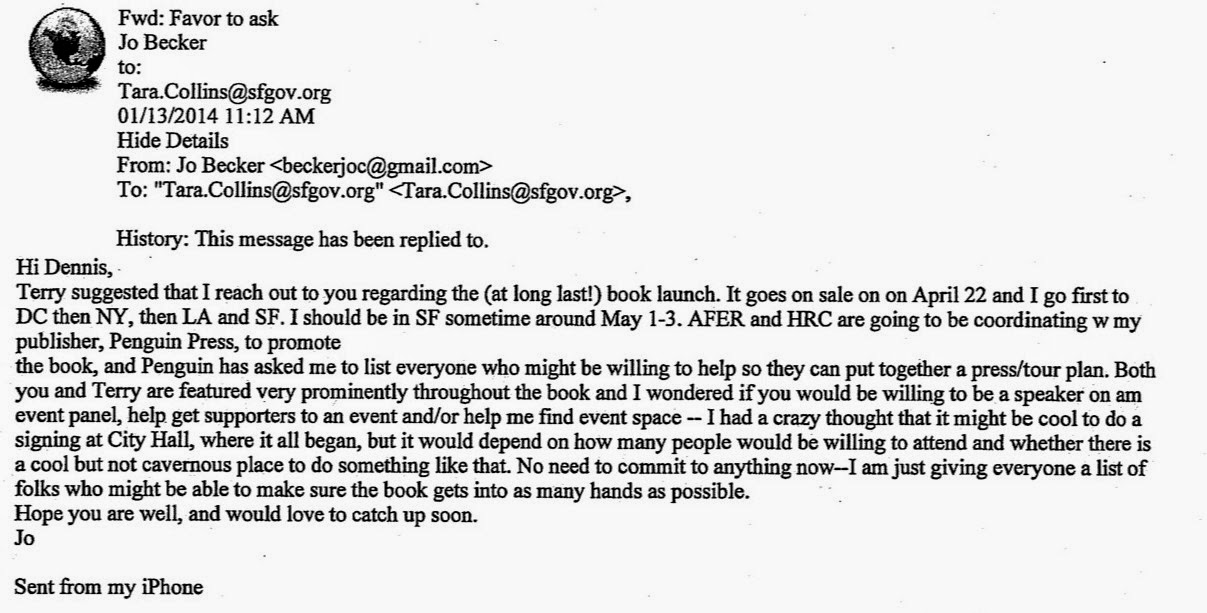
A journalist is offering to give her sources an event to celebrate themselves while also promoting the book. Is that what the New York Times would regard as ethical conduct? Then a second email sent by Becker the next day tells us something equally remarkable:

becker to herrera

Note the following: “HRC and AFER are going to be coordinating w/my publisher, Penguin Press, to promote the book, and Penguin has asked me to list everyone who might be willing to help so that can put together a press/tour plan.” Becker wanted to sell books at the City hall event, but this raised ethical issues about using City Hall for a private commercial enterprise. How were those resolved? At Becker’s original suggestion, Herrera was inclined to place a bulk order under his “campaign/office-holder account.”

So to recap. A key and celebrated source in the book is placing bulk orders and holding a reception at City Hall for the tour, at Becker’s request. At the same time, HRC and AFER are integrally involved in the entire book tour. Both groups are part of Chad Griffin’s Hollywood-DC p.r. empire. So the main source and central hero for Becker’s book was integral to its publicity and promotion. While publicly writing that he disowned being called the Rosa Parks of the movement, Griffin has been actively and aggressively promoting the very book that says that in its first paragraph! And he was using HRC’s and AFER’s money – money donated to advance gay equality, not Griffin’s personal profile – to promote his own hagiography.

If you want more evidence that this book was access journalism at its unethical worst, here it is. Quite why the NYT Public Editor has not weighed in on this is beyond me. It’s a disgrace.