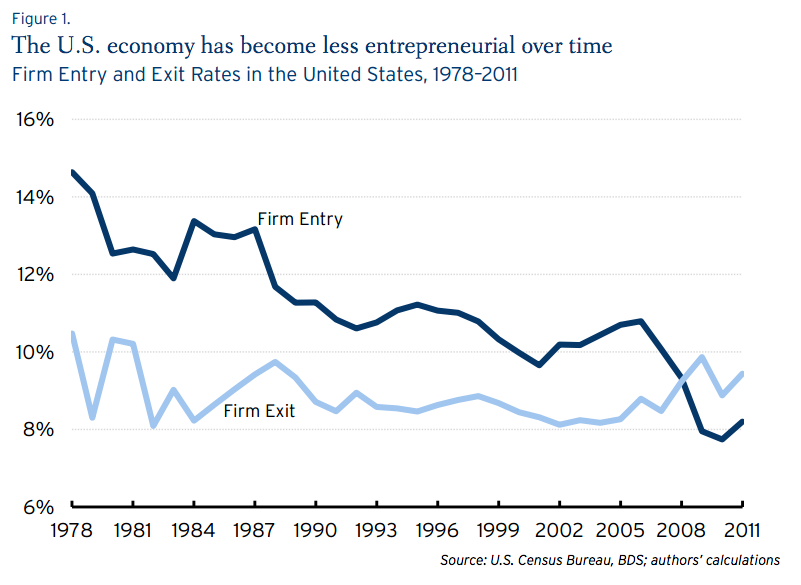
A new Brookings report warns that business dynamism and entrepreneurship are on the decline throughout the US. Danielle Kurtzleben explains why this is cause for concern:
[T]he idea at work here is the economic concept of creative destruction. New, more productive firms replace older firms, and workers get matched with better jobs over time when there’s more of this business “churn,” the authors write. A more stagnant business atmosphere, in other words, can lead to a more stagnant economy. Exactly why it’s happening, however, is more of a mystery. …
The jump in the exit rate has likely been a function of the recession, says says Robert Litan, one of the study’s co-authors and a nonresident senior fellow at Brookings, but the factors behind the falling entry rate are foggier. The fact that the trend is so long-standing, for example, suggests that it’s not one presidential administration or another that’s at fault, nor is it the recession. What’s behind it may be something less concrete are more ephemeral — an economy-wide decision to play it safe, from the richest CEOs to the plucky wannabe entrepreneurs.
Drum suspects that the proliferation of national chains is largely to blame for this trend:
I’d really like to see a breakdown of what kinds of business creation have declined. My first guess here is that the decline hasn’t been among the sort of Silicon Valley firms that drive innovation, but among more prosaic small firms: restaurants, dry cleaners, hardware stores, and so forth. The last few decades have seen an explosion among national chains and big box retailers, and it only makes sense that this has driven down the number of new entrants in these sectors. When there’s a McDonald’s and a Burger King on every corner, there’s just less room for people to open up their own lunch spots. But if there’s been a decline in the number of new small retailers, that may or may not say anything about the dynamism of the American economy. It just tells us what we already know: national chains, with their marketing efficiencies and highly efficient logistics, have taken over the retail sector. Amazon and other internet retailers are only hastening this trend.
Morrissey, however, fingers regulation for the culprit:
The reasons can’t be that unknown. Since the 1970s, the federal regulatory environment has grown exponentially, with its power amplified by the federal courts. Even short eras of regulatory reduction resulted in only moderate reversals of that decline, which quickly disappeared. Look, for instance, at the period between 1983-88 during the heyday of Reaganomics and deregulation, and the shallower gains during the George W. Bush administration.
Richard Florida notes one of the study’s main limitations:
The authors caution that their data cover the period through early 2011, so it’s possible that “these trends have reversed—or at least stabilized—since then.” The late economist Christopher Freeman, invoking Schumpeter’s “creative destruction,” long ago argued that economic crises set the stage for great bursts of innovation. Patent activity has ticked up since the crisis, and venture capital activity has surged in recent years.
But there are long lags between the onset of crises and these rebounds in innovation and entrepreneurial activity that power long-run economic growth. These Great Resets are generational events, with much longer time lines than typical business cycles.
Over the past 15 years, the world has witnessed an explosion of cases of myopia, or nearsightedness. A quarter of the world’s population, or 1.6 billion people, now suffer from some form of myopia, according to the Myopia Institute. If unchecked, those numbers are estimated to reach one-third of the world’s population by 2020. While myopia has always affected a fraction of the population, at least in countries that have kept records, the condition has recently reached unprecented rates among children and young adults.
A National Institutes of Health study published in 2009 showed that myopia prevalence in the United States increased by 66 percent between the early 1970’s and the early 2000’s.
Too much time indoors could be part of the problem:
Kathryn Rose, a researcher of visual disorders at the University of Sydney’s college of health sciences, recently concluded that spending too much time indoors also has a huge impact on eyesight deterioration. Rose said in a CNN interview that she was not sure how time spent using digital media relates to myopia progress, but that outdoor light has been shown to have a positive effect on vision. Studies from the U.S., Singapore, and China confirm a link between the time spent outdoors and the prevention of myopia, Rose said.
Saladin Ahmed provides a brief history of comic book censorship. He claims that during a “15-year span beginning in the late 1930s, the comic book racks of America’s newsstands were bursting with four-color contradictions.” But this state of affairs “was swiftly and mercilessly dismantled in 1954 by the newly formed Comics Code Authority”:
Spurred in part by the sensationalist book Seduction of the Innocent (a ridiculous sort of Reefer Madness for comic books), the Senate Subcommittee on Juvenile Delinquency turned an angry eye toward comics, and most publishers felt that heavy-handed regulation — perhaps even outright banning — was imminent. Comic book publishers, in consultation with right-wing politicians, formed the Comics Code Authority, a self-censorship group, in the hopes that this would forestall government intervention in the industry. New York Magistrate Charles F. Murphy, a “specialist in juvenile delinquency” (and a strident racist), was chosen to head the Authority and to devise its self-policing “code of ethics and standards.”
What this meant in practice:
The Code … contained the surprising provision that “ridicule or attack on any religious or racial group is never permissible.” Given the countless depictions of monkey-like Japanese and minstrel-show black people in Golden Age comics, one might think this provision a good thing. But Murphy soon made it clear that this provision really meant that black people in comic books would no longer be tolerated, in any form. When EC Comics reprinted the science fiction story “Judgment Day” by Al Feldstein and Joe Orlando (which had originally been printed to little controversy before the Code), Murphy claimed the story violated the Code, and that the black astronaut had to be made white in order for the story to run.
EC defiantly ran the story anyway, but Murphy had made a target of them, and the company was essentially forced out of the comics business. The message was clear: If comics were to be tolerated in this new postwar order, they had to be purged of assertive women, of people of color, of challenges to authority, and even of working-class, urban slang. And so the Comics Code hacked and mangled comics until they fit into the patriarchal, conservative, white suburban social order that was taking over every other sphere of American life.
Update from a reader:
This is a classic anti-comic book propaganda. Scare tactics are classic!
(Image: Panels from the original “Judgment Day” comic)
Ann Friedman argues that, if we’re going to address the problem of sexual assault on college campuses, we have to force reputation-conscious college administrations to get over themselves:
[M]aking colleges get serious about addressing sexual assaults will probably take more than just urging them to mend their ways. One of the institutional deterrents to encouraging more assault survivors to come forward is that it often means a marked increase in crime statistics. Last week the Pentagon reported that, after a similar campaign to change the way the military handles assault, reports of sexual assault jumped more than 50 percent. This is actually good news for survivors: It means more of them feel comfortable coming forward. But it doesn’t look good for the institutions involved. Universities are eager to please parents and woo new students, which has often led them to prioritize their own reputations above survivors’ needs.
Amanda Hess adds that this is especially important given that many of the trouble spots are among the most elite schools in the country. She worries about the obstacles students face when reporting rape:
In order for the federal government to learn that something may be amiss in a college’s handling of sexual assault, rape victims need to report their assaults to their schools in the first place—no guarantee, given the rampant underreporting of sexual assault in America. Then, when they feel that their colleges have not properly adjudicated their cases, those victims need to launch another complaint against the process itself, and take their cases to the Department of Education’s Office for Civil Rights. The very purpose of these complaints is to prove that colleges are denying some students equal access to education by failing to properly discipline rapists and support victims. Living through an assault, pursuing a complaint against your attacker, and then furthering a civil rights agenda—while also studying organic chemistry—is an almost unthinkable feat for an undergrad. Students who are incapable of juggling those outsized responsibilities may never be heard.
But Lauren Kirchner notes that victims do have ways of reporting rape even if their school is uncooperative:
One small comfort for college kids today is that, if they’re unsatisfied with their schools’ response to a crime, they’re just a Google search away from getting help in filing a report. Networks that span campuses and countries have sprung up to provide support and inform students about their rights—sites like End Rape on Campus (EROC) and Know Your IX (KYIX), and others. (In fact, the White House’s new NotAlone.gov mimics these smaller, non-profit organizations that have been providing the same support and services for years—not that the federal attention and funding isn’t welcome.)
I was dying to buy something, anything that would help my wife and children understand the profound surrealism and warped reality I’d experienced on my research trip to North Korea. But there was nothing to buy. The stores were filled with cheap Chinese goods, grey-market medicines and out-of-date foreign snacks and candies. North Korea produced only durable goods like Vinalon overcoats, shovel handles and work boots. I might have actually bought a Vinalon blazer or a North Korean skillet. But the regime didn’t offer these at their tourist shops.
I couldn’t even buy a painting or a ceramic bowl made in North Korea. Arts and crafts there are required to glorify the regime, yet it’s forbidden for a foreigner to possess images of the Dear Leaders, DPRK flags or nationalist iconography like the Chollima (a mythical winged horse that symbolizes the rapid advancement of the society), a double rainbow over Mount Paektu (the ‘official’ setting of Kim Jong-il’s illustrious birth) or some Taepodong missiles blazing upward. Hence the selection of a Beijing dollar store.
(Photo: A North Korean woman works as a shopkeeper in a Pyongyang knickknack shop on September 18, 2013. By Jonas Gratzer/LightRocket/Getty Images)
As Ladies’ Home Journal shifts from a monthly to a quarterly publication, Harold Pollack looks back on the serious journalism that occasionally graced its pages over the past 130 years, and highlights the role women’s magazines have played in bringing important issues to light:
Recent journalism in women’s magazines has explored surrogacy, use of anti-depressants during pregnancy, sexual harassment in higher education, Bill Clinton’s newfound role as a political spouse, even insurers’ unethical rescission of health coverage. My brilliant dissertation advisor Richard Zeckhauser told me to read Ann Landers and Dear Abby with special care. I found much good material there. When the moment is right, women’s magazines could contribute something more, too. One such moment occurred on May 1, 1950, when Ladies Home Journal printed a taboo-breaking article by Pearl Buck called “The child who never grew.” Buck recounted her gradual discovery of her daughter Caroline’s intellectual disability, and describes her painful decision to institutionalize Caroline at the age of nine within the Training School at Vineland, New Jersey.
You think I’m taking the Lewinsky bait? Glad she’s been able to survive what was a traumatizing experience. But Graydon Carter won’t get a subscription from me. I am, of course, eagerly awaiting Darrell Issa’s inquiry into Lewinsky’s previously concealed role in the Benghazi conspiracy.
There are now 28,560 subscribers. There are also 37,000 of you who have used up all your free read-ons and still haven’t subscribed. If you’re in the Dish that deep, $1.99 is a pretty small price to pay for the site you read so much. If even a tenth of you subscribed, we’d be past 30,000 subs. So take the plunge tonight (it takes a couple minutes max) and help this model of reader-supported web journalism thrive against the onslaught of sponsored content and constant advertising noise. Update from a reader:
You finally got me. Not only do I never pay for web content but I’m so philosophically opposed that I’ve published essays against the disappearance of the old free and universal web. Well, you got me. I subscribed today. What pushed me over the edge? Your post about your seasonal allergies in Washington, DC. I am a DC native and those two miserable weeks every spring nearly kill me. It’s much less of a problem where I live now (Maine). For one split second I imagined your allergies killed you. I realized the Dish has become a ritual for me, like reading the newspaper used to be. It’s the sort of ritual of community affirmation Benedict Anderson describes in Imagined Communities. And if your allergies ever did put you in the Big Sleep, I’d have a real hole in my life. Ugh, you finally got me you bastard.
(Photo: The Crimea travel poster produced by the USSR’s state tourist agency Интурист (Intourist), 1965 (indianriverposterco.com) via the great Eric Baker.)
My old friends at The Economist have their nickers in a twist (look it up) about the loss of American “credibility” because there has been no military response to Ukraine, little follow-up in Libya, and a crossed red line in Syria. The leader (look it up) makes some vague and confusing statements along the way. It argues that “international norms, such as freedom of navigation, will be weakened,” if the US doesn’t somehow throw its weight around more, while simultaneously acknowledging that “America towers above all others in military spending and experience.” They concede that on Ukraine, military force would be insane and Germany and Britain have made stronger sanctions impossible as of now; they also misstate what happened in Syria. They claim that “The Syrian dictator [used chemical weapons], and Mr Obama did nothing.” Nothing? So how is it that Syria has now peacefully relinquished almost all of its chemical stockpile? And wasn’t resolving that question – and not the broader problem of Syria’s sectarian implosion – the entire point of the threatened strike? Are we supposed to prefer an option that would have dragged the US into the Syrian vortex and not guaranteed any actual success to a policy that kept us out but largely solved the problem?
The first thing to say about this is that The Economist is fundamentally a British paper. It has a vast US readership, but its DNA is British. And being British for the past several decades has meant being reliant on the US to protect its security. Of course the Brits want the US policing every nook and cranny of the world. They don’t have to pay for it; yet they get to enjoy its fruits. They argue, of course, that these are fruits for America as well. And so they are. And if anyone were even thinking of reducing America’s maintenance of international trade routes, for example, they might have a point. But policing the world with the US military is not cost-free at all – either fiscally or in more basic human terms.
Think of the Vietnam War and the Iraq War – both conceived under the influence of the hubristic fumes and the idiocy of the “credibility argument: (see Peter Beinart’s take on that particular fallacy here). Look at the country’s debt – a huge amount of which can be traced to the military-industrial complex that Eisenhower warned us so presciently about, and one that went on steroids in the first decade of this century. And look at average living standards – stagnant for three decades at least in some part because of globalization. You can argue that the US should not withdraw from the world (and I would) – but withdrawal from the world is not the same thing as prudent and sensible recalibration of resources in a debt-racked, over-extended and thereby less effective country on the world stage.
We are not, paceThe Economist, still living in the post-Cold War era, when the US ran a surplus. We are living in a post-post-Cold War era where America owes inconceivable sums to China, a soon-to-be-bigger economic power. And if you want to see American influence really decline, then the best way to do that is to maintain unsustainable over-reach. You’d think Brits would have taken this lesson to heart, since that was one core reason they lost their empire as well. And history is littered with the demise of other over-stretched powers, like the Soviet Union or Imperial Spain. The future is littered with other potential over-reach victims, the most obvious of which is Greater Israel, run by many of the same neocons who drove the US into a ditch only a few years ago.
More to the point, it seems increasingly clear to me that this post-post-Cold War era is one destined to last for the foreseeable future. And the fundamentals of that era are increasingly opposed to the concept of American global hegemony. No one can police the world today as the US did in the 20th Century. The rationale of the world’s policeman has thus radically changed. As Millman notes in a superb piece:
The rise of Japan was followed by the rise of smaller east Asian states and now the rise of the Asian mega-states, China and India. Latin America and the Muslim Middle East have grown into substantial regions, demographically and economically, and are no longer obviously under Western control (or even influence). Africa’s demographic momentum, meanwhile, will carry that continent to far greater prominence by the end of the century than it has ever achieved before.
Not only are these other powers much stronger relative to the US – an inevitable function of the success of US foreign policy in the past – but they don’t accept America’s right to dictate the contours of the global order. Russia is the most obvious example, right now. But that was the deepest lesson of the Iraq catastrophe: the Iraqis didn’t actually want the things that Americans (including me) reflexively thought they wanted. They live by different values and different priorities. The [indigenous] sect beats the [imperial] nation every time; and authoritarianism trumps democracy every time. And our attempt to force them to be live by Bill Kristol’s values only guaranteed the failure.
America’s reflexive belief that its way of the world is superior to everyone else is also increasingly, tragically, attenuated.
It will take decades to recover from the state-authorized torture and detention policies of the Bush administration and the Obama administration’s refusal to adhere to the Geneva Conventions. American democracy is widely seen across the world (and not without reason) as an oligarchy of the super-rich; its Republican hinterlands are regarded as a repository of know-nothingness; its virulent opposition to providing access to healthcare for all is seen a psychosis; its NSA is viewed as a threat to allies; its police-state airport borders the sign of a society less free than many in Western Europe. And there is no Soviet Union to point to when America is challenged on these grounds. The alternative is not obviously much worse.
Now you can go on pretending that this hasn’t happened – and isn’t still happening – as the Economist and the Beltway hand-wringers do. You can topple the Libyan regime on humanitarian grounds, just as in the olden days (except Reagan was much less interventionist). But you’ll leave a nest of Jihadists in your wake. But all this has happened – and America’s collapsing infrastructure has become an emblem of a polity in steep decline. Obama has mitigated this to a heroic extent – but the underlying reality remains. We have to let go of control; we have to stop seeing every crisis in the world as one that America has to resolve; we have to tend to ourselves before we lecture to anyone else. And this the American people understand, as poll after poll tells us. And without the American people squarely behind it, no American foreign policy can succeed.
In the Ukraine crisis you see this most vividly. We supported the Maidan revolution but its practical effect has been to render order and peace throughout the country close to non-existent. Ukraine’s reformers have some responsibility for their predicament. They pissed away the post-Soviet era in rampant corruption, military decline, and economic stagnation. They removed a democratically elected government by violence, something inimical to any hope for democratic reform. They have no coherent plan for resisting Putin’s foul expansionism. Like Morgan Stanley, they expect to be bailed out – and that helped create this crisis. I’m far from exonerating Putin. But if we fail to see the arguments behind the propaganda of the other side, we will fail.
Of course, this process of letting go will be anxiety-producing. Relative decline is never easy for a hegemon, especially one drunk on the fumes of its own self-love. There will be a backlash. But you’ll notice how few of the current critics of Obama’s vastly under-rated foreign policy don’t actually have much to say specifically about how they would better defuse these myriad ructions across the globe (and they are mere ructions compared to the past, it’s worth remembering). At some point they will begin to see that their lack of alternatives is a function of something other than their nemesis in the White House. And at some point, one can only hope, they’ll grow up.
In the study looking at how MDMA could treat PTSD, the drug was given in conjunction with talk therapy. Patients lay down in a therapist’s office and listened to soothing music with headphones, wearing eyeshades.
They had the option of talking about what they were experiencing, and received counseling before and afterwards to integrate what happened to them while on the drug into their everyday lives. According to [research organization Multidisciplinary Association for Psychedelic Studies (MAPS)], 83 percent of the 19 people treated in a recent group had breakthroughs in this MDMA-assisted therapy and showed significant improvement in their PTSD symptoms.
“The MDMA allowed me to be my very, very, very best self, and I got to take care of my most broken self with my best self,” says Rachel Hope, a sexual-abuse survivor who participated in the study. MAPS’ results from this study were encouraging enough to the FDA that it was able to expand its efforts into what’s known in drug-trial parlance as “Phase 2 studies.” It’s now doing the same study with four new groups of patients in South Carolina, Colorado, Israel, and Vancouver.
Previous Dish on the therapeutic promise of MDMA here, here, here, and here.
Michael Shermer takes a look at the work of Just Babies author Paul Bloom, who studies how infants and toddlers approach morality:
In Bloom’s laboratory, a one-year-old baby watched puppets enact a morality play. One puppet rolled a ball to a second puppet, who passed the ball back. The first puppet then rolled the ball to a different puppet, who ran off with the ball. The baby was next given a choice between taking a treat away from the “nice” puppet or the “naughty” one. As Bloom predicted, the infant removed the treat from the naughty puppet—which is what most babies do in this experiment. But for this little moralist, removing a positive reinforcement (the treat) was not enough. “The boy then leaned over and smacked this puppet on the head,” Bloom recounts. In his inchoate moral mind, punishment was called for.
There are numerous permutations on this research paradigm—such as a puppet trying to roll a ball up a ramp, for which another puppet either helps or hinders it. Time and again, the moral sense of right (preferring helping puppets) and wrong (abjuring hurting puppets) emerges in people between three and 10 months of age, far too early to attribute to learning and culture. Morality, Bloom concludes, “entails certain feelings and motivations, such as a desire to help others in need, compassion for those in pain, anger toward the cruel, and guilt and pride about our own shameful and kind actions….” Society’s laws and customs can turn the moral dials up or down, of course, but nature endowed us with the dials in the first place. This is why the constitutions of our nations should be grounded in the constitution of our nature.



 The Dish
