A Better Answer To “Where Ya From?”

Geneticists Eran Elhaik and Tatiana Tatarinova have developed a fascinating new tool, which they call the Geographic Population Structure (GPS), that allows anyone to identify where their ancestors came from as far back as 1,000 years ago. The technology has a much greater degree of accuracy than previous methods:

Previously, scientists have only been able to locate where your DNA was formed to within 700km, which in Europe could be two countries away; however this pioneering technique has been 98 per cent successful in locating worldwide populations to their right geographic regions, and down to their village and island of origin. The breakthrough of knowing where the gene pools that created your DNA were last mixed has massive implications for life-saving personalised medicine, advancing forensic science and for the study of populations whose ancestral origins are under debate, such as African Americans, Roma gypsies and European Jews.

Jordan Pearson explains why the GPS is so precise:

The increased accuracy of the new model is based on a simple, if controversial, assumption made by the study authors: that race doesn’t exist.

“The model of races is incorrect and should be dismissed,” Elhaik told me in an email. Up until now, tracing genetic origins assumed that people could be typified as a mix of two to three defined races, presupposing a homogenous “European” identity, Elhaik said. “By contrast, GPS represents a paradigm shift in population genetics whereby all populations are considered admixed to various degrees.”

Admixing occurs when one gene pool mixes with another to create a whole new one. You can think of it like how primary colours mix to create new palettes and shades—“red” people from region A breed with “blue” people from region B, creating a new group of “purple” people, genetically speaking. What the study assumed, if you’ll forgive the analogy a moment longer, is that there aren’t purely “red,” “yellow,” or “blue” people in terms of genetic makeup; we’re all somewhere in between, and every population worldwide displays a certain amount of admixing.

Update from a reader:

I’m always keen to see new ideas and methods in human evolution and genetics, so checked out the clip from Elhaik.  It pinged my bullshit sensors pretty hard, so I asked a friend and PhD student in the Graham Coop lab (much more an expert on this sort of thing than I) his take.  He says “it’s plausibly a decent genetic clustering algorithm, and they present evidence that they do better than SPA, which is probably the best existing method for this kind of thing, but the hype is way over the top.”

He also sent me a blog review from an editor on the paper, a summary of some questionable reviews of the analysis service, and an allegation of intellectual theft including a response from Elhaik himself.

Briefly, there are a few big issues with this paper.  First, the concept of a single ancestral origin for an individual is obviously ridiculous.  We all have thousands of ancestors who lived 1000 years ago, geographically spread to varying degrees; this method at best finds an average between all of these, so their prediction for a lot of folks ends up in the middle of an ocean.  Second, the authors claim no competing financial interests yet started a for-profit company offering this analysis on the same day the paper was released.  Third, the paper uses methods first suggested several years ago on a popular genomics blog, but makes no effort to credit the source.

Finally, the idea that race has been considered a useful concept by any serious human population geneticist in the last decade is absurd.  The notion that this method is superior because it eschews racial divisions is a straw man.

The Legacy Of Gary Becker

Justin Wolfers eulogizes the University of Chicago economist-cum-sociologist, who passed away last weekend at the age of 83:

To Gary, who died on Saturday, economics was not a field of inquiry, but rather a method of analysis. He saw the power of the economic method to illuminate issues well beyond the pecuniary domain. Along the way, he transformed our understanding of discrimination, education, labor markets, crime, the family, social interactions and the law.

Before Professor Becker, these topics were considered noneconomic. Today, they’re central. Whether they are aware of it or not, whenever policy makers debate these issues today, they do so in the shadow of an analytic framework that he developed. Grandiose as it may sound, no economist since Marx has had such a profound impact across the social sciences, transforming not just economics, but also sociology, political science, criminology, demography and legal scholarship.

The heart of the Beckerian approach is that people make decisions with purpose. His approach grants agency to everyone from the love-struck teen to the potential addict who is trying to decide whether to shoot up for the first time. In his telling, they’re considering the likely consequences of their actions, and so they’re responsive to incentives.

Yglesias lists Becker’s major contributions to his field:

Becker pioneered the concept of “human capital” — the idea that individuals could and did act to deliberately increase the value of their labor by investing time and effort in gaining more skills. This was, at the time, a new way of bringing the traditional process of education into the framework of economic life. In the human capital view, people pursue schooling not merely for love of learning but because effort expended in learning is rewarded in the labor market.

Becker, like several of his colleagues at the University of Chicago economics department, was also an active popularizer of pro-market political ideas, including both standard right-of-center economic policies and more exotic ideas like auctioning permits to immigrate to the United States. But much of his influence can be seen in work that has little direct relationship to politics.

He also brought economics to bear on the issue of racism, Edward Glaeser notes:

Economists didn’t study discrimination in the 1950s, unless it was the price discrimination practiced by railroads. Gunnar Myrdal’s 1944 An American Dilemma: The Negro Problem and Modern Democracy may have later won the author the Nobel Prize in Economics, but he was seen by Americans as more of a sociologist than an economist, and he was a Swedish Social Democrat to boot. Becker emerged from a citadel of American economics, using the increasingly mathematical tools that would come to define economics.

The Economics of Discrimination noted that firms led by racist leaders should earn less money than firms that just try to maximize profits. This insight countered those who saw an intrinsic link between capitalism and racism, but Becker’s logic is inescapable: Maximization subject to a constraint (racism) does less well than unconstrained maximization. The same logic also implies that racist workers will earn less money, and racist homebuyers will pay more for housing. It does not imply that whites cannot benefit, however, if they collectively rig the system against African-Americans. Becker’s subversive message was that, in the right circumstances, the quest for profits can be a force for tolerance.

Cass Sunstein remembers Becker for his belatedly appreciated insights into odd subjects like restaurant pricing:

Behavioral economists like to emphasize fairness. People tend to think that it’s unfair to raise prices, and maybe popular restaurants don’t want to make their customers angry. But Becker didn’t have a lot of enthusiasm for behavioral economics, so he went in a different direction.

His key point was that people’s demand for some goods depends on the demand from other people. For some goods, the pleasure is greater when many people want to consume it – “perhaps because a person does not wish to be out of step with what is popular, or because confidence in the quality of the food, writing, or performance is greater when a restaurant, book, or theater is more popular.”

Becker’s argument helps to explain why some books, movies, restaurants, magazines, political campaigns, technologies and ideas turn out to be spectacularly successful, while very similar ones fail. If at some point people begin to think that your product is popular, you can get a huge boost.

Kathleen Geier, who respected Becker even as she disagreed with him profoundly, reviews the criticism of his ideas from the left, particularly on the notion of “human capital”:

Human capital was a conveniently optimistic theory that told us that our economic success was merit-based and within our control. It detracted attention from the growing power of the other kind of capital, and the attendant spiraling economic inequality it was creating.

Yet underneath its sunny facade, human capital theory has a dark side. As Philip Mirowski notes, Foucault pointed out that Becker’s concept of “human capital” brilliantly flipped our self-identification as economic actors from laborers to capitalists, “investing” in ourselves like we’re a piece of run-down property that needs some sprucing up. That’s a profoundly creepy and alienating self-concept. And it’s certainly of a piece with Becker’s hard-right politics.

Lastly, John Cassidy points out that Becker correctly doubted that the financial crisis would fundamentally alter the field of economics:

When Becker, Milton Friedman, and other members of the Chicago School reminded other economists that price systems convey valuable information, and that incentives matter, they were imparting important truths. But they took the laissez-faire arguments too far, and many of their followers went even further, denying the very possibility of market failure and pillorying virtually any form of government intervention as counterproductive.

That was ideology rather than sound economics. Compared to ten or fifteen years ago, some progress has been made. Even at economics conferences, you can’t get very far these days by saying that markets, particularly financial markets, are invariably “efficient,” and that we can’t hope to improve on their results. The passage of the Affordable Care Act was an acknowledgement that the health-care market wasn’t working in the interests of the uninsured. The current debate about inequality reflects a widespread belief that compensation and rewards aren’t wholly correlated with productivity, which is what orthodox economics would tell us; it also underscores the lopsided distribution of power and access.

These are encouraging signs. But, over all, Becker was right: the revolution in economics didn’t happen. Or, at least, it hasn’t happened yet.

An Effort To Eradicate Education, Ctd

Zack Beauchamp warns that if Boko Haram wants to sell the over 200 Nigerian schoolgirls it kidnapped last month into slavery – as its leader claims in the video above – it would be terribly easy for them to do so:

According to Walk Free, nine of these countries [in the West Africa region] —Mauritania, Benin, Cote d’Ivoire, Gambia, Gabon, Senegal, Sierra Leone, Togo, and Cape Verde — are in the 16 countries globally where people are most likely to be enslaved and trafficked across international borders as property. That means over half of the world’s worst slaving countries are in the same neighborhood as Nigeria. While Nigeria itself isn’t on that list, it has an arguably more dubious distinction. Nigeria is enormous: it has about 168 million people, over half of West Africa’s total population. This means it has the largest enslaved population in the region — roughly 700,000, by Walk Free’s estimate. That’s the fourth largest slave population in  the world, surpassed only by those in India, China, and Pakistan.

The prevalence of slavery in Nigeria and around it makes it terribly easy for Boko Haram to sell the kidnapped girls if it so chooses. Human traffickers coexist alongside other criminals around the region — drug smugglers, arms dealers, and Islamic militant groups. Each of these groups, in their own ways, weaken and corrupt local police and border enforcement so they can ply their trades. These weakened institutions are part of why West African countries have had so little success cracking down on the local slave trade.

Terrence McCoy reports on the Nigerian protest movement, which is frustrated with the Nigerian government’s slow and inept response to the kidnapping:

Nigerian President [Goodluck] Jonathan, who has taken sweeping criticism for what some have perceived as disregard for the crisis, addressed concerns on Sunday. “Wherever these girls are, we’ll get them out,” Jonathan said, adding that officials had no idea where they were. Then he proceeded to criticize parents for not being forthright with police. ”What we request is maximum cooperation from the guardians and the parents of these girls. Because up to this time, they have not been able to come clearly, to give the police clear identity of the girls that have yet to return,” he said.

The events illustrated an escalating clash between a protest movement and a government many say has been feckless in its pursuit of the children. Adding to that tension is dismay that the government seems to have no idea where the girls are — because Village elder Pogo Bitrus told The Washington Post it’s clear to locals.

“Some of them have been taken to the northern part of the state, and these are the ones with the bad experiences in the mass marriages,” Bitrus explained on Monday morning while waiting for a protester at an Abuja police station, who he claims was “detained for no reason.”

Nina Strochlic gets the sense that the government is trying to pretend nothing is wrong:

Indeed the government’s entire approach has been one of denial bordering on fantasy. “They don’t believe that this is real; they live in a different world,” says Nigerian journalist and activist Omoyele Sowore. The country has seen a rapid, spectacular escalation of violence in the past few weeks, with 19 people killed in a bombing in the capital late last week, following on 70 killed in a blast the day before the abductions.

Yet, while bombs are going off in Abuja and girls are being kidnapped and sold into slavery by the hundreds, the government is desperate to put on a confident face as it welcomes a thousand dignitaries to the World Economic Forum summit for Africa on Thursday. “They just want to do the WEF in Nigeria, like ‘Nothing is wrong with us, come to Nigeria and invest!’” says Sowore.

Last week, Kema Chikwe, a leading figure in Nigeria’s ruling party, raised the question of whether the kidnapping even occurred. “How did it happen? Who saw it happen? Who did not see it happen? Who is behind this?” she asked.

Though she is glad the Western press is finally paying attention, Karen Attiah remains uncomfortable with our “gendered notions of African children that deserve protection from African conflict”:

African boys seem to have received the lion’s share of western preoccupation when it comes to conflicts on the continent. A google image search for the words “child”, “conflict” and “Africa” are mostly images of male child soldiers holding semi-automatic weapons. Many people familiar with conflict know of the “Lost Boys of Sudan”, or the boy soldiers of “Invisible Children” of Uganda. Perhaps boy child soldiers invoke a western fascination with the myth of African males, who naturally brutish and violent and are easily coerced into killing one another because, “primordial hatred”. But do many people know that in 1996 in Aboke, Uganda, more than 100 school girls between the ages of 13 and 16 were kidnapped by the Lord’s Resistance Army? That many of them were rescued by their school mistress? That it took almost ten years to get most of them back? I have not heard much mention of the Aboke girls at all in coverage of the missing Chibok girls.

Beyond lack of coverage, I questioned on Twitter the language we use to talk about girls who are abducted in conflict situations. News media reports said that a number of the girls have been “sold as brides to Islamic militants for $12” Is it appropriate to call these girls “brides” or “wives” in our reporting just because the militants may refer to them as such? In scanning the Nigerian media, I did not see the words “brides” or “wives” feature as heavily as I did in Western reporting.

Meanwhile, eight more girls were reportedly kidnapped last night:

Villagers said the men arrived in trucks and started shooting. “Many people tried to run behind the mountain but when they heard gunshots, they came back,” one villager told Reuters. “The Boko Haram men were entering houses, ordering people out of their houses.” A police source told the news agency that a truck had taken the girls away. The abducted girls were aged 12-15.

Previous Dish on the kidnapping and the Nigerian insurgency here, here, and here.

Mankind’s Deadliest Natural Enemy, Ctd

Jonathan Eisen takes issue with this chart, which claims that mosquitoes kill more humans annually than any other animal. He notes that many “of the animals, including mosquitoes, are on the list are there because of the diseases they transmit:”

If we follow that logic, which I am fine with, then we need to add a whole lot of deaths to the “human” column.  After all, humans transmit a whole heck of a lot of diseases that kill humans.  One source I found has the following #s

  • HIV/AIDS: 1.78 million per year
  • Tuberculosis: 1.34 million per year
  • Flu: 250-500,000 per year
  • HAIs: >100,000
  • Syphilis: 100,000
  • Measles: 600,000

and many many many more.   The totals are probably greater than 5 million per year that are killed by infectious diseases where it was humans who transmitted the agent to other humans.  Way more than the mosquitoes.

Brad Plumer adds:

[T]he broader thrust of Bill Gates’ post was still correct — and vitally important.

Diseases transmitted by mosquitoes are a major public-health crisis that don’t get nearly enough attention. (Shark attacks, by contrast, often dominate headlines but only kill about 10 people per year.) Gates is doing invaluable work calling attention to the situation. And my colleague Dylan Matthews has a great list of cheap, cost-effective ways to tamp down on mosquito-borne diseases. But deadlier than humans? Not quite.

Relatedly, Ed Yong worries about the spread of drug-resistant malaria, which is spread by mosquitos:

Over the last century, almost every frontline antimalarial drug—chloroquine, sulfadoxine, pyrimethamine—has become obsolete because of defiant parasites that emerged from western Cambodia. From this cradle of resistance, the parasites gradually spread west to Africa, causing the deaths of millions. Malaria already kills around 660,000 people every year, and most of them are African kids. If artemisinin resistance reached that continent, it would be catastrophic, especially since there are no good replacement drugs on the immediate horizon.

[Malaria expert François] Nosten thinks that without radical measures, resistance will spread to India and Bangladesh. Once that happens, it will be too late. Those countries are too big, too populous, too uneven in their health services to even dream about containing the resistant parasites. Once there, they will inevitably spread further. He thinks it will happen in three years, maybe four. “Look at the speed of change on this border. It’s exponential. It’s not going to take 10 or 15 years to reach Bangladesh. It’ll take just a few. We have to do something before it’s too late.”

What’s At Stake In Ukraine?

tumblr_n51xmsLat11s7n71mo1_1280__1_

An awful lot, or so Kim R. Holmes believes, including the European order itself:

Putin’s larger goal appears to be to change the nature of the international system, particularly with respect to Europe. … If successful Putin will have succeeded in changing how Westerners view power and influence. The normal indices of national power — military and economic, for example — will have been shown to be far less important. Asymmetrical warfare will not be merely a thing waged by jihadists huddling in caves but by emerging great power leaders occupying palaces in Moscow and Beijing. That war will be fought at the strategic level, not to conquer one another’s territory or to destroy each other’s populations, but to alter the values and rules of the international system. All methods can and will be used (from cyber-warfare to “lawfare” to psychological warfare) in this type of conflict; the side that better understands the game will have the best chance of prevailing.

Far from the 19th- or 20th-century mentality he’s accused of harboring, Peter Pomerantsev argues that Putin’s strategy is responding cannily to – and in turn reshaping – the geopolitics of the present day:

The Kremlin’s approach might be called “non-linear war,” a term used in a short story written by one of Putin’s closest political advisors, Vladislav Surkov, which was published under his pseudonym, Nathan Dubovitsky, just a few days before the annexation of Crimea. Surkov is credited with inventing the system of “managed democracy” that has dominated Russia in the 21st century, and his new portfolio focuses on foreign policy. This time, he sets his new story in a dystopian future, after the “fifth world war.” …

This is a world where the old geo-political paradigms no longer hold.

As the Kremlin faces down the West, it is indeed gambling that old alliances like the EU and NATO mean less in the 21st century than the new commercial ties it has established with nominally “Western” companies, such as BP, Exxon, Mercedes, and BASF. Meanwhile, many Western countries welcome corrupt financial flows from the post-Soviet space; it is part of their economic models, and not one many want disturbed. So far, the Kremlin’s gamble seems to be paying off, with financial considerations helping to curb sanctions. Part of the rationale for fast-tracking Russia’s inclusion into the global economy was that interconnection would be a check on aggression. But the Kremlin has figured out that this can be flipped: Interconnection also means that Russia can get away with aggression.

Speaking of the European order, Max Fisher passes along the satirical map seen above, which he says is actually pretty accurate:

Ukraine is divided between the “Old New Russia” east, where Russia is backing the pro-Moscow separatists, and the “Eurofascists” west, the pro-European government of which has been portrayed by Russian media as a crypto-fascist conspiracy. The Baltic countries of Estonia, Latvia, and Lithuania are labeled “Nervous?” in reference to fears that Russia might invade there next; they were formerly part of the Soviet Union and still have significant ethnic Russian populations. And Poland is labeled “drama queens” as a play on the pro-European government’s tough rhetoric on Russia’s recent aggression.

There’s more good stuff going on in this map. Cyprus (the island nation south of Turkey, in the eastern Mediterranean) is labeled “Piggy-Bank” because the country is a huge offshore banking haven for Russians. The Russian city labeled “Sankt Putinburg” is Sochi, location of the recent winter Olympics. Georgia is labeled “SHH!” in reference to the country’s disastrous 2008 war with Russia — the little country is also portrayed with some of its breakaway territories as part of Russia.

Evaluating the West’s response thus far, James Goldgeier and Andrew Weiss conclude that a different approach is needed:

Isolating Russia politically and economically was an important step in the immediate aftermath of the annexation of Crimea to make clear to Putin that his actions were unwarranted, illegal, and strongly opposed by the international community. But our paramount goal now has to be different—saving Ukraine as a country. If Kiev cannot hope to hold meaningful elections on May 25 or reassert control over key parts of the country, what can the West do?

First and foremost, we need to find a way to get beyond the West versus Russia narrative. The sad truth is that neither side in this geopolitical tug of war is going to be able secure its goals all by itself or without serious bloodshed. Any attempt to “win” Ukraine will almost certainly lead to the country’s collapse and de facto partition.

What Ukraine really needs is an Afghan-style loya jirga, a grand assembly, ideally under the auspices of the United Nations or Organization for Security and Cooperation in Europe (OSCE), with the full backing of all outside powers. Participation in the loya jirga by representatives of all political, regional, and economic stakeholders from inside Ukraine would have to be mandatory.

The Bloomberg editors, on the other hand, want tougher sanctions now now now:

The events in Odessa also give the lie to Merkel’s argument, in her joint news conference with Obama last week, that it’s fine to wait to impose broader, so-called stage-three sanctions to see whether or not Ukraine stabilizes in time to hold elections. May 25, she said, was “not all that far away.” In fact, it’s hard to imagine a legitimate election being conducted in eastern Ukraine today, let alone after the turmoil is given three weeks to worsen, failing determined intervention from both Russia and the West to pull the two sides back.

Only Merkel can make Putin believe in the threat of comprehensive economic sanctions, and Germany’s push since Friday for another round of talks in Geneva, after the abject failure of the last, makes sense only if that threat is imminent, detailed and on the table. This is the West’s chosen tool for influencing Putin, and it must be used now if it is to be used at all.

Previous Dish on Putin’s novel approach to conflict here and here, and on his worldview here.

A Ruling At The Corner Of Church And State

Split 5-4 along partisan lines, the Supreme Court ruled yesterday in Town of Greece v. Galloway that the town, in upstate New York, did not violate the Establishment Clause by opening its monthly town board meeting with prayers, even though those prayers were almost exclusively Christian. Sarah Posner summarizes the majority and minority opinions:

In the majority opinion, Justice Anthony Kennedy relied on the Court’s 1983 decision in Marsh v. Chambers, which upheld the practice of opening state legislative sessions with prayer by a government-funded chaplain. Writing that the founders “considered legislative prayer a benign acknowledgment of religion’s role in society,” Kennedy maintained that “[a]n insistence on nonsectarian or ecumenical prayer as a single, fixed standard is not consistent with the tradition of legislative prayer outlined in the Court’s cases.”

Georgia State University constitutional law professor Eric Segall has described Marsh as creating a “pernicious historical test” that relies on the centuries-old precedent of prayer rather than a constitutional analysis of whether legislative prayer violates the Establishment Clause. As Justice Kagan argued in her dissent, joined by Justices Breyer, Ginsburg, and Sotomayor, “Greece’s prayers cannot simply ride on the constitutional coattails of the legislative tradition Marsh described.”

But some of Kennedy’s colleagues on the right, Ian Millhiser notes, thought he didn’t go far enough:

This final portion of Kennedy’s analysis is joined by just three justices because Justice Antonin Scalia joins an opinion by Justice Clarence Thomas calling for the Court to go even further. To Scalia and Thomas, the only kind of religious coercion banned by the Constitution is “coercion of religious orthodoxy and of financial support by force of law and threat of penalty” (emphasis in original). So unless the government threatens to jail or fine you for failing to pray, lawmakers can more or less do whatever they want. (Indeed, Thomas would go even further than that. In a section of his opinion that Scalia declines to join, Thomas writes that the “Establishment Clause is ‘best understood as a federalism provision.’” This means that Thomas believes that the separation of church and state applies to the federal government only.)

The upshot of [yesterday’s] opinion is that Kennedy and his fellow conservatives have finally begun a project they were expected to begin the day O’Connor retired. By the time this project finishes, it is unlikely that many limits will remain on overt government endorsements of religious faith.

Garrett Epps compares the circumstances of the case to those of Marsh:

Marsh is good law, and no party to Town of Greece was foolhardy enough to ask the Court to step back into the “legislative prayer” thicket. But there are crucial differences between the Nebraska chaplain’s invocations and those at the town-board meetings in Greece. To begin with, onlookers in Nebraska were in a gallery, while the chaplain addressed the members of the legislature. No citizen was called on to do business with the legislature during its session. And the chaplain, after first referring to Jesus in his early prayers, stopped the practice when a Jewish member quietly objected.

In Greece, however, citizens come to the town board not only to watch but to supplicate such favors as building permits and zoning changes. The “chaplain of the month” faces the audience, not the members, and often aggressively asks attendees to bow their heads and pray, and as noted, the prayers are rife with theological claims not only controversial to non-Christians but troubling for many of the faithful. The town board, which has a town employee solicit a different member of the clergy every month, has designated only four non-Christians to pray in 15 years of official prayer. (Those four were picked just after litigation over the prayers began, and the nod has gone to Christians for the six years since.) In Greece, moreover, once the lawsuit was brought against prayers, at least one volunteer chaplain responded by tongue-lashing the dissenters in his official prayer.

As Dahlia Lithwick sees it, the ruling completely sells out religious minorities:

I think the interesting change in the court’s posture today is that sectarian prayer in advance of legislative sessions is no longer characterized merely as “prayer.” In the hands of Justice Anthony Kennedy, who writes for five justices, these benedictions are now free and unfettered “prayer opportunities.” And “prayer opportunities” are, like “job creators” and “freedoms,” what make America great. …

“To hold that invocations must be nonsectarian,” Kennedy wrote for the five-justice plurality, “would force the legislatures that sponsor prayers and the courts that are asked to decide these cases to act as supervisors and censors of religious speech.” In other words, not only did the court move the goal posts—from now on sectarian prayer will be permissible until it isn’t—but it also threw out the rule book and benched all the refs. From now on, says the court, it’s improper for government or judicial officers to second-guess the motives of the prayer policy or the prayer giver. To the extent the court ever played a role in ensuring that minority religious rights were not trammeled by well-meaning majorities who fervently believe that here in America we are all basically just country-club Judeo-Christians with different hairstyles, the jig is up: From now on we just do as the religious majorities say, so long as nobody is being damned or converted.

Allahpundit examines the distinction between sectarian and non-sectarian prayer:

But won’t sectarian prayer raise the risk of religious indoctrination? It’s one thing to pray nonspecifically to “God,” but if you’re praying to Jesus then you’re obviously endorsing Christianity. Kennedy’s answer to that is interesting: The reason it’s okay to have prayers before a legislative session is because those prayers aren’t really designed to spread the faith, they’re more just to “solemnize” the occasion. That reminds me of the idea of “ceremonial deism,” a term that’s been used in dissents before to mock the Court’s willingness to tolerate minor government endorsements of religion so long as no one takes the endorsement very seriously. Technically “In God We Trust” may violate the idea that the feds shouldn’t be taking sides between believers and nonbelievers, but it’s so vague and so rote that it’s basically lost all religious meaning, which makes it okay. Kennedy’s offering a twist on that.

Will Americans agree with SCOTUS on this ruling? Allison Kopicki thinks so:

Nearly three-quarters of American voters said that “prayer at public meetings is fine as long as the public officials are not favoring some beliefs over others,” in a Fairleigh Dickinson University PublicMind poll that was conducted in December. About one-quarter of voters said that prayers should not be allowed, as prayers of any kind suggest favoring one belief over another. Nearly 9 in 10 Republican voters voiced support for prayers in public meetings, compared with 6 in 10 Democrat voters and three-quarters of independent voters.

But Paul Waldman believes that support is qualified:

Somewhat ironically, those who advocate for more state sponsorship of religion almost always do so in generic terms. They don’t say we need more Jesus in public schools, they say we need more God. They say that because they believe it will be more persuasive to people of other faiths, and precisely because they know that if more “God” got into public schools or state-sponsored events, it would be their God.

But I wonder how they’d feel if it weren’t. For instance, Dearborn, Michigan has a large Muslim population. Would people be okay with every city council meeting starting with a prayer by an imam, or with cheerleaders at the high school making banners with praise for Allah? In other words, how would they feel about religion getting entwined with government if it weren’t their religion?

Eugene Volokh dissects Kagan’s argument that prayer would be permissible if the town invited clergy “of many faiths” to perform it:

So if the Town of Greece had deliberately invited more non-Christian prayer givers (which apparently it hadn’t done until complaints started coming in), then even the sectarian prayers that were actually delivered would have been acceptable even to the dissent. “When one month a clergy member refers to Jesus, and the next to Allah or Jehovah — as the majority hopefully though counterfactually suggests happened here — the government does not identify itself with one religion or align itself with that faith’s citizens, and the effect of even sectarian prayer is transformed.” …

Note that the dissent does not indicate how often non-Christian prayer givers would need to lead the prayer (under the invite-clergy-of-many-faiths option), though it appears that proportional representation relative to the population might not suffice. If 95% of the religious worshippers in an area are Christian (probably pretty likely in many places, and perhaps in the Town of Greece itself), then proportional representation would mean that a non-Christian religious speaker would offer prayers only once every two years; it’s not clear whether that would suffice, given the majority’s “one month … and the next” analysis.

Serwer objects to both opinions on the grounds that prayer is prayer, sectarian or not:

The problem with the majority opinion is that the invocation beginning Greece’s town board meetings clearly favored Christianity, even if, as Kennedy suggests, there’s a long tradition of doing so and the imposition on non-believers was minimal. The problem with the dissent is that Kagan’s argument against using “sectarian prayer” to open government proceedings is really an argument against having any kind of prayer in such settings at all.

One could question whether such “nonsectarian prayer,” cleaved as it is from the specifics of religious belief, can really be called prayer, but Kagan’s reference to terms “common to diverse religious groups,” gives the game away. The very existence of prayers opening legislative sessions indicates a state preference for people of faith over people who do not adhere to any religion.

The “moment of silence” that Greece used to begin its town meetings with until 1999 would seem like the fairest compromise, and the one least offensive to the Constitution’s prohibition on government religious favoritism. With a moment of silence, every believer can pray according to their beliefs, and every non-believer can use the moment to consider the solemnity of the event.

Elizabeth Dias rounds up other reactions to the ruling:

The Becket Fund for Religious Liberty called Monday’s ruling a “great victory” for religious freedom. “Prayers like these have been taking place in our nation’s legislatures for over 200 years,” said Eric Rassbach, deputy general counsel at the Becket Fund, which filed a friend-of-the-court brief in the Town of Greece case. “They demonstrate our nation’s religious diversity, and highlight the fact that religion is a fundamental aspect of human culture.” Penny Nance, president of the Concerned Women for America, also applauded the ruling. “Everyone wins, including the staunchest atheists, when we allow the free exercise of religion or non-religion according to a person’s conscience,” she said in a statement. …

But the losing plaintiffs also have some religious leaders on their side. Rev. Dr. C. Welton Gaddy, president of the Interfaith Alliance, and Rabbi David Saperstein, director of the Religious Action Center of Reform Judaism, stood against Monday’s ruling and may be allies for the opposition as the fight continues. “If there is any positive side in this disturbing decision it is that the court makes clear that if ‘the invocations denigrate nonbelievers or religious minorities, threaten damnation, or preach conversion…That circumstance would present a different case than the one presently before the Court,’” Gaddy said. “The distinction is a difficult one to make and one I expect will cause the courts to revisit the issue soon.”

The View From Your Window Contest: Winner #203

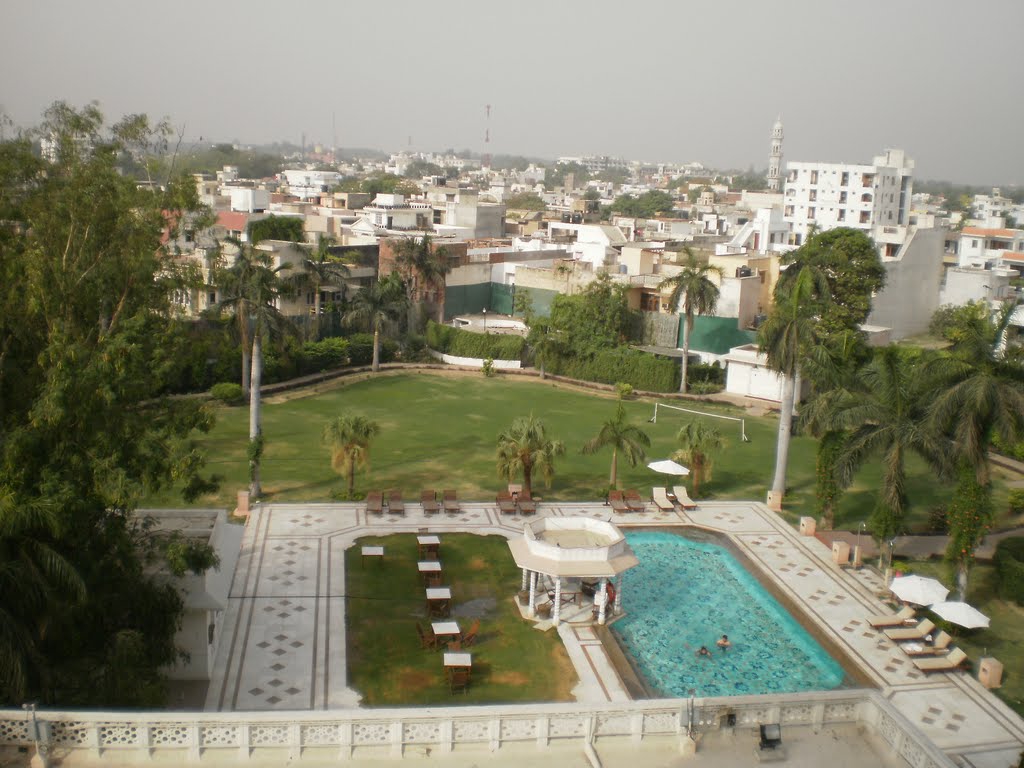
VFYWC-203

A confident reader starts us off:

It is obviously somewhere near the DMZ in Daeseong-Dong.

Another is less sure:

I’ve narrowed it down to either Surabaya, Indonesia or Elmira, New York. Close call, but I’ll go with Surabaya, Johnny.

Another:

Tehran, Iran. I’d say the white buildings and the palm trees are dead giveaways. I will leave the rest of the details for your insane VFYW sleuths to figure out.

Another has Fox-colored glasses:

Benghazi. Because no matter the question, the answer is always Benghazi. (And the contest picture could actually be Benghazi…)

Or farther west?

First time entrant. I spent a year studying in Senegal and this reminds me a lot of Dakar. I’ll guess the picture was taken somewhere around the Medina district.

A family duo looks to the Middle East:

Based on the minaret featured in this week’s picture, my six year old and I are guessing Muscat, Oman.

That was actually this week’s most popular incorrect guess. Another:

The minaret in the background is a close-but-not-exact match to the principal minaret of the Sultan Qaboos Grand Mosque. Several other Omani mosques bear similar designs, so it has to be that country, and probably Muscat. But I just can’t find a closer match! Along the way, though, I’ve learned a lot about Arab architecture, which is always fun. But this sole distinguishing feature is just too tough to match. I’m eager to hear more about those windowless-on-two-sides buildings that abound in this view. They’re definitely unique, but challenging to describe to a search engine.

Another nails the right country:

Hyderabad, India. Specifically, an area you might see on the flyover road from the airport. I could be wrong about this, but the minaret in the right middle ground and radio tower in left background make me a little more certain.

Another studies the scene in more detail:

Urban sprawl punctuated by palm trees, radio towers, and a lone white minaret. The minaret looks round or octagonal, with an onion dome on top, in the architectural style of many Indian/Pakistani mosques. Try as I might, I haven’t been able to narrow it down much further. The most similar minarets I found were in Jaipur, India, so I’m going with that for lack of a better idea.

Another almost has it:

Ten-second guess: this reminds me of the minarets in Northern India (vaguely reminiscent of the ones at the Taj). But this is clearly not the Taj itself, and I’ve got too many errands to run today to search. This looks a little too whitewashed to be Agra or Delhi, the first two places I might have otherwise started looking, so I’m going with the Pink City of Jaipur in Rajasthan. It’s still a big city and has its share of hazy air, perhaps a little less so because it is in the desert. Although the palm trees don’t quite fit with this city, and it troubles me that you would show a View from Bangalore the next day, but this could be an attempt to throw us off the track. To thine instincts be true. This feels like Northern India and so I’m going with that …

On the off chance that I’m close, my best memory of this part of the world is a week in the sacred city of Pushkar, about three hours away, with its masses of Hindu pilgrims, famous camel fair, and great camel trekking in the Thar desert. More monkeys, cows, and camels than cars on the inner city streets near the lake, but no alcohol, meat, or dairy in the food either. Interesting efforts to make pastry without butter.

A former winner gets the correct city and hotel:

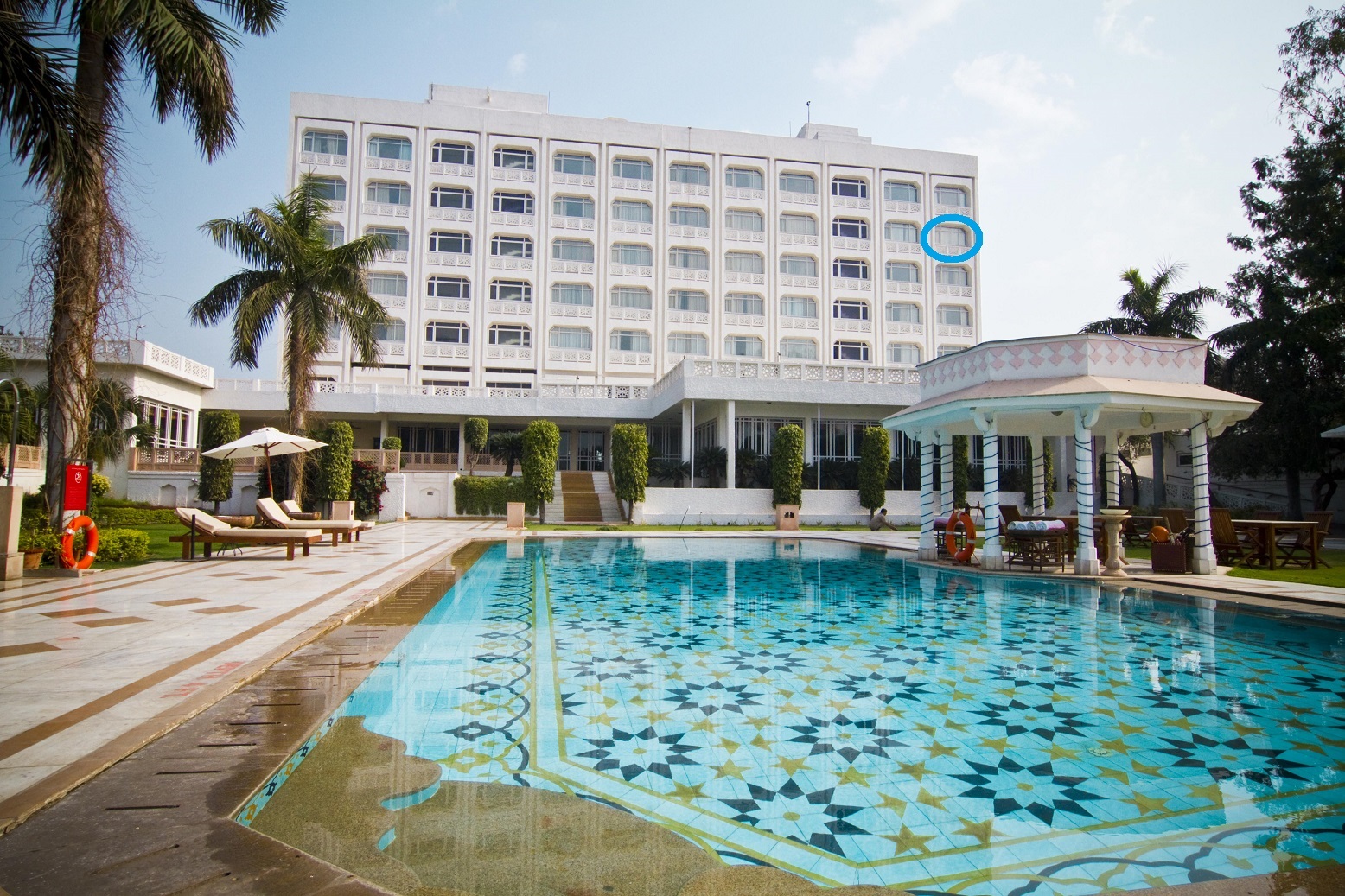
gateway-hotel-agra

Diabolical. Do you know how hard it is to find an image of Agra, India that doesn’t show the Taj Mahal? I knew the minaret at the center of the image was the key. A building in the lower left has a strong Greek influence, so I spent a bit of time around the Mediterranean. But focusing the search on the minaret I found an image of a similar minaret under construction in Agra. Then there came the wading through endless pictures of the Taj Mahal. From up close, from far away, crushing it between two fingers Kids In The Hall style. Everything.

Then, I found the above image. Bingo. Today’s window is from the Gateway Hotel in Agra, looking southwest, thankfully 180 degrees away from a view of the Taj Mahal.

Out of the 23 contestants this week, only a handful correctly guessed Agra and the hotel. For some context, below is a map plotting all of the entries this week (zoom in by double-clicking an area of interest, or drag your cursor up and down the slide):

This embed is invalid

Another former winner goes through her methodology:

vfyw203-b

For me, the only distinctive and potentially unique clue in the photograph was the tall, solitary minaret. Its design and decorative elements suggested the Pakistan-India-Bangladesh region, but when I couldn’t find it through various searches, I looked much more broadly. I soon realized that minarets vary incredibly, even in a single region, and for what is basically a simple architecture form. No two were the same unless part of the same mosque.

Eventually I found a 2004 photograph of a new mosque being built in Agar, India, near the “Park Plaza Hotel”. Its minaret, although still under constructed, was recognizable as that in the contest photograph. From there, I began checking hotel views in the area until finding one very similar to the contest view.

vfyw203-a

I have little confidence in my exact window guess but believe it is on the eastern side of the hotel’s southern face and on a higher floor. I compared nine photographs taken from various windows or facing the hotel exterior. The aim was to find angles that would include the shed-like building along the perimeter wall and only a limited portion of the eastern lawn and palms. The contest view also looks down on a tall tree growing to the east of the pool-lawn complex. Other features such as walkways and columns in the balcony railing helped narrow the options. It was hard to rectify the angles at which many of these shots were taken.

Thank you for the tour of minarets.

Another:

This one was one of the most difficult I’ve ever seen on the Dish.  The nondescript mosque surrounded by nondescript housing somewhere where there’s both palm trees and non-palm trees.  Very tough.  Anyways, given the smog and the fact there seems to be bathrooms in the bottom right corner of the photo with an “M” and “W” implying an English speaking country, I’m going to guess it’s somewhere in Lagos, Nigeria.  I’m sure Chini will set me straight.

Enter Chini:
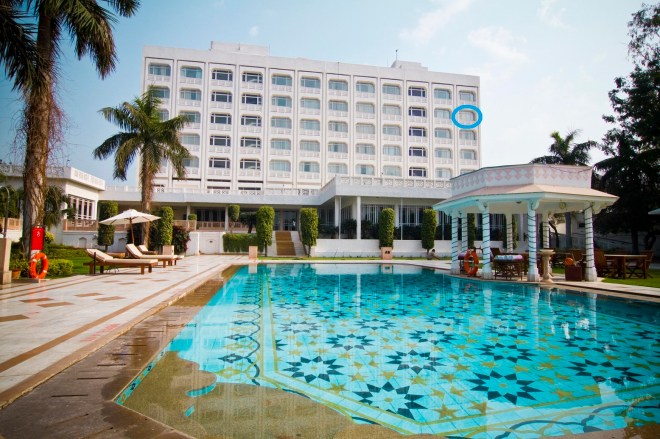
VFYW Agra Actual Window Marked - Copy

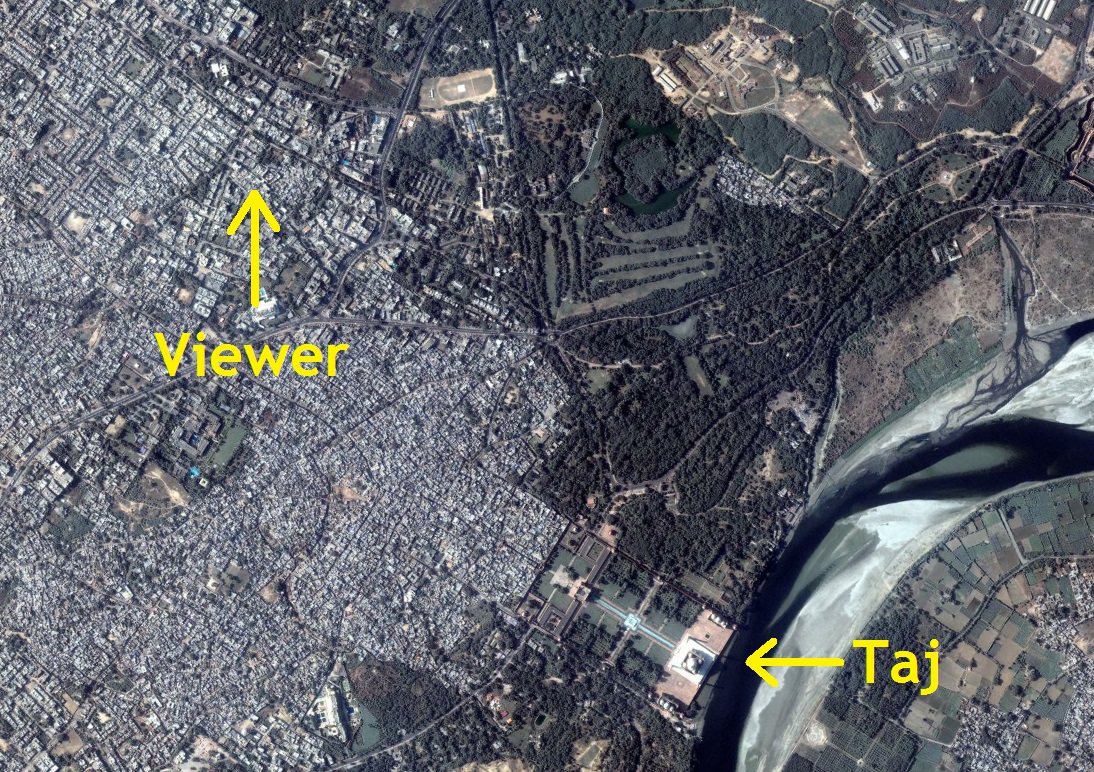
Man, if this entry were a B-17 it’d be coming in for a landing more shot up than the Memphis Belle. Allergies this weekend turned me into a red-eyed, sore-throated mess that could barely speak, much less search. By Monday I was basically nowhere, not to mention sleep deprived. But sometimes a change of scenery works wonders; for me that change took place on a train crossing the Delaware. What had eluded me all weekend long suddenly appeared with a few taps on an iPhone, followed shortly thereafter by a rather loud and inappropriate exclamation. (Much to the chagrin of the twenty-something sitting next to me who nearly spilled their beer in response.) So I suppose all roads don’t lead to Rome; this one led me to Agra, India by way of Trenton, New Jersey.
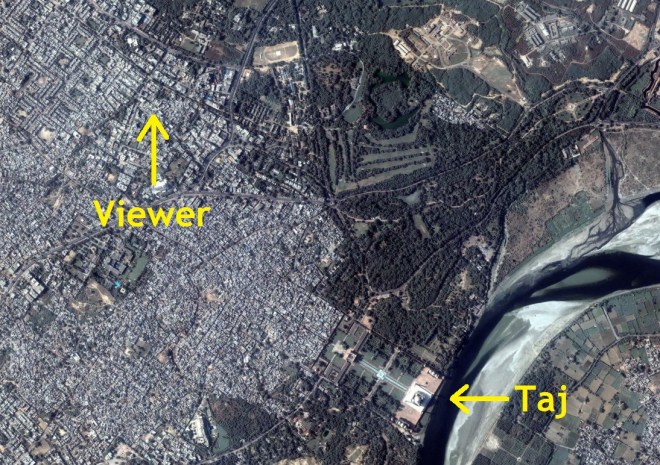
VFYW Agra Overhead Marked - Copy

This week’s view was taken from roughly the sixth floor of Agra’s Gateway Hotel. The photo looks west, southwest along a heading of 237.34 degrees. The best part is that the Taj Mahal sits exactly a mile away in the other direction. That and the number of online reviews for the hotel mean that this contest may have quite a few responses from people who’ve stayed there, as was the case with VFYW #151.

Not so, it seems. Teamwork paid off in this case:

203-image1

Ouch, this one was hard. In our previous entries we had some lucky breaks, or at least we could narrow our search fairly tightly. This time we really had to log some hours on Google. After a day and half of searches and discussion we realized that several continents were still in play.

The obvious clue was the minaret in the background. Traces of that minaret’s style could be seen in many places, but my wife concluded that the closest examples were appearing on the Indian subcontinent. We focused there. I 203-image2spotted a 2004 photograph of a minaret under construction in Agra that was similar to the one in the contest photograph. Hopping on Google Earth to examine Agra, I located a promising tall hotel (before I was able to find the minaret) and it had a photograph that was almost identical to the contest one …

Seen to the right. No one guessed the exact window, room or floor this week, but our winner – a regular player who has contributed some colorful entries in the past – came pretty close:

I actually forget how I found this, except that it was awesome and I impressed myself. We’re looking southwest from the Gateway Hotel in Agra, India, from a room on the less desirable side that affords no view of the Taj Mahal. We’re on the fourth floor, by my calculations, in the southeasterly wing of the building, and my bet-hedging guess – based on some worldly assumptions about the distribution of the Gateway’s 100 rooms and suites – is that we’re in Room 411. Photo of the window attached.
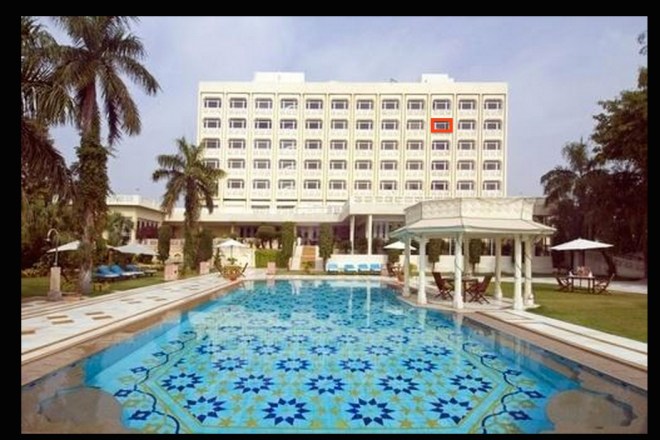
agraVFYW

Nice work. From the photo’s submitter:

My husband was in India, and knowing my obsession with the View From Your Window Contest, he sent along this photo. It was taken in Agra at the Gateway Hotel, Sunday morning, March 23. It’s room 517, to be precise.

If you choose to use this for the contest, I’ll be very impressed with the winners. First off, a Google Image search of Agra, India turns up 99 pictures of the Taj Mahal for every 1 picture of something else. And secondly, there’s no street view on Google Maps. So two of my primary tools for locating these things are essentially useless.

See everyone Saturday for the next contest (which will be easier this time, promise). Meanwhile, a reader responds to last week’s contest, in which we noted that Orlando, Florida was “probably the only US location we’ve ever featured that hasn’t elicited a single contestant’s praise or fond memories”:

Like half the Midwest, my family moved to central Florida in the ’80s, and it was indeed a stark landscape. Its beauty – like much of non-beach Florida – reveals itself very slowly: sinkhole lakes, hanging moss, summer showers you could set your clock by. You need to watch out for gators as you canoe the Wekiva.

It is the South – to everyone except other Southerners, who view us as 202suspiciously purple. And I know it’s a sickness, but I love Florida’s reputation for weirdness. They say if you shake the United States, all the odd bits settle in Florida.

Not to get all heavy, but I’ve often thought that to live in New York, LA, Chicago or even Boston, is to see yourself, your everyday experience (or at least some version of it), continually reflected back at you in movies, TV, books and magazines. These are stories of love, crime, comedy, tragedy, of the human experience in all of its complexity and contradictions. By living in those places, you know that You exist; your story is worth telling; it is important.

In Orlando, your story will never be told. In fact, Orlando is a town built upon an industry whereby millions of people visit it in order to experience a fantasyland version of every town except Orlando. Millions visit Orlando, but almost none see it. Orlando becomes a mirror for tourists to travel long distances to recreate where they came from, but with all the sharp edges smoothed off. It may be why that Orlando often feels like nowhere, or anywhere. Why the people who move here don’t transfer their allegiance from where they came to here. If they did, their stories would no longer be worth telling or important, they would become invisible, like the people who clean your room while you go to the theme park. No locals go to those places, unless it’s to relieve tourists of their money. We live in an entirely different world from that. And it doesn’t suck.

This will be the only note you get in defense of Orlando. And now that I think about it, I may be OK with that.

But that reader isn’t alone:

I live here in Orlando and wanted to write to defend our much-maligned city. When I read, “Ordinarily I would write something interesting about the city or the structures in the picture, but we’re dealing with Orlando,” I just get annoyed.

What most people think of as “Orlando” is practically its own independent municipality, Tourist Land, many miles from where the vast majority of residents of Real Orlando live. Universal and SeaWorld are out in the tourist corridor near the convention center, 15 miles from downtown – and Disney World is its own jurisdiction! People fly into the airport in Southeast Orlando, drive straight across the southern end of the city to I-Drive or Disney World, Universal Studios or Shingle Creek, all in plowed-over citrus groves or swamp; stay their entire time out there, in an environment built almost exclusively for tourists; and then drive back to the airport when vacation’s over.

When tourists visit New York and stay in Midtown, no one assumes that the lights and tourist traps of Midtown are representative of New York City. But for some reason, people think Orlando is just strip malls of kitschy T-shirt shops and fast-food restaurants.

In Real Orlando, we have historic downtowns and housing districts with significant history that long predates the modern tourist experience. DeLand and Winter Garden are old citrus-growing towns; and Maitland dates to the Second Seminole War. Zora Neale Hurston lived in Eatonville in 1887 and a festival in her honor is still held each year. One of the quaintest little Central Florida towns, Winter Park, dates to the 1850s and has an adorable historic district on Park Avenue that has been a shopping district for locals since the 1920s.

So when I hear people put down poor little Orlando, it’s clear to me that they only know Tourist Land and not the real Orlando!

(Archive: Text|Gallery)

How Journalists See Journalism

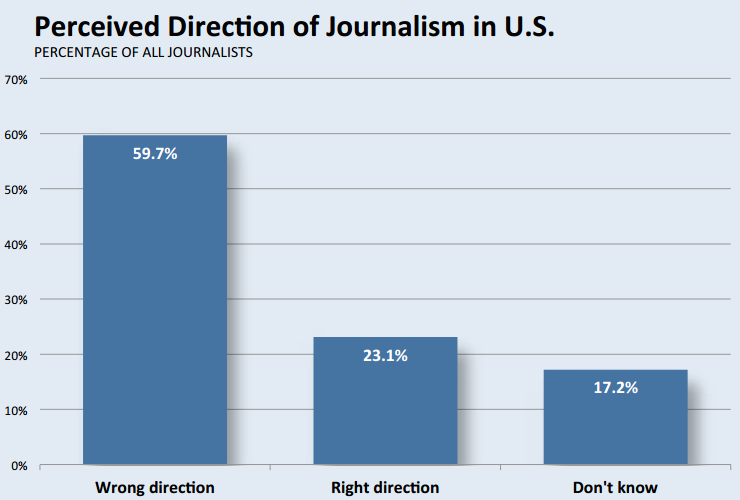
Journalism Survey

Most are unhappy (pdf) with the state of their profession:

Among the more negative findings are that U.S. journalists today are less satisfied with their work, less likely to say they have complete autonomy to select stories, much more likely to say that journalism is headed in the wrong direction than in the  right one, and much more likely to say that their news staffs have shrunk in the past year rather than remained the same or grown.

Other findings indicate that U.S. journalists are less likely to consider reaching the widest possible audiences and getting information to the public quickly as very important roles, and more likely to emphasize the importance of investigating  government claims and analyzing complex problems.

(Hat tip: Romenesko)

Getting Closer To A Deal With Iran

The signs are obvious: a faction is now revving up skepticism of the talks, wanting new conditions to be imposed, creating new slogans – “no consensus, no surrender” – and waving the flag. Another day at the Weekly Standard? Leon Wieseltier on a roll? Kenneth Pollack, that accountability-lite supporter of the Iraq War, and still pronouncing on WMDs in the Middle East? Nah – the fundamentalist extremists in Iran:

An event [over the weekend], organized by a group identifying itself as “the anxious” and held at the site of the former U.S. embassy in Tehran, drew dozens opposing the temporary nuclear deal, the local Shargh newspaper reported. Participants chanted slogans such as “no consensus, no surrender” and waved Iran’s flag and posters that read “details of the negotiations won’t remain a secret.”

Like the neocons, the revolutionary forces in Iran are trying to smear the politicians trying to move forward, highlighting Rouhani’s past failures the way the GOP is banging on about Benghazi. But Rouhani is apparently standing firm and the deal’s shape is emerging quite clearly:

Getting to the heart of the matter, many points seem close to being settled. Iran is ready to cap at 5% its production of enriched uranium and to limit its current stockpile from further enrichment. The controversial underground facility of Fordow will probably end up as a kind of research and development unit. The Arak reactor’s original configuration allowed the yearly production of about ten kilograms of plutonium, enough for one or two bombs. Ali Akbar Salehi, chairman of the Atomic Energy Organization of Iran (AEOI), has hinted that this configuration could be modified in order to accommodate low-enriched uranium fuel rather than natural uranium. This would reduce Arak’s plutonium production capacity by a factor of five to ten. And Iran has already confirmed that it has no intention of acquiring the fuel reprocessing capacity indispensable for isolating weapon-grade plutonium.

Yes. We. Can.

Do I Sound Gay? Ctd

Readers continue the thread:

I thought you or your readers might be interested to know that there has been a sizable amount of academic research done on this topic. You might want to check out J. Michael Bailey’s work out of Northwestern University, specifically “‘Gaydar’: Accuracy and the Role of Masculinity–Femininity,” which ran in Archives of Sexual Behavior in February 2010. From my understanding of this particular study, “sex-atypical speech” is actually the most correlative predictor (among speech, appearance, interests, movements) of observer positive identification of male homosexuals. Although, of course, not all self-identified male homosexuals exhibited sex-atypical speech.

In contrast, while “speech” also positively correlated for lesbian identification, it was the lowest correlate. For lesbians it was the “appearance” of the target that correlated best with positive identification.

Another reader illustrates how “sounding gay” can vary across cultures:

I’m Filipino, whose first language was Tagalog.

To me, sounding gay in Tagalog means not lisping but nasality of vowels. Tagalog itself does not have perceptibly nasalized vowels in its phonology. Furthermore, to my ears, gay Tagalog intonation patterns are closer to women’s than men’s (or, at least, mine mirrors my mom’s intonation, not my dad’s).

Another points us to David Sedaris’ classic story about being pulled out of fifth grade for speech therapy. Another urges gay men not to take it too personally:

I’ve enjoyed the discussion so far, but I think one thing we forget is that pretty much everyone hates the sound of his or her speaking voice when they hear it in a recording, especially the first time they hear it. Video causes even more distress. I think this is basic human insecurity, and, although it makes sense that gay men feel this insecurity in the context of masculinity and societal attitudes towards it, we should not try to make it a gay issue. Being a little unsure of oneself is much preferable to being cocksure.

Another opens up:

I was interested to read how you felt that you acted more stereotypically gay before you came out, and how you adopted more stereotypically dude-like affectations and pursuits after you left the closet. It reminded me of the feeling I got almost immediately after I came out: I finally felt that I was a man.

In my youngest years, before puberty, I was often mistaken for a girl. It was embarrassing. And when I got older, but before high school, the bullies made me feel like a girl. I wasn’t badly bullied, though I had a few incidents. But the bullies taunting was usually to make other boys feel like girls, to make them feel that the bullies were the real boys and the bullied were the same as girls.

It was only after I came out that I finally felt like a man. I am not quite sure why, although I finally felt authentic and realized that there were other men who were authentically just like me, and they, just like me, could be authentically attracted to and authentically love other men. I was also then able to accept whatever effeminacies I have as part of the man I am.

I don’t know if I sound gay. I have heard recordings of my voice, and it does sound completely different than I hear it in my own head, which is so odd. I suppose it sounds more gay than I would like. I guess that’s a last vestige of my own internalized homophobia, which is so hard to kill when you’re a 50-ish gay man. But I am so grateful for the feeling of being authentically male that I never had before I came out. I remember trying to explain that to my mother when she was so upset at my being gay.

Catch up with the whole thread on sounding gay (or British) here.