Mental Health Break

The world doesn’t have to be dog-eat-dog:

Miss Cellania captions:

Twelve very happy and well-behaved dogs go for an excursion to the beach in Australia and express themselves to the tune of “Happy.” Oh yeah, there’s a cat, too. It’s Didga, the skateboarding cat! You know he’ll be able to hold his own with all those dogs. This video is a lot of fun, but you just wait until they all go swimming – including Didga!

“The US Is A Living Hell”

That’s the verdict of a propagandistic human rights report issued by North Korea’s state-run Korean Central News Agency. Nina Strochlic finds the report’s relative accuracy unnerving:

In North Korea, where accurate depictions of human rights never make it into the state-crafted news, the press doesn’t exist to focus investigations inward. But it’s also disturbing that Pyongyang felt little need to load up a report on the U.S. with hyperbole or farce. The words may be overwrought (“Such poor human rights records in the U.S. are an inevitable product of the ruling quarters’ policy against humanity,” one line reads), but the facts are plainly, and uncomfortably, laid out. Something’s off when the most notoriously abusive country in the world has the material to level criticism, even if it has no credibility to do so.

Adam Taylor also looks over the report:

[T]he only truly debatable part is on gun crime. While it’s true that the number of mass shootings has risen in the United States, violent crime in general has dropped over the past few years, with homicide rates down in most major cities. And while the April 10 U.N. report did note that the United States has a high murder rate, the top spot went to Honduras. (KCNA appears to have misread the report, which said the Americas were the region with most gun crime.)

After fact-checking the report in detail, Matt Ford concludes that “Pyongyang’s sins don’t make Washington a saint”:

While it’s easy to dismiss North Korea’s critiques as hypocritical, it isn’t the only country to criticize America’s human-rights record. When asked about Malaysia’s progress on human rights at a press conference in Kuala Lampur this past week, Obama said his host “has still got some work to do. Just like the United States, by the way, has some work to do on these issues. Human Rights Watch probably has a list of things they think we should be doing as a government.”

On cue, Human Rights Watch released that very list, urging the United States to improve its record on mass incarceration, NSA surveillance, and racial discrimination, among other topics.

Misled By Maps

Girls Names

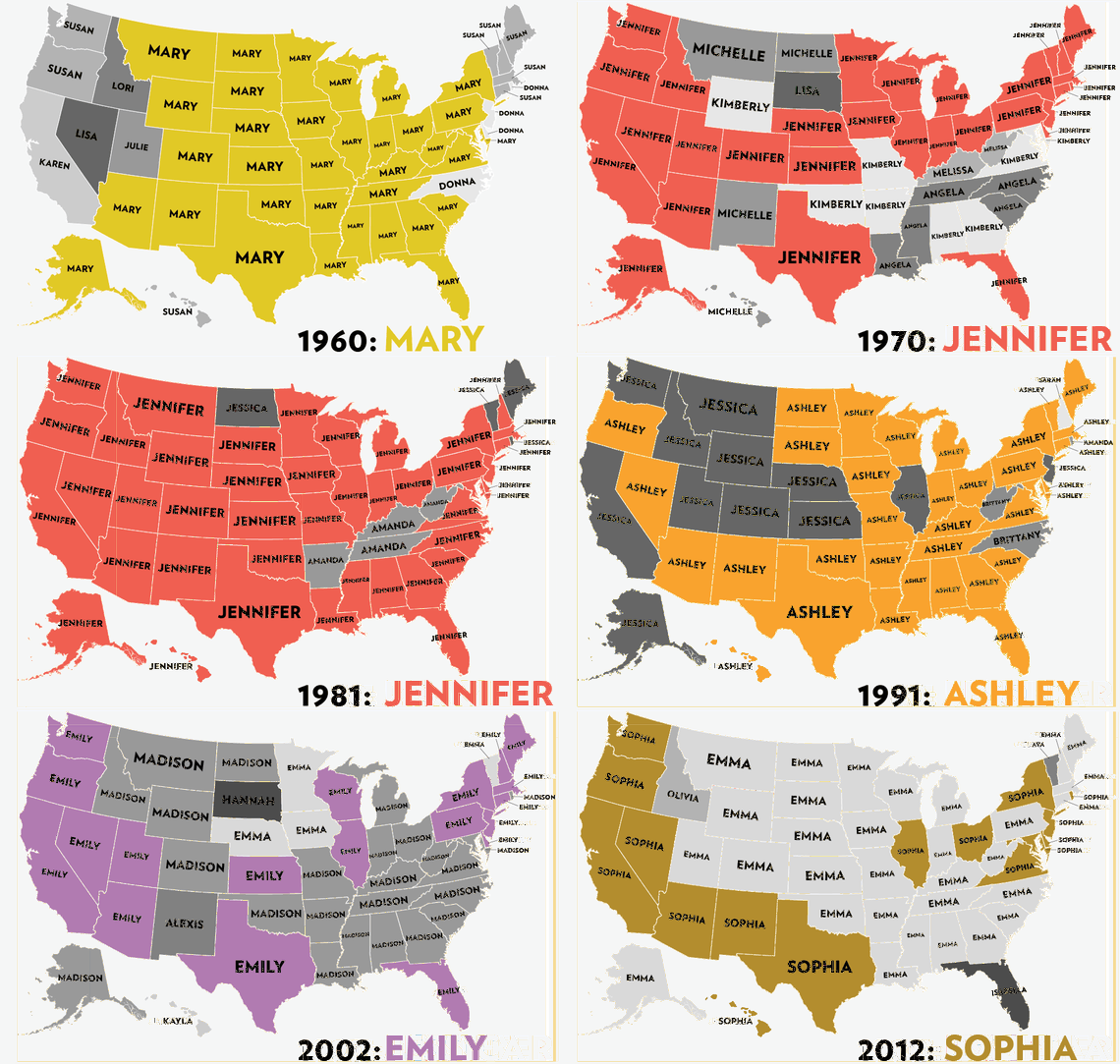
Ben Blatt ruins everyone’s good time by pointing out the shortcomings of viral maps like this one, which shows the most popular names for baby girls by state over time:

In 1984, only 13 states are labeled Ashley; by 1992, 30 states are. But it turns out that in 1984, a female baby born in the United States was actually 8 percent more likely to be named Ashley than in 1992.

Ashley was still the most popular girls’ name in 1991 and 1992. But its newfound dominance of the map is not the result of its growing popularity. Ashley was on the decline by the early ’90s—but other names were declining even faster. The original maps don’t actually say that Ashley was increasing in popularity in the early ’90s, but the way the information is presented, that misunderstanding is almost unavoidable. …

Again, this doesn’t mean the baby-name maps are wrong. They don’t purport to show anything except the most commonly given name in each state. In fact, these particular maps are well-designed and informative, if you have time to wade through the implications of the data. But it’s easy to see false trends here. Behind each map is data for hundreds of names across 50 states that would need to be examined closely to find the real trends. Unfortunately, there is no such thing as a viral Excel sheet.

But then he makes amends with an interactive feature displaying some maps of his own:

Screen Shot 2014-05-02 at 1.12.27 PM

Seattle Maxes Out The Minimum Wage

The city has announced a plan to raise its minimum wage to $15 over the course of four to seven years:

That hourly wage would effectively be the world’s highest government-set minimum rate in a major city, unless Switzerland adopts a $25 minimum wage in a referendum scheduled for later this month. While other economies have higher minimum wages in exchange-rate terms (Australia’s is roughly $16 an hour), when you take into account spending power, the highest current minimum wage is Luxembourg’s, at the equivalent of $13.35 an hour.

Seattle’s proposed wage hike, produced by a special committee of business, labor and political leaders, is expected to be approved by city lawmakers, and will affect about a sixth of the city’s more than 600,000 residents. It will be instituted gradually, reaching $15 in 2017 for companies with more than 500 employees, and in 2021 for small businesses that offer their employees benefits or tips. After that, further increases will be indexed to inflation.

Eric Liu, who served on the advisory committee that developed the plan, holds it up as an example of how the minimum wage battle is becoming increasingly local:

This is, as the vice president might say, a big f-ing deal. It’s not just the $15 figure, which sets the floor higher than in any other city or state. It’s the fact that a broad coalition with significant business support made it happen. That makes this deal a model for other cities—and further evidence that norms are changing.

It suggests that it’s becoming less acceptable in America to run a business in a way that relies on poverty wages. It’s becoming less acceptable to suggest that the go-to remedy for the pain of working people should be tax cuts for the wealthy. And though a minimum-wage increase is not an innovative tool, its revival is part of a widening repertoire of policy ideas for closing the opportunity gap.

Seattle’s action shows we’re entering a new age of bypass. Washington is stuck and will be for the foreseeable future. So it falls increasingly to cities to act—and in increasingly coordinated ways.

But Jordan Weissmann worries that the plan might backfire:

The truth is, nobody has any idea what would happen if the minimum wage jumped that high. But there are good reasons to worry that results would be ugly.

The research literature on whether minimum wage increases kill jobs is decidedly mixed. Some economists have found that hikes lead to small job losses among teens and in industries like fast food. Others have found that losses are nonexistent, or at least negligible. In the end, I tend to argue that even if you assume reasonable job losses, middle-class and poor families come out ahead in the bargain. Though some workers end up unemployed, enough get raises to make the tradeoff worthwhile.

But that assumes we don’t lift the pay floor too high, too fast. Minimum wage studies have typically looked at small increases, somewhere around 50 cents or a dollar. Seattle’s proposal would be far larger. It would also have virtually no U.S. precedent.

And Reihan thinks the higher minimum wage might end up pricing more poor Washingtonians out of the city:

Poverty in the Seattle area is a largely suburban phenomenon, and it is a suburban phenomenon because the poor have been driven out of Seattle in large numbers of high rents. Even in a happy scenario in which a higher hourly minimum wage leads to higher market incomes for low-wage workers, restrictions on new housing development mean that more income earned by low-income Seattleites will be chasing the same limited stock of low-rent housing. And it’s hard to see a higher hourly minimum wage deterring price-insensitive high-income people from continuing to settle in Seattle. These high-wage workers will continue to gentrify low- and middle-income neighborhoods, putting still more pressure on the low-rent housing stock.

The Slowdown On Getting Faster

derby

Roger Pielke Jr. wonders why the speed of the fastest horses has plateaued while the fastest humans continue to break records:

One possibility, advanced by [Mark] Denny and others, is that thoroughbred race times may have leveled off because the narrow genetic diversity of racehorses limits the genetic diversity in the pool of potential thoroughbred champions. Modern thoroughbreds are descendants of a small number of horses (less than 30 in the 18th century), and 95 percent are thought to trace their ancestry to a single horse, The Darley Arabian. Today, there are fewer than 25,000 thoroughbreds born each year in the United States. Compare that with the more than 7 billion people worldwide. The size of the human population may simply lead to a greater number of potential athletes with extreme speed.

David Epstein’s TED Talk challenges the claim that today’s athletes are truly superior. A highlight from the transcript:

[C]onsider that Usain Bolt started by propelling himself out of blocks down a specially fabricated carpet designed to allow him to travel as fast as humanly possible. Jesse Owens, on the other hand, ran on cinders, the ash from burnt wood, and that soft surface stole far more energy from his legs as he ran. Rather than blocks, Jesse Owens had a gardening trowel that he had to use to dig holes in the cinders to start from.Biomechanical analysis of the speed of Owens’ joints shows that had been running on the same surface as Bolt, he wouldn’t have been 14 feet behind, he would have been within one stride.

Cowen highlights other interesting parts of the speech.

The Return Of The Germans

One of the more insightful pieces I have yet read on the tragedy of Ukraine is this one by Clemens Wergen on the German reaction. I’ve been struck by Germany’s muted response to an invasion of an Eastern European state like Ukraine. It’s easily the biggest obstacle to a serious Western attempt to leverage Russia’s oil exports to curtail Putin’s neo-fascist experiment. Wergen helps explain it:

We have come to think of Germany as a Western European country, but that is largely a product of Cold War alliances. Before then it occupied a precarious middle between east and west. Twenty-five years after the end of the Cold War, German society may well be drifting away from the West again. In a poll last month by Infratest/dimap, 49 percent of Germans said they wanted their country to take a middle position between the West and Russia in the Ukraine crisis, and only 45 percent wanted to be firmly in the Western camp.

But there are some who also actively sympathize with Russia. To wit:

Europe’s populist right, which agrees with Russia’s propaganda that Europe has become too gay, too tolerant, too permissive in its morals and too un-Christian, and which welcomes an authoritarian leader challenging Europe’s fuzzy multilateralism. In Germany, you can find this current best represented by the new anti-euro Alternative für Deutschland Party. They take up a conservative strain of German thinking dating back to the 19th century, which harbors a resentment toward Western civilization and romanticizes a Russia seemingly uncorrupted by Western values and free-market capitalism.

Along with this, of course, is the German economy’s energy connection with Russia, symbolized by former chancellor Gerhard Shroeder’s seat on the board of Gazprom. What I infer from this – and from the staggering incompetence of Ukraine’s interim government in holding on to its territorial integrity – is that the Ukraine crisis cannot easily be forced into a Cold War template. Russia is not an ideological rival in any deep sense, as it was under Communism. It’s ambitions are not to control the globe, but to police and control its near-abroad by any means necessary – masked warfare, energy blackmail, military intimidation, constant propaganda. And Germany is not West Germany any more.

At some point, the neoconservative Cold War nostalgics may wake up to see an emerging new world order in the 21st Century. My fear is that they will try to wrest it back to the 20th – and fail.

Convincing Creationists Of Climate Change

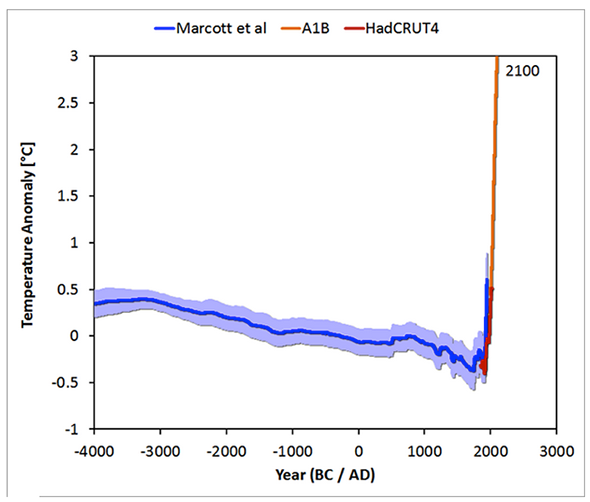
Climate Change 6000 Years

It can be done:

[W]hen it comes to talking to evangelical audiences about climate change, [climate scientist and evangelical Christian Katharine] Hayhoe doesn’t emphasize the age of the Earth, simply because, she says, there’s no need. “When I talk to Christian audiences, I only show ice core data and other proxy data going back 6,000 years,” says Hayhoe, “because I believe that you can make an even stronger case, for the massive way in which humans have interfered with the natural system, by only looking at a shorter period of time.”

“In terms of addressing the climate issue,” says Hayhoe, “we don’t have time for everybody to get on the same page regarding the age of the universe.”

Hard Times On J Street

Last week, J Street’s bid to join the Conference of Presidents of Major American Jewish Organizations was rejected. Michael Scherer argues that this illustrates how American Jews still think about Israel in starker, more existential terms than Israelis themselves do:

J Street … has as its mission an effort to “expand the very concept of what it means to be pro-Israel.” In practice, this means J Street is more closely aligned with the Israeli Labor party than the Likud Party; that it supports greater Israeli concessions to bring about a two-state solution; that it is more critical of Israeli history than most American Zionists; and that it does not share Prime Minister Benjamin Netanyahu’s hawkish views on Iran.

By a vote of 22 to 17, the American Jewish community’s largest umbrella group has decided that these views, which are widely debated in Israel, should not be allowed as a part of mainstream American Jewish identity. In short, the American Jewish community is still not ready to embrace the messiness of a real Democratic debate. To disagree over the best policies for Israel is, for a slight majority of American Jewish institutions, still an act of opposition to the nation itself.

You might imagine that some would see the entrenchment of apartheid-like rule on the West Bank, the dead end of the peace process, the potential rapprochement with Iran and the growing strength of the BDS movement, especially in Europe, as requiring a re-think with respect to blind support of anything Israel does. But you would be wrong. Yehuda Kurtzer calls the decision “an attempt to sustain a polity that no longer exists, and to imagine a firm dividing line between internal community dissent and external public debates”:

The fact that J Street wanted in to the establishment meant that in spite of policy differences with many of its members, they were ostensibly willing to try to belong to and perhaps even help sustain the declining Jewish consensus; the fact that they are kept out, essentially told to keep doing their work outside the framework of the normative community, actually reinforces the very breakdown of the communal structure from which Conference of Presidents is now a relic.

If once upon a time Jews held a line not to hang our dirty laundry in public, the American public square has become a Jewish Laundromat – all with the tacit endorsement of what was once the community’s mouthpiece and most influential instrument.

Joe Klein laments what he terms “a decidedly un-Jewish development”:

Where I come from–the outer boroughs of New York City–Jews were known for, and entertained ourselves by, arguing about everything. Nothing was ever off the table. But I’ve noticed a tendency of the neo-conservative Jews to denigrate those who disagree with their extreme right-wing positions. They bully. They refuse to engage in a serious debate. They have a cult-like devotion to the party line. They call groups like J Street “anti-Israel,” when it’s possible, perhaps even probable, that COPOMJAO’s hard line will compromise Israel’s ability to thrive in the future.

The CPOMJAO rejection will work well for J Street. It will be “good” publicity, especially among those Jews who have been dismayed by those who claim to Judaism’s official leaders in America. COPOMJAO, meanwhile, seems as silly as its name. It needs reform, including a new identity: I would suggest The Jew Crew as a replacement, but that would imply a lack of self-righteousness and openness to diverse opinions that COPOMJAO doesn’t seem to have.

But Jonathan Tobin argues that J Street, not the conference, is the divisive one:

The Conference was created to provide a way for a diverse and cantankerous Jewish community a single structure with which it could deal with the U.S. government. The point was, though its members have often disagreed and true consensus between left and right is often impossible, the Conference still provides Congress and the executive branch an address through which they can reach a broad and diverse coalition of Jewish organizations. Adding one more on the left wouldn’t have changed that but unlike other left-leaning groups, J Street has never had any interest in playing ball with rivals or allies. Its purpose is not to enrich and broaden that consensus but to destroy it. And that was something that groups that had no real ideological fight with J Street rightly feared.
Reality Check

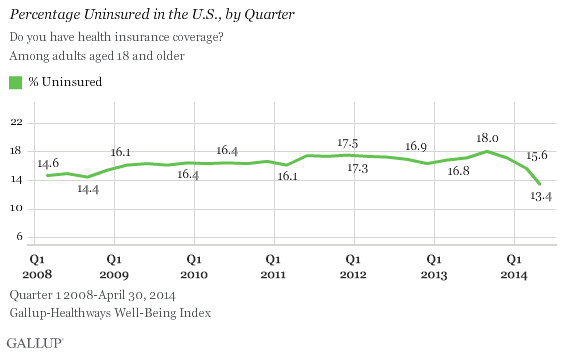
Gallup finds “the lowest monthly uninsured rate recorded since Gallup and Healthways began tracking it in January 2008“:

Uninsured Rate

Jonathan Cohn wants Republicans to face facts:

Republicans and other critics of the health care law keep saying the law isn’t having much impact on the number of uninsured Americans. A few even suggest it’s having no impact at all. These arguments are just not credible anymore.

At this point, the trend in the Gallup polling clearly isn’t a blip. It points in the same direction as previous surveys, from the Rand Corporation and the Urban Institute. And it’s consistent with evidence about the raw number of people who have signed up for insurance through the new marketplaces—and, yes, who have paid their premiums.

It seems to me that the ACA is doing what it was intended to do. And can we have a moment of actual moral clarity here? Is it not simply better – better for the human beings involved, better for the economy, better for productivity, better for the deficit – if more people are insured. The more that have access to regular care, the fewer highly expensive emergency room visits in the future; the better the health of our fellow citizens, the more able they are to contribute to our common weal; and this is not to speak of the categorical moral advantage of simply giving someone their health back. We have become obsessed with process – and much of that obsession is good. It matters whether premiums are paid and what price they are and what the age mix is.

But none of this seems to me to be the real issue. Maybe it’s my Catholicism coming through, but isn’t providing for the sick a core moral task? And finding a way to harness the private sector to do so more efficiently is win-win. Which brings up a question: why aren’t the Catholic bishops doing more to support and celebrate this huge advance? It cannot be because of contraception can it? Even if you concede that point, the moral gain of this law compared with a small moral loss is undeniable. It seems to me that the bishops – including the bishop of Rome – could make that case much more emphatically than they have.

Kliff highlights details from the poll:

The gains of insurance coverage have been especially large among lower-income Americans – the people who qualify for Medicaid or insurance subsidies under the Affordable Care Act. There’s been a 5.2 percentage-point drop in the uninsured rate, for Americans who have a household income lower than $36,000 since the end of 2013.

Minorities and younger Americans have also seen steeper declines; the uninsured rate for African Americans has fallen by 7.7 percentage-points over the last four months.

Jason Millman adds:

Now that Obamacare open enrollment is over, where does the uninsured rate go from here? Gallup says the number could tick back up if some newly insured don’t pay their premiums, though evidence suggests that from 80 percent to 90 percent of those signing up for private coverage have paid at least for the first month. It’s also possible that people could gain new coverage through special enrollment periods triggered by certain life events.

Medicaid enrollment also goes all year, and a previous Rand Corp. survey showed tha temployer coverage has played a major part in driving down the uninsured rate.

Meanwhile, Pew reports that opinions of the ACA have barely budged:

Public views of the 2010 health care law have changed little over the past several months. Currently, 55% disapprove of the Affordable Care Act and 41% approve. In September, before the launch of the online health care exchanges, 53% disapproved and 42% approved.

Republicans continue to be largely united in their opposition of the health care law — 88% disapprove and 10% approve of it. Among Democrats, about three-in-four (73%) approve, while roughly one-in-four (24%) disapprove of the law. Independents remain mostly opposed to the law, with 57% disapproving and about four-in-ten (39%) approving of it.


Nuclear Is Better Than The Alternative

Brad Plumer explains why recent nuclear power plant closings should alarm environmentalists:

So what happens when a nuclear power plant gets retired? It depends on the region. But one recent study of a shuttered nuclear plant in California found that greenhouse-gas emissions surged, as the nuclear plant got replaced by fossil fuels.

Back in February 2012, Southern California Edison shut off two nuclear reactors at the San Onofre plant after finding cracks in the steam generator system. (A year later, the company announced that it would retire the reactors for good, deciding it the repair and licensing process would take too long and involve too many lawsuits.)

That plant was massive, providing about 8 percent of California’s electricity. So the state went on a frenzy of construction, building mostly new natural gas units and some wind units. In the end, however, fossil fuels were the easiest to deploy. Overall carbon-dioxide emissions in the region rose by 9.2 million tons in the following year — equivalent to putting an extra 2 million cars on the road.

And look at the result of Germany’s decision to revoke nuclear: they’re not just hurting the planet but also enabling Putin. Sigh. To my mind, nuclear is an imperfect but real solution to disentangling ourselves from the Middle East and saving the planet. And yet the liberal coalition that should support it is AWOL – a victim largely of ideology.