You Can’t Always Raise Them Right… Or Left

Looking at how parents attempt to inculcate their kids with their political beliefs, Te-Erika Patterson notes that those attempts often backfire:

It’s understandable that parents with strong beliefs would feel it is their duty to see their children adopt those beliefs. But, however well-meaning these efforts are, they may be in vain. A study recently published in the British Journal of Political Science, based on data from the U.S. and U.K., found that parents who are insistent that their children adopt their political views inadvertently influence their children to abandon the belief once they become adults. The mechanism is perhaps surprising: Children who come from homes where politics is a frequent topic of discussion are more likely to talk about politics once they leave home, exposing them to new viewpoints—which they then adopt with surprising frequency.

The War Over The Core, Ctd

Last week, Louis C.K. became the most high-profile critic of the Common Core, setting off a Twitter firestorm in the process. Alexander Nazaryan slams the comedian for “malign[ing] an earnest effort at education reform, one that is far too young to be judged so harshly”:

The [Common Core] tests are thus far imperfect, as is how we prepare for them. With that I agree. But staging scenes from Of Mice and Men isn’t going to catch us up to China anytime soon. Nor are art projects or iPads. It was dismaying to hear the new New York City schools chancellor, Carmen Fariña, recently complain that our students are deprived of “joy” in the classroom. Joy, our twerking young ones know. Trigonometry, not so much. Louis C.K.’s frustration doesn’t pass muster as a critique of educational reform. Yes, the problems his daughter was given are tough. That’s as it should be.

But Rebecca Mead finds herself agreeing with him:

[T]he issue identified by Louis C.K., and by other less well-known but equally furious parents, is not that the material children are expected to learn is too hard. It isn’t unreasonable to expect kids to have learned to multiply and divide numbers up to a hundred by the time they leave third grade—and in all likelihood, Louis C.K.’s child will have done so by June, if she hasn’t already, and be the better for it. The greater problem lies with the ways in which the achievement of those standards is measured. An emphasis on a certain kind of testing has become a blight upon the city’s classrooms. “The teachers are great,” C.K. tweeted. “But it’s changed in recent years. It’s all about these tests. It feels like a dark time.” Plenty of parents and educators agree with him.

Libby Nelson argues that Louis C.K. should be blaming NCLB, not Common Core:

No Child Left Behind, the 2002 federal education law, required all states to develop academic standards. It also mandated standardized testing every year from third grade through eighth grade to see if they meet those standards. The idea was to hold schools accountable for whether their students were learning. So students started taking a lot more tests: when No Child Left Behind was passed, 19 states had annual standardized testing in reading and math, according to the Center for Education Policy. By 2006, every state was testing its students every year from third through eighth grade.

No Child Left Behind is still the law. And the Common Core state standards don’t change those testing requirements. They just change the exam that students are already required to take.

Meanwhile, one of our readers – who happens to be one of the lead writers of the Common Core State Standards for mathematics – sends in a response to the parent who wrote, “The Common Core math instruction is truly insane. Parents can’t even help their child with homework half the time because getting the right answer is not enough”:

I agree wholeheartedly that parents should be able to help their children with their homework. My own daughter’s kindergarten teacher handled this well. The teacher gave the children workbooks for practicing the nuts and bolts of math. My daughter was responsible for completing a minimum number of pages each week, and that was where my wife and I came in. We took it as our job to enforce the minimum, assist our daughter if she got stuck, and ensure that every answer was correct. The problems in that workbook were in the nature of exercises – nothing my wife and I would have to scratch our heads over. That approach made sense to us. If a curriculum series is expecting too much of parents, then I’m not sure schools should be buying it.

The curriculum market is in a state of flux right now. At the risk of overgeneralizing, in the time since the standards were developed, some textbook publishers have rushed out with half-baked materials, while some others have basically slapped a “Common Core” sticker on the same books they had been selling for years. The situation won’t last, but quality takes time. Generally speaking, US math textbooks have been terrible for decades – just not in ways that tend to go viral on Facebook.

Another reader objects to the idea that getting the “right answer” is enough:

In fact, learning math is not about just getting the right answer. It is about understanding the math behind the answer, which is why doing it the right way is important to developing good math skills. That many have gotten by just memorizing formulas that produce the right answer is part of the reason they aren’t good at math, don’t understand math, don’t like math, and are unable to extend their math knowledge to anything beyond memorized formulas in stock quiz problems.

And an educator wonders how well schools will put the standards into practice:

I’m a high school science teacher and my colleagues and I are wrestling with implementing the new Next Generation Science Standards (NGSS). In California, they’ve designated $1 billion to implement the standards. Many states are not making this type of commitment. Therefore, you have veteran teachers who have often placed emphasis on the content of a course having to now focus on the process and skills within the material. I’m personally a fan of the new standards in both the Common Core and the NGSS, but the implementation and professional development for our teachers has been severely lacking.

As alluded to by other writers, test scores will dip drastically as well. I was just explaining to my class that next year’s sophomores will take the new PARCC assessment, yet have only had a year of instruction in the Common Core methodology. While some schools and students may be able to adapt in this short time and perform well on the tests, schools that haven’t had the funds to train teachers and purchase instructional materials that reflect the new emphasis on skills and process will lag behind.

The full thread on the Common Core is here.
No Bankers Were Harmed In The Making Of This Financial Crisis

Or almost none – a single banker was sentenced to prison for his role in the Great Recession. Jesse Eisinger investigates why:

Over the past year, I’ve interviewed Wall Street traders, bank executives, defense lawyers and dozens of current and former prosecutors to understand why the largest man-made economic catastrophe since the Depression resulted in the jailing of a single investment banker – one who happened to be several rungs from the corporate suite at a second-tier financial institution. Many assume that the federal authorities simply lacked the guts to go after powerful Wall Street bankers, but that obscures a far more complicated dynamic.

During the past decade, the Justice Department suffered a series of corporate prosecutorial fiascos, which led to critical changes in how it approached white-collar crime. The department began to focus on reaching settlements rather than seeking prison sentences, which over time unintentionally deprived its ranks of the experience needed to win trials against the most formidable law firms. By the time [Kareem] Serageldin committed his crime, Justice Department leadership, as well as prosecutors in integral United States attorney’s offices, were de-emphasizing complicated financial cases — even neglecting clues that suggested that Lehman executives knew more than they were letting on about their bank’s liquidity problem. In the mid-’90s, white-collar prosecutions represented an average of 17.6 percent of all federal cases. In the three years ending in 2012, the share was 9.4 percent.

You Can’t Feed Your Family With A New TV

Screen Shot 2014-05-01 at 2.38.45 PM

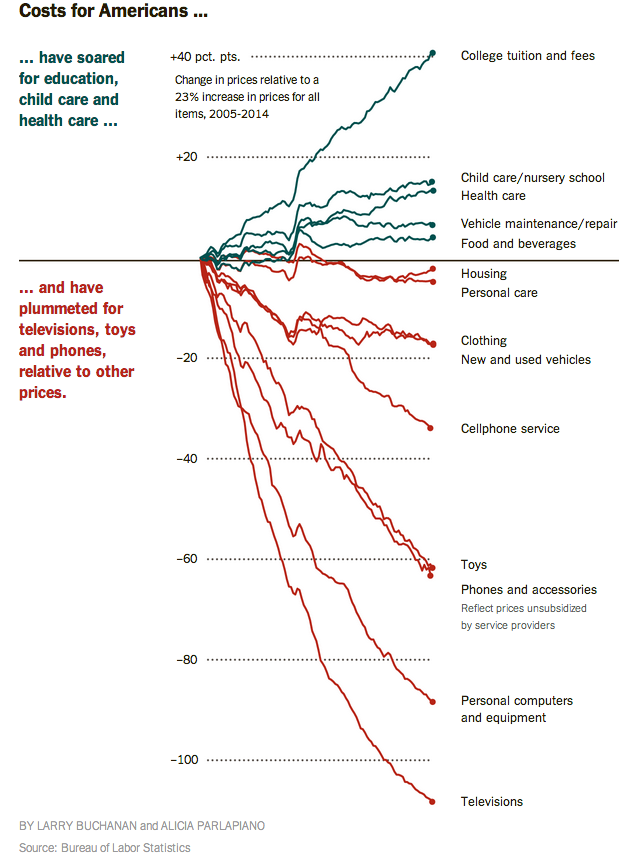
Jordan Weissmann explains why this chart, from Annie Lowrey’s latest look (NYT) at the lives of the American poor, is so scary:

Prices are rising on the very things that are essential for climbing out of poverty.

A college education has become a necessary passport to financial stability. It’s hard to hold a job if you’re chronically ill. Working full-time is difficult if you can’t pay somebody to watch your child. While a high-definition television is nice, it won’t permanently improve your circumstances. And psychology has told us that the stress of financial instability, of not knowing whether you’ll be able to pay your next bill or get enough hours at work, is part of what makes poverty such a horrible experience. Humans also tend to judge their experiences relative to their immediate surroundings, so the fact that the poor are materially better off than during the Carter era doesn’t offer them much personal solace.

Derek Thompson points out another key distinction:

When you look at the items in red with falling prices, they largely reflect industries whose jobs are easily off-shored and automated. The secret to cutting prices (over-generalizing only slightly here) is basically to replace American workers. If you can replace U.S. labor with foreign workers and robots, you’re paying less to make the same thing. Look back at the items toward the bottom of the graph. Our clothes come from Cambodia. Our toys come from China. Meanwhile, Korea, a world-leader in electronics and auto manufacturing, has the highest industrial robot density in the world. Cheap things aren’t made by American humans.

Now consider education, health, and childcare, the blue sectors above where prices are rising considerably faster than average. These are service industries that employ local workers. They are not, to use the economic term, “tradable.”

Does Your Name Boost Your Credibility?

It appears people are more inclined to believe you if your name is easy to pronounce:

In a new study, published in PLoS ONE, the researchers asked undergraduate volunteers to rate the pronounceability of real names from 18 countries, and then used these ratings to generate a set of difficult to pronounce names, such as Yevgeni Dherzhinsky, and a set of easy names, such as Putali Angami. The researchers then told a new group of undergraduate participants that some international students had listed their favorite trivia statements, such as “Giraffes are the only mammals that cannot jump,” and that the participants’ task would be to read some of those statements, and report whether they thought that the statements were true or false. Importantly, each trivia statement was paired with a difficult to pronounce name (“Yevgeni Dherzhinsky said:”), or an easy name, from the sets generated earlier.

The authors hypothesized that claims paired with easy names would be rated as true more often than claims paired with difficult names. The results supported the authors’ hypothesis: Difficult to pronounce names led to near-chance “true” responses, whereas statements paired with easy names elicited more “true” responses. The results from this study clearly show that the pronounceability of people’s names can influence the “truthiness” we feel when evaluating their claims: We seem to believe Putali Angami and Bodo Wallmeyer more than Shobha Bhattacharya and Yevgeny Dherzhinsky.

Deep Dish: Sully And Hitch After Dark

sull-and-hitch-after-dark-sq-cover

My entire 2006 conversation with Hitch is now available for subscribers. Because the quality of the audio is not-so-great, we’ve provided a full transcript as well – it can be downloaded and read as an e-book by clicking here. The gist:

A while back I thought it would be a cool idea to do some post-prandial chats with some of my favorite people. It occurred to me deep-dish-buttonthat the best conversations I ever heard in Washington never happened on television or radio. They were always way off the record. But they might occur, I suspected, if we just attached microphones to ourselves, had a bottle of wine or two and just riffed. And who else to start with but Hitch?

You’ll have to forgive the quality of the recording, as it was made with a cheap microphone on Hitch’s dining room table, but we’ve tried to improve it and now think it’s good enough to share.

It’s on God and no-God, Iraq and war, love and death (somewhat poignant in retrospect). Listen or read here. And thanks for subscribing.

Of course, if you’d like to listen to or read this – and haven’t yet subscribed – now’s your chance. Subscribe here! Just $1.99 a month – $19.99 a year.

The Best Of The Dish This Weekend

Senior Citizens Participate In World Laughter Day

I spent almost the entire weekend in bed or hooked up to a nebulizer, and inhalers. The pollen in DC right now is Code Dark Red, and it seems to seep into my very muscles. Each year this happens and yet I forget about it until it happens again: the city is at its new greenest, the parks beckon, the temperature is in the low 70s, the breeze is gentle again … and I’m in lockdown. So I didn’t go to the Nerd Prom. Not that you were asking.

This weekend was Hellish on the Dish as well. Damon Linker asked us to re-imagine Hell as simply the absence of love; Islam’s Hell (and Heaven) turns out to be relatively open to all; medieval mystic Julian of Norwich found the doctrine utterly alien to the God she worshiped. Plus: Valley Of The Dead Dolls!

Four other posts: the impact of “white supremacy” on the ICU’s infant ward; bad-ass chick drinks; one of the most gorgeous visual eulogies I’ve ever seen; and the amazing digital literary results when the scanner misreads “arms” as “anus”. A reader sent in his fave:

While he yet spoke, a youth broke from the group before them, and rushing towards the Regent, threw himself with a cry of joy at his feet. ‘My Edwin, my brother!’ exclaimed Wallace; and immediately raising him, clasped him in his anus. The throng of Scots, who had accompanied their young leader from Stirling, now crowded about the chief; some kneeling, and kissing his garments ; others, ejaculating, with uplifted hands, their thanks at seeing their protector in safety, and with redoubled glory.

The most popular post of the weekend was A Grim Climate Milestone; followed by Oh Peggy.

See you in the morning.

(Photo: Senior citizens perform various laughing exercises during an event on the occasion of World Laughter Day held at Girgaon on May 4, 2014 in Mumbai, India. By Kalpak Pathak/Hindustan Times via Getty Images.)

A Poem For Sunday

6186207976_b29da5e9a6_b

“1 Corinthians 13” by Spencer Reece:

How long do we wait for love?
Long ago, we rowed on a pond.
Our oars left the moon broken—
our gestures ruining the surface.
Our parents wanted us to marry.
Beyond the roses where we lay,
men who loved men grew wounds.
When do we start to forget our age?
Your husband and I look the same.
All day, your mother confuses us
as her dementia grows stronger.
Your boys yell: Red Rover!
We whisper your sister’s name
like librarians; at last on the list,
her heart clapping in her rib cage,
having stopped now six times,
the pumps opened by balloons,
we await her new heart cut
out from the chest of a stranger.
Your old house settles in its bones,
pleased by how we are arranged.
Our shadow grows like an obituary.
One of us says: “It is getting so dark.”
Your children end their game.
Trees stiffen into scrapbooks.
The sky’s shelves fill with stars.

(From The Road to Emmaus © 2014 by Spencer Reece. Reprinted by permission of Farrar, Straus & Giroux. Photo by Jenny Downing)

Book Club: Why Does Jesus Need To Be Divine?

A reader writes:

Question: If there is no God, what becomes of Christianity?  I think for many religious people, if there is no God, they would feel that there is no point.  No point to life.  No point to religion.  Christianity would lose its meaning and significance.  It would become a sham.  People have a strong desire for some ultimate meaning, for “truth,” for a final reward or punishment, for an afterlife, and in their view, these things require a deity (how else could they exist?). And if there is no God, then the core attraction of religion is gone.

But just the same, as a thought experiment, let’s imagine there is no God.  Nothing supernatural in the universe.  Let’s imagine that hatchescross.jpgJesus was not the Son of God, but merely a charismatic and radical teacher of a new form of love and compassion who so inspired his followers that they were willing to die for him. Let’s assume that the scriptures were not divinely inspired writings, but merely the product of the greatest authors over a millennium of human history.  Let’s say that all of the awe inspiring cathedrals, the soulful hymns and music, two thousand years of Christian paintings and sculpture, let’s say all of that was the product solely of the human heart and mind.  No help from the outside.  And finally, let’s imagine that all human acts of amazing sacrifice, generosity, bravery and compassion (even if the person was inspired by religious belief) were entirely and exclusively humans acts.

Where would this leave Christianity?  Would it be any less?  Would its teachings be false?  Would the strength and inspiration it provides be any less real?  Somewhat to my surprise, when I engage in this thought experiment, I find it uplifting.

Christianity becomes not some gift from God, but instead a wondrous example of human potential.  What thoughts we can have!  What beauty we can create!  God doesn’t get the credit – we do.  Rather than exalting Jesus, if you take God out of Christianity, you end up exalting all of humanity.

And the nice thing is, this understanding easily accommodates all of the bad aspects of religion too.  All the manipulation and abuse, all the false pretense and religious justification for horrible behavior.  Pretty much everyone agrees that those are human distortions of “true religion.”  Nobody blames God for that.  Humans take the blame (rightly so), so why don’t we get the credit when things go right?  No guessing about when it’s God will, or human distortion – it’s always us.  We get the credit, we get the blame.

Seems like a pretty conservative notion to me.  In the end, we, humanity, are the responsible party.

Yes, and we have a lot to be proud of. But doesn’t this accretion of cultural genius and human love point back, at the end, to something more perfect? As we ascend from the lowest forms of our nature, do we not chart a trajectory beyond it? Does this experience not help us understand the meaning of the word “divine” – to be human and yet not to fear death, to be human and yet to choose love over hate, to be human and yet be at peace with everything? “And all will be well. And all will be well. And all manner of thing will be well.”

Jesus, Christianity teaches, was very much human. But wasn’t his transcendence of so much of that humanness something that, in retrospect, his friends and disciples also believed to be divine? It’s the sacramental mixture of the two that captures the essence of Christianity, and its eternal mystery. There is something about humanity that intimates the divine.

A Gay Evangelical Preaches To The Unconverted, Ctd

Reviewing Matthew Vines’s new book, God And The Gay Christian: The Biblical Case in Support of Same-Sex Relationships, Randy Potts explains why it could shift the conversation among conservative evangelicals:

Thus far, most attempts to ask conservative Christians to reconsider their beliefs regarding same-sex couples have appealed either to the heart, on the progressive end, or the mind, on the academic end, but both approaches fail to understand how change in the conservative Christian church occurs. Appeals to the heart, however deeply expressed, often fall on deaf ears because bearing the cross is seen as a difficult task: any tale of hardship regarding an attempt to follow Scripture will often only buttresses the importance of the struggle itself. Appeals to the mind can also fail because conservative Christians do not come to their faith primarily through intellect nor do they approach the Bible as a book that can be put under a microscope and dissected with reason and logic. At the end of the day, the Bible and the experience of Christianity for conservatives is a walk of faith borne out in testimony, prayer, fellowship, and service: tribalism, at its most basic.

This is where all previous attempts have failed to sway conservative Christians: gay apologetics have been written from the outside of this tribe looking in and the writers have been open to attack for their “lifestyle,” the focus of character assassination rather than argument. Vines is open to no such attacks and fundamentalists are already getting the memo – aside from the usual reviews, Albert Mohler, president of the Southern Baptist Theological Seminary, has already published a 100-page ebook rebuttal. The difficulty here is that if they are too strident or crude in their attacks they will alienate younger evangelicals already sympathetic to Vines’ project. If character assassination won’t work and the theological debate comes across as splitting hairs, Vines wins by default, resetting the debate as a member of the tribe – as a voice from within, not from without.

The book is a depth charge against religious homophobia. Greg Garrett unpacks how Vines ask evangelicals to read Scripture:

What Matthew Vines does so well in his new book is to help fellow evangelicals move from “transparency” (the commonly-held belief that the Bible “says what it means and means what it says”) to a rubric in which tradition, logic, Spirit, and our communities help us discern what scripture ought to mean for us today.

This approach is not—and Vines is clear about this—de-centering scripture. It is an approach that says we should read, revere, and follow the Bible. But we need to read the Bible better. We need to understand that the sin of Sodom was not homosexuality, but a failure to love and welcome the stranger, that the proscription in Leviticus against a male having sex with another male must be interpreted as bound up in the Hebrews’ patriarchal revulsion of men behaving like women, and so on.

Vines reads—and writes—about the Bible as a good evangelical does. Every position is supported from the scriptures, and his close readings of these problematic texts demonstrate proper reference to contemporary scholarship and proper deference to the belief that the Bible is our greatest source of information about who God is and what God wants.

In an interview about his book, Vines elaborates on how the Bible figures in the arguments he makes:

In denominational debates about this issue over the past several decades, the key fault line between Christians hasn’t actually been whether they support or oppose same-sex relationships. From the viewpoint of theologically conservative Christians, disagreements over this issue are merely symptomatic of a deeper disagreement: Is the Bible authoritative for Christians, or not?

If you argue that we are free to agree or disagree with parts of the Bible we may not like, then supporting same-sex relationships is easy: just say that the biblical authors were wrong and move on. But that isn’t how I see the Bible, and it isn’t how most evangelicals see it either. When I say I have a high view of Scripture, what I mean is that I don’t feel free to set aside parts of the Bible that may make me uncomfortable. Instead, I have to seriously grapple with Scripture, daily striving to submit my will to the Bible rather than submitting the Bible to my will. For Christians who share that understanding of Scripture, biblical interpretation on same-sex relationships is far more consequential in determining our beliefs.

Recent Dish on Vines’ book here. Our coverage of his viral video on the Bible and homosexuality is here and here.