The Terror Report Is Terrifying

terrorism_figures

Catherine Traywick looks over the State Department’s annual terrorism report, which came out on Wednesday:

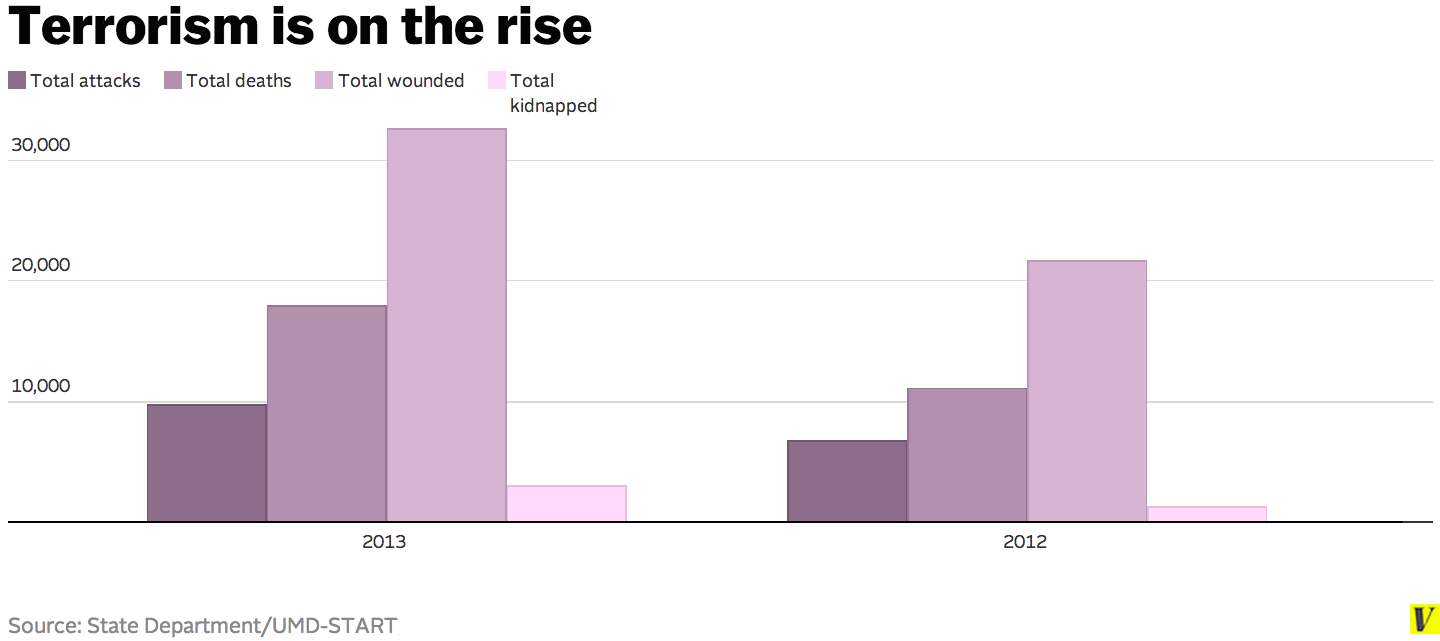
All told, the State Department found that worldwide terrorist attacks rose by 40 percent over the past year, from 6,771 in 2012 to 9,707 in 2013. Two-thirds of the strikes occurred in Iraq, Pakistan, Afghanistan, and India, resulting in the deaths of more than 11,000 people. A total of 17,891 people died in terrorist attacks in 2013, up from 11,098 in 2012.

The report attributed much of the violence to sectarian strife in Syria, Lebanon, and Pakistan, which have been riven by brutal fighting between the countries’ religious and ethnic populations. Iraq has been hit particularly hard, with Sunni militants slaughtering thousands of Shiite civilians, but Syria’s brutal civil war has begun to morph from a rebellion against Syrian strongman Bashar al-Assad to ongoing communal violence between the country’s Alawite and Sunni populations. Islamist militants in Syria, the report says, are increasingly “motivated by a sectarian view of the conflict and a desire to protect the Sunni Muslim community from the Alawite-dominant [Assad] regime.”

Providing the above chart, Zack Beauchamp digs deeper into what the report has to say about Iraq and Syria:

“The [country] that accounts for nearly half of the increase in the two years is Iraq,” Gary LaFree, the University of Maryland researcher whose institute compiled the raw data for the State Department, told me. Moreover, since attacks in Iraq were more frequent and deadlier than in the other 9 nations with the most terrorist attacks, it’s responsible for much larger percentages of the increases in deaths and injuries.

LaFree told me his numbers undercounted attacks in Syria, as it’s hard to verify responsibility for any one attack in the midst of a civil war. But the State Department sees a classic al-Qaeda pattern. “Thousands of foreign fighters traveled to Syria to join the fight against the Assad regime,” the 2013 report warns. According to State’s counterterorrism coordinator, Tina Kaidenow, “we’re concerned over the long term that [Syria] will attract individuals who will be radicalized.”
How Reliable Are Online Reviews?

Josephine Wolff investigates:

While the cacophony of voices may be overwhelming, the percentage of customers who write reviews is actually quite low. In a 2014 study that analyzed data from a private apparel retailer’s website, [MIT professor Duncan] Simester found that only about 1.5 percent of customers, or 15 out of 1,000, write reviews. “And these customers aren’t representative, they tend to buy more niche items,” he says. Simester also discovered that about 1 in every 15 reviews of an item—about 5 percent—are written by people who haven’t purchased it. “And the problem is the other 985 customers rely on the reviews written by these 15 people.”

Some reviews, in fact, may be entirely false. Others may be planted by businesses to burnish their own reputations or tarnish those of competitors. … Bing Liu, a professor of computer science at the University of Illinois, who has studied review sites, estimates that roughly 30 percent of all reviews online may be fraudulent.

When Mental Illness Is A Gift, Ctd

Elyn Saks, author of The Center Cannot Hold: My Journey Through Madness, shares her thoughts on the connection between creativity and a mental illness like her schizophrenia:

The book she mentions is Touched with Fire: Manic-Depressive Illness and the Artistic Temperament. Yesterday’s introductory videos from Saks are here. Readers continue the thread:

I’ve struggled with severe panic and anxiety issues for years. I take an SSRI every day and have for probably a dozen years. If I go off of it four or five days, I’m in real trouble. It is not a pleasant feeling.

However, if I am off for a few days, that second and third day give me a huge burst of creativity. In college when I had a big paper due, I would start the outline on day one, put together some paragraphs on day two, and then on day three I would bang out 20 pages effortlessly. This is something I stopped doing years ago. It wasn’t healthy mentally or physically. But there is something to it.

Another who struggles with mental illness:

A quick comment about mental illness being some sort of gift from someone who has been wrestling with PTSD, a mild form of bi-polar disorder and a dissociative disorder for decades. Like so many things that are out there that can give you a temporary ability to exceed your relatively normal operating envelope, there are negative tradeoffs – many of which lead to agonizing self-destruction behaviors. This is very well known, but I think bears repeating. Glamorizing and romanticizing the occasional exceptionally high-functioning moment while ignoring the agony and constant struggle each day usually is just continues to marginalize those of us who suffer from profound and usually very difficult to diagnose disorders.

China’s Demographic Timebomb

An aging population, rapid urbanization, and a skewed sex ratio could spell trouble down the line for the world’s largest country:

China is different from the other aging countries of the world in that a) it is not yet fully developed, b) most of its population is still poor, and c) it has the highest sex ratio in the world.

By 2055, China’s elderly population will exceed the elderly population of all of North America, Europe and Japan combined, and this is exacerbated by the now declining working-age population. China’s impressive economic growth has been facilitated by its expanding working-age population: The population ages 15-64 increased by 55 percent between 1980 and 2005, but this age cohort is now in decline due to the declining fertility rate. In 2012, the working age population declined by 3.5 million and is expected to continue to decline unless there is a dramatic shift in China’s fertility rate.

Aging will have a negative effect on economic growth through higher pension and healthcare costs, fewer low-income jobs, increased wage depression, slowing economic growth and job creation, declining interest from foreign investors, lower entrepreneurship, and higher budget deficits. Labor force declines also translate into lower tax revenues for governments, and if these governments are tempted by deficit financing, global financial stability may be compromised, according to the Center for Strategic and International Studies (CSIS) Commission on Global Aging.

Only A Fraction Of College Men Are Rapists

Marcotte stresses that the high rates of sexual assault on college campuses don’t mean there are as many assailants as you might assume:

Let’s be clear: No one is saying that the high rates of victimization among college women mean that all men are rapists. That 1 in 5 college women have been assaulted doesn’t mean that 1 in 5 men are assailants. Far from it.

A study published in 2002 by David Lisak and Paul Miller, for which they interviewed college men about their sexual histories, found that only about 6 percent of the men surveyed had attempted or successfully raped someone. While some of them only tried once, most of the rapists were repeat offenders, with each committing an average of 5.8 rapes apiece. The 6 percent of men who were rapists were generally violent men, as well. “The 120 rapists were responsible for 1,225 separate acts of interpersonal violence, including rape, battery, and child physical and sexual abuse,” the researchers write. A single rapist can leave a wake of victims, racking up the numbers rapidly, as the victim surveys are clearly showing.

Update from a reader:

Can I possibly be the only one just flabbergasted by the line in this post that “only about 6 percent of the men surveyed had attempted or successfully raped someone”? The idea that 6 guys out of a group of 100 being rapists is a small number shocks the hell out of me. I am a straight white male with a college fraternity background I am not particularly proud of, but even with that life experience, had you asked me to guess the percentage of guys who had actually raped or attempted to rape a woman, I would have suggested some tiny fraction less than 1%. I mean, who the hell RAPES someone? I accept the positive aspect of the larger point – that the number of rapists is smaller than the number of victims – but that seems obvious to me, and way less shocking (and frankly depressing) than the “good” news that “only” 6/100 guys is a rapist.

Recent Dish on campus rape here and here.

Testosterone Ad Absurdum

It still amuses me to read blank-slate lefties insisting that gender difference is a function of culture alone. To me, it’s the same kind of scientific know-nothingism that you find on the right with respect to evolution. Note I’m not saying that culture has nothing to do with it – that would be know-nothingness of a reverse kind. But the power of testosterone as a hormone should never be under-estimated.

And the funny thing is: testosterone exists across the entire animal kingdom and correlates very highly with what we think of as culturally masculine attributes: physical strength, risk-taking, competitiveness, ego and the constant desire to fuck. So when I came across this fascinating article on the marsupial, antechinus, I had to chuckle. During the mating season, the males’ testosterone levels go through the roof. The result is sexual mayhem:

Males relentlessly bound from partner to partner, as massive hormone releases in their bodies cause their immune systems to crash and their fur to fall out. They bleed internally. Some males even go blind, yet still stumble around the leaf litter hoping for one last tryst. In a few short weeks, every single male lies dead, leaving the females to raise their offspring …

While [testosterone] mobilizes all the sugars in the antechinus’ body so it doesn’t need to feed for the three-week orgy, it also glitches the mechanism responsible for regulating the production of cortisol, a stress hormone that in small amounts results in bursts of energy and higher pain tolerances. With runaway levels of cortisol, though, the males’ bodies literally begin to fall apart. Bone density plummets and blood-sugar levels go nuts. Their immune systems essentially degrade to worthlessness, as open sores form and never heal.

That’s a dystopian vision of untrammeled maleness if ever there was one. It reveals what we cannot deny about our nature almost as baldly as it wants us to keep it under control.

Escalation In Ukraine

The Ukrainian military has launched its first offensive against pro-Russian separatists, conducting operations around the eastern city of Slavyansk:

The Ukrainian Defence Ministry said two Mi-24 attack helicopters had been shot down by shoulder-launched anti-aircraft missiles while on patrol overnight around Slaviansk. Two airmen were killed and others wounded. Other Ukrainian officials and the separatist leader in Slaviansk said earlier that one airman was taken prisoner. A third helicopter, an Mi-8 transport aircraft, was also hit and a serviceman wounded, the Defence Ministry said. The SBU security service said this helicopter was carrying medics. …

The SBU said the deadly use by the separatists of shoulder-launched anti-aircraft missiles was evidence that “trained, highly qualified foreign military specialists” were operating in the area “and not local civilians, as the Russian government says, armed only with guns taken from hunting stores”. Ukrainian officials said their troops overran rebel checkpoints and Slaviansk was now “tightly encircled”.

Kevin Rothrock thinks through what might happen next:

Irregular militia marching on Slaviansk and other southeastern cities in Ukraine could present Kiev with a tricky legal situation. Though Moscow exercises de facto control over Crimea, the national government refuses to recognize Russia’s annexation, complicating Kiev’s classification of any combatants marching into the Ukrainian mainland from Crimea, which formally remains a part of Ukraine. Would these soldiers be Russian troops? Or are they more Ukrainian “terrorists,” as Kiev now identifies combatants throughout the southeast?

In other words, the Kremlin might project its power into Ukraine’s mainland by encouraging, and perhaps arming, Crimean militia, who in turn would advance on Slaviansk. In theory, Moscow might succeed, if only semantically, in “laundering” an armed intervention in this way.

Meanwhile, as the following video, photos, and tweets illustrate, clashes have erupted in the city of Odessa, with at least seven 38 people reported dead and many more injured:

https://twitter.com/MaximEristavi/status/462243274808627201

https://twitter.com/PaulSonne/status/462282086729383937

The Ground Game Only Goes So Far

Voter Turnout

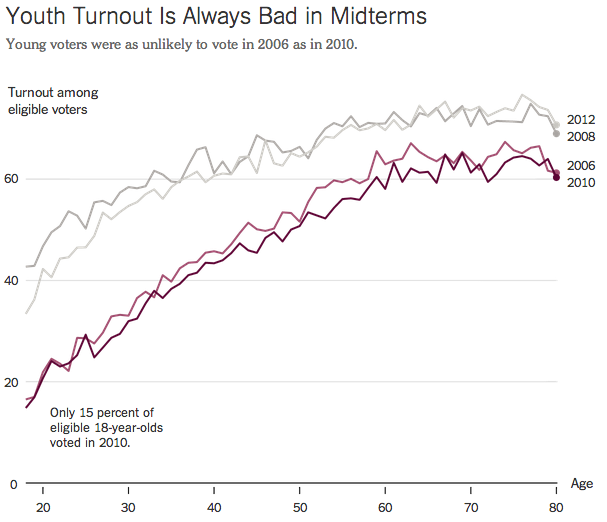
Nate Cohn drives that point home:

Much of the optimism on Democratic turnout stems from Mr. Obama’s successful turnout operation in 2012, or from experiments showing large increases in turnout when voters receive targeted mailers or contacts. But political scientists and campaign operatives found that even Mr. Obama’s impressive ground operation was worth less than one point in his presidential elections. And those experiments are usually conducted in extremely low turnout elections, like a local mayoral race, in which there are many more marginal voters. Finding people who are potential voters but not existing voters in a national election is harder.

Even Democratic operatives know the limits of the ground game. In a New Republic cover article that otherwise suggested that a strong turnout operation could solve Democratic problems, Guy Cecil, executive director of the Democratic Senatorial Campaign Committee, conceded that field operations would “only solve our problem if the election is a close one.”

Charlie Cook expects Democrats to have a rough election:

[A]n array of new polling from a variety of sources suggests that Democrats have no reason to be encouraged at this point. Things still look pretty awful for the party. Especially meaningful to consider is that—no matter how bad the national poll numbers appear for Democrats—eight of their nine most vulnerable Senate seats this year are in states that Mitt Romney carried in 2012. Further, nine of the most competitive 11 Senate seats in both parties are in Romney states; the numbers in these states will likely be considerably worse than the national numbers.

Liberals vs Affordable Housing

Noting that the slumlord Donald Sterling “has profited enormously from the tendency of liberal cities in California to limit housing permits,” Reihan asks why the left sees a higher minimum wage as more important than expanding the housing supply:

Even if you believe that a higher wage floor will have absolutely no impact on employment levels or on net job growth, it seems sensible to first focus on limits on housing supply. If you believe that a higher wage floor might lead to the exclusion of some non-trivial number of less-skilled workers from the formal labor market, the case for focusing on limits on housing supply is even stronger, as it’s not at all clear that relaxing these limits will hurt anyone at all … Some homeowners might have to sacrifice spectacular views as they are surrounded by new housing developments. Yet this hardly seems like a compelling reason to force low-income households to pay much higher rents to be within easy commuting distance of employment opportunities. It turns out that for affluent liberal voters living in picturesque cities, it is cheap to back minimum wage hikes that might reduce employment levels for the less-skilled or raise prices for the kind of people who frequent quick-service restaurants and other establishments that employ low-wage workers while it is very dear to back policies that will increase housing supply.

Douthat sees this issue as a rare opportunity for some left-right convergence:

Reasonable people can disagree, but on the merits, if you care about working class opportunity and mobility, there is at least some public policy justification for policies (like a minimum wage set at $7.25 rather than $10.10) that try to maximize low-wage hiring even if it means some of those workers will rely on safety-net programs. Where the policies that protect and enrich the petits rentiers class are concerned, however – and seriously enrich literal rent-collectors like Donald Sterling – no such opportunity-enhancing justification exists. So when the urban left organizes around an agenda that targets low-wage employers and leaves the petits rentiers alone, it’s both embracing policies whose costs might exceed their benefits and leaving more deserving targets untouched.

This is why the anti-cronyist, anti-rentier, libertarian-populist idea that many conservatives have raised of late, both in response to all the Piketty excitement and as a reformist case in its own right, deserves more than just a dismissive sneer from egalitarian liberals.