Musical sellouts get their anthem:
Month: May 2014
The Occasional Upper-Class
In a summary (NYT) of the findings from his new book, Chasing the American Dream, Mark Robert Rank explains that “the 1 percent” doesn’t include the same people from one year to the next:
It turns out that 12 percent of the population will find themselves in the top 1 percent of the income distribution for at least one year. What’s more, 39 percent of Americans will spend a year in the top 5 percent of the income distribution, 56 percent will find themselves in the top 10 percent, and a whopping 73 percent will spend a year in the top 20 percent of the income distribution.
Yet while many Americans will experience some level of affluence during their lives, a much smaller percentage of them will do so for an extended period of time. Although 12 percent of the population will experience a year in which they find themselves in the top 1 percent of the income distribution, a mere 0.6 percent will do so in 10 consecutive years.
It is clear that the image of a static 1 and 99 percent is largely incorrect.
After a few celebratory digs at the left, Kevin Williamson uses these findings to urge conservatives to re-focus on poverty:
Professor Rank’s work and the reality of what an optimist might call lifetime income dynamism and a pessimist might call lifetime income instability should have conservatives rethinking their approach to the issue. It is not enough to explain that income inequality does not mean what Paul Krugman wants his readers to think it means, or to keep hammering away at the necessary but not sufficient project of reorienting our welfare programs toward work and the Sisyphean labor of trying to make those programs at least operationally efficient. A deeper appreciation for the lumpy and unpredictable nature of personal income over the course of a working life might help conservatives to deal with the issue of risk aversion, which is a critical factor behind our generally poor record of connecting with women and non-white voters, who lack the economic confidence of traditional conservative constituencies, and not without some reason. Selling an ownership society to people who are terrified of and baffled by the stock market is not a model for success.
But, as Danielle Kurtzleben points out, Rank’s book also addresses the barriers to achieving success in America, of which there are several:
Being smart, white, and coming from a wealthy family may not guarantee a person will achieve the American Dream, but all of those things can help by putting a person at the center of the funnels, the authors write. Falling right through all of those funnels — good primary schooling, getting a higher education, and finding a good job — makes it all the easier to get to the end goal.
Being lower-skilled or growing up poorer, meanwhile, starts a person out at a disadvantage. It means more distance to travel to get to the center of the funnel, meaning more obstacles to be overcome. So having to work harder to even graduate can keep a person out of the middle. And Americans who grow up poor, for example, have a tough time of climbing the ladder — much harder than their peers in other countries. Likewise, SAT scores tend to be higher for kids from higher-income families.
Ask Elyn Saks Anything: Living With Schizophrenia
In our first video from the author of The Center Cannot Hold: My Journey Through Madness, Saks explains what it’s like to have a major mental illness:
Her symptoms began as a teenager:
More about Saks:
Elyn Saks is an expert in mental health law and a winner of the MacArthur Foundation Fellowship, which she used to create the Saks Institute for Mental Health Law, Policy, and Ethics. She is also Associate Dean and Orrin B. Evans Professor of Law, Psychology, and Psychiatry and the Behavioral Sciences at the University of Southern California Gould Law School. Saks lives with schizophrenia and has chronicled her experience with the illness in her award-winning, best-selling autobiography, The Center Cannot Hold: My Journey Through Madness.
(Archive)
Should Doctors Play Executioner?
After the botched execution in Oklahoma, Room For Debate wrestles with question. Neil J. Farber examines opinion within the medical community:
In the survey in 2000, 1,000 physicians in the United States were asked whether they condoned colleagues’ involvement in capital punishment. Of the 482 physicians who returned questionnaires, 80 percent said they believed at least one of the proscribed actions by the American Medical Association and the American College of Physicans (starting IV lines, monitoring vital signs, selecting injection sites, administering the lethal drugs, determining death, maintaining lethal injection devices, supervising personnel who give the lethal injections, and ordering the lethal drugs) was actually permitted, and 53 percent said 5 or more of the actions were acceptable. Those who approved of the death penalty were more likely to approve doctors’ involvement with several actions.
Sidney Wolfe makes the standard case against doctors administering lethal injection drugs:
[G]roups like the American Medical Association oppose participation and anesthesiologists can lose board certification for taking part in executions. Involvement perverts the duties and responsibilities that physicians have to heal, not to hurt. Administering a lethal dose of drugs is the most serious violation of ethics, but merely being present to pronounce a patient dead still makes that physician complicit in someone’s killing, as a necessary part of the death squad.
Ken Baum and Julie Cantor share a different perspective:
Physician involvement in lethal injection can make capital punishment less grotesque, more palatable, and even routine. But so long as the state uses the tools of the physician to kill its citizens, those who wish to step in to ensure that executions are, at the very least, competently handled should have the option to do so. Anything else is death penalty politics at the expense of the condemned. And no matter where you come out on capital punishment, no one should be sentenced to a botched execution.
Faces Of The Day
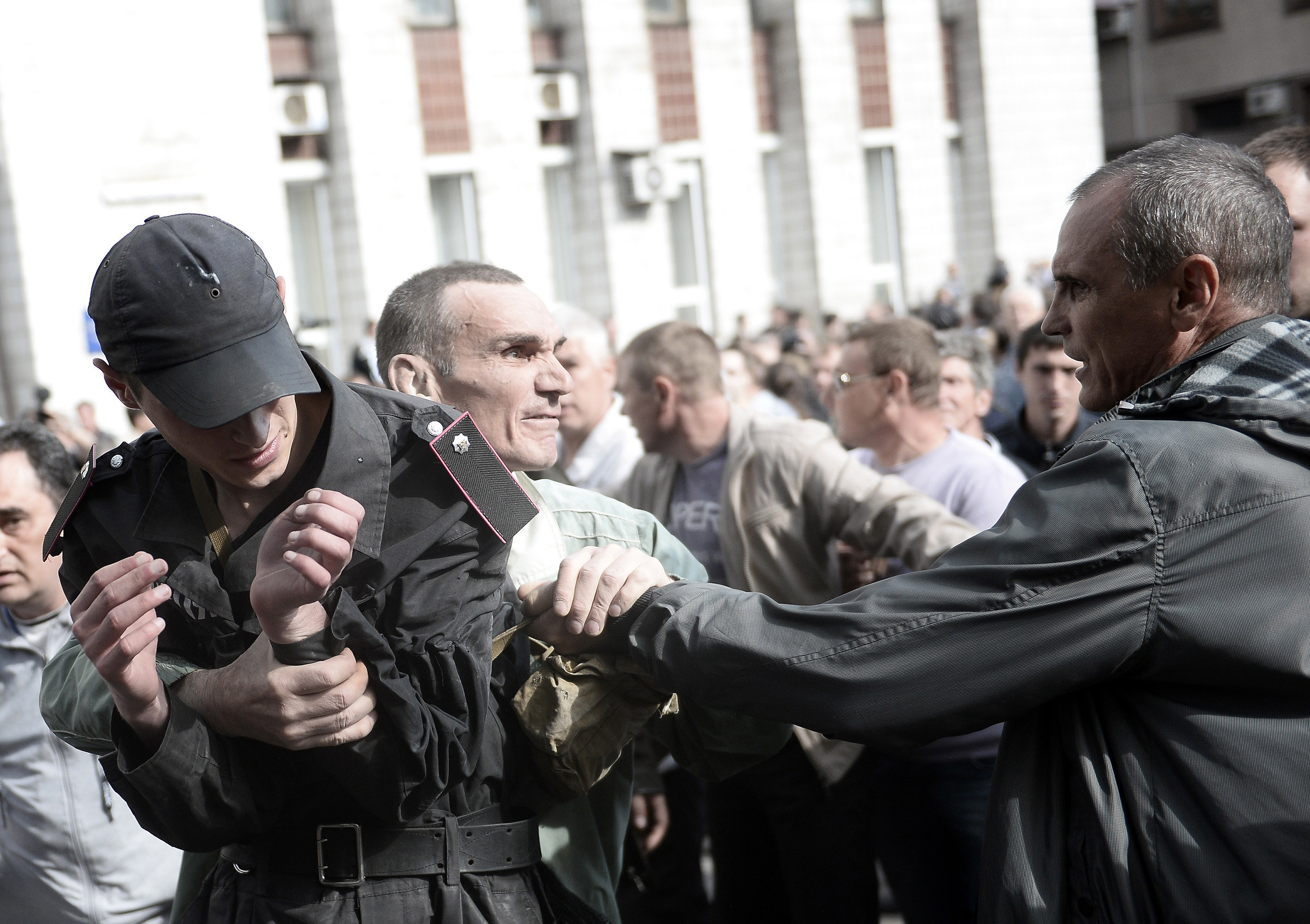
Pro-Russian separatists seize the Prosecution Office in Donetsk, Ukraine, on May 1, 2014. By Burak Akbulut/Anadolu Agency/Getty Images.
And Sometimes I Just Get Things Wrong
I guess it’s a function of not following the Benghazi story as diligently as some others. But that’s no excuse. Weigel and Dickerson are must-read correctives to my take on the Ben Rhodes email, and show how this new email – though indeed foolishly withheld (the real story) – isn’t anywhere near as damning as it may sound at first blush. For two reasons: the information Rhodes was working off – via the CIA and State – was indeed that the attack was related to the inflammatory video. Dickerson:
Rhodes sent his email at 8 p.m. on Friday, Sept. 14. Nine hours earlier, the CIA had sent its first set of talking points. The very first line of the first CIA talking point read: “The currently available information suggests that the demonstrations in Benghazi were spontaneously inspired by the protests at the US Embassy in Cairo and evolved into a direct assault against the US Consulate and subsequently its annex.” (The original copies are here, released by the White House last May.) What was causing the protests in Cairo that the CIA mentions? The video.
Weigel offers this timeline, via Zeke Miller:
2:23 p.m.: The CIA’s office of general counsel adds a line about the “inspired by the protests” theory being inconclusive.
3:04 p.m.: The talking points are sent to relevant White House aides, including Ben Rhodes.
4:42 p.m.: The CIA circulates new talking points but removes a mention of al Qaida.
6:21 p.m.: The White House (Tommy Vietor, not Ben Rhodes) adds a line about the administration warning, on September 10, of social media reports calling for demonstrations.
7:39 p.m.: State Department spokeswoman Victoria Nuland objects to some of the language because “the penultimate point could be abused by members to beat the State Department for not paying attention to Agency warnings.”
8:09 p.m.: Ben Rhodes sends the “smoking gun” email, nine hours after the first draft of talking points from the CIA said that the attacks grew out of a demonstration.
Weigel’s conclusion:
The White House’s shifty-sounding excuse, that the “demonstration” story line came not from its spin factory but from the CIA, remains surprisingly accurate.
It was spin, not deception. There’s a big difference. And for full disclosure: I’m friends with Ben and should have known he is not the type to lie about anything. But sometimes, a relationship like that makes me be extra skeptical about stories involving friends or acquaintances. I learned that in the Bush administration. But in this case, I was over-correcting and under-informed. Apologies.
Iraq Votes. But Will It Matter?
Joel Wing outlines the likely results of yesterday’s general election in Iraq:
Most Iraq watchers now seem to believe that the prime minister [Nouri al-Maliki] will get the most seats in parliament, and then go through a very long process of negotiations that could drag out for up to a year, and ensure himself another four years in office. The premier is hoping that his Shiite base will come out for him out of fear of the growing insurgency, and give him a plurality of votes. He will then be able to play upon the splits within the Sunni parties to ally with Deputy Premier Salah al-Mutlaq. If that gives him momentum the history of Iraqi politics is for the other parties to jump on board to assure themselves positions within the new government.
An alternative scenario could play out however. Last year ISCI was able to cut into Maliki’s base, and are hoping to repeat that again. It has portrayed itself as a nationalist party that has the support of the religious establishment in Najaf. The Sadrists’ Ahrar bloc believes that it can maintain its alliance with the Supreme Council that it forged in the 2013 elections. If they get anything near the number of seats of Maliki it will be a free for all for to create the majority necessary for a new government.
Bob Dreyfuss recounts how Maliki has cemented himself in power since the last election:
Back in 2010, when an opposition party led by Ayad Allawi—a wily, nonsectarian, secular Shiite politician with a largely Sunni base—won the biggest share of the vote, both the United States and Iran weighed in to prop up Maliki and ensure that he was able to form a government that eventually excluded Allawi. A year later, in 2011, the remaining American troops departed, and within days Maliki went to war against Sunni politicians, the Sunni establishment and others who opposed his authoritarian style.
Maliki used spurious charges of terrorism against top politicos, including the Sunni vice president of Iraq, who was forced to flee for his life. Following that, Maliki cracked down viciously on peaceful, Arab Spring–style protests in Anbar, killing hundreds and detaining thousands. …
So, it’s no wonder that the Iraqi insurgency that erupted after 2003 is back. This time, it’s enhanced by the chaos in Syria, where a largely Sunni army of Islamist fanatics and rag-tag rebels tied to Al Qaeda and ISIS are battling the government of President Bashar al-Assad. Cities such as Ramadi and Fallujah have turned into strongholds of the insurgency, and the anti-Maliki radicals have deployed waves of suicide bombers and car bomb experts to slaughter thousands of Shiite civilians in markets, public squares and other soft targets. They’ve also carried out a lethal pattern of assassinations of moderate and establishment Sunnis outside Baghdad.
Jay Ulfelder doubts the polls will stem the rising tide of violence:
Iraq is already suffering mass atrocities of its own at the hands of insurgent groups who routinely kill large numbers of civilians in indiscriminate attacks, every one of which would stun American or European publics if it happened there. According to the widely respected Iraq Body Count project, the pace of civilian killings in Iraq accelerated sharply in July 2013 after a several-year lull of sorts in which “only” a few hundred civilians were dying from violence each month. Since the middle of last year, the civilian toll has averaged more than 1,000 fatalities per month. That’s well off the pace of 2006-2007, the peak period of civilian casualties under Coalition occupation, but it’s still an astonishing level of violence. …
In theory, elections are supposed to be a brake on this process, giving rival factions opportunities to compete for power and influence state policy in nonviolent ways. In practice, this often isn’t the case. Instead, Iraq appears to be following the more conventional path in which election winners focus on consolidating their own power instead of governing well, and excluded factions seek other means to advance their interests.
Zalmay Khalilzad, who also expects Maliki to remain in power, addresses how the US should respond:
A new leader, untainted by a record of distrust and broken deals, could offer Iraq a promising way forward. A U.S. push to oust Maliki, however, would be risky. Relations between Washington and Kabul deteriorated sharply after Afghan president Hamid Karzai won re-election over the Obama Administration’s opposition. The experience with Maliki, moreover, shows that U.S. support for the winning candidate does not necessarily translate into reliable governance. …
Instead of relying on preferred Iraqi leaders, the Obama Administration should clearly articulate the program of reform it wants implemented during the process of government formation. Iraq’s constitution, which emphasizes federalism and decentralization of power, provides a roadmap for reform. Continued effort at monopolization of power by a majoritarian central government could incite a Kurdish push for sovereignty, as well as increased violence among Iraq’s Sunni population. Some Sunni leaders, after opposing federalism in the years after Saddam’s overthrow, now seek recognition of its provinces as federal regions.
Book Club: Was There An Empty Tomb?
A reader challenges a part of Ehrman’s book we haven’t discussed yet:
Reading your thoughts and the reader responses so far, I’m surprised no one has mentioned Ehrman’s claim, in Chapter Four, that Jesus most likely wasn’t given a proper burial, meaning there was no tomb for his resurrection to leave empty – nor an actual body left to be resurrected, as theological orthodoxy would seem to demand. An excerpt from this chapter was recently featured on The Daily Beast, in which Ehrman makes this explicit: “Without an empty tomb, there would be no ground for saying that Jesus was physically raised.” And clearly, as Ehrman shows in his book, the “empty tomb” features prominently in Christian apologetics on this issue. The idea that Jesus really was buried allows Christians to ask, “Well, then what did happen to Jesus’ body?” If he wasn’t eaten by dogs, then we need to somehow account for his body, which people certainly would have been looking for after his followers started saying he was raised from the dead. Or so the argument goes.
As it happens, the chapter on this issue by Craig Evans in the evangelical response to Ehrman’s book was the one I actually found perhaps most persuasive, and your readers should be aware of it. Evans cites a variety of ancient texts – including passages from Philo, Josephus, and Roman legal documents – that give us good reasons to think Roman authorities were tolerant of Jewish religious customs. It would take too long to go through all of Evans’ evidence, but their cumulative force is striking, and he makes clear that his argument especially concerns what the Romans allowed in Jerusalem, the center of Jewish religious life, where religious demands for performing certain rites, like the burial of the dead, would have been especially forceful (Jews in other places, such as Alexandria, seemed to fare worse).
Even Ehrman’s own book unwittingly offers evidence for this. Recall the account he gives of Pontius Pilate erecting images of the Roman emperor in Jerusalem, which violated Jewish beliefs about “graven images.” What happened after the Jewish uproar over this? They were removed.
Evans also makes clear that tolerance for Jewish burial customs extended, in various circumstances, to those who were crucified. Most interestingly, in my view, is the archaeological evidence he marshals on this point.

He walks the reader through examples we have of tombs and (more frequently) ossuaries containing the remnants of those crucified or nails of the kind used in crucifixions covered in calcium, meaning they were once in human bones. In short, not everyone who was crucified, and certainly not all Jews, were simply left for the wild dogs or carrion birds to eat. Evans cites Jodi Magness, a Jewish archaeologist at Ehrman’s own UNC-Chapel Hill, who summarizes the matter this way:
Gospel account of Jesus’ burial are largely consistent with the archaeological evidence. Although archaeology does not prove there was a follower of Jesus named Joseph of Arimathea or that Pontius Pilate granted his request for Jesus’ body, the Gospel accounts describing Jesus’ removal from the cross and burial are consistent with archaeological evidence and with Jewish law.
And speaking of Joseph of Arimathea, Evans argues that even that story has some real credence. Because the Sanhedrin, or Jewish Council, delivered Jesus to the Roman authorities, they would have been responsible for arranging a proper burial. So whether or not Joseph actually existed, the broad outline of the story he figures in is, according to Evans, reasonably consonant with the customs of the day.
Lastly, Ehrman makes a big deal of the fact that in the early creed Paul cites in his first letter to the
Corinthians, it merely says “And he was buried” rather than “And he was buried in a tomb.” When I read Ehrman’s book, I couldn’t understand quite why that mattered. Being buried implies a tomb, or a grave of some kind, but regardless being buried is not the same as being left to the dogs. Evans makes exactly the same point. And as for the supposed lack of symmetry in the creed – the line corresponding to the one just mentioned says “And he appeared to Cephas,” which leads Ehrman to think Joseph should be noted as the one who buried Jesus – Evans makes the reasonable point that naming who Jesus appeared to after his resurrection would be a far more important detail to include than the name of who buried Jesus, so the comparison doesn’t quite hold. Of course, maybe Joseph wasn’t named because that particular tradition arose later, but even if it did, the lack of knowing exactly who buried Jesus does nothing to alter the other contextual evidence that leads Evans to argue that it wouldn’t have been unusual for Jesus, a Jew in Jerusalem, to be given a proper burial.
Overall, then, this is one point where my layman reading of both sides of the argument makes me lean toward Ehrman’s evangelical critics.

Agreed. Another critical point worth reiterating in this context: perhaps the most striking thing in the book is that Ehrman explicitly states he has changed his mind as to when the belief in Jesus’ divinity arose. He used to think it came about decades later, but is now convinced by the evidence that the resurrection was a very early Christian belief. So the empty tomb is a real possibility and the resurrection was claimed by the earliest Christians. Sometimes religious beliefs are weakened by historical evidence; but sometimes they are actually strengthened.
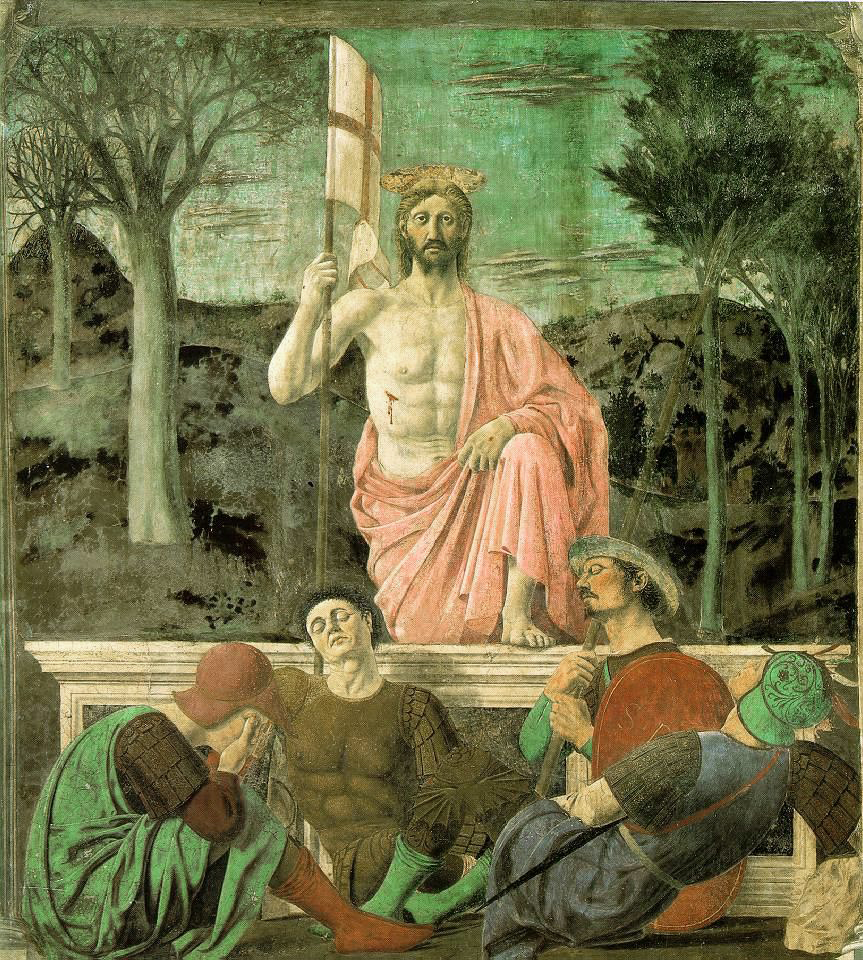
(Read the whole Book Club thread on How Jesus Became God here. Email any responses to bookclub@andrewsullivan.com rather than the main account, and please try to keep them under 500 words. Painting: The Resurrection Of Jesus by Piero Della Francesca.)
Yes, Mormons Can Be Funny
A parody of an LDS childrens’ book meets the Mormon prohibition on facial hair. It’s from the BunYion, at BYU:
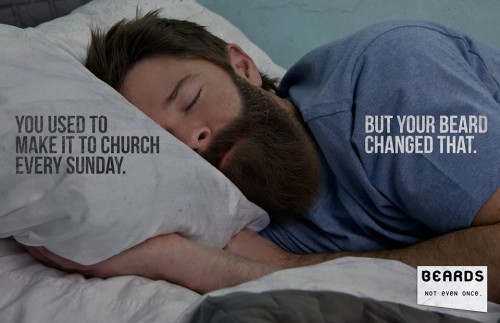
The comments are a trip:
It saddens me that the men of the church are addicted to beards. I recently heard that Utah leads the nation in subscriptions to “Beard Aficionado” magazine. Some may justify their addiction by saying beards are “natural” that “no one is getting hurt” or that I only grow “soft” beards and not “hard” beards. However, once you grow a beard you don’t know what future happiness will be forfeited. Remember the story that was told in General Conference about the young woman who refused to marry a young man because, in the past, the young man had a beard? Sin has consequences!
Another:
For all of those facial hair lovers, please know that there is still hope. For sometime I struggled with “beard or no beard” I would play on the edge with mustaches, goatees, and I even attempted a handlebar at one point. Just to see what it was like….
After sometime I noticed something missing in my life. I was with some friends and I noticed they all seemed to be happy and I couldn’t tell why. Then I realized it, they all were clean shaven! I went home that very night and threw away all my beard trimming equipment, found an old razor, and shaved off those vile hairs. Oh the silky smooth feeling of redemption. If you feel manly, awesome, and/ or like you could survive a zombie apocalypse with only a crowbar you don’t have to stay that way. Shave off your beard and go from looking like a man to a boy in a matter of minutes. Shave brethren, shaving is the answer.
How Many Obamacare Enrollees Have Paid Up?
A committee report by House Republicans claims it’s relatively few:
Only two-thirds of people signing up on Obamacare’s exchanges paid their premiums as of April 15, the US House Energy and Commerce Committee reported Wednesday. If true, that means one-third of people on the exchanges had not completed the final step to actually obtaining health insurance in time for the committee’s report.
Cohn calls bullshit:
With House Republican committee reports, you always have to read the details. And in this case the details say quite a lot.
The committee staff got their information directly from insurers, but it’s only valid up through April 15. As experts and industry officials quickly pointed out, that’s too early to get an accurate sense of the payup rate.
Remember, open enrollment officially ended on March 31. And, thanks to the Administration’s extensions, people were still signing up well into April. At the time the Committee requested the information, many of these people would have just received their first invoices for payment. Payment wouldn’t have been due until the end of the month—in other words, Wednesday. It’s safe to assume that lots of people waited until the last minute to send their checks, which means it’s safe to assume the real payup rate is higher than 67 percent.
Benen scoffs at “the latest evolution in the GOP’s anti-healthcare line”:
What started with “no one will want to sign up” eventually became “no one should sign up,” which morphed into “not enough people are signing up,” and finally “those who did sign up don’t count.”
But Suderman points the finger at the administration:
Republicans on the Committee are aware that the information they have so far is incomplete, and they are going to follow up with insurers toward the end of May. So we’ll get more information—eventually. But it’s going to take time. The administration could have headed off a lot of this sort of discussion by being more transparent from the start, releasing updates about payment rates, along with sign ups and demographics, and context about deadlines as well. Instead, they stonewalled and deflected. Which is how we ended with a Republican Committee trying to get this information themselves, and a report that at most suggests an eventual possibility of significant non-payment problems, but doesn’t demonstrate much of anything right now. For the time being, then, we’re left right back where we started, with no solid, comprehensive information to rely on about how many sign ups have paid.
And Philip Klein thinks the report “puts HHS officials in a pickle”:
If they attack the Republican report as inaccurate, it will be an implicit acknowledgement that they have numbers that they aren’t releasing. So their choice is either to stay silent and let the GOP-obtained data fill the news vacuum, or release detailed enrollment data. It’s way past time for them to come clean.
 The Dish