Pfizer Wants To Expatriate

Jia Lynn Yang explains why the pharma giant is trying to acquire its British rival AstraZeneca:

It’s no secret that one of Pfizer’s motivations in its $100 billion bid for AstraZeneca is to save big on U.S. taxes. By purchasing a foreign company with company cash being held overseas, the pharmaceutical giant avoids getting hit by the U.S. federal corporate tax rate of 35 percent.

As part of the deal, Pfizer is also seeking to incorporate in Britain, a break from the company’s American roots — and the American corporate tax rate. But Pfizer isn’t picking just any country as a potential new home for incorporation. The British government has been tweaking its tax code in recent years to make it easier for businesses to lower their tax bills — especially for multinationals with byzantine accounting structures. And in the pantheon of companies that do this, few are more adept than tech and pharmaceutical companies. Companies exactly like Pfizer.

Peter Waldman describes how Pfizer could finagle the acquisition, which AstraZeneca has so far rebuffed, to avoid US taxes entirely:

[H. David] Rosenbloom [director of the international tax program at New York University School of Law] expects Pfizer to use a foreign subsidiary to borrow against the untaxed earnings overseas, and to use the borrowings to purchase AstraZeneca. That way the money may never technically land on U.S. shores and may never be subject to U.S. tax, and Pfizer could take a tax deduction on the interest expense, Rosenbloom says.

Barro suggests a way to counter the UK’s efforts to lure tax-averse corporations:

It’s counterintuitive, but Congress could avoid this problem by abolishing the tax on corporations’ profits and much more aggressively taxing their American shareholders – who are unlikely to flee to London along with Pfizer’s incorporation documents.

A Dropping Number Of Dropouts

And an unprecedented number of diplomas:

Screen Shot 2014-04-30 at 3.03.29 PM

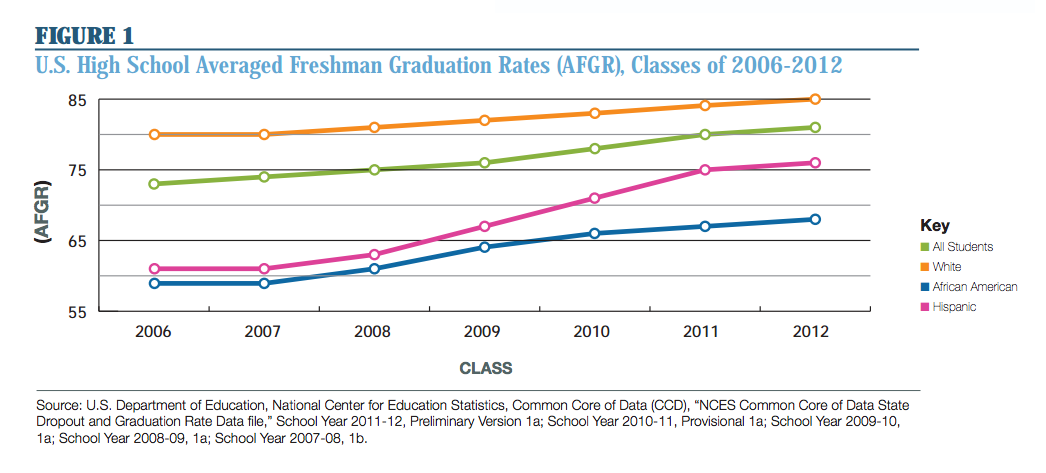
Stephanie Simon reports that the high-school graduation rate in the US has topped 80 percent for the first time in history, and that “if states can keep up their rapid pace of improvement, the rate could hit 90 percent by 2020”:

The improvement has been driven by steep gains among African-American and Hispanic students and by progress in shutting down hundreds of troubled urban schools dubbed “dropout factories.” And it’s not confined to one region of the country. Rural states such as Iowa, Vermont and Nebraska are among the best at keeping kids in school until graduation – but other top performers include Texas, Tennessee and Missouri, all of which serve large numbers of low-income students in densely populated cities. The practical result: Over the past decade, 1.7 million more students received diplomas than would have been expected if graduation rates had remained flat.

However, as the above chart makes clear, not all the news is good:

[W]hile low-income and minority students have made a lot of progress, wide gaps in achievement persist. Graduation rates increased 15 percentage points for Hispanic students and 9 points for African-American students from 2006 to 2012. But only 76 percent of Hispanic students and 68 percent of African-American students graduated in 2012, compared with 81 percent of white students, the report said. …

[In addition,] disparities are still great between special education students in different states. Students with disabilities make up about 15 percent of students nationally and have a graduation rate 20 percentage points lower than the overall rate. In Montana, 81 percent of high school students with disabilities graduated, while in Nevada, only 24 percent did.

Chris Kardish has more on the variations at the state level:

Overall graduation rates in states range from 59 percent in Nevada to 93 percent in Vermont. A number of states are graduating even low-income students above the 80-percent mark, including Texas, Nebraska, Iowa, Tennessee and Indiana. For other states, the graduation rate even among students who aren’t living in poverty stands below 80 percent. Those include Georgia, Louisiana, New Mexico, Arizona, Nevada and Oregon. Tennessee in particular has been a leader in raising graduation rates. The state boosted graduation rate 17 percent from 2003 to 2010 and reached 87 percent in 2012.

(Graph from Building A Grad Nation: Progress and Challenge in Ending The High-School Dropout Epidemic)

The View From Your Obamacare: Job Freedom

The popular thread continues:

You wrote, “When you are a long-term HIV survivor, that kind of health security and independence is, well, priceless.” Take out “long-term HIV” and replace it with “person with diabetes” or “person with a seizure disorder” or “person with a heart condition” and all of us feel that same security and independence and relief that you describe. I’ve had well-controlled diabetes for almost 30 years, which includes President Obama Visits Boston To Talk About Health Caremy entire working life. And for my entire life, I’ve known that I had to get and keep a job that offered a group insurance plan (or be married to someone who had that) in order to take care of myself and be financially stable (i.e., in the middle-class).

So that’s what I’ve done; I worked when my ex-husband was in graduate school (his school coverage didn’t cover pre-existing conditions); I put off having children until he had a job with group insurance; I worked at in the most toxic law firm environment I can imagine for 6 1/2 years because I was divorced and had to provide my own coverage; I finally left when I was hired by the federal government (admittedly, a lot of benefits came with that move, not just good health coverage).

But in the last few months, another sense of freedom has crept up on me and I realize that NEVER AGAIN will I feel trapped by my job as I have for my entire working life.

If I decide to leave the law, I can. If I want to piece together several part-time jobs that that allow me to use my other skills and would provide me with the minimum income, I can do it. It’s all up to me. I have no more excuses. It almost feels like personal responsibility and freedom and adult behavior all wrapped up together. But that doesn’t make sense, because then the Republicans would be all for it, right? I am so thrilled that Obamacare exists and I use the name proudly whenever I can. Another meep-meep for the ages!

Another also quotes me:

[The ACA’s] assurance of a stable insurance market that does not screen out someone with a pre-existing condition made me far more comfortable starting my own business. It gave me a baseline of security that simply didn’t exist before. It helped make entrepreneurialism possible.

Amen. I live in Silicon Valley.

As dynamic as this place is, I can’t tell you how many former colleagues have stayed in jobs just for the benefits. I really don’t understand why employers don’t want to get out of the healthcare business. It’s not a core competency and it’s nothing but a headache. This American Life had a story about how medical benefits became a way to lure workers during the WWI’s government-mandated frozen wages.

I’m currently in a struggling startup with no benefits. I have them through a partner, so I’m one of the lucky ones. I wonder how much innovation is being locked up by employer-based healthcare.

Another has part-time job freedom:

I am a 27-year-old freelance photographer and writer who works in the skateboard industry. I’m also a semi-professional downhill skater. It’s pretty much my dream job, and I wouldn’t have been able to chase it down without Obamacare. The ability to stay on my parents’ insurance until I was 26 gave me the freedom to move across the country and participate in a risky physical activity without fear of financial ruin. Later, when I aged out of my parents’ insurance, the lower premiums made it possible to afford insurance, without which I could not skate. (Thankfully, my sponsors pay for it.)

If the ACA hadn’t passed, I would be working a boring, stable office job instead of traveling the world pursuing my creative passion. Obama disappointed me on civil liberties and accountability for torture, but the Affordable Care Act has made a real and important difference in my life.

And this reader has freedom from jobs altogether:

I got health insurance through Covered CA. I’m 64 and Obamacare allowed me to retire a year earlier. Before Obamacare I would have been uninsurable and have to keep working to get employer-based coverage. I worked as an RN for 38 years and was wearing out fast. It’s the best thing that could have happened.

(Photo by Yoon S. Byun/The Boston Globe via Getty Images)
Dirty Dreams And Reproductive Schemes

WLA_moma_Henri_Rousseau_The_Dream

Neurologist Patrick McNamara believes our nighttime reveries are “directly related to long-term sexual strategies”:

If dreaming somehow reflects our sexual wish-fulfillment, then dream recall, dream content and dream sharing should be relatively lower in those who are satisfied with their current attachment orientation (secure, dismissive, and avoidant) and relatively higher among those who want to change their status (the preoccupied/anxious group). To test this idea, my team at Boston University recruited hundreds of volunteers until we had enough in each attachment category. We asked them about their dreams, and coders who were blind to the purpose of the study painstakingly analyzed them.

When we collated the results, we were startled by what we found.

The anxious, preoccupied group was far more likely to recall dreams than the securely attached; they took less time to enter REM sleep and had many more dreams featuring aggression against competitors. But both the anxious and the securely attached recalled more dreams than avoidant participants. That is precisely the pattern one would predict if dream sleep were directly related to long-term sexual strategies. The anxious individual is passionately interested in getting into a relationship with a romantic target, and thus recalls more especially vivid and emotional dreams filled with content concerning intimacy. The avoidant individual, conversely, suppresses the subconscious call for sexual closeness as reflected in dreams.

(Henri Rousseau’s The Dream, 1910, via Wiki Commons)

Diagnosed With Homelessness

Bryan Walsh spotlights a study on the correlation between traumatic brain injuries (TBIs) and homelessness:

Jane Topolovec-Vranic, a researcher in trauma and neurosurgery at St. Michael’s Hospital in Toronto, surveyed 111 homeless men recruited from a city shelter to see whether they had suffered a TBI sometime in their past. She found that 45% of them had experienced a traumatic brain injury at some point in their life. (Sadly, most of her subjects’ TBIs resulted from assault.)

“You could see how it would happen,” she says. “You have a concussion, and you can’t concentrate or focus. Their thinking abilities and personalities change. They can’t manage at work, and they may lose their job, and eventually lose their families. And then it’s a negative spiral” — a spiral that, for the men in Topolovec-Vranic’s study, ends up in a homeless shelter.

Charlotte Lytton adds:

The findings are important in demonstrating that homelessness can often be created by medical—as opposed to lifestyle—deviations. “Recognition that a TBI sustained in childhood or early teenage years could predispose someone to homelessness may challenge some assumptions that homelessness is a conscious choice made by these individuals, or just the result of their addictions or mental illness,” Dr. Topolovec-Vranic explains.