Simon Lewsen traces “our whale fixation [to] the fraught, shifting relationship between humans and the non-human world”:
Anthropologist Arne Kalland explains that, with the rise of the green movement, cetaceans became icons of environmental utopianism. They epitomized the complexity of the natural world: a realm that could teach us a thing or two, if we didn’t destroy it first. Whales were imagined as highly sensitive creatures swimming peacefully through rarified water. Many whale behaviours jibe with human notions of compassion: they sing to each other, nurture their infants into maturity, and care for their wounded and elderly. Given their longevity (they predate humanity by at least 25 million years) and brain size (larger than that of any other creature), it is possible to envision them as sage-like and profound—a species that has outgrown our territorial and violent impulses. Their ability to communicate across hundred-mile expanses seemed to indicate an otherworldly, near-telepathic sensitivity.
As Kalland makes clear, this eco-utopian “super whale” is actually a mash-up of different species-specific traits:
the grey whale’s friendliness, the sperm whale’s braininess, and the humpback’s phenomenal ability to project sound across large ocean basins. In ecological terms, this hybrid creature is every bit as mythical as the unicorn.
Lewsen adds that a global whaling moratorium in 1982 shifted the real threat from human hunters to more complex problems, such as industrial pollution:
Some whales, like the humpback and blues, really do need our protections; other species, like the minke, could probably sustain a limited harvest. Of course, the thought of an intelligent mammal being brutalized with harpoons is obscene, but from a conservation perspective, there’s little to be gained from scapegoating small-time hunters for global problems. The super whale became the sacred cow of the green movement, and after the 1980s moratorium, many pods regenerated briskly; meanwhile, carbon emissions continued to rise.
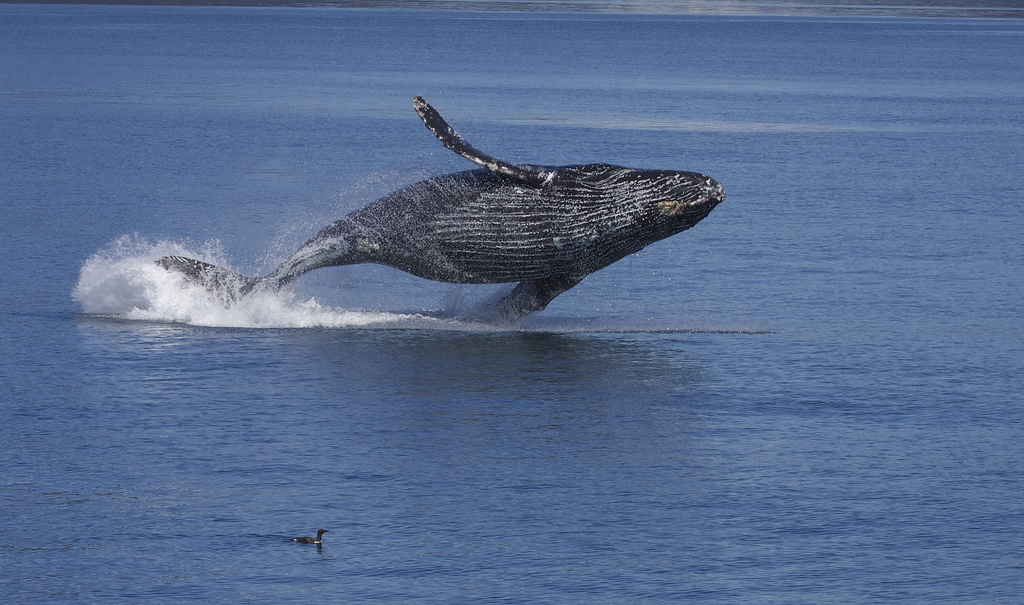
(Photo of breaching humpback whale by Gregory “Greg” Smith)
 The Dish