The Junky author defied the red-blue divide:
[T]he young Burroughs’ hatred of the New Deal liberals who held power in North America didn’t keep him from embracing the anti-feudal, anti-imperial liberals
he encountered in South America. In Colombia he even gave his gun to a guerrilla boy. “Always a pushover for a just cause and a pretty face,” he wrote to [Allen] Ginsberg in 1953. “Wouldn’t surprise me if I end up with the Liberal guerrillas.”
In later years, conversely, he still didn’t have much praise for the federal government. In The Job—Daniel Odier’s book of interviews with Burroughs, published in various forms between 1969 and 1974—the novelist denounced the income tax (“These laws benefit those who are already rich”) and allowed what began as a rant about money to evolve into an attack on inflation. (“Money is like junk. A dose that fixes you on Monday won’t fix you on Friday. We are being swept with vertiginous speed into a worldwide inflation comparable to what happened in Germany after World War I.”) When Odier inquired about the assassination of Sen. Robert Kennedy, Burroughs began his answer with the sort of conspiracy theory you might expect from a hip ’60s liberal—”It seems likely that the assassination was arranged by the far right”—but then veered in a different direction, declaring that “the arrangers are now taking this opportunity to pass anti-gun laws, and disarm the nation for the fascist takeover.” On the rare occasion that Burroughs did manage to say something nice about the feds, he still couched his comments in libertarian language. In 1982, when Isaac Asimov’s Science Fiction Magazine asked him how he felt about the space program, he replied that it was “practically the only expenditure I don’t begrudge the government.”
Turns out he marched to the beat of a very different drummer:
Jack Black was a former hobo and burglar whose memoir You Can’t Win engrossed the teenaged Burroughs, leaving a lasting impact on both his outlook and his literary voice. … It was Black’s description of an underground code—and his scattered references to the beggars and outlaws who embraced that code as an extended “Johnson Family”—that gave Burroughs’ rebellious streak an ideological framework. A Johnson “just minds his own business of staying alive and thinks that what other people do is other people’s business,” Burroughs wrote in his 1985 book The Adding Machine. “Yes, this world would be a pretty easy and pleasant place to live in if everybody could just mind his own business and let others do the same. But a wise old black faggot said to me years ago: ‘Some people are shits, darling.'” In 1988, penning a preface for a reprint of Black’s book, Burroughs offered this account of the world’s core conflict: “A basic split between shits and Johnsons has emerged.”
Previous Dish on Burroughs here, here, and here.
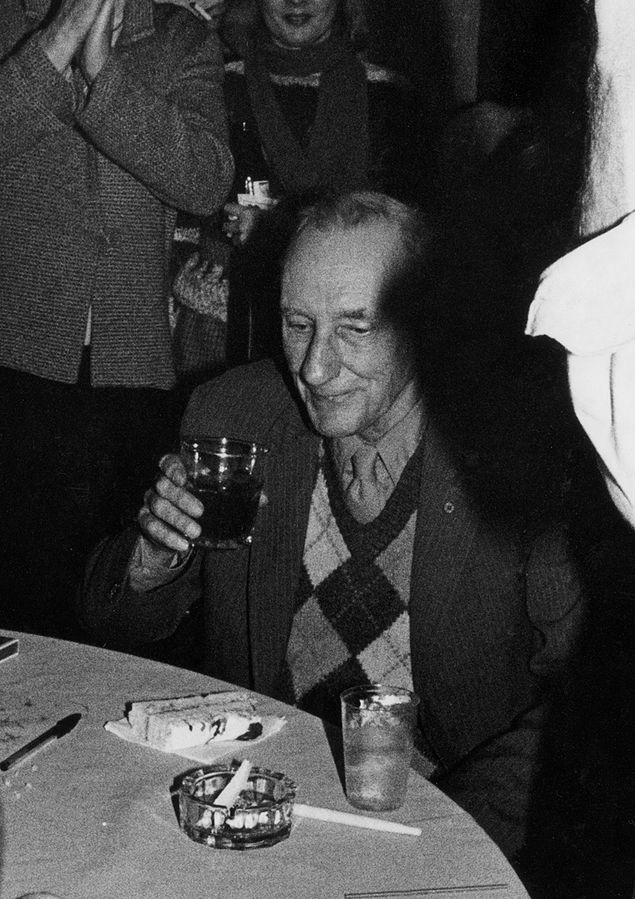
(Image of Burroughs at his 70th birthday party via Wikimedia Commons)
 The Dish
