One of the epiphanies I had a long time ago when thinking about the question of marriage equality was upon reading a passage from Hannah Arendt in Dissent in 1958. I’ve cited it a few times over the years on the Dish, but its core point is worth revisiting:
Even political rights, like the right to vote, and nearly all other rights enumerated in the Constitution, are secondary to the inalienable human rights to ‘life, liberty and the pursuit of happiness’ proclaimed in the Declaration of Independence; and to this category the right to home and marriage unquestionably belongs.
In my old 1990s stump speech that I gave at countless colleges and bookstores and fundraisers, I used to end on that quote. The question was not really why gay people should seek the right to marry; the question was why a tiny minority of Americans had been excluded from one of  the most basic rights of any American: the pursuit of happiness. I’d ask of the straight people in the crowd if they’d ever doubted that their right to the pursuit of happiness included the right to marry the person they loved. And the answer was: of course not. It was inconceivable that the pursuit of happiness could mean anything unless it included the institution most relevant to love and family and thereby happiness.
And so it’s particularly gratifying to see the ruling striking down Wisconsin’s ban on marriage equality rest on this core idea (with a few citations of yours truly). The question becomes one in which core notions of equality – rather than esoteric questions about social policy – are front and center. And this, remember, was precisely what many on the right were opposed to. But their insistence that the right to marry was not a civil right ultimately rested on the notion that gay people were somehow not citizens or were somehow incapable of the responsibilities of the institution. And that’s when their case began to fall apart – because Americans increasingly looked at their gay neighbors, family and friends and did not see them as somehow non-citizens or unable to love and be loved in a committed life-long marriage.
And so it’s not a surprise to me that a new poll from the WaPo has the following result for the question: “Regardless of your own preference on the issue, do you think that the part of the U.S. Constitution providing Americans with equal protection under the law does or does not give gays and lesbians the legal right to marry?”
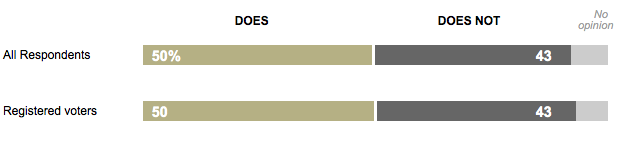
This is where we’re headed. Back in the 1990s, I kept that argument in speeches to rouse the base, as it were. I knew that putting it like that in print would be a reach. But in due course, the power of the point keeps growing. Either gay people are citizens or not. It’s really that simple. For any citizen in the US has the right to marry the person they love. The great mystery and tragedy is why it took us – gay and straight – so long to realize and internalize it.
 The Dish