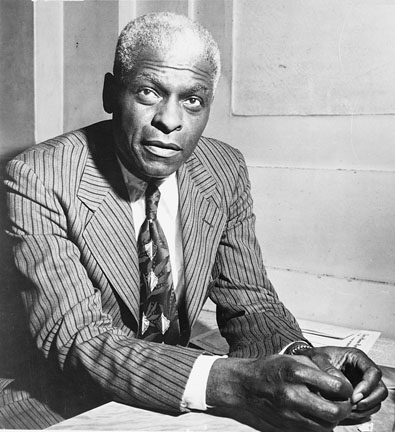
In an interview, Randal Jelks discusses his biography, Benjamin Elijah Mays: Schoolmaster of the Movement, about the Morehouse College president whom MLK Jr. considered his spiritual and intellectual father. How Mays laid the theological groundwork for the civil right movement:
He went to India and met and interviewed Gandhi in 1936 and came back and wrote about
his encounter. He talked with Gandhi about what a nonviolent social movement looks like and how it should take place.
Martin King was 15 when he came to Morehouse. The war was beginning to affect enrollment, and Mays, at an all-men’s college, used early admissions to find talented teenagers to enroll. King and other students were often invited to Mays’ house to sit at table when dignitaries were visiting. The students had to learn about the visitor beforehand and were expected by Dr. and Mrs. Mays to ask questions. The great civil rights activist Dorothy Height remembers meeting Martin King at 15 sitting at the Mayses’ dining room table. This was not peculiar to King. Many other students tell you the same.
If Jelks’ biography discusses what came before Dr. King, Matthew J. Cressler argues that the religious dimension of debates about racial justice didn’t end with his death, but extended to what came after it – including the Black Power movement:
Journalists were quick to contrast what they took to be the irrational rage of urban youth shouting “Black Power!” with caricatures of a more palatable southern Christian nonviolence – needless to say, neither of these characterizations approximated the reality of either.
The first generation of post-civil rights scholarship reproduced this juxtaposition between secular anger and religious love, black violence and Christian nonviolence. Even as more recent scholars have challenged many of the classic binaries separating Black Power from civil rights, the secular/religious divide usually persists since it serves as a convenient category for marking the elusive shift from one style of social justice struggle to another. (The convenience of this argument depends on presuppositions about the inherent peacefulness of “real” or “proper” religion that are built into the modern study of religion itself, but that is a conversation for another time.)
Convenience notwithstanding, Black Power was actually taken up by a number of black religious communities almost immediately after its first iteration. On July 31, 1966, not long after Carmichael’s famous statement, the National Committee of Negro Churchmen published their own statement expressing deep disturbance over the manufactured controversy surrounding “Black power” and what they called the media’s “historic distortions of important human realities.” They argued that “what we see shining through the variety of rhetoric is not anything new but the same old problem of power and race which has faced our beloved country since 1619.” They identified the hypocrisy of “the assumption that white people are justified in getting what they want through the use of power, but that Negro Americans must, either by nature or by circumstance, make their appeal only through conscience.” Two years later this same committee, now named the National Committee of Black Churchmen, officially affirmed emergent Black Theology as a “theology of black liberation.”
Even the Black Panthers – often presented as the paradigmatic foil for (the popular, sanitized version of) the Christian nonviolence of Martin Luther King – met in churches and collaborated with religious people and communities from the get-go.
(Photo of Mays via Wikipedia)
 The Dish