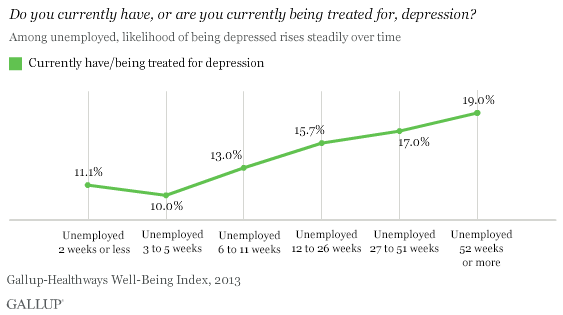
A new survey indicates that out-of-work Americans are twice as likely to suffer from depression as their employed peers. And the long-term unemployed appear to be the worst off:
Gallup also finds that the long-term unemployed spend less time with their family and friends, potentially contributing to those higher rates of depression. The survey notes that we cannot identify causality: “These results don’t necessarily imply unemployment itself causes these differences. It may be that unhappy or less positive job seekers are less likely to be able to get jobs in the first place.” That’s true, but these findings are also consistent previous academic evidence.
Rebecca Rosen mulls over the findings:
[Gallup’s Steve] Crabtree cites a 2011 study by the Heldrich Center for Workforce Development at Rutgers University which found that long-term unemployed people were much more likely to report that they had spent two hours or less being social the previous day.
“Again,” Crabtree writes, “these results don’t necessarily imply unemployment itself causes these differences. It may be that unhappy or less positive job seekers are less likely to be able to get jobs in the first place—if, for example, employers are looking for more upbeat workers. It is also possible that those who spend less time with family and friends are therefore less able to draw on their social networks for employment leads.”
Surely there are people out there who are accurately described by one of those possibilities. But it’s all too easy to imagine a scenario in which all of these act together in a vicious cycle that mires a person in unemployment. That same Rutgers study found much higher rates of reporting “feeling ashamed or embarrassed” or “strain in family relations” for those for whom a loss of a job had had devastating financial consequences. As one reader wrote to The Atlantic in 2011, “I look at my peers who are getting married and having children and generally living life and it’s depressing. They’ve got jobs, health insurance, relationships, homes; I don’t even have a real bed to sleep on.” Would hanging out with friends and family be very appealing under such circumstances? Not to me, at least. From there, it’s a pretty direct line to isolation, depression, the toll those will have on a job search, to more isolation, more depression, and on and on and on.
 The Dish