Danielle Kurtzleben worries that the growth of on-demand service startups like TaskRabbit and Instacart points to “deeper, unsettling trends going on in the US economy”:
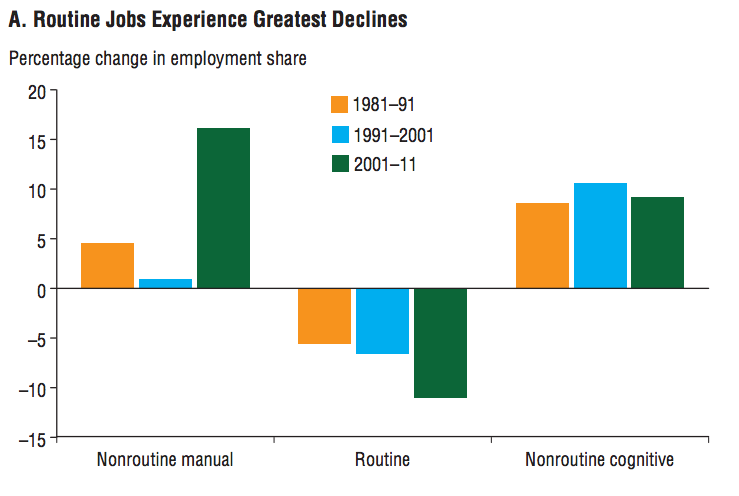
The New York Times’ Farhad Manjoo wrote in May that Instacart and services like it could “redefine how we think about the future of labor.” That sounds great in an era when technology replaces cashiers withself-check-out machines and automates assembly-line jobs out of existence. But the growth of TaskRabbit and other similar firms could mostly mean yet more job growth at the lower end of the spectrum. These low-skill jobs have made up the bulk of job growth over the last decade or so, as the Dallas Fed showed in a recent paper.
While jobs fall out of the middle, new jobs are created at the top and bottom. And those jobs at the bottom tend to be “nonroutine manual” jobs: those that require few skills and little problem-solving. Many of these errand jobs fit this bill perfectly, involving deliveries and other rote tasks. These new errand jobs can feature high pay — Instacart, Manjoo noted, can pay $30 an hour. But a major problem is finding steady work — no grocery run takes eight hours.
 The Dish