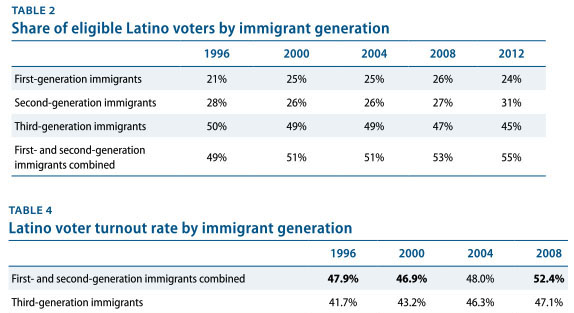
Drum uses the above chart to explain why the GOP establishment is losing sleep over immigration reform:
A new report from the Center for American Progress suggests they’re pretty justified in being scared. Immigration reform is an especially salient voting topic for first- and second-generation immigrants, and that group has two important characteristics: (a) it’s growing as a share of the Latino population, and (b) it’s turning out to vote in ever higher numbers … Republicans may be able to hold onto Congress for a while longer in the face of numbers like these, but winning the presidency is going to get harder and harder. Not impossible. But that’s a mighty big headwind, and it’s getting stronger every year.
Despite Cantor’s loss, Lanhee Chen contends that immigration reform isn’t dead:
[T]he fundamental dynamic that haunted Republicans in 2012 still exists: Unless they are able to demonstrate some leadership on immigration reform, they risk forfeiting the Latino vote in 2016. Even if a perceived moderate on the issue, such as Jeb Bush or Rick Perry, ends up being the Republican presidential nominee, the party will be held liable for inaction. This will have consequences for the nominee and candidates in states with sizable Hispanic populations.
Rand Paul, for one, still supports immigration reform. Allahpundit expects most the other Republican presidential hopefuls to follow his lead:
As traumatized as Republican candidates must be by Cantor’s destruction, they’re more traumatized, I think, by Romney’s margin among Latinos in 2012 after he backed “self-deportation” in the primaries to pander to righties. They’re not going to follow him down the same road, and if they were tempted to, the donor class wouldn’t let them. Unless you’re Ted Cruz or Rand Paul, neither of whom stands a chance of winning the business-lobby primary, your campaign hinges on winning as many rich backers as possible. That means you support legalizing illegals, even if you have to lard up that positions with conditions to stay viable in the primaries. Even Paul, after all, is leery of trying to win a confrontation with the establishment in a national race backed by nothing more than grassroots support. That’s why he’s been moderating his position on foreign policy and why he’s refusing to budge on immigration after Cantor’s beating. He won’t be the donor class’s choice, but maybe he can peel away some members. It’s Cruz, alone among the contenders, who’ll be running a chiefly grassroots campaign. That’ll ensure his status as de facto leader of the tea party, win or lose, but it’s not the obvious path to the nomination in the McCain/Romney era. Because he has little to lose, he’s the only man running who might embrace a firm “security first” position. And needless to say, even he’ll stay away from “self-deportation.”
Chait suspects it’s the “deal” part of an immigration deal that infuriates Republican diehards:
Conservative Republicans may not hate immigration reform, but they hate compromise in general. By an 82-14 margin, liberals want their elected officials to make compromises. By a 63-32 margin, conservatives want elected officials not to compromise. Republicans simply don’t trust bipartisan deals. … The conservative revolt against compromise expresses itself constantly. It comes through in the ever-present trope of citing the length of legislation as a primary reason to oppose it. It likewise comes through in the way conservative intellectuals routinely attack bills as a “stew of deals, payoffs, waivers, and special-interest breaks” — which is to say, they hate the fact that passing bills in Congress requires cutting deals with disparate constituencies, which is how legislation works.
Waldman thinks it’s basically impossible for any Republican to both govern and please the base:
As far as that activist base is concerned, every Republican politician should be nothing but an agent of chaos and destruction, or at least pretend that’s who he is. It’s not only incompatible with governing, it’s barely compatible with holding office. Anyone who actually tries to accomplish anything is quickly turned from hero to traitor, as Marco Rubio was when he attempted to devise an immigration plan; Tea Partiers who once celebrated Rubio now view him with contempt. The only kind of legislator who can stay in their good graces is one who never bothers legislating, like Ted Cruz. Writing laws is for compromisers and turncoats; what matters is that the revolution continue forever.
 The Dish