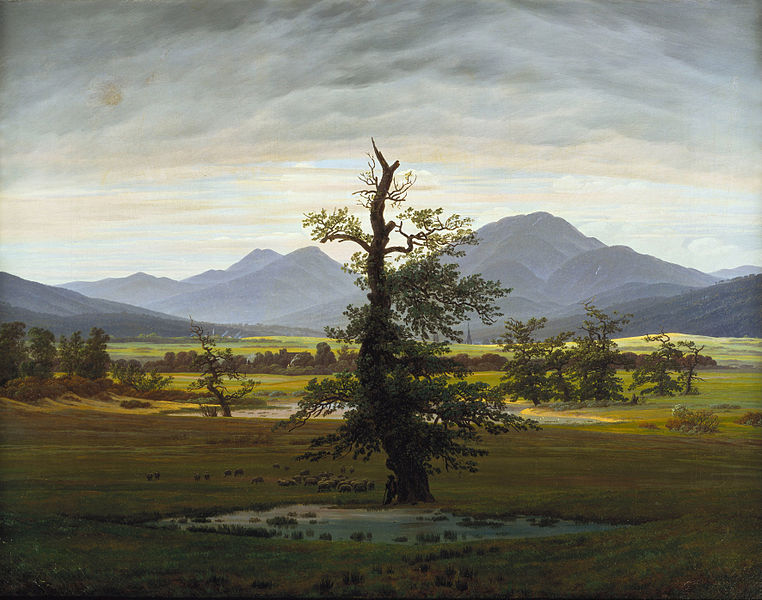
“In the form of the tree,” writes Allison Meier, “artists found expressions of life, death, and the great beyond.” In a review of the Morgan Library & Museum’s exhibit on Romantic landscape art, she taxonomizes the various kinds of tree art on display:
One of the frequent, ominous tree symbols is the blasted tree. [In Hubert Robert’s La Cascade] a poor tree has been terribly wounded, perhaps by a recent lightning strike, although it’s often an old battle scar. What’s important is that the tree is usually still living, leaves clinging to its battered branches. To the Romantics it represented the cycle of nature, from death to life, all at once. It could also be a foreboding symbol for those venturing into the wild, a disruption of the pastoral peace, as the wrath of God can fell even these timber giants. In Mary Shelley’s Frankenstein, Victor Frankenstein declares himself a “blasted tree” in regards to his own destruction.
The blasted tree often crosses over with the lone tree. Here [above] Caspar David Friedrich has depicted a survivor. Its peak is fractured, yet it has endured. Below it stands a solitary shepherd, and there’s a subtext that as this man lives and dies, the tree will continue in its longer life. Also notice the church off in the distance, dwarfed by the tree. Friedrich wasn’t diminishing the spiritual, he was showing that it was deeper and more universal than the faith of one church.
(Image: Village Landscape in Morning Light (The Lone Tree) by Caspar David Friedrich, 1822, via Wikimedia Commons)
 The Dish

