A reader writes:
This writer’s complaint shows no connection to the contemporary job market or college reality. Anyone who writes about “Why don’t kids nowadays do what we did back in our day!” is probably full of shit. Not to put too fine a point on it.
I too worked my way through college: security guard, office clerk, janitor, movie theatre tickets/concessions, laborer on construction sites – then, once 21, waiter/bartender. I worked summers to save cash for the school year and during the school year as well. No frats, no
parties – just full-time work and classes (and years or semesters off when broke). I ended up with a PhD and in academe, where I now work advising and teaching and deal every day with the economic reality contemporary college students face.
So, kids nowadays, why don’t they just work instead of taking out student loans? The sort of jobs I got when I was their age are no longer available to your average college student in a four-year university. They have to spend their summers doing unpaid or lowly-paid or pay-tuition-to-get-course-credit-and-work-for-free internships to prep for their long-term career goals. What paying jobs are available for the kids who choose the JuCo/State School route are minimum-wage fast food/retail jobs that actually will not help you pay your tuition now, much less save money for tuition later.
“Summer jobs” don’t exist anymore. The average age of the minimum wage worker is now 35, not 18. This reality is just one more symptom of the end of the striving lower-middle class. Kids whose parents can pay the rent while their children work unpaid summer internship help their kids get – or stay-ahead. Kids who don’t have such resources are screwed, though some universities (including, thank God, the one I work at) do their best to help these kids with stipends or grants.
The good old days are done. Anyone who thinks otherwise isn’t paying attention.
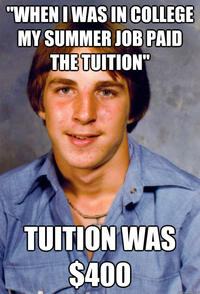
Several more readers support that view with data:
In my work as a graduate teaching assistant and adjunct instructor over the past seven years, I can also attest to the fact that many undergraduate students are working while going to school – it just isn’t enough. The reader blithely concedes that “tuition has increased,” but that’s such an understatement. It’s a fitting coincidence that he said he started college in 1985 because this Labor Department study shows that college costs have not just “increased” but have skyrocketed over 500% since 1985. And this is while the cost of living has also increased but wages have stagnated.
Another adds, “Even the state institutions have more than doubled in cost since the ’80s.” Another continues along those lines:
Even state schools have gotten expensive. Emma Green at The Atlantic did a great piece back in April on Randal Olson’s graduate work at Missouri State University, where he determined that it now takes a little under 1000 hours of work at minimum wage just to cover the average cost of tuition only, and he was using in-state tuition data from state schools. With additional fees (including room and board and meal plans), the idea of working your way through college is just unrealistic now.
Another crunches some numbers:
$8000 a year for tuition, in the scenario your reader presented, means that working at just above minimum wage ($8), you’d have to work 1000 hours, or 20 hours/week to make that money. This is ignoring whatever deductions occur for federal/state/local income taxes and FICA taxes.
But wait! This is for a non-residential program, which means that you also have to cover housing and food. Let’s assume $300 a month in rent and $200 in food a month (~$2 a meal). That’s another $6000, or another 15 hours/week. And this doesn’t begin to include other costs such as transportation, books and supplies, clothing, etc.
So basically, even in the scenario your reader describes, you’re essentially working at least a full-time job on top of a full slate of classes and homework to make this work. Of course these costs are mitigated if you’re able to live at home, or your parents can help defray some costs, but students take out loans specifically because parents are not able/willing to defray these costs, and many students live in areas that aren’t close enough to any kind of college to commute.
Furthermore, this all supposes that these students are even able to get jobs. Given that the unemployment rate for 16-24 year olds is much higher than other age groups (13-15% vs. <7%), the unemployment rate for high school graduates is also way higher (7% vs. <5%), AND that these numbers are all down from their peaks in 2009-2010, I’m not certain how reasonable that is.
And even if they could make this situation work, it’s not apparent that it would be worth it. Employment rates for young college graduates aren’t very good, and if you drill down in the numbers deeper, those who come from less prestigious schools are more likely to be unemployed or underemployed. Should you scrimp and sacrifice to go to a local school, get a degree, and possibly be not much better off coming out of that, or should you take on debt to go to a better school without distractions? I’m not certain which of these is the better choice, but i don’t think it’s as clear cut as your reader does, especially when the benefits are four years off from when these students make their decision.
Finally, your reader was able to do what he did because a) he spread out his degree over 10 years, and b) his tuition costs were MUCH lower, even after you control for inflation. It’s a stark fact that tuition has outpaced both inflation and real wage growth over the last 30 years.
As a Millennial (and one of the lucky ones with no debt and a good job), it kills me when I hear people talking about how they managed to do this or that 20+ years ago. Things just aren’t that simple any more.
(Image of “Old Economy Steven” from Know Your Meme)
 The Dish