Neil Padukone connects the high incidence of rape in India to its urban design choices:
Most of New Delhi is built according to what urban planners sometimes call “single-use” design: sections of the city are devoted almost exclusively to one use (industrial, institutional, retail, or residential) and separated from each other by open space, roads or other barriers. … This is in contrast to “mixed-use” planning, which carefully integrates residential, retail, institutional, and cultural spaces into the same area—areas that are easily accessible by walking, bicycle, or mass transit.
There are many reasons planners favor mixed-use design, including smaller carbon footprints and increased access to economic opportunity. Easy and efficient access to work, leisure, home, and childcare makes juggling responsibilities much easier, particularly for women. But one of the most important benefits of mixed-use planning is what the urbanist Jane Jacobs famously called “eyes on the street.” If an area is used for multiple purposes, there will always be somebody—a homemaker, shopkeeper, pedestrian, peddler, or office worker—keeping a passive watch, inadvertently but effectively policing it 24 hours a day. Street vendors, for example, may be the most perennial pairs of eyes that monitor any streets, and even police have tapped this human resource.
Two girls who were gang-raped and murdered in Uttar Pradesh last week were attacked while going to relieve themselves in a field at night. Hayes Brown discusses how the absence of private toilets poses a serious safety problem for women in the poorest parts of the world:
Some critics have said that the focus on sanitation as an issue ignores the larger issue of rape and deterring men from assaulting women in the first place. As an article from First Point India explains, however, nobody is arguing that “the sole reason for sexual violence is the lack of a loo. It is an undeniable fact, however, that the absence of a safe toilet adds to the vulnerability of women. And there are numbers to show it.” The First Point article cites a BBC report in which “a senior police official in Bihar said some 400 women would have ‘escaped’ rape last year if they had toilets in their homes.”
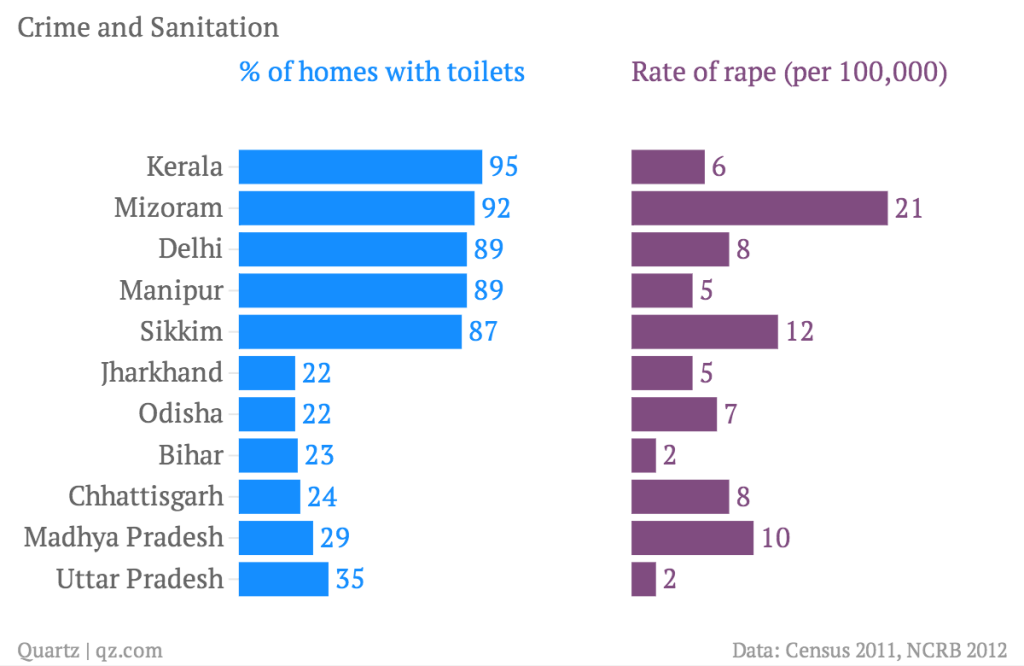
Diksha Madhok pushes back on that alleged link with the above chart:
[I]f a toilet shortage is fueling rape in India, then their presence should lead to lesser crimes against women. But data analyzed from the National Crime Records Bureau (NCRB) show that there is no inverse relation between rape and toilets. Quartz India compared the states with the highest and lowest toilet density against their rates of rape, defined as those reported per 100,000 women.
The state of Mizoram has one of the lowest number of households without toilets. Yet, the rape rate against women remains a stubborn 21, much higher than the national average of 4.26. Meanwhile, only 20% of households in Jharkhand have a toilet, but its rape rate is one-fourth of Mizoram’s.
Update from a reader:
As an Indian living in India, I strongly favour mixed-use urban spaces. That said, if this was the reason for rape, it would be a reason for all sorts of other crimes. But violent crime against men is relatively rare in India. As a man, I feel perfectly safe walking in quite seedy-looking neighbourhoods – far more than I would in New York or Paris. With women, two sorts of crime occur: (1) molestation (rape is merely the extreme end of a spectrum) and (2) “chain-snatching”, ie grabbing their gold chains and running. The solution to (2) is presumably not to wear gold chains, but social customs die hard. As for (1), I remain convinced that this is a societal problem exacerbated by inadequate policing by poorly-trained and often prejudiced personnel.
Back to mixed-use spaces: in 2006, the Chief Justice of the Indian Supreme Court, Y K Sabharwal, ordered the sealing of commercial establishments in many residential areas. Thousands of such establishments were sealed, many of which had been functioning for decades. It turned out that Sabharwal’s sons, both of whom were in the real estate business, stood to benefit immensely from this order. Journalists from the Mid-Day newspaper who reported this were held in contempt of court and jailed. A good overview of all this is here.
The bottom line is, India’s separate-use urban practices encourage not only criminal activity, but corruption. And when it’s the Supreme Court, there is little recourse for citizens.
 The Dish