Hannah Newman takes stock of the burgeoning “invasivore” movement:
Norman’s Cay is currently the only American restaurant north of South Carolina serving
lionfish, but that’s likely to change soon, thanks to a fast-spreading trend seeking to use our appetites as a way to control the vast numbers of plants and animals colonizing new habitats and destroying native species.
Yet as the second lionfish taco quickly disappeared from my plate, I couldn’t help but wonder: Can we really take down invasives with knives and forks? If more of us eat lionfish, wild boar tenderloin, Asian carp fritters, or garlic mustard pesto, will it make a difference?
Experts are skeptical, pointing out that once a foreign species has entrenched itself in a new place – such as the Indo-Pacific lionfish that has now virtually taken over the waters of the Western Atlantic, Caribbean and Gulf of Mexico – eradication is almost impossible. Critics argue that encouraging consumption might have the unintended effect of spreading harmful species even more widely. But the invasivores are undeterred, noting that their campaign is not only selling books and changing restaurant menus; it’s also spreading awareness of a crippling environmental problem that is rapidly homogenizing the world’s ecosystems and costing over $130 billion a year in the United States alone.
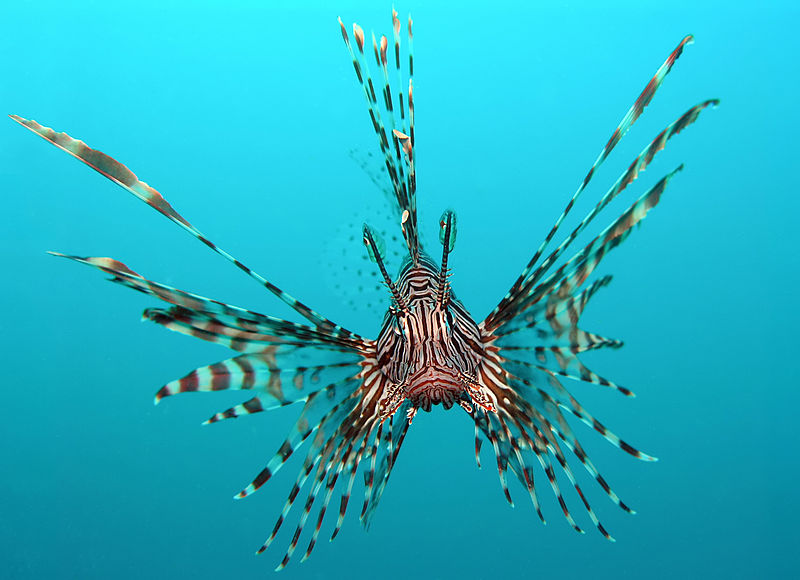
(Photo: The red lionfish [Pterois volitans] is one of two species of lionfish to colonize the the east coast of North America and the Caribbean. It’s pictured above its native habitat in Indonesia. By Jens Petersen)
 The Dish
