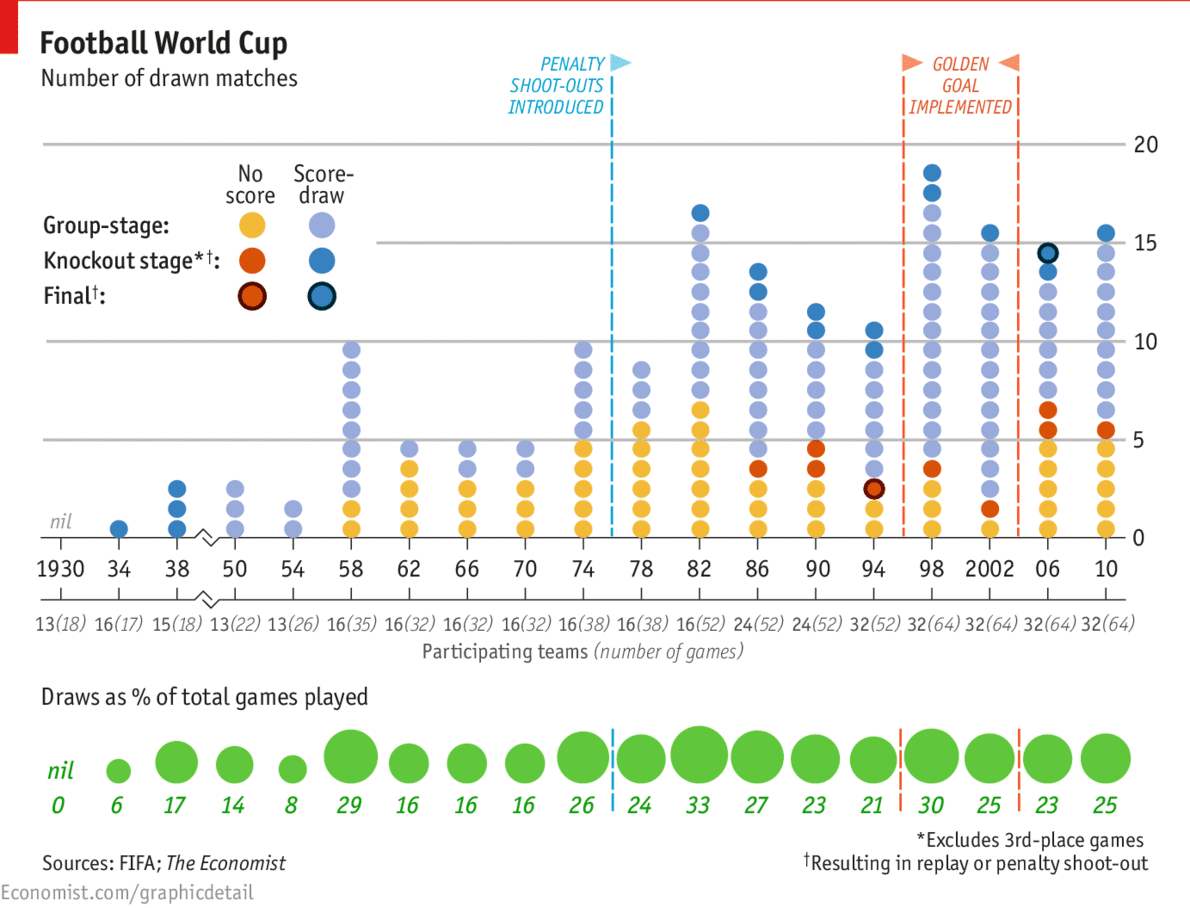
Monday’s 0-0 match between Iran and Nigeria was the first draw of the ongoing World Cup. As the above chart from The Economist illustrates, that’s pretty unusual:
The match was conspicuous in an otherwise high-scoring tournament, which so far has seen 44 goals, or 3.14 per match. It is proving to be one of the most exciting World Cups of recent times, including shock results such as the Netherlands’ 5-1 win over Spain, the reigning champions. Such excitement bucks the modern trend. Until this year, the tournament had been losing its kick. … Prior to this tournament, more matches have resulted in stalemate, often scoreless, in the last six tournaments than the previous 13 combined. Even the 1994 and 2006 cup finals ended in a draw (the former without a single goal) and had to be decided by penalty shoot-outs.
Elaine Teng notices a recent trend toward higher-scoring matches:
The scoring barrage is no fluke.
Over the past four years, with some exceptions (including a big one named Jose Mourinho), elite football has become more offensive-minded as a whole. In Europe’s top leagues, where over half of the World Cup players ply their trade, the average number of goals per match has been consistently on the rise. According to The Telegraph, the Premier League averaged 2.58 goals per game between 2006 and 2010. Since then, that number has jumped to 2.79, and the trend holds true in Spain, Germany, and Italy. Possession-based football—most famously Spain’s tiki-taka—is looking vulnerable, as the counterattacking style has reasserted itself. Many teams are now happy to let the other team have the ball, then exploit space and hit their opponents on the back foot when chances come.
But Daniel Alarcón sticks up for 0-0 matches:
I’ve always been a fan of the scoreless draw—the good kind, of course, not the Nigeria-Iran kind. This stems, in part, from being raised in the United States in the 1980s, the dark ages for footballing culture in the U.S., when one was consistently subjected to the mainstream notion that soccer was both foreign and boring. The possibility of a 0-0 final score was exhibit A for that ignorant thesis. A fan knows that this is ridiculous, of course. A fan knows that the score tells only part of the story, that a nil-nil, un empate a ceros, can have all the drama and entertainment of a 3-2 or a penalty shootout.
Watching soccer is about expectation, it’s about anxiety. Something is always happening, and unlike other sports, the scoreline is not necessarily an accurate barometer of the quality of the match, nor does the superior team always score more goals. Sometimes, no one scores, and it can be amazing. To put it another way, there are nil-nils, and then there are nil-nils.
But such low scoring is among the chief reasons David Post doubts the US will ever love soccer the way other countries do:
[S]occer has wa-a-a-y too much failure in it, and, generally speaking, Americans don’t like failure, and don’t like to dwell upon it. Soccer is all about failure — about failure and the ability (and will) to overcome it. Over and over and over again they charge down the field, knowing full well that the chances that they get the ball into the net on the attack are awfully slim; think about that the next time you watch some left back running full tilt in the 88th minute of a 0-0 game to try to get himself in position to receive the ball on the counter-attack; he knows damned well that the whole enterprise is almost surely for naught, yet on he goes (at least, if he’s good, and “determined,” and “committed” – words you hear a lot at a soccer game). Succeed a couple or three times in 90 minutes (plus extra time!) of hard work and your team’s a juggernaut. Soccer fans do more cheering for the “good effort”, the fabulously-constructed set of passes that sets up a chance that doesn’t result in anything on the scoresheet, than fans in any other sport.
 The Dish