Jeff Shesol spots a fascinating detail in Bruce Allen Murphy’s new biography, Scalia: A Court of One – his obsession with dictionaries, especially those from the 18th and 19th centuries. Scalia’s penchant for parsing the meaning of words “is apparent—often ostentatiously so—in nearly every opinion that Scalia has put on paper over the past three decades”:
Sometimes, this has yielded a comical result, as in Scalia’s dissent in Edwards v. Aguillard, a 1987 decision overturning a pretty plainly labelled Louisiana law called the Balanced Treatment for Creation-Science and Evolution-Science Act on the grounds that it advanced a particular religious belief. Scalia, having considered very carefully the phrase in question, insisted, presumably with a straight face, that the term “creation science” had no religious meaning whatsoever. “The Act’s reference to ‘creation,’” he wrote, “is not convincing evidence of religious purpose…. We have no basis on the record to conclude that creation science need be anything other than a collection of scientific data supporting the theory that life abruptly appeared on earth.”
In other instances, Scalia’s word games have had profound, societal implications, leading to—in at least one case—a dramatic shift in constitutional law.
In District of Columbia v. Heller, which Scalia considers his greatest achievement, he relied not on one but on three eighteenth-century dictionaries to “clarify” the Second Amendment, which reads, “A well regulated militia being necessary to the security of a free state, the right of the people to keep and bear arms shall not be infringed.” By the time that Scalia had finished his exegesis, the “prefatory clause” about a militia had been clarified into irrelevance, and “bear arms” had been so scrutinized and squinted at and worked over that Americans awoke to find that they had a new, individual right to carry a handgun—a right that cannot be found in the language, plain or otherwise, of the Constitution. Michael Waldman, who has just published a book on the Second Amendment, observes that Scalia, in his opinion, “has the feel of an ambitious Scrabble player trying too hard to prove that triple word score really does exist.”
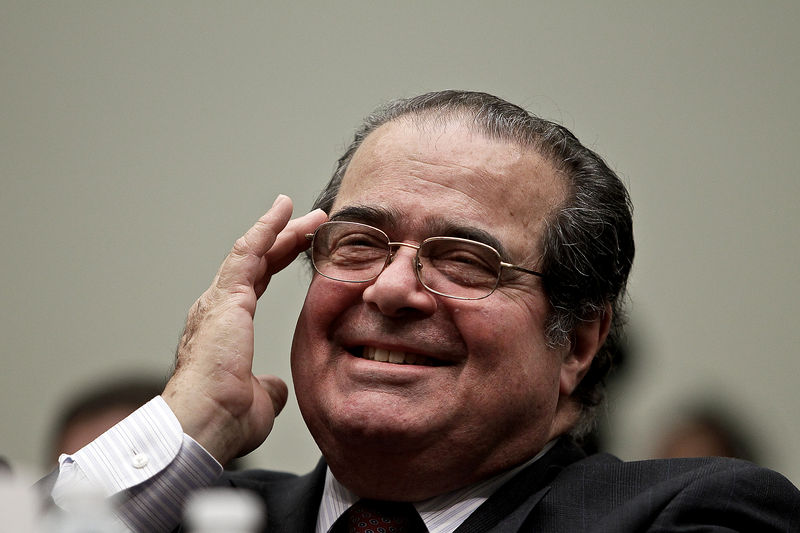
(Photo: Supreme Court Associate Justice Antonin Scalia testifies before the House Judiciary Committee’s Commercial and Administrative Law Subcommittee on Capitol Hill May 20, 2010 in Washington, DC, by Stephen Masker via Wikimedia Commons)
 The Dish
