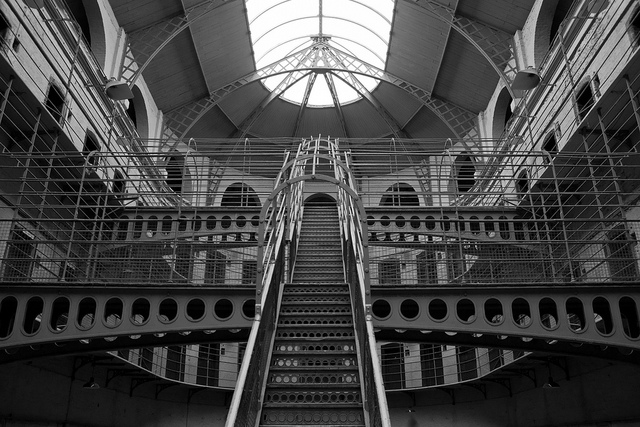
Jeremy Bentham’s utopian prison design appears to have been a big mistake – and its consequences are still being felt after more than two centuries:
Though many scholars focusing on penitentiaries suspect that staff-prisoner relations are molded by institutional architecture, little empirical work has been completed on the topic. Now, a new study led by [researcher Karin] Beijersbergen and published in Crime & Delinquency has concluded that building styles, floor plans, and other design features do indeed have a significant impact on the way Dutch prisoners perceive their relationships with prison staff. …
After controlling for age, ethnicity, intimate relationships at the time of arrest, education level, personality traits, criminal histories, and officer-to-inmate ratios, the authors discovered that their hunch was correct. If the prisoners were housed in leaky dungeon-like panopticons, they tended to feel more estranged from guards. But if they were enjoying campus-style living arrangements or apartment-style high-rises, they perceived the relationships as more supportive.
On a similar note, architect Raphael Sperry – who is working to get the American Institute of Architects’ to change its code to “prohibit the design of spaces that inherently violate human rights” – discusses the business of designing prisons:
A lot of large firms have a unit that designs prisons. Sometimes that expertise overlaps with other high-security business types – military facilities and some other government facilities – but prisons are pretty specialized. The group within a large firm might be five percent of their business, in some cases maybe 15 percent. There are some firms that specialize in prisons and those ones that I’ve encountered really try to be progressive. They are the most forward-thinking, and [are] using evidence-based best practices. …
We are not advocating that we put the firms that do prisons out of business; we would just like if they would foreground human rights in the work that they do, and I think it’s better if they do that collectively. That’s what the code is about. If one or two companies say, ‘We are not going to design prisons that violate human rights,’ those guys are going to go out of business and the product will still be built. It’s important to take a collective stance.
(Photo by Paolo Trabattoni)
 The Dish