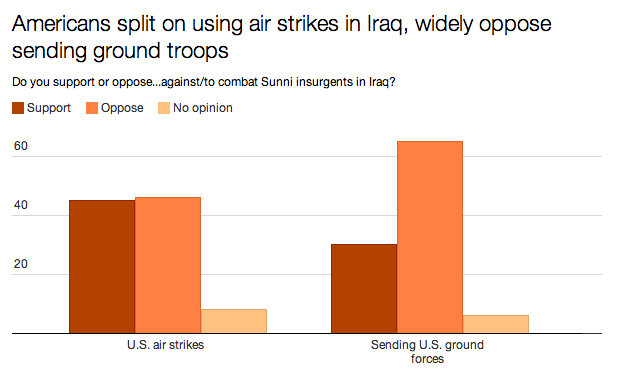
Yesterday I posited that Obama’s sudden downward turbulence in the polls was almost certainly about Iraq. Sure was:
President Obama receives his worst marks yet for handling the situation in Iraq, with 52 percent disapproving and strong negative sentiment now outpacing strong approval by 2 to 1 (34 to 17 percent) in a new Washington Post-ABC News poll. Asked whether the U.S. should launch air strikes against Sunni insurgents, 45 percent support and 46 percent oppose that idea. Fifty-eight percent of Republicans support air strikes, compared with 44 percent among Democrats and 41 percent of independents. The gap between men and women is just as large and extends across party lines. Men support air strikes by a 54 to 40 percent margin, while women oppose them by 52 to 38 percent.
Nearly two-thirds of the public, however, opposes sending U.S. ground forces to combat insurgents, including at least six in 10 Democrats, Republicans and independents. No demographic or political group in the poll expresses majority support for deploying ground troops, while opposition surges to above 70 percent among those over age 50 and post-graduates.
Flagging yet another new poll, Aaron Blake remarks on the partisan gap:
A new CBS News/New York Times poll on Iraq suggests that the American people are quite uncertain about what should be done amid the rise of the al-Qaeda-inspired group ISIS. Perhaps most notably, though, there is little urgency among Democrats or independents to get involved, suggesting that any push for further involvement will be spurred in large part — yet again — by the political right.
The poll shows majorities of Democrats (51 percent) and independents (55 percent) believe that the United States does not have the responsibility to do something in Iraq, while 52 percent of Republicans say it does. Similarly, majorities of both Democrats (60 percent) and independents (56 percent) say the violence in Iraq doesn’t raise the threat of terrorism against the United States. Six in 10 Republicans say it does increase the threat.
Waldman ponders why Obama’s approval numbers keep sinking when he and the public agree on pretty much everything:
While you can quibble about the wording of a question here or there, the overall picture is one of a public that would like to help, so long as it doesn’t involve much direct risk to our personnel, but still doesn’t think what we do is going to make much of a difference. That certainly sounds like a description of where the President himself is at the moment.
So why doesn’t he get more credit for being on their side? We can stipulate that there is literally nothing Obama could do that would satisfy most Republicans; when he says he intends to do exactly what they want, they simply change what they want, since agreeing with him on anything is psychologically intolerable for so many of them. But what upsets most Americans, I suspect, is that we’re being forced to think about Iraq at all. To the American public, the place is a black hole, sucking all our good intentions and sacrifice and money and attention into its miasma of chaos. They hear that there’s an army of Sunni extremists rampaging through the country, then see that Muqtada al-Sadr’s Shiite followers are mobilizing in response (remember when they were the bad guys?), and they can’t figure out how anything we could do would possibly stop this nightmare.
Which is where I am – except I’ve come to a more non-interventionist position overall since 2003. Drum’s take:
In other words, Iraq is like the economy: it doesn’t really matter what the president is doing. If the economy is good, the public approves of his performance. It it’s bad, they disapprove.
But Larison isn’t letting Obama off the hook:
As I’ve said before, Obama sets himself up to fail by trying to take the “lead” in crises and conflicts that the U.S. doesn’t know the first thing about resolving. The mismatch between rhetoric and action has been a persistent problem for this administration. For instance, Obama has made unnecessary declarations about the legitimacy of other leaders and governments (e.g., “Assad must go”) that would seem to require much more aggressive policies than he or the public would be prepared to support. As a result, his policy is judged against the much higher standard that he unwisely set for the administration. Pursuing more ambitious hawkish goals with limited means puts Obama in a bad position at home as well, since it invites attacks from hawks that always want the U.S. to “do more” without giving anyone else something that they can fully support.
I agree. But in his actions, Obama has been more eloquent. Maybe it’s impossible for a US president to resist giving the impression that he is somehow able to do anything about vast, complicated upheavals thousands of miles away, but at some point we need one who will say so more definitively.
 The Dish