Philip Bump put it together:
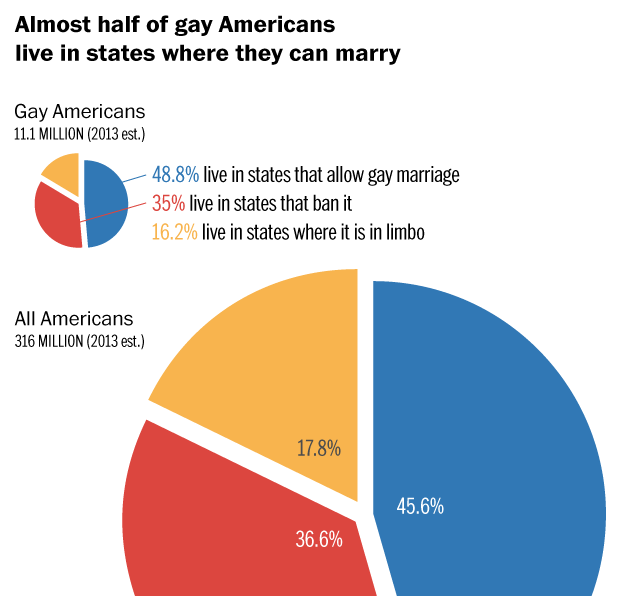
Nearly half of the 11-plus million gay Americans (how we arrived at that figure is explained in more depth below) now live in states that allow gay marriage, and are more likely to live in such states than Americans on the whole. 48.8 percent of gay Americans live in states where they can legally marry, according to our estimates. The percentage of Americans in those states overall is at 45.6 percent. And, of course, a large portion of the country live in states where the legal status is in limbo.
Speaking of that limbo, Bazelon looks at yesterday’s court ruling out of Utah:
The 10th Circuit stayed its ruling to give the opponents of gay marriage a chance to appeal to the Supreme Court. Rick Hasen and plenty of other people think this means gay marriage is headed back to the justices as early as next term. So far, though, there’s no split over gay marriage in the lower courts since the DOMA ruling. Anyone want to subscribe to my (minority) theory that gay marriage could become the law of the land without another word from the high court? Gay marriage has so much righteous momentum behind it—maybe it doesn’t need another push from Kennedy. Though surely, with a record of 20–0 this year in the lower courts, he will be ready to give it.
I’m prepared to make that bet with Emily – although you never know. Ilya Somin sounds off:
For reasons I explained in this post, I am skeptical about the validity of the argument embraced by the Tenth Circuit majority. But I do believe they reached the right result, because laws restricting marriage to opposite-sex couples are an example of unconstitutional sex discrimination. This reasoning was endorsed by the district court opinion affirmed by the Tenth Circuit (though it also endorsed other constitutional arguments against laws restricting marriage to opposite-sex couples).
Be that as it may, [yesterday’s] decision is an important victory for advocates of same-sex marriage. But Judge Kelly’s dissent suggests that the legal battle over the issue is far from over. The question is likely to return to the Supreme Court, quite possibly sooner than many of us at first anticipated.
My reaction to the Utah ruling – and the more exciting one in Indiana – here.
 The Dish