Noting a resurgence of interest in the 17th century poet and Anglican clergyman George Herbert, Wesley Hill unpacks why he resonates with modern believers:
[T]he reason Herbert’s Complete English Works still finds readers like me is because he fuses such rich truths [about God’s love for us] with a heartfelt, occasionally
wince-inducing honesty about how those truths are so hard to grasp. Doubt and grief never quite dissipate from his verse. They don’t overshadow his proclamation of Christ. But they linger, like a chill that hasn’t been driven out of the room, despite the fire blazing in the hearth.
In one poem, Herbert pictures Christ making a place for his “sighs,” or what the apostle Paul called our “groan” (Rom. 8:23). “Look,” says Christ to Herbert, gesturing to the wound in his side, “you may put it”—whatever sighs or groans you intend to convey to God—”very near my heart.” Notice the impeccable theology: Christ intercedes for us before God the Father. But notice, too, how the theology isn’t detached from the poet’s own messy experience. “Away despair,” the poem begins, drawing on Herbert’s wavering belief. “Winds and waves” assault the boat of his faith, and he needs to feel that Christ is interceding for him in the midst of that storm.
Isn’t that precisely the shape of faith? We know that God has come to our rescue. Yet, in this time between the times, we live stretched like a tension wire between Christ’s resurrection and his future coming. We are vulnerable to grief, anxiety, and hesitation. Herbert knew that better than almost anyone, and it’s one of the main reasons he’s still worth reading.
Related Dish on Herbert here. We featured his poetry Easter weekend here, here, and here.
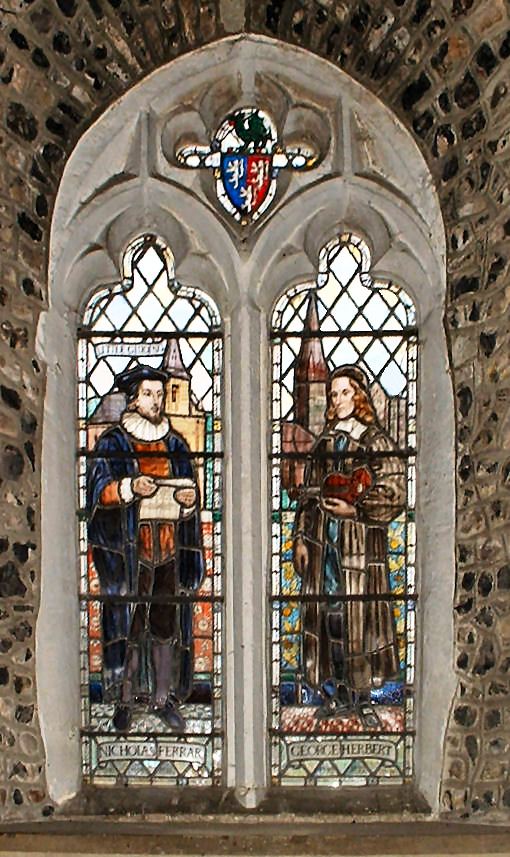
(Image: Stained glass images depicting Herbert and his friend Nicholas Ferrar, from the Church of St Andrew, Bemerton, also known as George Herbert’s Church, via Wikimedia Commons)
 The Dish
