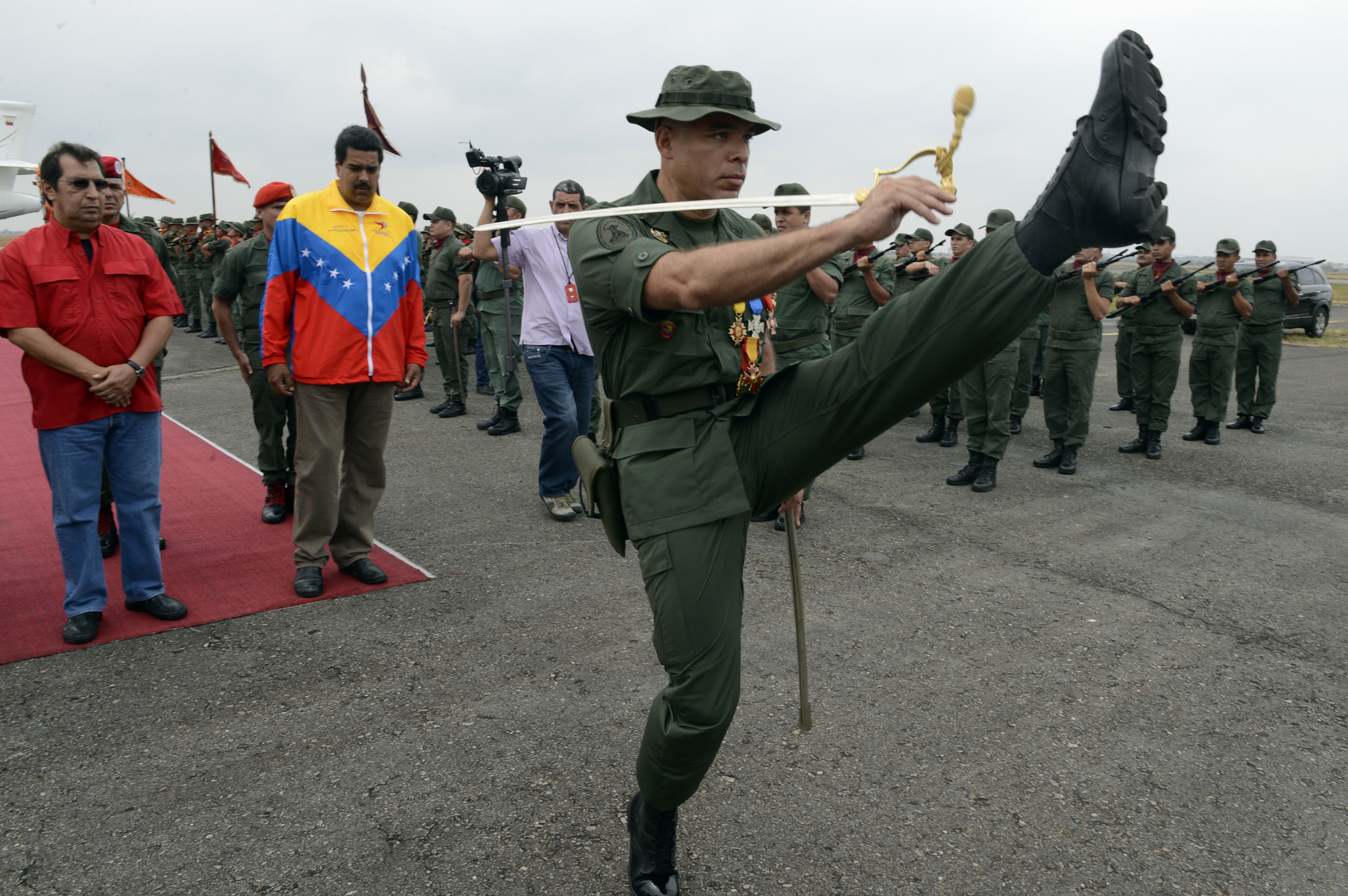
Venezuela’s supreme court decided last week that military participation in pro-government rallies was not only permissible, but actually a good thing. Juan Nagel decries the ruling for “dramatically eroding what is left of democracy, bringing Venezuela back to its nineteenth-century roots when warlords ruled the land”:
The Venezuelan Constitution clearly establishes the military as a non-partisan entity. According to Articles 328 and 330, active service members “have a right to vote,” but they cannot participate in “acts of propaganda or political partisanship, and they cannot proselytize.” This, apparently, is not clear enough for Venezuela’s highest court. In complete opposition to the text, the court ruled that active military participation in partisan acts “is a high water-mark for democratic participation.” The ruling goes on to hail the use of the military in partisan activities as “a progressive act geared toward the consolidation of civilian-military union.” … The ruling basically sets into law what has been a fact in chavista Venezuela: that the military is the armed faction of the governing party.
He contextualizes the court’s WAR IS PEACE ploy to show how dangerous it really is:
Keeping the military impartial was an important part of Venezuela’s democracy. The military guards all elections in Venezuela, doing everything from manning voting centers to handling voting material. They are also charged with ensuring safety in and around voting centers. Now that they are part of the governing party, how can anyone in the opposition be sure that results will be respected? Asking the military to take care of elections is like asking your dog to guard a stash of freshly cooked bacon.
That may be the only way president Nicolás Maduro can win an election at this point, considering how the country is falling apart:
[R]ampant scarcities of food and basic goods, sky-high inflation, and staggering crime rates have chipped away at Maduro’s popularity, reducing them to record lows. In early February, a rash of street protests and barricades paralyzed the nation, and were violently suppressed by state authorities in a series of crackdowns that saw several notable opposition leaders incarcerated. The resulting negative publicity led even previously supportive international media outlets, such as the The Guardian to become more critical, and when Hollywood stars began chiming in against his government, the 2014 Academy Awards were pulled from the Venezuelan television lineup for the first time in 39 years.
And now this: in the middle of a triumphalist speech for “national journalists day,” broadcast by law on every Venezuelan television and radio station, the lights suddenly went out on Maduro—and on much of the country. Much of Caracas, and areas in nearly all of Venezuela’s other 22 states was affected the country’s aging and poorly maintained power grid struggled to get back online.
(Photo: Venezuelan acting president Nicolas Maduro (2nd-L) and state governor Adam Chavez (L) receive military honors before heading for a campaign rally in the state of Barinas, Venezuela on March 30, 2013, ahead of the presidential election on April 14. By Juan Barreto/AFP/Getty Images)
 The Dish