Ilya Somin believes the number of times SCOTUS has ruled unanimously against the Obama administration on an issue of executive power says something about the president’s view of the constitution:
The administration’s unanimous defeats in significant constitutional cases cover a wide range of issues, including freedom of religion, property rights, executive power, and the Fourth Amendment. What these otherwise disparate cases have in common is a strong reluctance to accept even modest limits on federal authority.
Ramesh is on the same page:
Some of the complaints reflect the normal back-and-forth of party politics. Democrats charged that the George W. Bush administration seized too much power as well. Almost all of those complaints, however, centered on longstanding differences of opinion over the scope of a president’s Article II powers as commander-in-chief. The Obama administration has advanced broad readings of its power over a wider range of issues, without much in the way of Article II arguments.
The fact that even liberal Supreme Court justices appointed by Democratic presidents — two appointed by Obama himself — have repeatedly ruled that the administration’s positions ran afoul of the Constitution suggests that more than just party politics is at work.
But the questions involving Article II have much more profound implications. The notion that the executive branch has the right in wartime to seize an American citizen and torture him into incoherence strikes me as a more important question than whether someone can have access to free contraception if her employers disapprove. Orin Kerr finds this criticism unfair for another reason:
Ilya has some fun suggesting that Obama was the uniter, in that he personally brought the Justices together with his positions. But at least in the cell phone cases, the arguments likely were crafted mostly by career lawyers who have been in the government for a long time.
The Bush Administration DOJ took the same position back when it existed, at least to the extent that the arguments of DOJ lawyers can be imputed to “the Administration.” And state prosecutors took the same position in their respective state courts and in Riley. It’s the standard position you would expect any prosecutor to take, not something BHO cooked up one afternoon after reading his daily chapter of Saul Alinsky.
More broadly, I think the internal dynamics of the Justices are too contingent to draw easy conclusions from vote counts. Maybe my experience is quirky. But when I was a law clerk, I was struck by how a case that seemed very easy ex ante could somehow emerge 5-4 ex post. And the opposite was true, too: a very hard and close case ex ante could somehow emerge 9-0. The public would assume that the 5-4 cases were close and the 9-0 cases were simple and easy. But at least in my experience, the reality was sometimes far different.
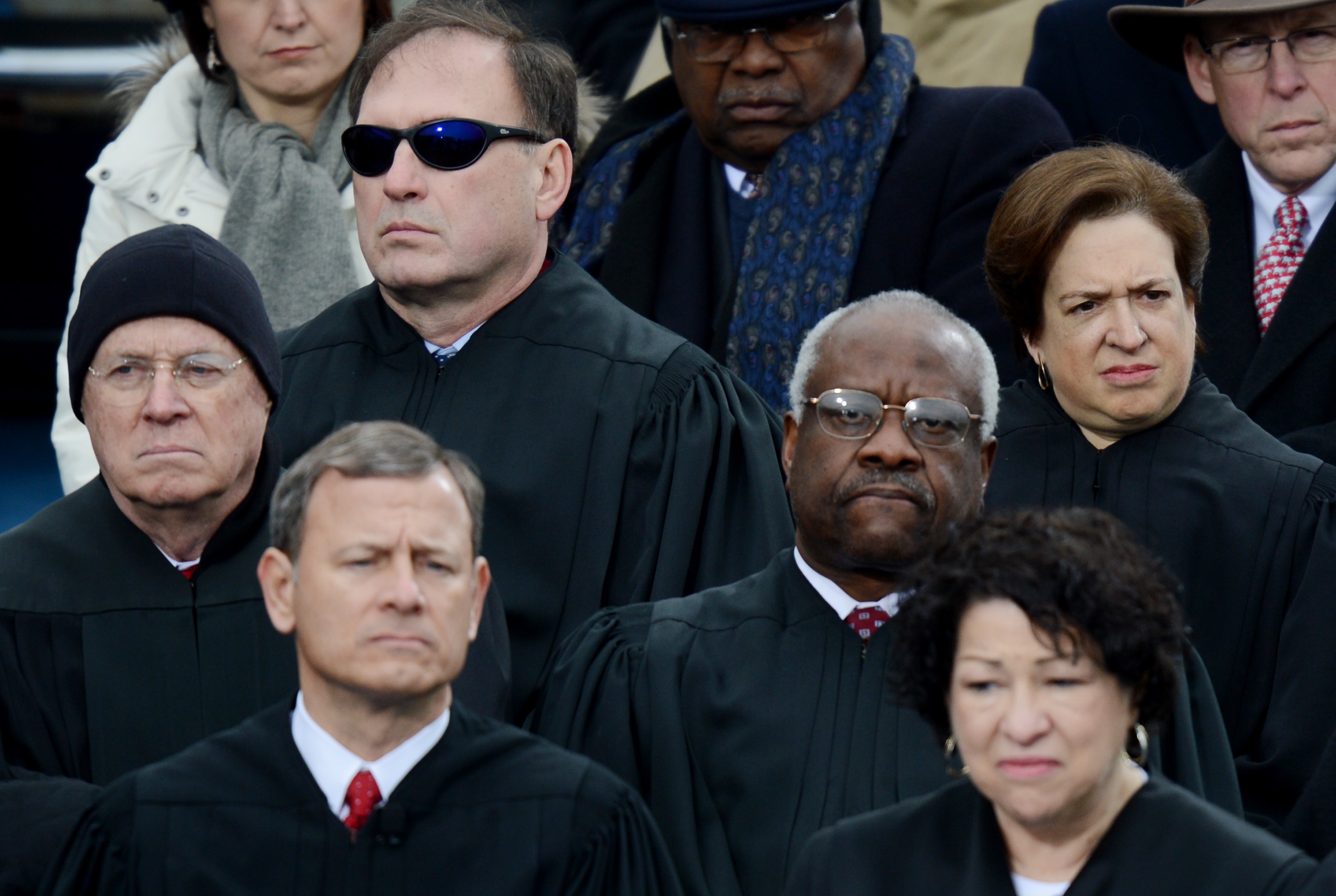
(Photo: Members of the US Supreme Court after US President Barack Obama was sworn-in during the 57th Presidential Inauguration ceremonial swearing-in at the US Capitol on January 21, 2013 in Washington, DC. By Saul Loeb/AFP/Getty Images.)
 The Dish