Colin Fleming insists that its bad rap is unearned:
In jazz, unlike rock, the drum solo is afforded the utmost respect. The genre’s percussionists pore over the work of giants of the form like Art Blakey, and with good reason. Consider Blakey’s solo on “Bu’s Delight” from 1963, a mini-masterpiece of pacing, narrative, and sonic architecture. The cymbals, maintaining the beat from earlier in the track, provide a low-key intro, to which Blakey adds tom rolls that have this spooky, hoodoo vibe to them, something for Macbeth’s witches to dance to. The rolls coalesce into a riff that advances and then retreats, as though feeling out its environment, gaining more confidence in the process, and then giving in to pure and mighty blues funk, a soundtrack to kick up a jig under moonlight. This is the drum solo at its best.
But plenty of jazzers do indulge in the same excess that made so many rock drum solos the kind of thing that Animal skewered on The Muppets, bashing away like a furry Dionysius at the wine fair. Lightyear Entertainment’s recent album of Buddy Rich solos—just solos—illustrates this well. It’s a record meant to blow your mind once and then never be listened to again.
You can do so above. Update from a reader:
With the futbol ongoing in Brazil, I thought you needed more of a Latin tinge – so, live at the North Sea Jazz Festival in 2002, here are: Michel Camilo (Dominican) on piano, the great Horacio “El Negro” Hernandez (Cuban) on drums, and Anthony Jackson (U.S.A.!!) on bass:
Juan Aguirre watches USA play Germany in a World Cup soccer match on one of two large screens placed for fans in Chicago’s Grant Park on June 26, 2014. Organizers expected as many as 20,000 people to watch the game in the park. By Scott Olson/Getty Images. Team USA ended up losing 1 -0 but they still advance to the round of 16.
Allahpundit wonders if there might be some clues in yesterday’sRiley ruling, given the surprisingly intense support Roberts expressed for digital privacy:
Maybe not: Gabe Malor’s right that there’s a difference legally between the cops searching data stored on your own hard drive and searching data (or metadata) you’ve shared willingly with a telecom company. There’s a privacy interest in the former but not, under current precedent, in the latter. Then again, Roberts’s language today really is broad. If the Court’s worried about letting the state tap a bottomless reservoir of information about individuals, they may not care much where the tap is placed. You could, in theory, dispatch with current precedent in one flourish: Since, in our interconnected world, virtually all digital information is disclosed to some entity at some point, the act of disclosure to a telecom company can’t be understood as destroying the individual’s privacy interest in the information.
“After Riley,” Tim Edgar remarks, “the intelligence community has some reason to be nervous”:
In defending its activities, the Obama Administration has pointed—entirely appropriately—at privacy protections, including detailed targeting and minimization procedures, and substantial internal and external oversight. Despite real challenges, these protections are meaningful and far exceed anything that other nations provide to protect privacy in their intelligence activities. The Chief Justice made short shrift of a similar argument in Riley, when the government said it would develop “protocols” to deal with the privacy problems its cell phone searches would create in an age of cloud computing. “Probably a good idea, but the Founders did not fight a revolution to gain the right to government agency protocols,” he said.
As someone who wrote and reviewed many such guidelines for intelligence agencies, I couldn’t agree more! I expect to see this quote in brief after brief, whenever the government says internal safeguards are good enough. There is undoubtedly some heartburn at the NSA on this point. Safeguards and oversight matter. The Supreme Court reminds us that they are no substitute for the Constitution.
But Garrett Epps isn’t ready to make any predictions:
There is already speculation about what, if any, implications this case will have for challenges to the National Security Agency’s amassing and storage of data from Americans’ cell-phone and computer use. It would, I think, be a mistake to read too much into it—nothing in this case implicated national security or terrorism, two government interests to which this Court seems relatively eager to defer—as in Clapper. But it does suggest that the Court that hears that case, when it does, will be more technically savvy than it has been. The John Roberts who wrote Riley will understand why privacy advocates worry about the collection of “metadata” as well as of the contents of calls.
Tally up the disasters: the loss to UKIP and Labour in the European elections; the embarrassment of having hired criminal phone-hacker Andy Coulson for Number 10; a doomed campaign to stop the incoming president of the European Commission; a looming end to the UK with Scotland’s impending referendum on independence; and a favorability rating of 35 percent (behind UKIP’s Nigel Farage at 36 percent).
the very public implosion of [Opposition leader] Ed Miliband. Yesterday, at Prime Ministers Questions, Miliband had the opportunity to humiliate David Cameron over the Coulson conviction. Instead, he ended up humiliating himself. “As the Tory benches cheered and their Labour counterparts grimaced, the wind left Miliband’s sails. After this right hook, Miliband’s technical queries on the civil service could not help sounding flat. Against expectations, Cameron ended the session on top,” reported that fanatical right-wing scandal sheet the New Statesman. Although the Statesman actually got it wrong. The problem for Miliband is that when Cameron came out on top it surprised precisely no one.
Then there’s a shift in mood since the Tories were able to avoid catastrophe in the recent local and European elections, and Labour looked much more wobbly than expected. And a Tory prime minister’s usual foes – his own backbenchers – are quiescent, if only because they see both a potential victory next year but more important a referendum on Britain (sans Scotland, perhaps) leaving the EU. In that Cameron’s failure to stop Carl Juncker winning the European Commission actually helps him in the long run – because it is likely to make the EU even less popular in Britain than it now is. Clive Crook is (rightly) worried:
Cameron’s difficulties over Europe are rapidly compounding. His position requires him to argue that Europe is reformable; Europe is telling the world it isn’t. How many of these rebuffs can Cameron absorb before he has to acknowledge that the U.K.’s choice is not between a new, less centralized union and divorce, but between divorce and the union as it is (only more so)? In effect, he’s already cast aside the argument that Britain has a compelling interest in remaining an EU member on almost any terms. If he believed that, he wouldn’t have promised a referendum in the first place.
Not so long ago, it was unimaginable that Scotland would leave the UK and that the UK would leave the EU. I still think the odds are slightly against both, but no one should bet on it. In which case, perhaps Cameron could survive … but the very structure of the country he governs fundamentally come apart.
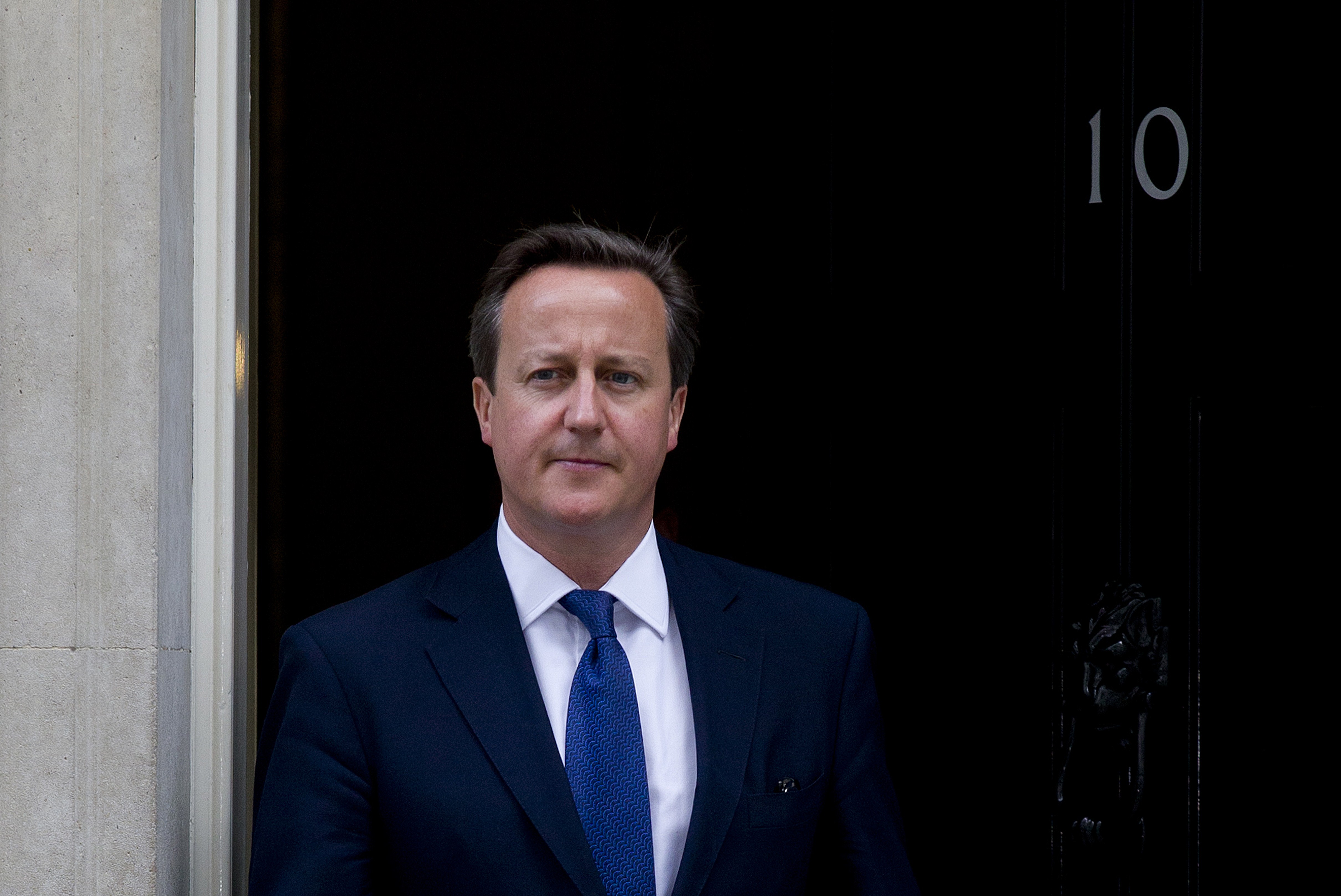
(Photo: British Prime Minister David Cameron leaves 10 Downing Street in London on 18 June, 2014. By Justin Tallis/AFP/Getty Images.)
FX’s new series Tyrant is about the Americanized son of a brutal Arab dictator who returns home for a family wedding and ends up having to stay to run the country. With a premise like that, how could they go wrong? Let’s start with the bad casting:
The problems begin with Adam Rayner, who plays the show’s protagonist, Bassam “Barry” Al Fayeed. After fleeing Abbudin—the fictional country standing in for pre-civil war Syria or Saddam-era Iraq—as a teenager, Bassam has made a life as a pediatrician in Pasadena, trying to forget that his father once used chemical weapons against his own people. After years of estrangement, he reluctantly brings his wife Molly (Jennifer Finnigan) and two children to Abbudin for the first time to attend his nephew’s wedding. (For some reason, Bassam’s wife doesn’t understand why her husband might have a complicated relationship with his war criminal father, and is hoping the two might reconnect.) Bassam is horrified by his family’s corruption and secretly afraid he is no better than them. The role requires an actor who can show the potential for brutality beneath his righteous outrage. Rayner mostly just glowers.
This is particularly disappointing because Rayner is a white, English actor cast in an Arab role. The producers’ claims that they couldn’t find an Arab actor with the skills to carry a show would be easier to forgive if Adam Rayner was giving a Bryan Cranston–level performance. Instead, he’s just a pretty white guy in a suit, easily overshadowed by the (actually Middle-Eastern) actors around him.
There’s not a fleshed-out character in the show, beginning with Barry’s stock-villainous brother Jamal (Ashraf Barhom), who we immediately meet raping a subject with her own husband and children still in her house. To a person, the characters are types: the shallow American kids, the dissolute playboys, the noble protesters and journalists, the cynical advisers, sneering elites and sad-eyed children. The problem isn’t that Tyrant portrays a troubled region as troubled; it’s that it doesn’t use its time to begin to make this world as real as ours.
Eric Deggans also faults the show for trading in stereotypes:
This is a show about the Middle East as seen through Americanized eyes, with little of the nuances in Arab or Muslim culture on display. The unfortunate effect is a constant, not-so-subtle message: If these people would just act like Americans, everything would be so much better. Piled on top of this simplistic dynamic is a series of decisions made by the characters that seem utterly baffling. …
In fact, even though the country is teetering on edge of rebellion during many episodes, no one in Bassam’s immediate family acts as if he is worried about his own safety. And when they arrive in Abbudin, they seem to know almost nothing about the country — as if at least one of them wouldn’t have hopped on Google to read up a little on this dictatorship ruled by their relatives.
“Tyrant” feels less like an act of powerful imagination and more like the recreation of a Generic Middle East (it was shot in Tel Aviv), where everyone is oppressed, except the tacky gluttons who are blowing their money in nightclubs. Everyone speaks in cliches, whether they are defending their right to Dom Perignon or talking about winning over survivors of the regime’s gas attacks or overseas audiences.
And the show, in keeping with the long-running television vogue for explaining repulsive people, veers towards moral relativism. Having established Jamal as a serial rapist, it is genuinely bizarre that “Tyrant” spends subsequent episodes worrying about his sexual health. It is nice that a prep-school aged Barry was horrified by his father’s use of chemical weapons, but against tens of thousands dead, are we really supposed to be this concerned with his feelings?
Arguing against intervention in Iraq, Aaron David Miller downplays the threat posed to Americans:
[I]t is unlikely that it will come to rule Syria or Iraq in full, let alone fulfill its fantasy of creating an Islamic caliphate. … Instead, it is likely that ISIS will become a major counterterrorism problem for the region, and perhaps for Europe. As for striking America, that’s a more complicated issue. It didn’t work out so well for al Qaeda’s central operations, as recent history shows. And as my Foreign Policy colleague Micah Zenko reminds us, in 2013 there were 17,800 global fatalities due to terrorism, but only 16 of those were Americans.Although preventing attacks is the most important foreign policy priority, bar none, terrorism — including from ISIS – just isn’t a strategic threat to the homeland right now.
Ambinder thinks Obama is responding to the threat, such as it is, pretty astutely:
ISIS’ anti-American bluster is worth noting, as are its direct ties to lethal insurgents elsewhere. But surely the way to expedite the fermentation of the next wave of Sunni terrorism is for the U.S. to start fighting Sunnis.
Interestingly enough, the central tenet of President Obama’s counter-terrorism policy is NOT to deny terrorists safe havens. Our counter-terrorism policy is mocked by critics as little more than a game of whack-a-mole. And they’re right. A terrorist pops up here; so here is where you send the drone. Mole whacked. …
If all the terrorists in the world found themselves attracted to a caliphate between Syria, Kurdistan and Iraq, they would make the country a ripe target for later, purposeful intervention by the United States. Right now, the threats to the U.S. are bluster. Keeping a response to an intelligence and special operations force surge to Iraq is a good way to make sure that, whatever happens — and really, there is no way of knowing what ISIS will look like in a month, or two — the U.S. will have its eyes and ears on a potential threat.
But Aki Peritz is worried about “bleedout”, especially in Europe, as Western jihadis come home from the fight:
There are troubling signs that bleedout from the Syria conflict might already be occurring. Just this year, an attack on a Jewish center in Brussels that left four people dead was reportedly the handiwork of a Syrian returnee. In Kosovo last November, local authorities arrested several individuals, including two Syria vets, who were plotting an unspecified terrorist attack. More ominously, French authorities busted another Syrian returnee in Cannes for building a one-kilogram bomb filled with the high explosive TATP—right out of the al Qaeda playbook.
Multiple investigations remain ongoing to determine whether Syrian extremist groups specifically greenlighted any of these operations. But for a jihadist organization to spare 100 or 200 foreign fighters to return to their home countries to carry out operations, however, doesn’t require a stretch of the imagination.
“North Atlantic Skies” is a data visualization of the airline flights across the North Atlantic between Canada, the United States, and Europe in August 2013. The visualization was created by NATS, a United Kingdom air traffic control service provider, and showcases a period of 24 hours with 2,524 flights total. We previously wrote about a similar visualization by NATS of airline flights in Europe.
That’s the measure of this country’s commitment to democratic self-government. The duly elected officials of Washington DC have been moving ahead with plans to decriminalize possession of marijuana, reducing the current penalties from $1,000 and a one-year jail-sentence to a $25 civil fine and a 60-day jail sentence for public smoking. The latest public opinion polls put support for outright legalization in the District at 63 percent:
Washingtonians of every age, race and ethnicity — teenagers and seniors, blacks and whites — registered double-digit increases in support of legalization. Even among those who oppose legalization, nearly half support relaxing punishment for marijuana possession to a fine of $100 or less.
So you have close to unanimity of the city’s residents and voters behind the current proposal. But in America – unlike any other democratic country on the planet – the voters in Washington DC can simply be over-ruled by a handful of congressmen from other parts of the country on the House Appropriations Committee. And so this condescending douchebag from Maryland gets to preach to Washingtonians as if we were incapable of running our own lives:
“Congress has the authority to stop irresponsible actions by local officials, and I am glad we did for the health and safety of children throughout the District,” Representative Andy Harris, the Maryland Republican who proposed the provision, said in a statement.
It’s all for the children! But wait! The House Committee can only remove funding for implementing any such change in the law; it cannot actually change the law. And the only parts of the new law that require funding for enforcement are – yep! -the penalties:
Eliminating the previous criminal penalties … costs nothing. So by preventing funding for DC’s decriminalization law, House Republicans could end enforcement for the few penalties that remain. That would leave DC with decriminalization but no ability to enforce civil fines or jail time — something that looks very similar to outright legalization.
Somehow I doubt that an act of brazen contempt for democracy will lead to a triumph of democracy. The full House will have to vote on this at some point. But, in the last days of Prohibition, you never know.
Update from a reader on Twitter:
@sullydish & don’t forget, they also ban DC from doing needlexchange, which spreads HIV & has caused 1000s of deaths
As the Iraqi president refuses to step down and instead vows to move ahead with forming his own government, Juan Cole sees the crisis deepening:
Al-Maliki rather outrageously accused those who called for him to step down in favor of a government of national unity of de facto allying with ISIS, a would-be al-Qaeda affiliate, and the remnants of the Baath Party that used to rule Iraq in former dictator Saddam Hussein’s day.
At the same time, Ali al-Hatim, leader of the Council of Sunni Tribes, rejected the notion of al-Maliki gaining a third term: “He has to go, like it or not.” He characterized al-Maliki’s rule as “rule by Iran.” He also denounced the present constitution as an “occupation constitution.”
But even if Maliki were willing to step down, replacing him wouldn’t be easy:
“There is no chance of the elites coming together to confront the serious threat to the state that ISIS presents with Maliki at the helm,” said Emma Sky, who served as the political advisor to Gen. Ray Odierno during his tenure as the top U.S. general in Iraq. “The best hope is that the elites agree on an alternative — they have the votes to do so.”
Still, finding a replacement acceptable to all of Iraq’s sects and political parties will be an extraordinarily difficult task because of the number of boxes the potential leader must check. He has to be a Shiite, but not one as harshly anti-Sunni as Maliki. He needs the military know-how to repair Iraq’s battered armed forces and oversee a counterattack against ISIS. To top it off, he needs the diplomatic skills to work with both Washington and Tehran, despite the lingering tensions between the United States and Iran.
Reading between the lines of US strategy, Mark Thompson suspects that Obama is trying to save Maliki but force him to compromise:
It’s simple: the U.S. military generally “sends messages” by attacking. Now it is sending messages by not attacking. And its target this time around isn’t the enemy, but its purported ally running the country.
While the Pentagon officially denies it, the U.S, government is dragging its feet when it comes to defending Prime Minister Nouri al-Malaki’s government in Iraq. … Washington is trying to hit the sweet spot: promise to deliver enough help in the form of air strikes and on-the-ground advisers to preserve Maliki’s government, but make sure it arrives slowly enough that he feels compelled to compromise with the Sunnis and Kurds who are now tearing the country apart.
As far as Joel Wing can tell, the jihadists and their allies have effectively conquered Anbar province:
Radio Free Iraq, which has been keeping track of the security situation in Anbar estimated that up to 85% of the province is now under insurgent control. It is important to note that while the Islamic State has done plenty of fighting in Anbar there are several other major groups involved as well, such as the Baathist Naqshibandi and its Military Councils, Jaysh al-Mujahadeen, many tribes, and others. Together they have made the security forces chase them across Anbar, while seizing town after town.
Just as the Iraqi forces collapsed in Ninewa and parts of Kirkuk and Salahaddin in June, it has done the same in much of Anbar. The border crossings with Syria and Jordan are now under insurgent control, along with much of the area around Fallujah. The militants are now attempting to seize the remaining towns and cities between those two points such as Ramadi, Haditha, and Hit. The security forces, allied tribes, and the militias were already doing a bad job in holding the province before the June offensive started. They have repeatedly gone into the same towns again and again, but then leave allowing the insurgents to move right back in. Now they are fleeing like they have in the rest of the country.
Jordan claims that its border with Iraq is secure, but Jamie Dettmer fears that a third front is about to open up … in Lebanon:
Iraqi Shia militiamen who were in Syria assisting Bashar Assad’s forces mostly in the Damascus suburbs reportedly are returning home to try to battle the Sunni advance against the Shia-dominated government of Prime Minister Nouri al-Maliki. One fighter told AP: “We took part in the fighting in Syria. But now the priority is Iraq.”
The Shia militiamen’s exodus from the fight in Syria – some estimates put their number as high as 30,000 – will leave a gap in the Assad war machine. Firas Abi Ali, an analyst with the risk assessment consultancy IHS, says Hezbollah will likely fill the gap left by Shia militiamen returning to Iraq. But he believes the withdrawal won’t be accomplished quickly, since ISIS controls the land routes, and the departure as it unfolds probably will “reduce the ability of the Syrian government to mount new offensives and place it on the strategic defensive.”
So, for ISIS and Sunni militants there is now every reason to increase the pressure in Lebanon on Iran-backed Hezbollah. And the signs are that they are.
Meanwhile, Lake and Rogin report that ISIS is trying to take over the Balad airbase, Iraq’s largest:
Of course, even if ISIS were to gain control of Balad, there is no guarantee its fighters would know how to operate or maintain the aircraft that are stored there. But an ISIS takeover of Balad would be significant nonetheless. As NBC News reported Tuesday, Iraqi officers say without air support they are on an equal footing with ISIS fighters.
Jessica Lewis—the research director for the Institute for the Study of War and a former U.S. Army intelligence officer who served in Iraq—told The Daily Beast, “It would mean that ISIS can beat the best that the Iraqi Army can muster, not just the northern units that have been ignored. It would mean strategic defeat for the Iraqi Army.”

 The Dish