Can Pakistan Tackle The Taliban?

Last week, the Pakistani military launched a major operation to clear Taliban extremists from the lawless region of North Waziristan, after five years of prodding from the United States. Shuja Nawaz expects it to fail:

Pakistan still lacks any national strategy in which the government and armed forces together fight Islamist militancy and terrorism. In North Waziristan, the army is re-using the blunt force approach it has used before: clear out the local population, then use air strikes, artillery, and ground forces to clean out any insurgents that remain. This tactical, rather than strategic, approach means that the North Waziristan battle will not be definitive, but rather just another fight in Pakistan’s inconclusive long war.

To build a national strategy, Prime Minister Nawaz Sharif’s government needs to bring the military out of what has been a long silence to share with the Pakistani public its vision of what will work. The government must then include the military’s view in a way it has not so far. In February, for example, Sharif’s administration released an embryonic National Internal Security Policy that had been prepared with no visible participation by the military and that has already hit snags in its implementation.

Hassan Abbas fears that Pakistan is underestimating the sophistication of its enemies:

Only recently, Pakistan’s security ‘wizards’ have started realizing that Tehrik-i-Taliban Pakistan (TTP) (the really ‘bad Taliban’) benefits in many ways from logistics, infrastructure and even funding sources of ‘good Taliban.’ What Pakistan still avoids to fully acknowledge is that TTP today is a far more dangerous group than it was when it emerged in late 2007.  Now, its tentacles are reaching deep into Pakistan and it has close links with the remnants of al Qaeda as well as organized crime. …

Pakistan will not be able to defeat, dismantle, and discredit the TTP through military means alone in [the Federally Administered Tribal Areas]. It should be ready to deal with them through civilian law enforcement methods inside the mainstream Pakistan, especially Punjab and Khyber Pukhtunkhwa province. Pakistan’s recent security policy brief shows little indication that it has any plans to invest in reform and modernization of its police and broader criminal justice system. Change in this arena will be the most potent sign of real shift in Pakistan’s counterterrorism policy.

And Muqtedar Khan argues that securing Waziristan should be a regional initiative, not a solo project by Karachi:

The Waziristan region in Pakistan has become a watering hole for extremists who threaten many countries. Besides Pakistan, India, Iran, and Afghanistan have strong interests in eliminating threats that emanate from this area. The problem is that most countries in the region feel that Pakistan is hunting with the hound and running with the hare at the same time. Pakistan’s intelligence is suspected of nurturing many of the same groups for geopolitical reasons even as they threaten its own stability. This perception prevents Pakistan from developing closer relations with its neighbors who have the resources, the will, and the interest to help Pakistan become terror free.

A regional coalition will make the struggle against extremism more potent, more durable and less expensive, but it will take more than deft diplomacy to achieve. Pakistan must convince its neighbors that the alleged ties between the Pakistani state and the Taliban have been severed irreparably.


The Best Of The Dish Today

Glastonbury Festival - Day One

A reader emailed today and included the following passage from DFW’s famed Kenyon Commencement speech that resonated with me as we all try to come to terms with the decisions we have to make in Iraq:

[A] huge percentage of the stuff that I tend to be automatically certain of is, it turns out, totally wrong and deluded. I have learned this the hard way, as I predict you graduates will, too.

Here is just one example of the total wrongness of something I tend to be automatically sure of: everything in my own immediate experience supports my deep belief that I am the absolute centre of the universe; the realest, most vivid and important person in existence. We rarely think about this sort of natural, basic self-centredness because it’s so socially repulsive. But it’s pretty much the same for all of us. It is our default setting, hard-wired into our boards at birth. Think about it: there is no experience you have had that you are not the absolute centre of. The world as you experience it is there in front of YOU or behind YOU, to the left or right of YOU, on YOUR TV or YOUR monitor. And so on. Other people’s thoughts and feelings have to be communicated to you somehow, but your own are so immediate, urgent, real.

This is not a matter of virtue. It’s a matter of my choosing to do the work of somehow altering or getting free of my natural, hard-wired default setting which is to be deeply and literally self-centered and to see and interpret everything through this lens of self. People who can adjust their natural default setting this way are often described as being “well-adjusted”, which I suggest to you is not an accidental term.

Now think of cable news or the instant web cacophony; think of “winning the morning”; think of all the certainty I convey on this blog every day. What I’ve been striving for in this space since the Iraq War began is a way to think about the world that is less about ME and to grasp the realities of global politics in a way that is less about US. What I pray for is an America that is “well-adjusted.”

Posts worth revisiting today: Internet addiction in China and in a brilliant music video; Republican sectarian warfare after Mississippi; another Windsor-fueled breakthrough for marriage equality; and the mental health of animals and Uruguayan football players.

The most popular post of the day was Raging Against Obama – And History; followed by The Whoring Just Keeps Getting Worse, on the latest low in “sponsored content.”

Many of today’s posts were updated with your emails – read them all here.  You can always leave your unfiltered comments at our Facebook page and @sullydish. 15 19 more readers became subscribers today. You can join them here – and get access to all the readons and Deep Dish – for a little as $1.99 month.

See you in the morning.

(Photo: People walk through the site at Worthy Farm in Pilton on the eve of the first day of the 2014 Glastonbury Festival on June 24, 2014 in Glastonbury, England. Gates opened today at the Somerset dairy farm that plays host to one of the largest music festivals in the world. Tickets to the event, which is now in its 44th year, sold out in minutes even before any of the headline acts had been confirmed. The festival, which started in 1970 when several hundred hippies paid £1, now attracts more than 175,000 people. By Matt Cardy/Getty Images.)

Debating “The Case Against 8”

You’ve probably heard more than you want to about this, but if you’re interested in what happened when I engaged its directors – and two plaintiffs – then sit back, and get some popcorn. And if you’re curious about the real history of the marriage equality movement, Evan Wolfson has put together a helpful time-line of ten milestone moments. And you can extend it back a bit in terms of the debate in the gay community all the way to the 1950s, if you care more about context than p.r. Or even back to the 1580s, if you’re alert.

Dissent Of The Day

A reader writes:

Andrew, could you please stop referring to publishers who sell sponsored content as whores? It’s really offensive to whores.

Update from a reader:

This was meant as a joke, but our culture’s ease with the word “whore” and the ease with which sex workers are shamed is despicable. If you want to show someone is really worthless, say they’re a whore. Like the LGBT community, sex workers are a group whose existence challenges traditional sexual relations. Is the reason they are openly scorned that society feels they choose this, and maybe even that they profit? But even if you think that true (it’s not), we shouldn’t deplore a word that carries so much sexist hate.

Men can be whores just as much as women can. But point taken.

Don’t Drive Stoned And Drunk, Ctd

Sullum says Washington’s blood-THC limit effectively prohibits medical marijuana users from driving at all:

Washington’s five-nanogram rule, modeled after the per se standard for alcohol, was meant to reassure voters worried about the threat posed by stoned drivers. But like all per se standards, it treats some people as unsafe to drive even when they’re not.

Last year experiments by KIRO, the CBS station in Seattle, and KDVR, the Fox affiliate in Denver, showed that regular cannabis consumers can perform competently on driving courses and simulators at THC levels far above five nanograms. The lack of correspondence between the new standard and impairment is especially unfair to medical marijuana users, some of whom may be above the five-nanogram limit all the time, meaning they are never legally allowed to drive in Washington. …

“The five-nanogram rule doesn’t make sense,” says Mark Kleiman, a University of California at Los Angeles drug policy expert who was hired to advise Washington’s cannabis regulators. “It doesn’t correspond to impairment, and for regular users, they’re always going to be over the limit. It would be absurd to say you can smoke pot but then you can never drive.”

Along with Kleiman, Amy Weiss-Meyer reviews research on driving under the influence:

In 2000, researchers at Maastricht University in the Netherlands gave driving tests to subjects who had consumed various amounts of alcohol and/or marijuana. While all subjects both drank and smoked in each round of the study, some were given placebos, so that the researchers were able to test the effects of each substance on its own as well as their combined effect. They measured drivers’ “standard deviation of lateral position” (SDLP), or the distance they drifted out of their lane, and also the time out of lane (TOL).

The study found that alcohol on its own increased SDLP by 2.2 centimeters (as compared to double-placebo conditions). Marijuana, depending on the dosage of THC (100 or 200 micrograms per kilogram of body weight), increased SDLP from placebo conditions by 2.7 and 3.5 centimeters respectively. In other words, drivers who had smoked pot were less able to drive in a straight line than drivers with an elevated BAC. (Most drivers’ BACs fluctuated around 0.04 grams per deciliter, below the legal limit of 0.08.)

The researchers concluded that the percentage of TOL was not significantly affected by either alcohol or marijuana alone, but that it was much higher when both substances were used together.

Abby Haglage joins the conversation:

The truth is, after decades of analysis, we still don’t have a firm grasp on how THC impairs driving. Laboratory studies have confirmed that THC (officially, Delta-9-tetrahydrocannabinol) impairs many motor skills necessary for driving. But actual driving simulation studies have not mimicked these results. One sound example is a 2004 study in which three researchers found THC to inhibit attention, reaction time, hand-eye coordination, short-term memory, time and distance perception, and concentration.

But when tested in actual driving simulation, the authors found the results did not “replicate” their laboratory evidence. In other words, researchers were able to prove that THC should, technically, impair driving, but not that it does. Their explanation for the discrepancy: Drivers with THC are likely cognizant of their impairment and are thus able to “compensate…by driving more slowly and avoiding risky driving maneuvers.”

Face Of The Day

Villagers Perform Grebeg  Ritual To Ward Off Evil Spirits

A boy has his face painted in preparation for the Grebeg ritual in Tegallalang Village, Gianyar, Bali, Indonesia on June 25, 2014. During the biannual ritual, young members of the community parade through the village with painted faces and bodies to ward off evil spirits. By Putu Sayoga/Getty Images.

Pain As Privilege

Historian Joanna Bourke, the author of The Story of Pain, recalls that physical discomfort was once thought to be an affliction of the elite:

In many white middle-class and upper-class circles, slaves and “savages,” for instance, were routinely depicted as possessing a limited capacity to experience pain, a biological “fact” that conveniently diminished any culpability among their so-called superiors for acts of abuse inflicted on them. Although the author of Practical Rules for the Management and Medical Treatment of Negro Slaves, in the Sugar Colonies (1811) conceded that “the knife of the anatomist … has never been able to detect” anatomical differences between slaves and their white masters, he nevertheless contended that slaves were better “able to endure, with few expressions of pain, the accidents of nature.” This was providential indeed, given that they were subjected to so many “accidents of nature” while laboring on sugar-cane plantations. …

But what was it about the non-European body that allegedly rendered it less susceptible to painful stimuli?

Racial sciences placed great emphasis on the development and complexity of the brain and nerves. As the author of Pain and Sympathy (1907) concluded, attempting to explain why the “savage” could “bear physical torture without shrinking”: the “higher the life, the keener is the sense of pain.” There was also speculation that the civilizing process itself had rendered European peoples more sensitive to pain. The cele­brated American neurologist Silas Weir Mitchell stated in 1892 that in the ‘process of being civilized we have won … intensified capacity to suffer.” After all, “the savage does not feel pain as we do: nor as we examine the descending scale of life do animals seem to have the acuteness of pain-sense at which we have arrived.”

Naturally Nonsense

Brad Plumer considers the absurdity of labeling food as “all-natural”:

In a recent essay in PLOS Biology, [Cambridge geneticist Ottoline] Leyser argues that it’s time to kill this mistaken idea once and for all. Basically everything in modern agriculture is unnatural. “The cereal crops we eat bear little resemblance to their naturally selected ancestors, and the environments in which we grow them are equally highly manipulated and engineered by us,” she writes. “We have, over the last 10,000 years, bred out of our main food plants all kinds of survival strategies that natural selection put in.”

There’s more along these lines. “Agriculture is the invention of humans,” she adds. “It is the deliberate manipulation of plants (and animals) and the environment in which they grow to provide food for us. The imperative is not that we should stop interfering with nature, but that we should interfere in the best way possible to provide a reliable, sustainable, equitable supply of nutritious food.”

Roberto Ferdman provides a chart on the subject:

The list of lucrative food labels is long, and, at times, upsetting.

Food-labels

Many of these labels are pasted onto food packages for good reason. It’s imperative, after all, that consumers with celiac disease be able to tell which food items are gluten free, or that those with milk allergies be able to tell which are made without lactose.

But some are utterly meaningless. Take food labeled with the word “natural,” for instance. Actually, remember it, because it’s probably the most egregious example on supermarket shelves today. The food industry now sells almost $41 billion worth of food each year labeled with the word “natural,” according to data from Nielsen. And the “natural” means, well, nothing. The US Food and Drug Administration (FDA) doesn’t even have an official definition or delineation of what “natural” actually means.

Update from a reader, who passes along a classic Carlin skit on the subject:

Another reader takes issue with Ferdman’s reference to people with “milk allergies”:

Please, please don’t continue to spread the misconception that lactose intolerance has any relationship whatsoever to genuine allergy. It contributes to widespread misunderstanding of what allergies are, and, in particular, how serious genuine allergic reactions can be.

Lactose intolerance is a digestive disturbance. It is very unpleasant and uncomfortable – and definitely something to be avoided. I am afflicted myself and I know what I’m talking about here. But, accidental ingestion of lactose is not a life-threatening situation.

Genuine allergic reactions, on the other hand, can definitely be life-threatening. Every year there are reports of deaths due to genuine allergic reactions to accidental ingestion of peanuts or shellfish. Applying the term “allergy” to conditions that are nowhere near life-threatening trivializes the word and makes education of the public much more difficult.

ISIS’s Frenemies

In a lengthy and penetrating look into the Syrian roots of the current conflict in Iraq, Rania Abouzeid discusses ISIS’s fraught relations with other militant groups:

ISIL couldn’t work with others in Syria, so how long before it turns on, or aggravates, its new Iraqi allies? ISIL’s code of conduct for Mosul’s Nineveh province, posted just two days after insurgents seized the area, provides one indication. Its repressive rules are the SYRIA-CONFLICT-NUSRAsame as those it has enforced in Raqqa: obligatory prayers five times a day in mosques; women must dress modestly (i.e., in a balloon-like black cloak and face-covering veil) and should only leave their homes in emergencies; and all shrines should be destroyed, among other edicts. Unlike Nusra, it hasn’t learned to prioritize the importance of gaining popular support.

But the fate of ISIL is far from the only question. Will Nusra and other Syrian rebel groups try to make some sort of large-scale move against ISIL positions in Syria now that the group is preoccupied in Iraq? Will Nusra lose members to a group whose Islamic state is increasingly taking shape? How will Zawahiri react? He is unlikely to capitulate to ISIL, but nor can he much criticize a group that is implementing the ultimate goals of his own organization. Could al Qaeda try to prove its relevance through new attacks? Does it still have the capability?

Will Saletan breaks down how ISIS violates all of Osama Bin Laden’s rules for Jihad:

Bin Laden was a theocratic fundamentalist, but he cautioned his allies to avoid the “alienation from harshness” that was “taking over the public opinion.” The worst offender was Somalia’s al-Shabab. In a 2011 letter, Bin Laden urged Atiyah to “send advice to the brothers in Somalia about the benefit of doubt when it comes to dealing with crimes and applying Shari’a, similar to what the prophet (PBUH) said, to use doubts to fend off the punishments.”

When ISIS captures a city, it follows this rule at first. But soon, the nice-guy act disappears. The group seizes property and humanitarian aid. It executes Christian and Muslim “apostates.” Two days after taking Mosul, Iraq’s second largest city, ISIS banned booze and cigarettes, instructed women to stay home, and announced that government employees who failed to repent would be put to death. This behavior antagonizes Sunni fighters who have collaborated with ISIS. “In some areas that ISIS has taken they are killing our people, they are imposing their Islamic laws on us,” one tribal leader told the New York Times. “We do not want that.”

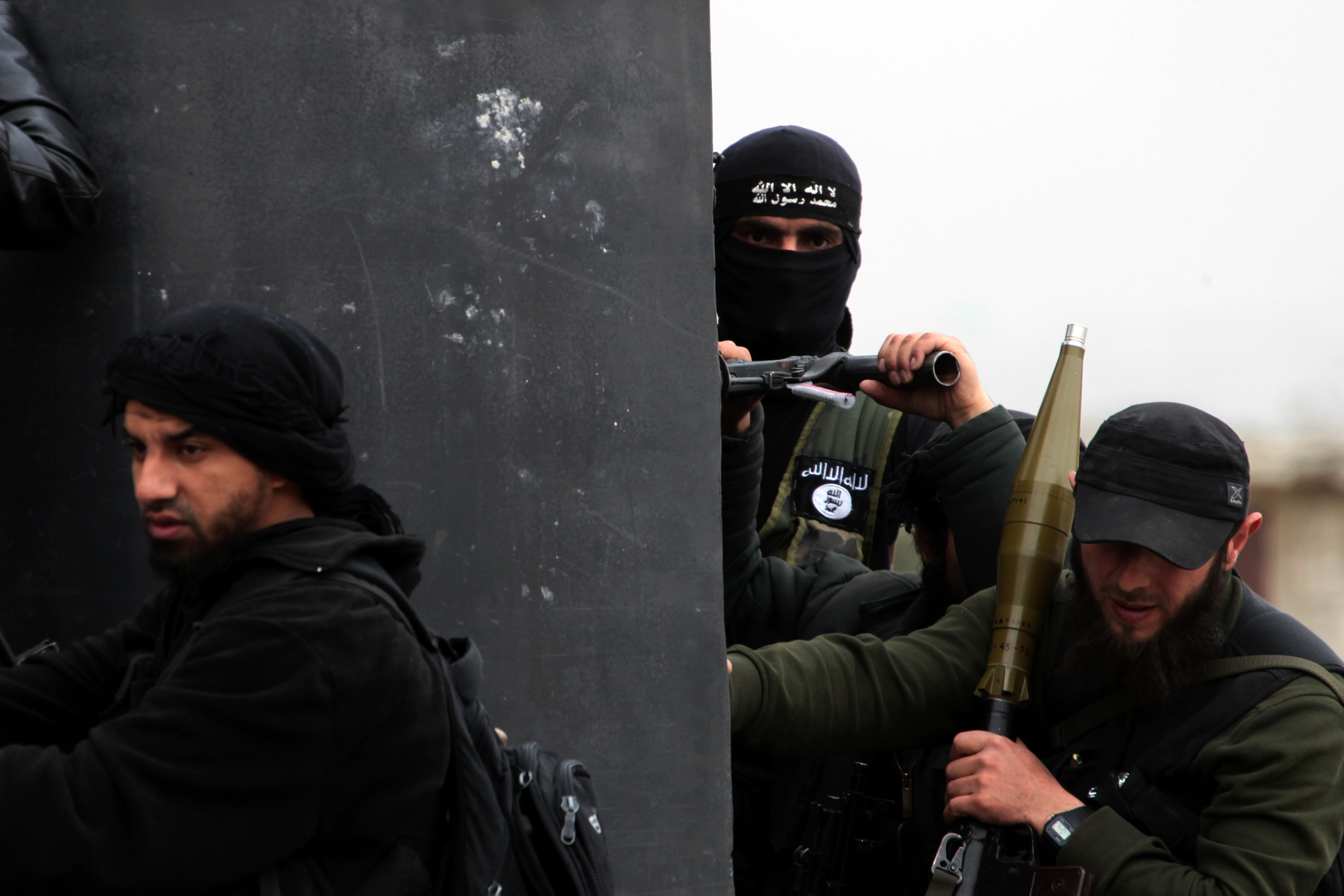
(Photo: A Turkish fighter of the jihadist group Al-Nusra Front, bearing the flag of Al-Qaeda on his jacket (C-back), holds position with fellow comrades on April 4, 2013 in the Syrian village of Aziza, on the southern outskirts of Aleppo. By Guillaume Briquet/AFP/Getty Images.)