The New York Times reports today that “this cycle, three gay Republicans running for Congress … are featuring their significant others in campaign ads, a first for a gay congressional candidate from either major political party.” Less surprisingly: The races are in Massachusetts, New Hampshire, and California, all against Democratic incumbents, and with only one facing a primary. Still!
Money quote from the NYT piece:
“Republican candidates are saying it loud,” said Mark McKinnon, a Republican strategist. “They’re out and they’re proud enough to feature their partners in ads, which I think just reflects how fast this issue is moving across the American political spectrum.”
Are Democratic gay candidates still in a defensive crouch at this point?
In a WSJ op-ed late last week, Rand Paul finally showed his cards on Iraq, taking the neocons to task and invoking Reagan to make a case for not taking sides in the Iraq conflict. On Meet The Press yesterday, he defended his position, turning Cheney’s unhinged criticism of Obama back on the former vice president himself:
Money quote:
“I think the same questions could be asked of those who supported the Iraq War,” Paul said. “You know, were they right in their predictions? Were there weapons of mass destruction there? That’s what the war was sold on. Was democracy easily achievable? Was the war won in 2005, when many of these people said it was won? They didn’t really, I think, understand the civil war that would break out.”
Matt Welch compares Paul’s positions to those of the Cheneys:
The contrast is striking here not just in policy content but in tone. The Cheneys snarl about “appeasing our enemies,” “abandoning our allies,” and “apologizing for our great nation,” as if it was the 2004 Republican National Convention all over again. Paul, with the exception of one somewhat intemperate paragraph asking “Why should we listen to them again?”, approaches the question with an assumption of personal and national humility, a sense that American knowledge of (and power to shape) fluid events in the Middle East has limitations, as does American appetite for making the kind of commitments that the Cheneys of the world constantly seek … This is a pretty clearly defined fork in the road for GOP foreign policy.
When asked about Paul’s comments, Cheney said his position hasn’t changed: “I was a strong supporter then of going into Iraq, I’m a strong supporter now.” (He was more vague about what exactly the U.S. should be doing in Iraq now, aside from it being the opposite of whatever President Obama is doing.) “If we spend our time debating what happened 11 or 12 years ago, we’re going to miss the threat that is growing and that we do face,” Cheney continued. “Rand Paul, with all due respect, is basically an isolationist. He doesn’t believe we ought to be involved in that part of the world. I think it’s absolutely essential.”
Later, Cheney said he hasn’t decided who he’ll support in 2016, but suggested it won’t be Paul. “Now, Rand Paul and — by my standards, as I look at his — his philosophy, is basically an isolationist,” he said. “That didn’t work in the 1930s, it sure as heck won’t work in the aftermath of 9/11, when 19 guys armed with airline tickets and box cutters came all the way from Afghanistan and killed 3,000 of our citizens.”
Look at the formulae that Cheney recites. He can’t actually address the debate over the Iraq war; he just reiterates his own position then and now. You get the impression he hasn’t actually had a single conversation in person challenging his rigid mindset since the war began. And once again, it’s the One Percent solution. When you posit a threat of apocalyptic devastation far beyond even the horror of 9/11, the cost-benefit analysis will always come down to maximal action everywhere and anywhere. But he hasn’t for a second absorbed that this apocalyptic vision was precisely what was debunked by the Iraq War.
There were no nukes or chemical weapons coming for us. They existed solely in Dick Cheney’s imagination. Thanks to Obama’s deal with Putin, there are also no WMDs left lying around the battlefield for ISIS to pick up and use. The alternative to getting the hell out of a region where we have only sowed chaos and sectarian warfare to no measurable gain is the boogey-man of “isolationism.” You have to conclude that Cheney is intellectually dead. Nothing that happened in the last fourteen years has made even the slightest dent in his terrorized worldview. Sometimes I wonder if Cheney was seriously traumatized by 9/11 in ways even more profound than the rest of us – it occurred on his watch, after all, and he was the recipient of all sorts of terrifying intelligence in the months that followed. But to have reacted by never moving on from his own terror on 9/12 is not a position. It’s a condition.
Meanwhile, Kilgore finds it odd that Paul references Reagan’s defense secretary, Caspar Weinberger:
Cap was less famous for his “doctrine” than for his persistence in securing the highest level of defense spending imaginable. In his endlessly fascinating account of the budget wars of Reagan’s first term, The Triumph of Politics, David Stockman all but calls Weinberger a traitor for his mendacious and successful efforts to trick Ronald Reagan into double-loading defense increases into his seminal 1981 budget proposal. This is one part of the Reagan-Weinberger legacy Paul will probably not want to emulate. And it matters: the most obvious way to convince reflexively belligerent Republicans that he’s kosher despite opposing various past, present and future military engagements would be to insist on arming America to the teeth. But Paul’s government-shrinking visions would make that sort of gambit very difficult. And try as he might, it will be very difficult for Paul to make a credible claim Ronald Reagan stood tall for taming the Pentagon.
The hawks are having a field day, of course. Here’s Rubin:
Understand that he doesn’t merely say we shouldn’t put boots on the ground; he argues that we don’t have an interest in the outcome. He manages to get through an entire op-ed without recognizing that a state dominated by the Islamic State of Iraq and Syria (ISIS) would represent a bigger threat to the United States than Afghanistan did pre-9/11. Paul observes that the Iraq war was harder than anticipated but ignores the success of the surge and the peaceful, stable state in which the George W. Bush administration left Iraq. He also borrows President Obama’s false talking point that we couldn’t leave forces there. (Paul incidentally doesn’t understand or is deliberately misleading readers when he says our actions in Syria contribute to the rise of ISIS there; in fact, had we swiftly pushed out Syrian President Bashar al-Assad, there would have been no – zero – ISIS fighters there.)
Jim Manzi recently repeated his belief that government-funded innovation is the best weapon we have against climate change. Chait accused Manzi and his ilk of being all talk. Samuel Thernstrom of the Energy Innovation Reform Projectsticks up for Manzi:
It is true that one of the unfortunate costs of the Obama administration’s ill-advised investments in Solyndra and other bad bets in their effort to pick winners in the market of energy technologies was an erosion of conservatives’ longstanding support for basic R&D. (ARPA-E is actually an outgrowth of a George W. Bush administration initiative to create “innovation hubs” at DOE.) But despite the backlash, the picture is not nearly what Chait paints: My organization works with conservatives on these issues and our experience is that there is an enormous appetite for these ideas—but the most frequent objection I hear is the widespread disbelief that liberals would ever accept them. Reading Chait, you can see why they feel that way.
If liberals want conservatives to join them in causes like climate change, they would be wise to spend some time thinking about whether there is anything that they can do to make the proposition more appealing. My organization favors funding for ARPA-E — but before we ask Americans to give the Department of Energy more money, let’s restructure it to make it an agency that’s capable of spending money effectively. Secretary Moniz has actually taken some steps in the right direction recently, which I applaud. Imagine what could be done if that work was actually the focus of the administration’s efforts rather than its quixotic charge at carbon regulations. The Department of Energy should be at the forefront of our climate response, not the Environmental Protection Agency — and Chait is wrong to think that we don’t need to recognize that.
Dov Zakheim pushes Washington to recognize the Kurdish claim to independence, but he doubts the administration will go for it:
The pro-Western, anti-Islamist Kurds are America’s natural allies. During the nineties, they were the focus of American support while Saddam Hussein was in power. Yet the administration remains reluctant to exert itself on their behalf, and, in particular, to help modernize their military equipment.
For their part, however, the Kurds, having seized Kirkuk, their historic capital, are determined both to control that city and their long-term fate. They will press for independence if the sectarian fighting continues to rage south of their border. The Obama administration, which quickly recognized a far less stable South Sudan, should recognize the new Kurdish state. Given its willingness to work even with Iran in order to prop up the central government in Baghdad, however, it is unlikely to do so, prompting Kurdish resentment that will not easily be mollified.
But the case for Kurdistan isn’t as clear-cut as Zakheim wants it to be. The Bloomberg editors make the opposing argument:
U.S. President Barack Obama [last] week explained why keeping Iraq whole and stable is a U.S. national security interest. Kurdistan’s secession would make an extended and destabilizing sectarian war to redraw the borders of the Middle East, from Jordan to Iran, more likely.
So what can officials in Baghdad and Washington do to persuade Kurds to remain part of Iraq?
They might start by noting how difficult it can be for internationally unrecognized states to thrive. Iran and — depending on the response of Turkey’s Kurdish minority — Turkey could turn on a self-proclaimed Kurdish state, making for a tough and lonely existence.
Iraq’s central government, encouraged by the U.S., should also demonstrate that it accepts the new reality that has emerged since the collapse of the army in Mosul. The Kurds will not walk away from oil-rich Kirkuk, and that should be reflected in Iraq’s internal borders. Nor should they be expected to continue to submit to an arrangement for sharing oil revenues, enshrined in the Iraqi constitution, that centralizes all control and payments in Baghdad.
Meanwhile, the newly assertive Kurds seem to be doing whatever the heck they want, such as delivering oil to Israel:
In a step that cements the impression of a de facto independent Kurdistan, a million barrels of Kurdish oil were delivered to a client in Israel today, despite threats by Baghdad to sue anyone buying it. The US government, fearing another blow to embattled Baghdad, had also worked to prevent anyone from buying the oil.
Reuters broke the story in a scoop, followed a few hours later by a statement on the Kurdish government website. “We are proud of this milestone achievement, which was accomplished despite almost three weeks of intimidation and baseless interferences from Baghdad against the tanker-ship owners and the related international traders and buyers.”
The relationship between the Kurds and Israel is by no means new, though it has never been formal. It also appears that the oil delivered to the Israeli port of Askelon is likely not destined for use locally but rather for storage and eventual shipment elsewhere. For the Israelis, though, it is a key part of a strategy to deepen relations with the Kurds of Iraqi Kurdistan, as well as access new supplies of energy.
For the Kurds of course the implications are potentially profound. The ability to export oil at scale entirely outside the control of the Iraqi central government is a huge step toward de facto independence, whether or not the Kurds took the step of formally severing ties with Iraq.
Arguing that the United States “was built on debt,” Claude S. Fischer takes a benign view of our borrowing and spending, especially countering those who blame it for the recent financial crisis:
The Americans who couldn’t get a bailout took on loans for what they thought were the right reasons. Yes, between 1989 and 2007, with more and more businesses accepting credit cards, Americans roughly tripled their credit card debt, a $2,300 rise in outstanding balances per family. But the swell of debt is almost entirely accounted for by the cost of housing, which grew as more Americans became homeowners. In those same years, 1989 to 2007, Americans increased their mortgage debt by an average of $46,000 per family. One may protest that Americans bought “too much house,” but in an era of stagnant wages, houses stood out as good investments. And, until the bubble burst, they were. Americans were not engaged in a bacchanal of self-indulgent borrowing. The percentage of family debt incurred for “goods and services” hardly changed between 1989 and 2007. Americans were buying—or borrowing—into the smart-money strategy of real estate ownership.
After the bubble burst, between 2007 and 2010, credit card balances dropped by about $800 and mortgage debt by about $3,500 per family. The biggest change lately in the debt burden has been a rapid increase in borrowing for education, which is also investment rather than consumption, and is driven not by private habits of excess but by college and state government budgets.
Later this month, the Whitney will unveil its major retrospective on Jeff Koons. In a profile, Ingrid Sischy notes that, for an artist whose auction sales totaled $177 million in the last year, Koons seems to care little about cash:
Barbara Kruger, the artist whose unsentimental pronouncements have been cutting to the chase about the art world for decades, says “Oh boy” when I call to discuss Koons, whom she has known since they both were starting out in New York. She needed to think about it and later wrote me: “Jeff is like the man who fell to earth, who, in this grotesque time of art flippage and speculative mania, is either the icing on the cake or some kind of Piketty-esque harbinger of the return of Brecht’s ‘making strange.’ Or a glitteringly bent version of that alienated vision. He brings the cake and lets them eat it.”
Kruger’s reference to Thomas Piketty, the French economist whose book [Capital in the Twenty-First Century] on the current chasm between the very rich and the very poor has become a cultural touchstone, is part of the whole picture; this social reality is what one can’t help thinking about when one hears about the prices of contemporary art today, especially the sums that Koons’s works are fetching.
The odd thing, as many who know Koons, including Kruger, will say, is that money doesn’t interest him. … In Koons’s public life there is no showy “I am rich” stuff. Money is mostly a means to an end for him to create his art. What he does need is wealthy patrons. [Curator Scott] Rothkopf, whose retrospective is blessedly clear-eyed, puts it this way: “If it is going to cost several million dollars to produce new work, he has got to martial the resources from wealthy patrons to produce this thing. He has to convince extremely wealthy people, via art dealers, to buy into the dream of this perfect object.”
In an interview about his forthcoming book, Empty Ideas: A Critique of Analytic Philosophy, Peter Unger sighs over the pretensions his field, arguing that “when you’re doing philosophy, you don’t have a prayer of offering even anything close to a correct or even intelligible answer” to the big questions of metaphysics, epistemology, and the like. So why pursue it? He maintains that “for lots of people there’s fun in doing philosophy”:
With a certain proviso, philosophy is an enjoyable form of literature, at least for people of a certain training and temperament.
The proviso is that a fair amount of it contains special symbols instead of words, so that it looks like some sort of scientific thing, almost like an equation. Mathematics, symbolic logic, so on and so forth. So philosophers put that in, and give themselves the impression that they’re doing things ‘ohhh, so scientifically’ that they need the math. All this makes it much less enjoyable to me. I don’t like reading that stuff. But insofar as we can get over all of that useless and pretentious writing, it’s an enjoyable sort of literature, if they take the time to make it reader-friendly.
Take Derek Parfit’s book, Reasons and Persons. It’s in four parts. The first part is not enjoyable to read, because he talks about a lot of theories which he labels with letters. You can’t keep it straight, you need a scorecard next to the page. But the other three parts don’t have that, and they’re tremendously enjoyable to read — at least for some people who have some training in philosophy, and have the temperament for it. It’s wonderful stuff, fascinating stuff.
Reasons and Persons is extremely enjoyable. But does Parfit ever discover anything? No, not at all. Does he ever make credible, interesting new statements about concrete reality? No, not even close. But it’s very enjoyable literature for very many people.
The authors of a forthcoming paper in Psychological Science investigated “whether learning about neuroscience can influence judgments in a real-world situation: deciding how someone who commits a crime should be punished.” Tania Lombrozo explains the experiment:
The motivating intuition is this: to hold someone responsible for her actions, she must have acted with free will. But if her actions were the result of brute, mechanical processes that fully determined their effects — a view that a neuroscientific understanding of the mind might engender — then she didn’t have free will, so she shouldn’t be held morally responsible or punished too harshly. … [I]f learning about neuroscience suggests that the world is deterministic, and if determinism is judged incompatible with free will, then learning about neuroscience could have implications for how people assign moral responsibility and dole out retributive punishment.
To test these ideas, the researchers had participants read articles that were either about neuroscience or about other topics (nuclear power, natural headache remedies). The neuroscience articles highlighted the mechanistic, neural bases for human decisions….
After the participants read the neuroscience articles and the alternatives, researchers presented them with “a seemingly distinct study for which they read about a student’s violent crime” and asked them to assign a punishment:
The researchers found that, on average, participants who read the neuroscience articles assigned shorter prison sentences to [student Jonathan] Scarrow and found Scarrow less blameworthy than those who read the other articles. Bolstered by three additional studies reported in the paper, the findings suggest that learning about neuroscience reduces belief in free will, which in turn makes people less inclined towards retributive punishment.
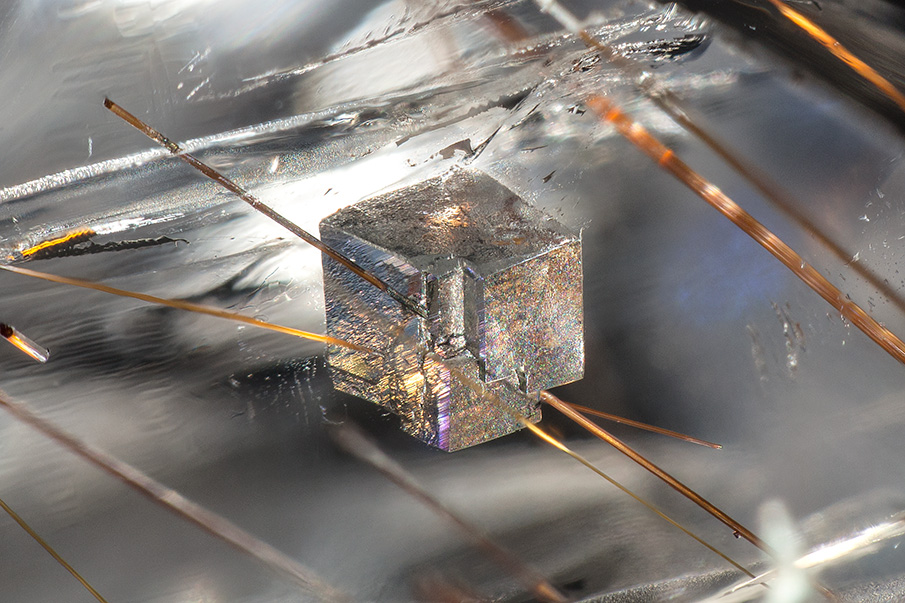
Danny Sanchez photographs the microscopic interiors of gems:
For all the infinite vastness of the universe we’ve seen through telescopes, the world seen under a microscope also reveals some pretty alien-looking vistas. Like the tiny cosmos hidden inside gemstones, a realm that photomicrographer Danny Sanchez captures in striking photographs.
“When I first started looking through the microscope at gemstones, it was all space to me,” says Sanchez, who’s spent the last eight years learning to examine and photograph gemological interiors. “It was all the limitless imagination of outer space.”
Sanchez’s images reflect an awe for the cosmos, and the aesthetic influence of science fiction. Shattered remnants of a doomed planet emerge from microscopic rutile embedded in sapphire; the pyramidal pyrite shell of some ancient being drifts in geological time; a mountainous horizon hidden in a nugget of quartz looks absolutely extraterrestrial. The photos recall sci-fi visionary John Berkey.
See more of Sanchez’s work, which is for sale, here.
(Photo: “Dolomite in quartz (1). Field of view = 5.2mm”)



 The Dish