Will Amazon Set The Mobile Market On Fire?

Christopher Mims thinks not:

The central problems with the Fire, the factors that will kill its sales as surely as they have held Windows Phone to single digit market share in North America, are these:

1. People are loath to switch from the phones they already have, and in the process abandon all the apps and media they’ve bought.

2. The North American market for smartphones–and especially the market for high-end smartphones like the Fire – is heavily saturated, which means there are hardly any new users out there who might adopt the Fire as their first phone.

3. Fire can’t access the existing pool of Android apps. It’s missing critical ones like Uber (Bezos says it’s coming) and Snapchat (no word on when it will appear).

Yglesias worries that the new Fire Phone is too high-end for its own good:

Jeff Bezos’ company has a unique opportunity to come into the smartphone space with a strategy that’s not symmetrical to what other people are doing. Amazon’s phone is first and foremost a physical extension of Amazon-the-store. That argues for a strategy built around a cheap, zero-margin phone that aims to undercut the existing market leaders.

Instead, Amazon seems to be trying to beat the market leaders by adding a bunch of snazzy 3D features to what we’ve come to expect from a high-end smartphone. They’ve even gone out of their way to slightly exceed iPhone 5S specs as far as I can tell. The only price edge Amazon is offering is one year’s worth of Prime membership for free. But this, too, seems backwards. Rather than making Prime a benefit of phone ownership, why not make a cheap phone a benefit of Prime membership?

Manjoo concurs:

For Amazon, a company whose previous devices have had innovative pricing plans that often involved selling devices at cost, the Fire phone’s uninspired price tag is a surprising disappointment. The world needed a great, cheap smartphone.

But Vauhini Vara is tickled by some of the high-end features:

[I]t can do a bunch of charming tricks that are, in fact, like something out of a futuristic “Dick Tracy.” It can change the perspective in games in response to your head movements, make images appear almost as if they were in 3-D (though it isn’t actually 3-D, as some had predicted it would be), and scroll through the content on a Web page – say, a newspaper article – when you tilt it. … People seem to be finding its phone’s newfangled features pretty cool – cool enough, maybe, to get them to switch over from the iPhones and Samsung Galaxies that, after all, haven’t offered much in the way of new whiz-bang gadgetry over the past couple of years.

And Timothy B. Lee believes Amazon made one shrewd move:

The Fire Phone includes an app called Firefly that helps users identify things they point their cameras at, from books to paintings. For some items, Firefly will present useful information, like the Wikipedia page for a famous painting. If it’s an item Amazon sells, Firefly will let you click to buy it.

This should terrify brick and mortar retailers. They have long worried about “showrooming,” the practice where customers will find a product in a physical store (like Best Buy or Home Depot) but then order it from Amazon where the price is lower. Showrooming isn’t new – journalists have been writing trend pieces about it for years. But Firefly promises to make the process effortless.

The Battle Over Iraq’s Oil, Ctd

David Unger checks up on the battle over the Baiji oil refinery, Iraq’s largest:

An Iraqi government spokesman told Reuters midday Thursday that the refinery was in their “complete control,” but other reports cite witnesses and refinery employees as saying Sunni rebels remain in command. The jihadists, led by the Islamic State of Iraq and the Levant (ISIS), likely aim long term to use revenue from fuel sales to finance terror operations across the region.

The Baiji refinery supplies motor fuel for northern Iraq and can process around 310,000 barrels a day, fed by oil fields in the autonomous Kurdistan region. It also fuels a nearby power plant that provides electricity for Baghdad, which already suffers from outages. … The flow of oil to the refinery is already off-line, according to Thamir Uqaili, an oil and gas consultant who worked in Iraq for the Iraq National Oil Co. and Iraq’s Ministry of Oil for over 40 years. If it remains damaged or off-line, it will create a shortage of products that cannot be replaced quickly, Mr. Uqaili writes via e-mail.

Frank Verrastro and Sarah Ladislaw look at what the Iraq crisis, in combination with other world events, means for world oil markets:

At present, the combination of the loss of Libyan, Nigerian, Venezuelan and Iranian oil production for various reasons, the uncertainty surrounding Russia’s gambit in Ukraine and the prospects for further reductions (seasonal maintenance, hurricanes, etc.) as we enter the second half of the year point to potentially tighter markets and higher prices (EIA’s Short term energy outlook for  June identified some 2.6 mmb/d of unplanned supply disruptions from OPEC sources and an additional 720 mmb/d of non-OPEC volumes).

Further, since Iraq was expected to contribute a large portion of near term incremental OPEC increases, sustained or enhanced violence would undoubtedly limit investment and volumes going forward.   And while Saudi Arabia still maintains over a million barrels per day of spare capacity and could offset some of the loss of larger Iraqi volumes, a complete loss of Iraqi exports would require more drastic measures – like the release of strategic stocks – in order to prevent prices from spiking.

From Steve LeVine’s viewpoint, it means a return to Saudi oil:

Until a couple of years ago, some Saudis spoke of adding yet another 2.5 million barrels a day of capacity, giving them 15 million in all. But if there ever were such plans officially, they have been shelved since the recent US shale revolution added millions of barrels a day to US production. In April, the US produced 11.2 million barrels (paywall) of oil and gas liquids a day, the most since 1970. It has been said that, four decades after the Arab oil embargoes, the US will soon become an oil exporter and no longer beholden to the Persian Gulf, and specifically Riyadh.

But a series of geopolitical disruptions including in Libya and Nigeria have canceled out those gains. And after the upheaval in Iraq analysts now believe that such disruptions will remain a factor for many years. If that is the case, Saudi Arabia’s oil will again be central to the global economy. Specifically, the world may need Riyadh to invest the billions necessary to increase its production capacity to 15 million barrels a day.

James West notes that the US is much less dependent on Iraqi oil than it was a decade ago:

But the U.S. is still tied to global oil markets, and that means what happens in Iraq can have an economic impact here. One thing every expert I spoke to agreed on is this: Even with decreasing oil imports, the U.S. is inextricably linked to world markets. That means that if the situation in Iraq continues to deteriorate, the U.S. economy may not be immune.

“The cost to the United States of a big oil shock … will be lower than they were [in the past],” [John] Duffield said. “Our main vulnerability is not so much the direct impact on oil, but the impact on the rest of the world’s economy, if there’s a big oil supply disruption.” He added that “as long as the world oil market is pretty highly integrated, the U.S. is vulnerable to an oil supply disruption in the Middle East or the Persian Gulf, regardless of the amount of oil it imports from the region.”

A Divider, Not A Uniter

Alec MacGillis finds it “difficult to envision how Walker would broaden his party’s national appeal beyond the same shrinking pool of voters that Romney drew from”:

Unlike Mitt Romney, or, for that matter, John McCain, he is beloved by the conservative base, but he has the mien of a mainstream candidate, not a favorite of the fringe. His boosters, who include numerous greenroom conservatives in Washington and major donors around the country, such as the Koch brothers, see him as the rare Republican who could muster broad national support without yielding a millimeter on doctrine.

This interpretation of Walker’s appeal could hardly be more flawed. He has succeeded in the sort of environment least conducive to producing a candidate capable of winning a national majority. Over the past few decades, Walker’s home turf of metropolitan Milwaukee has developed into the most bitterly divided political ground in the country“the most polarized part of a polarized state in a polarized nation,” as a recent series by Craig Gilbert in the Milwaukee Journal Sentinel put it.

If that isn’t enough to bring Walker fans down to earth, maybe this news will:

Prosecutors say Wisconsin Gov. Scott Walker is at the center of a “criminal scheme” to coordinate fundraising with conservative groups across the country, according to documents revealed on Thursday.

The documents were unsealed Thursday by order of a federal judge as part of a lawsuit that sought to block a secret state investigation, known as a “John Doe probe,” into the 2012 gubernatorial recall elections, which the incumbent Walker won. In the filing, the prosecutors say Walker, his chief of staff Keith Gilkes and another top adviser illegally coordinated with national conservative groups and national figures including GOP strategist Karl Rove. Rove’s assistant said he was traveling Thursday and couldn’t comment.

Philip Bump maps the alleged coordination.  Andrew Prokop doesn’t expect charges anytime soon:

Overall, the documents released Thursday provide new information on the case prosecutors sought to make, and what evidence they initially had. But they don’t indicate any new substantive development in the investigation. Until prosecutors get permission from both federal and state courts to use the documents they subpoenaed, charges seem unlikely to be filed.

Chait ponders the political consequences:

The announcement by prosecutors in Wisconsin raises several disconcerting possibilities for a prospective Walker candidacy. The worst possibility is that he will be convicted of running a criminal scheme. A second, less-bad possibility is that he will avoid prosecution, perhaps by Republican judges who see the first Amendment as carte blanche to violate any and all campaign finance laws. This would still create an extended legal battle in which Walker’s name is associated with the “criminal scheme,” a phrase combining two terms which each have a highly negative connotation to most voters. This sort of coverage has caused Christie’s poll numbers to tank even without (yet) facing criminal charges.

Who Is Obamacare Covering?

Uninsured Numbers

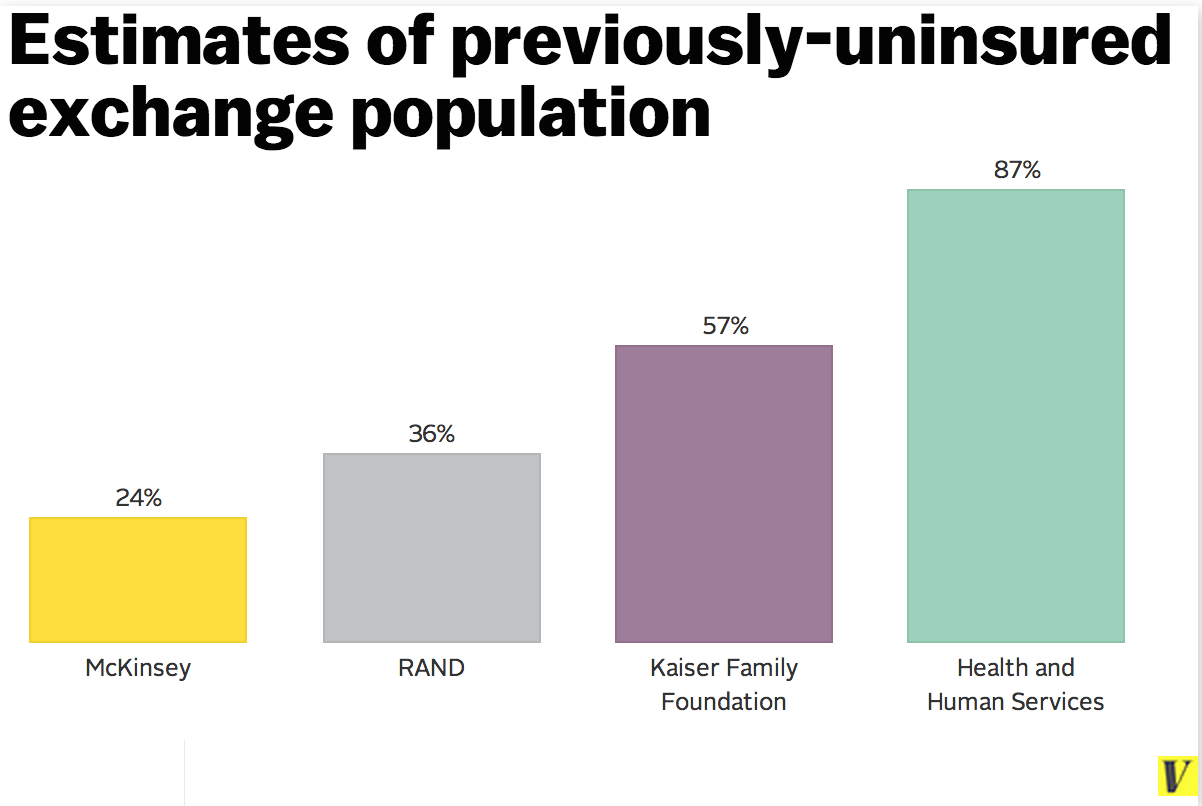
Sarah Kliff passes along the finding, from a new Kaiser survey, that a “slim majority of Obamacare’s private insurance enrollees were uninsured when they signed up for coverage.” But other organizations have produced strikingly different results:

Here’s the thing that’s so frustrating in trying to sort out this question about who was uninsured: the variation between different groups’ estimates is just massive. When you dig into the methodology, as health wonks are wont to do, you start to notice that the surveys happened at different times, with different people who were asked different questions. …

The new Kaiser Family Foundation survey is the most up-to-date, randomized study that specifically asks people to identify what coverage source they had prior to signing up on the exchange. This separates it from RAND (whose survey data misses the end of open enrollment), McKinsey (which asks a slightly different question) and the Obama administration estimate (it leaves out anyone buying through a state exchange).

Drum examines the surveys’ methodologies:

The basic problem is that the pool of uninsured has a lot of churn: people are covered for a while, then lose their jobs, then get another job, etc. So if you had insurance last August, but lost your job and signed up for Obamacare in November, do you count as previously uninsured? According to McKinsey, no. According to Kaiser, yes.

My own guess is that the Kaiser methodology is probably the closest of the four to what we’d normally think of as “uninsured,” and its sample size is big enough to be reliable.

Cohn focuses on another aspect of the survey – premium costs:

Strictly among people who had coverage previously, the “winners” (people who say they paying less for insurance now) outnumber the “losers” (people who say they are paying more for insurance now). Specifically, 46 percent of respondents who had insurance before Obamacare said they were spending less on their new monthly premiums, while 39 percent said they were spending more. That’s not much of a difference, given the survey’s margin of error. But it certainly doesn’t suggest, as the law’s opponents frequently claim, that most people are worse off. And when you consider that many people who were buying insurance on their own previously are now getting Medicaid, which is basically free, it would appear that there are clearly more winners than losers, at least when it comes to what people are paying up front for coverage.

Adrianna McIntyre expects premiums will go up next year but at a lower rate than before:

The people who enroll in health insurance in future years are expected to be healthier than the people enrolled today. The penalty for not carrying insurance is modest this year: $95 or 1 percent of income for an individual, whichever’s higher. That gets scaled up over the next few years, compelling more people to purchase insurance.

The people who declined to sign up for insurance — and pay the penalty instead — are probably healthy; had they been uninsured and sick, they would have taken advantage of new coverage options under Obamacare. As these healthier people enroll in coverage, the average health of the insured population gets better, and insurance gets cheaper.

Recent Dish on Obamacare’s costs here.

A Poem For Friday

6221020167_6258285c0c_b

“Exegesis” by Kevin Simmonds:

There was nothing trivial about the
Thai masseuse who slid his vertical
along my vertical, the power
outage, or those extra minutes
without charge. I cannot say he
wasn’t God. What I felt then, what
I feel with a man’s body on mine, is
holy, holy the way I imagine it is
right & without damage, worth
thanks   &   remembrance   &
justification for.

(From Bend to It © Kevin Simmonds, 2014. Reprinted with permission by Salmon Poetry. Photo by Daniel Spiess)

Back To Chalabi?

Eli Lake covers US outreach to Iraqi political actors:

On Wednesday, Brett McGurk, the senior State Department official responsible for policy on Iraq, met in Baghdad at the home of Ahmed Chalabi, the former exile leader who was supported by neoconservatives inside the Bush administration before the Iraq war.

The meeting, first reported by The New York Times, was the first time McGurk had traveled to Chalabi’s Baghdad estate, according to Chalabi’s Washington adviser, Francis Brooke. “They discussed the current politics and Dr. Chalabi told him it would be very difficult for (Nouri al) Maliki to continue as prime minister,” Brooke told The Daily Beast.

Uh-oh. Then this:

Brooke would not say if Chalabi was eyeing the top job himself. But he did point out that the former exile leader—who is now a member of parliament and a senior member of the Shi’ite party affiliated with Iraq’s powerful Hakim family—supported the creation of a national reconciliation committee and the release of Sunni prisoners detained without charge. What’s more, Brooke added, Chalabi “is now open to reconsideration of the national de-Baathification law.”

That’s the law that purged members of Saddam Hussein’s Baathist party from Iraq’s government—the law that Chalabi helped write. Not surprising, the de-Baathification law is one piece of legislation that has infuriated Iraq’s Sunni minority, who say it has been used to isolate their leaders from important national positions.

But Beauchamp doubts booting Maliki would do much good:

[T]he core of the conflict is that Sunnis and Shias want the government to look dramatically different, and be run by different people. That is an astronomically difficult problem to solve on its own terms. The idea that the United States could pressure a solution to it — in the middle of a civil war — overestimates how much influence America has over Baghdad .

It’s not that Sunni-Shia divide is totally intractable. As [Marc] Lynch notes, there have been opportunities to make deals that would have significantly calmed sectarian tensions. Deals that Maliki rejected, of course. And perhaps the US could help broker negotiations at one point in the future.

But the idea that the US could solve the deeper problems fueling the insurgency by removing Maliki oversimplifies just how deep those problems go, and ignores the bigger and more difficult issues. Removing Maliki is a first step, but the broader causes of the chaos in Iraq run much deeper than his administration.

This all feels like some sick, recurring nightmare. Because, after all, trusting Chalabi the first time around worked out so well, didn’t it?

No Place To Sleep, By Design

b41fdad26

Robert Rosenberger calls attention to urban design choices meant to deter the homeless:

An example of a pervasive homeless deterrence technology is benches designed to discourage sleeping. These include benches with vertical slats between each seat, individual bucket seats, large armrests between seats, and wall railings which enable leaning but not sitting or lying, among many other designs. There are even benches made to be slightly uncomfortable in order to dissuade people from sitting too long.

Sadly, such designs are particularly common in subway, bus stops, and parks that present the homeless with the prospect of a safely public place to sleep.

When thinking about this landscape of homeless deterrence technologies like the benches and still-ubiquitous spikes, it is important to consider the role of laws against loitering. For many cities, loitering laws have the effect of enabling law enforcement to arrest the homeless simply for being around. Such regulations target things like sleeping in public, panhandling, or even outdoor charity food service. This further complicates the relation of the homeless to this public landscape. Why do you think the homeless so often choose bus stops in particular as a place to sleep? One reason is surely that it affords a kind of plausible deniability: I was just waiting for the bus.

The Inept Iraqi Military

Jassem Al Salami surveys the fruits of all that American aid and training:

The Iraqis’ aerial tactics are sloppy. Instead of orbiting a target area at a safe distance in order to gain full awareness before attacking, Iraqi pilots tend to fly straight in firing rockets and guns at close range. The absence of zooming optical gear might explain that reckless pattern. These tactics not only compromise the aircraft’s effect on the battlefield, they also expose Iraqi pilots to ISIS ambushes. The Iraqi army has already lost at least one helicopter west of Baghdad.

Iraqi armored units are no better than the air force and army aviation. ISIS rides mostly in “technical” armed pickups, whereas the Iraqi army possesses modern M-1A1 main battle tanks and BTR-4 armored fighting vehicles plus older T-72 and T-55 tanks and BMP fighting vehicles. ISIS cannot match their firepower. But almost no Iraqi armor has even appeared on the battlefields in Mosul, Tal Afar and Kirkuk—except in videos depicting ISIS fighters destroying abandoned vehicles. Perversely, the only tanks that we can confirm have taken part in the fighting are the six T-55s now belonging to ISIS.

Dividing the military with sectarian meddling, in Zaid al-Ali’s words, was just one of many ways in which Nouri al-Maliki has squandered his country’s hard-fought security gains over the past few years:

On the day Tikrit fell, Iraq suddenly changed: Violent government-backed militias were suddenly allowed to operate openly in Baghdad and Baquba, manning checkpoints and organizing security without any oversight. Senior Iranian military commanders landed in Baghdad to help organize the city’s defense. Finally, in an effort to rally his base against ISIS, Maliki called for volunteers to take up arms against the militants and extremists — ignoring the fact that the military’s problem was never a lack of manpower. It was the clearest admission of failure possible.

Maliki micromanaged the security forces for years, and in the end he didn’t even trust them, choosing instead to let foreign-backed militias and untrained volunteers defend the capital. Meanwhile, one week after Tikrit’s fall, Baghdad had done nothing to free it from ISIS, abandoning its citizens to their fate and allowing the militants to reinforce their positions free from interference.

This was no accident, Keating suggests:

I’ve written about this a bit in reference to Qaddafi’s rule in Libya, but authoritarian rulers—and Maliki is clearly at least headed in that direction—often prefer not to have a strong and professionally organized military. As Hosni Mubarak learned a few years ago, strong militaries can turn on you when the going gets tough. But such “coup-proofing” obviously comes at the expense of the military’s preparedness for outside threats. Maliki made it abundantly clear to U.S. officials that one of his primary concerns was the possibility of a military coup organized by Saddam Hussein’s former officers. The best protection against such a scenario is not a large, well-trained, multiethnic military but a small elite fighting force selected on the basis of loyalty.

Even so, Kirk Sowell expects the Iraqi army to beat ISIS in direct fighting:

In Tal Afar this week, ISIS was initially able to gain some ground there because it’s out in the west, harder to resupply. But after the government sent more units out, they were able to regain the initiative. ISIS has around 10,000 fighters, and the Iraqi army still has 200,000. ISIS doesn’t have an unlimited supply of personnel, so these direct fights – like in Tal Afar – just drain them.

Syria has a much greater impact on Iraq than Iraq has on Syria. Having this rear base in Raqqa has been great for ISIS – it’s what allowed them to organize and recruit and train their fighters. If you take parts of Anbar and Nineveh, in Iraq, and Deir Ezzor and Raqqa and parts of Hassakeh, in Syria, that’s the so-called Islamic state. But these aren’t areas they totally control, and once Baghdad sends high-quality [military] units up to Mosul, ISIS is not going to be able to hold its ground or form an administration or anything like that.

But Zack Beauchamp points out ISIS’s skill advantage over the Iraqi forces:

[Nathaniel] Rosenblatt and [Yasser] Abbas [of private research firm Caerus] say there’s been an influx of skilled Saddam-era military leaders and soldiers into ISIS’ ranks. “When you look at some of the reports about the leadership under [ISIS commander Abu Bakr] al-Baghdadi,” Rosenblatt said,  “those second-in-command guys have very strong ties to Saddam’s army.” Acquiring lots of weapons, money, and experience over the course of the Syrian war allowed them to translate that new training into real military effectiveness.

It’s hard to overstate how much of advantage this training and professionalism gives the Islamist group. “ISIS knows how to use smaller units” effectively against larger forces, says [researcher Phillip] Smyth. They’re “very efficient, and you have to deal with that.”

This matters greatly. An undisciplined force, one whose movements aren’t well coordinated or can’t deploy proper tactics for taking city blocks, can be beaten by a much smaller opponent that knows what it’s doing.