What Do You Do With A BA In English?

You will actually get hired more than most:

Defying all conventional wisdom and their parents’ warnings, most English majors also secure jobs, and not just at Starbucks. Last week, at the gathering of the Associated Departments of English, it was reported that English majors had 2 percent lower unemployment than the national rate, with an average starting salary of $40,800 and average mid-career salaries of $71,400. According to a 2013–14 study by PayScale.com, English ranks just above business administration as a “major that pays you back.”

But using numbers to dispute the fatalism over humanities is a bit like reading novels to cure consumption – at best it is a distraction before the next coughing fit. Besides, engineers and dentists still earn more than English majors. Rather than citing more statistics, we might ask why humanists keep simultaneously pursuing this field and lamenting its perpetual crisis. The answer is that crisis, which comes from the Greek word for “choice,” is what humanities do best.

Meanwhile, Pascal-Emmanuel Gobry wishes certain political reporters had studied the liberal arts rather than communications:

The expression “liberal education” is quite important. Today, when we think “liberal education”, we think “Would you like fries with that?” But as the common root with the word liberty suggests, liberal education is an education that helps make us free. Only by first understanding not only the empirical scaffolding of our Universe–a.k.a. science–but also its conceptual scaffolding, a.k.a. the ideas, concepts and history which shape the world we live in, can we ever hope to be free, that is to say to be able to make informed, conscious decisions. …

Nobody stops to ask what education is for, because the answer is implicitly accepted by all: an education is for getting a job. It is, in other words, for being a cog in the giant machine of post-industrial capitalism. It is, in other words, for the opposite thing that our forefathers wanted for us.

Update from a reader:

Good grief, can Gobry be any more melodramatic about the need for a liberal education? I don’t dispute the importance of the humanities, but explaining condescendingly why we’re all “less free” for not reading Aristotle is asinine.

I majored in Russian in college, because that massive, eternally tsarist country has, in spite of the odds, turned out some of the greatest literature we have. And besides that, the language and culture are fascinating. Even though I only had the opportunity to spend three months there, my studies and time abroad were formative experiences. They have certainly shaped how I approach the rest of my life, and I continue to foster a love for all things Russian.

Unfortunately, the world can support only so many American Slavophiles, so I also majored in Chemistry. Why? Because I needed to get a job. Yeah, I guess it’s a bummer that I can’t “freely” pursue whatever I want, but we can’t all get paid to mock people for not reading Plato or Max Weber. When I’m not at work, I can spend my time doing whatever I want; but when it comes to making a buck, whether we like it or not, concrete skills that produce tangible goods make money.


Trying To Stand It

After becoming convinced that his sedentary lifestyle posed a major health threat, Dan Kois decided to spend a month on his feet. (He made exceptions for driving, using the bathroom, and, once, attending a play). His thoughts toward the end of the experiment:

Hit wall. Completely fucking dead. Wife rubbed my feet tonight. If Sitting Dan got a foot massage from his wife, he’d thank her. Standing Dan is a whiny asshole. Email to friend: “If a nun gave me a $100 bill I would be like, screw you, my legs hurt.”

What he learned:

[T]his enforced standing has made me realize how much of my time bonding with my family is spent seated. Now we play Crazy Eights with me hulking over the table like a grudgingly accepted giant. I’ve begged off story time because my kids don’t like craning their necks to see the pages, and I find it maddening not to be able to snuggle with them in bed. At the beach house we shared with my in-laws for Easter weekend, I was completely unable to relax or join anyone else in relaxing. … It all came to a head at Easter dinner, during which I stood straight up as if in a Last Supper parody, loved ones assembled to each side, my roast lamb perched on that stupid aluminum work tray. All I wanted to do was just be for a little while! Instead, I could never stop thinking about my dumb, clumsy, painful body, not for a second. …

My month has been an ordeal, but it’s clearly succeeded. I’ve lost almost five pounds and gained muscle in my legs, especially my calves. I’ve cut my time-wasting drastically, editing and writing more than in any month I can remember. I’ve walked 92.5 miles, basically without trying.

Which Party Will Lead The Energy Revolution?

Jim Manzi recently praised America’s innovation-heavy approach to climate change. Chait admits that the “embrace of new environmental technology does represent genuine differentiation from the mindless scientific denialism and reflexive sneering at green energy that is the mainstream Republican position.” But he claims that Manzi and other reform conservatives, aka “reformicons,” lack a coherent agenda:

In a 2007 National Review cover story, Manzi proposed to create a new agency tasked with funding advanced, speculative scientific research. “The agency for funding any government-sponsored research should be explicitly modeled on the Defense Advanced Research Projects Agency,” he wrote. In 2009, the stimulus created this exact thing. It’s called “The Advanced Research Projects-Energy.” It was explicitly modeled after DARPA. (You can read an account of its creation in “The New New Deal,” a history of the stimulus, which reports on page four that the agency was “modeled after DARPA.”) It still exists.

Now, maybe the reformicons believe ARPA-E needs to have its funding boosted. But they haven’t actually defined a specific proposal to do so. Indeed, it’s not clear they actually realize the agency exists. Since Manzi proposed created a DARPA for energy in 2008, I have only found one example of him mentioning the idea since — a 2011 column calling for a“DARPA analog focused on new energy technologies,” a phrasing that implies Manzi was proposing to create an agency that had already existed for two and a half years. Since its establishment, the Obama administration has been fighting to preserve the agency from House Republicans, who have proposed to cut its budget by 80 percent. Needless to say, the technology-first reformicons have said nothing at all about the incumbent Party stance of slashing basic energy science research.

The Best Of The Dish Today

Members of the Public Relax In The Warm Weather In London

As summer kicked in, we continued our deep dive into Iraq today. No US airstrikes, mercifully. An intransigent sectarian in Maliki. The case for partition. The options with Iran. Turkey’s strange, paranoid complacency. Oh, and the now-familiar but still shocking gall of Paul Wolfowitz.

If you want your eyes open to a different take on the transgender experience, this email is quite something. If you can’t believe the deranged Benghazi fixation on the right, you’re not alone. Plus: another formerly sympathetic observer gives up on Israel’s occupation. And this optical-illusion video deserves some sort of award.

The most popular post of the day was Obama Caught Another Terrorist and the Right Can’t Handle It. Next up: Paul Wolfowitz’s Noble Lies.

Many of today’s posts were updated with your emails – read them all here.  You can always leave your unfiltered comments at our Facebook page and @sullydish. 26 35 more readers became subscribers today. You can join them here – and get access to all the readons and Deep Dish – for a little as $1.99 month. One writes:

I don’t have a comment for your thread, nothing unique that hasn’t been covered on The Dish since the recent Iraq crisis began. With that said, I work in the counterterrorism community, where one of my responsibilities is to shape counterterrorism policy for the National Security Council staff. I have the full range of American and allied intelligence reporting to shape my work, which is essential. At the same time, I also look to The Dish nearly every hour for the ongoing political, moral, ethical, and historical debate on the Iraq crisis. I could do a good job with the former, I can only discharge my duties in a truly responsible way with the latter.

You need not post any of this – I recognize it’s hardly interesting – I just felt a note of thanks to you and the team was appropriate. Yes, the president and other people far more powerful than me are fans, but so are the mid-level civil servants working on Saturday mornings. I’m proud to be a long-term subscriber. Please keep going.

See you in the morning.

(Photo by Dan Kitwood/Getty)

The Rarest Of Them All

“Rarity itself has become very rare,” argues Rex Sorgatz:

With access to infinite bytes of media, describing a digital object as “rare” sticks out like a lumbering anachronism. YouTube — the official home of lumbering anachronisms — excels at these extraordinarily contradictory moments. Here, for instance, are the Beatles, performing a “VERY RARE” rendition of “Happy Birthday.” That sonic obscurity has been heard 2.3 million times. And here [see above] is a “Rare Acoustic” version of Slash performing “Sweet Child O’ Mine.” Over 26 million have devoured this esoteric Axl-less morsel.

More? Nearly 5 million people have heard Bob Marley opine “No Woman No Cry” (“version rare”), while a bit of conspiratorial Area 51 footage (“RARE,” of course) has racked up 1.5 million views. And some Woody Allen standup from 1965 (excitedly: “RARE!”) has garnered a half-million views, while double that number have endured a Marlon Brando screentest (prosaically: “Rare”).

He concludes:

“Rare” is such an quizzical descriptor, a blatant contradiction of the very nature of digital culture.  Rarity describes a state of scarcity, and as we enter a proto-post-scarcity economy, digital stuff defies such shortages. Things are no longer rare; they are either popular or unpopular.

Life Of An Obit Writer

Ann Wroe writes the obituaries for The Economist. Isabelle Fraser, a fan, spoke to Wroe about what the job is like:

Readers often write in to complain, “especially when it’s an evil man. They hate that. They do think, the Americans especially, that it’s a sign of honouring someone, a sign of respect.” Wroe says that when she receives such letters, “I write back and say that all human life is interesting.”

Those characters who make for the best tales are usually people who are totally unknown; often they are suggested by readers. One such person was Marie Smith, the last person to speak Eyak, an Alaskan language. “She was the only person left who remembered all the different words for all the parts of a spruce tree. And nobody is ever going to see a spruce tree in that way again. I love it when there is an end of a whole tradition or culture: it is the last glimpse we are going to get first-hand of something that’s gone.”

Wroe’s attitude about death is refreshing, allowing her to face it every week, albeit from a certain distance. “I don’t think of dead as dead, that’s the thing, and therefore it doesn’t trouble me. It’s an absence, if you like. It’s not the end.” She notes how “I never mention how people die, because I don’t think that’s important at all. I think an obituary is a celebration of a life.”

America’s Trust Deficit

Trust America

Dan Hopkins blames Obamacare’s low polling on it:

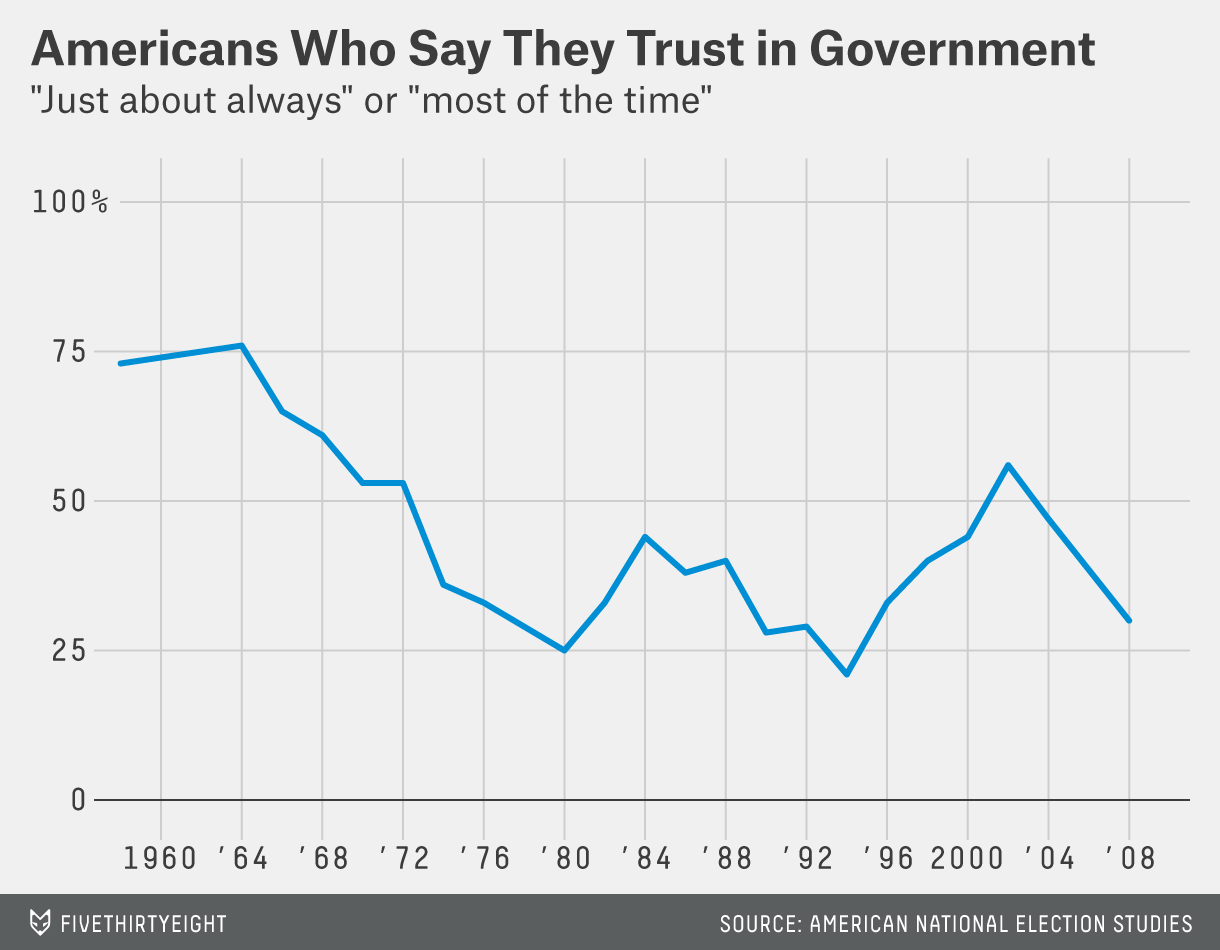
During a period of high trust like the early 1960s, Americans were confident that the government could accomplish what it set out to accomplish — and were willing to give it the benefit of the doubt. A War on Poverty? Sign us up, even if we were also trying to put the first person on the moon. And fighting a major war in southeast Asia. In 1966, Chief Justice Earl Warren said that President Lyndon Johnson had been “working hard on Vietnam and has been for a long time. … He will find some way out.” At the time trust was high, and much of the country agreed.

During a period of low trust, however, we might endorse a policy in theory but oppose it in practice because we doubt the government’s ability to make it happen.

He also argues that low trust can “become a self-fulfilling prophecy”:

In a low-trust environment, politicians who want to expand the government’s role face a conundrum. Even when the public is supportive of their policy goals, Americans might well doubt the government’s capacity to deliver on those goals. And that in turn might encourage the architects of public policy to hide the government’s role, leading to public policies that are at once highly complex and obscured from view. That’s not a great recipe for rebuilding trust in government. But it’s an apt description of Obamacare.

An Anthology Of Other People’s Mail, Ctd

Recently we featured the blog-turned-book, Letters of Note, an eclectic archive of correspondence from both the famous and unknown. Andrea Denhoed recently talked to Shaun Usher, the project’s mastermind, offering a glimpse of how it all works:

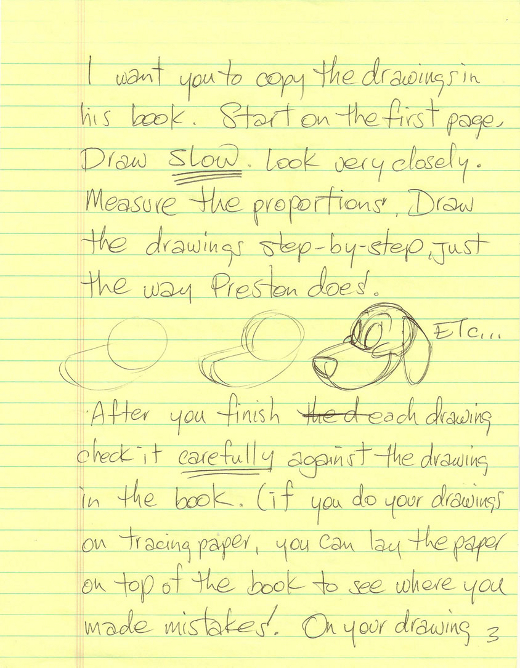
The success of “Letters of Note” is certainly a tribute to the charm of written correspondence, dish_renstimpyletter but it’s also evidence of the value of a supportive spouse—Usher’s wife, who was working as a manager for a cosmetics company, supported the family alone for most of two years before his work became profitable—and the indispensability of tireless trench work. These days, Usher receives a steady flow of submissions and has connections with a number of archivists. Starting out, however, there was much more digging involved. He says, “In those days … I’d get a list of famous people and I’d type into Google, I don’t know, ‘Stan Laurel letter’ and I’d literally just search about Google to see what I could find. And it worked to an extent.” His first letter to go viral was found this way, several pages into the search results. It’s an unusually kind and lengthy letter to a young fan from John Kricfalusi, the creator of the cartoon “Ren and Stimpy.” It included sketches, encouragement (“Alright Bastard, let’s get to work. Draw!”) and practical cartooning advice (“Learn how to draw hands.”)

The project’s popularity, however, has brought its own frustrations:

Usher estimates that he reads at least twenty unusable letters for each one that he ends up including. He says, “I’ve bought hundreds of books purely to find one letter I just had a hunch might be in there.” With his success, a new problem has cropped up: he also receives a huge number of unusable submissions. He’s been sent a few, he says, that are too scandalous to post. “It’s so frustrating,” he says. But “I’d get sued pretty quickly.” Far more often, he gets “very personal letters—from their grandma, or their grandpa … and it’s this very lovely letter. But I receive so many of them, and I’ve seen them so many times that they’re not …” He trails off, like he can’t quite bring himself to say that these precious family heirlooms can be boring. “I have to write some very tactful rejection letters.”

The idea behind the Letters of Note project—that correspondence holds a rare communicative and aesthetic power—also happens to be well calibrated for the Internet. It hits on a juncture of Pinterest-style object nostalgia, an appetite for emotive but bite-size reading, and a mild voyeurism. Usher points out the irony that “the very service that’s going to kill off letter writing” is responsible for bringing these missives before so many eyes.

(Image: Page from John Kricfalusi’s letter via Letters of Note)

Reading Above The Din

Although Tim Parks grants that today’s readers are willing to put in time for lengthy novels like Karl Ove Knausgaard’s multi-volume My Struggle or the Lord of the Rings trilogy, he finds that “the texture of these books seems radically different from the serious fiction of the nineteenth and early-twentieth centuries. There is a battering ram quality to the contemporary novel, an insistence and repetition that perhaps permits the reader to hang in despite the frequent interruptions to which most ordinary readers leave themselves open.” So what does this mean for fiction?

“In a good novel—it hardly needs to be said—every word matters.” Thus Jay Caspian Kang giving us the lit-crit, text-is-sacred orthodoxy in a recent New Yorker blog post. Honestly, I wonder whether this was ever really true; authors have often published then republished their work with all kinds of alterations but arguably without greatly changing a reader’s experience (one thinks of Thomas Hardy, Lawrence, Faulkner), while many readers (myself included), in the long process of reading a substantial novel, will simply not register this or that word, or again will reread certain sections when they’ve lost their thread after a forced break, altering the balance of one part to another, so that we all come away from a book with rather different ideas of what exactly it was we experienced during perhaps a hundred hours of reading.

But today Kang’s claim seems less and less likely to be true. I will go out on a limb with a prediction: the novel of elegant, highly distinct prose, of conceptual delicacy and syntactical complexity, will tend to divide itself up into shorter and shorter sections, offering more frequent pauses where we can take time out. The larger popular novel, or the novel of extensive narrative architecture, will be ever more laden with repetitive formulas, and coercive, declamatory rhetoric to make it easier and easier, after breaks, to pick up, not a thread, but a sturdy cable. No doubt there will be precious exceptions. Look out for them.

In response to Parks, Corey Robin confesses to taking long subway rides to no place in particular in order to find time to read:

I take nothing with me but my book and a pen. I take notes on the front and back pages of the book. If I run out of pages, I carry a little notebook with me. I never get off the train (except, occasionally, to meet my wife for lunch in Manhattan.) I have an ancient phone, so there’s no internet or desire to text, and I’m mostly underground, so there are no phone calls.

When I get back, I sometimes post about my little rides and what I’m reading on Facebook: Schumpeter in Queens, The Theory of Moral Sentiments in the Bronx, Hayek in Brooklyn. The more incongruous, the better, though sometimes I find some funny or interesting parallels between what I’m reading and where I’m riding and what I’m seeing.

But the joking on Facebook covers up my dirty little secret: I ride the rails to read because if I’m at home, and not writing, I’m on the internet. “It is not simply that one is interrupted,” as Park writes; “it is that one is actually inclined to interruption.”

Freddie recommends turning off “the part of your mind that cares about getting finished quickly”:

A project book is one that you want to take a long time with, often one that necessitates taking a long time with. And though so many of your instincts are going to militate against it, you should stretch out into that time. Get comfortable. Think of your project book as a long-term sublease, a place that you know you won’t live in forever but one that you also know has to come to feel like home. You want to take months, reading little chunks at a time. It might offend your bookworm nature, but I find it’s useful to make a regular appointment– for this hour, twice a week, I will read this book and ancillary materials about it. Think of it like appointment television, if that suits you. Learn to enjoy the feeling of not being in complete control over what you mentally consume all the time, a feeling that has become rarer and rarer.