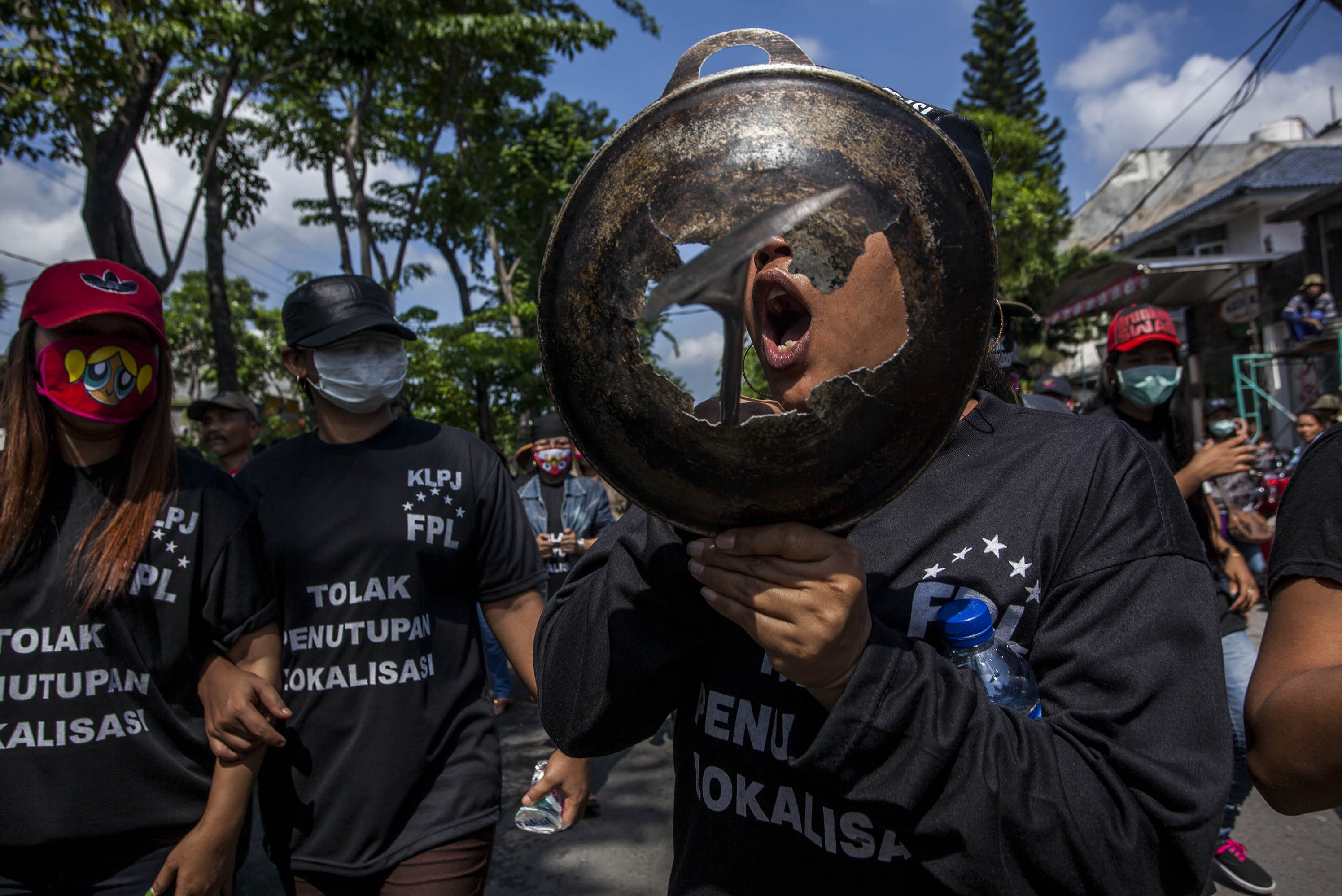
A Indonesian commercial female sex worker holds a broken pan during protest against the closing of the “Dolly” red-light district in Surabaya, Indonesia on June 18, 2014. Sex workers and others, such as taxi drivers and street vendors working in the district, oppose the plan out of concern for lost income. By Ulet Ifansasti/Getty Images)
Month: June 2014
Responding To Student Groans, Ctd
A reader writes:
I think that one aspect that is getting lost in all of this discussion of mounting student debt is that federal money is an enabler of growing college tuition. When the government gives students extra money to spend on college, they will tend to compete the price of tuition up. (Just how much the price increases depends on the relative elasticity of supply and demand.) If, instead, the government paid universities a certain amount per student admitted, the universities would tend to compete the price of tuition down.
It’s counterintuitive that subsidizing the customer doesn’t ultimately help the customer. But then a lot of economics is counterintuitive. Ironically, the best way the federal government could aid students would be to eliminate Pell Grants, tax write-offs and credits altogether and use that money to incentivize lower tuition rates on the supply side.
Why Doesn’t Turkey Fear ISIS?
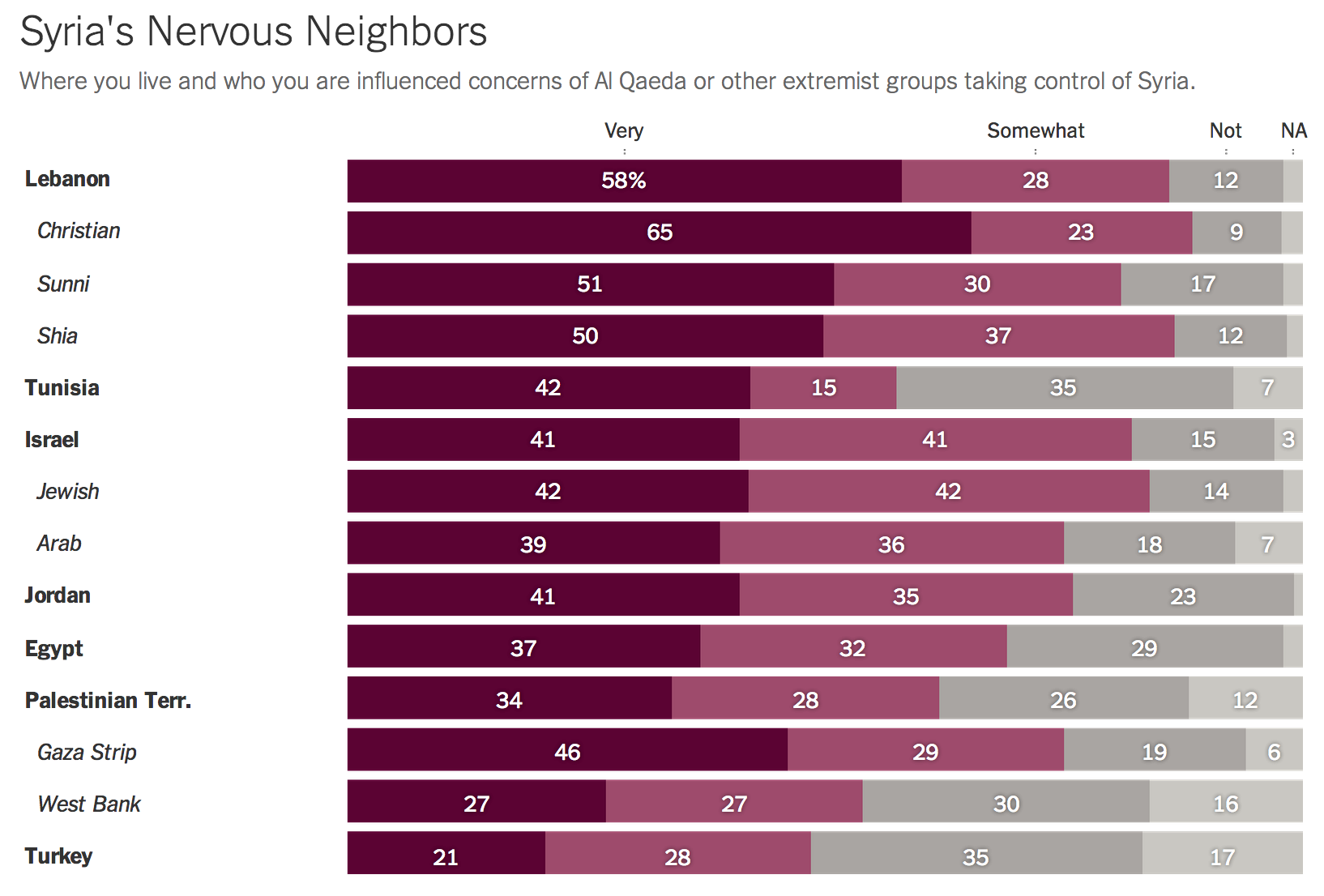
Turkey is less alarmed than its neighbors by Syria’s extremist groups:
Mustafa Akyol largely credits conspiracy theories for Turkey’s relative calm:
Many Turkish opinion leaders, especially those in the pro-government media, cannot accept ISIS, or its ilk, as extremist Islamist actors with genuinely held beliefs and self-defined goals. Rather they take it for granted that these terror groups are merely the pawns of a great game designed by none other than the Western powers.
For example, Abdulkadir Selvi, a senior journalist who has been quite vocal in the press and on television generally espousing a pro-government stance, wrote a piece last week titled “Who is ISIS working for?” This was his answer: “Al-Qaeda was a useful instrument for the US. To put it in an analogy, ISIS was born from al-Qaeda’s relationship with [the] CIA. The West gave its manners to al-Qaeda and now it designs our region through the hands of ISIS.” In short, al-Qaeda and its offshoot ISIS are both creations of the US Central Intelligence Agency and serve American interests.
Recent Dish on Turkey’s unsuccessful Syria policy here.
Quote For The Day
“Let me first address the first part of your remark about, ‘well, [Saddam] may have been unpleasant, but …’ This is a man who is guilty of the deaths of no less than one million Iraqis over a period of 35 years. So there is no ‘he may have been a brutal tyrant’ … there is no ‘but’ after that, there’s no comma after that phrase. It’s a period. Having said that, I can say that none of my aspirations for Iraq have come true. My worst fears, my greatest nightmares, have all been exceeded,” – Feisal Istrabadi, Indiana University Law School, who helped draft the post-Saddam constitution, and was Iraq’s deputy ambassador to the United Nations from 2004-2007.
Mental Health Break
The Battle Over Iraq’s Oil
Iraq’s largest refinery has come under attack:
The refinery accounts for more than a quarter of the country’s entire refining capacity, all of which goes toward domestic consumption – petrol, cooking oil and fuel for power stations. At the height of the insurgency from 2004 to late 2007, the Baiji refinery was under the control of Sunni militants who used to siphon off crude and petroleum products to finance their operations. Isis has used its control of oilfields in Syria to boost its coffers.
Any lengthy disruption at Baiji risks long lines at the petrol pump and electricity shortages, putting further pressure on the Shia-led government of the prime minister, Nouri al-Maliki.
Ari Phillips checks in on the Iraqi oil intended for export:
“Most of the oil fields in the region are around Basra between Iran and Kuwait, so they aren’t really under threat right now and I doubt they will be,” Peter Juul, a policy analyst specializing in the Middle East at American Progress, told ThinkProgress. “Unless somehow ISIS runs the table and takes over the entire country, which would lead to general chaos — but I don’t think that will happen.”
Rob Wile explains what a disruption of the southern oil fields would mean:
If the conflict migrates to the South, we could be looking at $160 a barrel, [Bank of America Merrill Lynch] says.
Our commodity research team believes that in the unlikely event ISIS invades the South and the entire 2.6 million b/d of southern oil production is lost, oil prices could face $40-50/bbl upside. Further immediate risks to production seem limited under the base case scenario where oil prices remain around $110/bbl. The bulk of Iraq’s oil fields are located in the Shia South, far from the conflict zones.
The Guardian assesses the situation:
Output from Iraq reached an all-time high of 3.5 barrels a day earlier this year and remains at a high level but output is hampered by a lack of export capacity made worse since a northern pipeline was blown up.
The key oilfields in Iraq have largely escaped the real impact of the fighting because they are located in the south of the country. But threats to oil workers of kidnapping, coupled with corruption and equipment shortages, have already hampered their development.
China is already considering its other energy options:
While Iraq has been growing in importance as a source for China’s energy needs, that’s likely to change if the crisis continues much longer. China may instead focus more on tapping oil in Russia, Iran, and Oman, according to Li Li, research and strategy director at ICIS C1 Energy, a Shanghai-based energy information consultancy, English-language China Daily reported.
Engaging The T, Ctd
A reader revives a recent thread with a fascinating personal story:
If you choose to use any of this, please scrub my name from it. I am a transgendered woman who has, in fact, committed the unpardonable sin of transitioning and then, largely, being done with the whole thing. The vast majority of people in my personal life have no idea, and almost no one in my professional life does. Now that’s because I pass very well, which is both a matter of luck and a matter of will. It was luck because I didn’t shoot up to an inconvenient height, nor were my hands or feet inconveniently large, but it was will because I tried to just be an ordinary woman of my generation (born in the late 1960s).
In the last decade or so, I have seen transgender activism take on the idea that gender is “constructed” and that the “medicalization” of being trans is a horrible thing. It seems short-sighted in the extreme – at least for those of us who have a difference of opinion between our self-image and our secondary sexual characteristics. I say that because just as Medicare and other providers are finally starting to cover SRS (sex reassignment surgery) and hormone treatments, the activists are trying to make the case that none of that is necessary. It has taken activists two decades and more to get us to this place, and just as we are starting to see the light at the end of the tunnel, they are trying to not just pull the rope up, but burn it.
Why? Because some transgender people are not able to pass and/or some transgender people have a hard time finding work (whether because of passing issues or unwillingness to conform, even the least bit, with the kinds of behavior necessary to secure a well-paying job).
I agree, mostly, with your assessment that those of us who are minorities may be in the uncomfortable position of having to educate people and answer questions because we may be the first person someone outside our little social category may have had significant interaction with. It isn’t really fair, but better to learn it from someone within the group than to persist in ignorance or, worse yet, to learn it from someone hostile to the group. I do part company with you on the issue of genitalia, however. That is a really intrusive question and one that I think is reasonable for me to divulge to anyone I am dating, any medical professional, any mental health professional and to select friends. It isn’t for public consumption, however.
You wrote this:
The transgender desire not to be trans-gender but to be one gender physically and mentally is actually quite an affront to queer theorists for whom all gender and sex are social constructions. Many of these people want testosterone and estrogen and surgery to end their divided selves. And it doesn’t get more crudely biological and not-social than that. Which means that there are also divisions within the trans world between those who might be able to pass completely as another gender, after reassignment surgery, and those whose visual ambiguity or androgyny will remain.
Here is where I really have parted company with what has become of the trans-movement in the last decade or so. When I transitioned in the early 1990s, the idea was to move through being transgendered and into just being a woman (or a man, for my FTM brothers). Now, it seems the point is to be neither a man nor a woman. What’s more, well-adjusted and socially successful transgendered people like myself are a profound threat to the activist and academic portions of the movement because we violate the narrative.
As a black transgendered woman, the narrative is that I have found it difficult if not impossible to find work that pays me more than a pittance. What’s more, I am supposed to have spent some time as a prostitute. As a transgendered woman, the narrative is that I am socially shunned and ostracized and only other transgendered people or “allies” will have anything to do with me.
None of that has applied to me, and it has not applied to me in a very visible fashion. I have not worked with someone who knew I was trans since the mid-nineties, when I told a boss that I was trans because I knew that I was going to need surgery and thus need to take some extended time off. Since my boss at the time was a lesbian, I thought it was a good risk. To give you an idea of how well I pass, when I told her she was fine, but the next day a couple of my coworkers, who were also gay and whom I had told first to see how our boss would react, said I needed to clarify some things for her. She actually had thought I was moving in the opposite direction (FTM instead of MTF) and was worried because, as she put it, “I just can’t see a femme like her as a boy”. We all had a really good laugh about that.
This was while I was working at a large software company in the San Francisco Bay Area. Does that sound like rejection and ostracism? It doesn’t to me, and I didn’t experience it that way. It remains, to this day, one of my favorite memories from the time in my life where transitioning was still something I was doing and not something I had done.
One other thing you get right is that, in fact, from the point of view of the queer theorists and the activists who follow them, wanting hormones and surgery is a profoundly conservative impulse as defined by the theorists and activists. Like marriage equality it does cede some realities that in a certain (politically) correct light be seen as conservative. In the latter case of marriage equality, it absolute cedes the conservative idea that marriage is a stabilizing force in the lives of individuals and communities. In the former case it concedes the “gender binary,” at least in as much as it doesn’t try to construe being transgendered as a third, fourth or twelfth gender and instead cedes that for the vast majority of people male and female more or less accurately.
One of the results of this has been that transwomen like myself have largely stepped back from the community and do not mentor people newly in transition. It is not that I don’t want to; it’s that I don’t think I have anything to offer. Rather, it is that what I have to offer puts me at odds with a lot of the trans community – at least that portion of it involved in conceiving “theory”. I am very pragmatic in my approach to transition. Questions I think a trans person needs to ask and find answers to are:
1) Am I going to stay in a field that I started as my birth gender or am I going to find a new career? (For me, I started young enough that I didn’t have a career, so I got into one because of the need for regular money in sums above and beyond sustenance levels and regular, reliable health insurance coverage)
1a) If the former, what do I do with my work history?
1b) If the latter, what kind of jobs can I find where I will make enough to actually be able to do this?
2) How am I going to broach this subject with my friends and family?
3) How do I do this?
These are no longer questions to ask, according to queer theorists.
I applaud your courage in taking on this topic. You are going to be flamed for it as sure as there will be men in Speedos at Gay Pride parades in a couple of weekends.
Another reader circles back to the beginning of the thread:
Kevin Williamson’s essay may be over the top in its callousness, but I have to say, I read a lot of lefty sites/news outlets, and the focus on “the T question” sort of takes me aback. Why so much focus for what may be, as you note, as little as 0.1 of the population? Why is this the premier civil rights question of our lifetime, as trans folks might have it?
Worse than this is the impulse, which you address, among trans activists to essentially burn down the existing societal framework due to its inherent oppressiveness and replace it with something new – something that people like myself, a married suburban father who bears no ill will toward the transgendered community – will be required to accept.
For example, the use of the term “cisgendered.” We’re now supposed to use this at all times, you realize; I’m supposed to refer to myself as “cisgendered,” as a rhetorical means of leveling the playing field. The 99 percent or 99.9 percent must now adopt the rhetorical demands of the trans activists lest we reveal ourselves to be utterly hateful.
But you know what? I don’t use the term “cisgendered” and I will not use the term “cisgendered.” I think the term itself and the supposed logic behind it are ridiculous. Do your own thing; live your own life, and I will insist that however you choose to do so, you are accorded the same legal rights and privileges that every other American possesses. But when that’s not good enough – when my refusal to think of myself as “cisgendered” or use the term marks me as a bigot – I’m off the bus.
Update from a reader:
Your reader is claiming that an unknown group of straw trans-men and women are forcing him to use the term “cisgendered” to describe himself. To which I say, what planet do you live on?? “Cisgender” is an academic term adopted by some in the trans community to describe those who do, in fact, associate with the gender of their birth. Why your reader is so incensed that trans folks call him “cisgender” is beyond me. Why he thinks he’s now required to call himself that is a question for the ages. I have seen no movement, even among the most nutjob of activists, to force the term “cisgender” on the American citizenry.
Your reader, in short, is no bigot, but sounds like my parents did in 2006: “We support you, but why do you have to call it marriage?” (I’m thankful to report they were fully on the marriage bandwagon within five years after that.)
(Photo: The bedroom door of a Dish reader’s 15-year-old daughter)
The Neocons’ Very Own Reality
Simon Jenkins is aghast at the neocons’ push – even now – for more intervention:
It beggars belief that further military intervention by the west in Iraq is now being considered. Yet the yearning to intervene, to bomb someone even if just to “send a message”, shows how thin is the veneer of sanity cloaking great power aggression. War still has the best tunes. How glorious it must seem to certain politicians to somehow turn 10 years of disaster in Iraq into a final victory.
That is why the causes and effects of 2003 must be nailed to the wall, time and again. Trillions of dollars were spent and tens of thousands of people died, for no good reason then and no good reason now. It was a total disgrace.
Torture champion Marc Thiessen’s latest nonsense is a text-book case of creating a reality that can simply erase the record of catastrophe:
First, [Obama] withdrew all U.S. forces from Iraq — allowing the defeated terrorists to regroup and reconstitute themselves.
Second, he failed to support the moderate, pro-Western opposition in neighboring Syria — creating room for ISIS to fill the security vacuum. ISIS took over large swaths of Syrian territory, established a safe haven, used it to recruit and train thousands of jihadists, and prepared their current offensive in Iraq.
The result: When Obama took office, the terrorists had been driven from their safe havens; now they are on threatening to take control of a nation. Iraq is on the cusp of turning into what Afghanistan was in the 1990s — a safe haven from which to plan attacks on America and its allies.
To respond: first, Bush decided that 2011 was the drop-dead date for ending the occupation, Obama refused to keep any troops there without any immunity from prosecution, and the Iraqi government insisted we leave entirely. Second, there was no way to separate out the “moderate” Sunni elements in Syria without possibly empowering far more extreme groups, like ISIS. Look at how easily ISIS has been able to arm itself with US vehicles and weapons from the surrendering Iraqi army. How much easier if we had just given them to their confreres in Syria instead. Third, while there is a danger of a Islamist haven, ISIS is not al Qaeda, has its hands extremely full, and is focused primarily on its own region, not the US. Ezra points his finger at the real culprits behind the continuing disintegration of the country the neocons broke:
The totality of the Bush administration’s failure in Iraq is stunning. It is not simply that they failed to build the liberal democracy they wanted. It’s that they ended up strengthening theocracies they feared.
And it’s not simply that they failed to find the weapons of mass destruction that they worried could one day be passed onto terrorists. It’s that a terrorist organization now controls a territory about the size of Belgium, raising the possibility that America’s invasion and occupation inadvertently trained the fighters and created the vacuum that will lead to al Qaeda’s successor organization.
And all this cost us trillions of dollars and thousands of American lives.
Meanwhile, Saletan compares GOP rhetoric on welfare and foreign policy. He posits that “the principle of self-reliance extends far beyond welfare”:
Republicans say ISIS is filling the “vacuum” left by Obama’s withdrawal. But the vacuum—which is really just another name for how the world works when we’re not there—affects other parties, too. As ISIS advances on Baghdad, Shiite militias are assembling. Iran is stepping in. Turkey may be next. The conflict could explode into sectarian civil war, though some Shiite leaders are trying to avoid that. But what’s striking is how quickly, in our absence, the threatened elements of Iraqi society and the region are mobilizing to stop ISIS. They’re doing it because they have to. If they don’t, nobody else will.
Yes, ISIS is a threat to us. We’ll be safer if it’s crippled. But are we really the best people to do the job? For nearly a decade, we tried to manage Iraq. What we got was dysfunction. Maybe it’s time to let Iraq learn to manage itself.
Surely this is a contribution the Tea Party could make to the national security debate, if they weren’t consumed with Obama-hatred. Isn’t plying a sectarian government with aid and training a way of making them dependent on us, of encouraging them not to take full responsibility for their own country and their own future? When will the Tea Party right begin to see their incoherence on the question of welfare dependency at home and abroad? I guess we’ll see if Rand Paul can gain traction from this moment against the torturers, invaders and micro-managers of the neocon clique. Or if he’s a lot of talk and very few cattle.
No Gas For U!
As promised, Russia’s energy giant Gazprom cut off gas exports to Ukraine on Monday due to the country’s unpaid bills. But the company says gas will still flow to Western Europe through trans-Ukrainian pipelines. This is obviously not just about payments:
The previous disputes in 2006 and 2009 were largely about payments and price levels – and agreements were eventually reached in a more-or-less business-like fashion. The current situation, which has flared in the wake of Russia’s annexation of Crimea and the on-going conflict in Eastern Ukraine makes it clearer than ever the way in which the Kremlin uses energy exports as a geopolitical lever.
In this context, it is difficult to see how a lasting agreement on gas prices can be brokered without a wider agreement between Ukraine, the EU and Russia on Ukraine’s future and its territorial integrity. The gas dispute is a litmus test of the wider geopolitical crisis and, with no resolution in sight, it promises to be a worrying winter for gas consumers in Europe.
Walter Russell Mead sees the gas war as yet another clever coup for Putin:
All of this is being done with plausible deniability in mind. Moscow is carefully flying below the radar here, not escalating the provocations to the point of formal aggression, but nevertheless having the same effects on Ukrainian stability and viability. Putin is counting on the irresolution of a divided West: as long as the waters are muddy, it’s easier for European countries sitting on the fence to hesitate about taking tougher measures.
With natural gas prices rebounding from a steady decline this spring, Putin is getting more spending money just when he wants it. Put that together with instability in the Middle East—a reminder to Europe that it isn’t easy to free itself from dependence on Russian energy—and it seems that Putin is holding all the good cards these days.
But markets, somewhat surprisingly, aren’t freaking out. Jason Karaian offers several reasons why:
Despite the pipeline explosion, a parallel line was able to carry gas to Europe without too much disruption, Ukraine’s gas company said (link in Ukrainian). The current dispute is also taking place in the warmer months, whereas previous cutoffs came during the dead of winter. The 2011 opening of the Nord Stream pipeline, which pumps gas from Russia to Germany, has reduced the EU’s reliance on gas piped via Ukraine. And, across Europe, gas reserves are unusually high following recent mild weather, and unlike in 2006 and 2009, the pipelines that normally ship gas from Ukraine to the west are now able to reverse their flows, if need be. For these and other reasons, the markets see the dispute as more of a skirmish than a full-blown war.
The Dish previously touched on the natural gas dimension of the Ukraine crisis here.
“The Occupation Is Indefensible”
In a lengthy and powerful reflection inspired by Israel’s outsized response to the kidnapping of three yeshiva students in the West Bank on Friday, Max Fisher announces that he is finished blaming the Israeli-Palestinian conflict on “both sides”:
There has always been, and there remains, plenty of culpability to go around in this conflict, plenty of individuals and groups that squandered peace and perpetuated suffering many times over. Everyone is complicit and no one is pure. The crisis over the kidnapped students shows all this. But it is also highlights what has become perhaps the most essential truth of the Israel-Palestine conflict: for all the complexity of how it came to be and why it’s continued, for all the shared responsibility for this week’s crisis and everything that led up to it, the conflict predominantly matters for the human suffering it causes. And today the vast majority of that suffering comes from Israel’s occupation of the Palestinian territories.
Today, the suffering has become so disproportionately administered by the occupation and so disproportionately felt by Palestinians that, in a conflict famous for its complexity and its gray areas, this is an issue that looks less gray all the time: the occupation is wrong, it is the problem, and Israel is responsible. …
Ha’aretz columnist Gideon Levy generated anticipatable controversy when he wrote that “if, in the West Bank, yeshiva students aren’t abducted, then the West Bank disappears from Israel’s consciousness.” To many, this sounded as if the column were encouraging Palestinians to abduct school-age Israelis; to others, presumably including the columnist himself, it may have rung true as a description of many Israelis’ apathy to the suffering of West Bank Palestinians.
Here’s what has happened in Hebron as a result of the kidnappings:
In the three days since, the Israeli military has descended on the southern part of the West Bank where the yeshiva students disappeared, and especially on the major Palestinian city of Hebron. I happened to visit Hebron the day before the kidnapping and found it already suffocated by occupation. Dozens of Palestinians have been arrested; some estimates say 120, some nearer to 80, but all agree that it includes the entire population of middle-aged and older men who work for Hamas’s political branch (remember that they are also a political party). The military has severely restricted Palestinian movement in Hebron, forbidden residents under age 50 from leaving the country, and completely shut down all movement in or out of Gaza and the southern West Bank save for “humanitarian and medical assistance.”
I don’t know how you live in a place where a foreign army can do this to you at will at any time. And I do not begin to know how you live with it for decades and decades, as the occupation continues to advance by colonizing and settling. Until the United States is capable of ending aid to Israel unless it ceases its illegal and immoral attempt to control and repress a whole nation under its thumb, this will go on. In so many ways, this is America’s colonization as well. Until we have the foresight and sanity to cease our enabling of it.