One of Britney’s backup backup dancers seizes the moment:
Month: June 2014
Headline Of The Day
“These Bears Are Having Lots Of Oral Sex, And Scientists Think They Know Why”
And it gets deeply Freudian from there.
Recession Ripples
Spring-boarding off a recent paper (pdf), Ryan Avent sizes up the Great Recession:
[T]he rich world is setting itself up to suffer through future events like the crisis of the last few years. Because there has been no urgency about moving back to full economic capacity, both interest rates and inflation rates remain at rock-bottom levels across much of the rich world. That means that there is very little cushion in the system against future shocks.
If big trouble strikes central banks will once again struggle to find the will to boost activity, and economies will once again move sideways for long periods of time. Fiscal policy is unlikely to come to the rescue, since the economic morass of the past six years seems to have made the public less tolerant of bold fiscal stimulus and certainly hasn’t done anything for sovereign debt loads.
The most pernicious aspect of this dynamic is its pace. If we woke up tomorrow to find the German economy brought to a screeching halt, we would rush to action, to restore activity there and prevent damage elsewhere. But because this disaster is playing out a bit at a time, such that our expectations slowly adjust, we tolerate it.
Weissmann chimes in:
Typically, we expect economies to fully heal after a recession. But if a downturn is powerful enough, and its effects are allowed to linger long enough, the thinking goes, a country can end up permanently scarred. The unemployed drift from the workforce for good. Companies cut back on investing in new tools or research, which makes them less productive and innovative in the future. Ultimately, the economy’s potential—its size if everything were functioning normally, judged by fundamentals like labor availability and capital stock—simply shrinks. Hysteresis sets in.
And Americans aren’t the only ones supposedly suffering. Most of the developed world appears to be infected, too.
The War Beyond Iraq, Ctd
Here's an updated map with clearly coded legend show ISIS gains in Syria and Iraq during lighting offensive pic.twitter.com/3ARqzi4gT3
— Tamer El-Ghobashy (@TamerELG) June 16, 2014
Nicholas Blanford sees ISIS’s Iraq campaign changing the Syrian regime’s war strategy, which in turn has implications for Lebanon:
Although sworn enemies on paper, ISIS has largely refrained from fighting the Syrian regime to focus on building an Islamic state in northern Syria and ousting more moderate rebel rivals. In return, the regime has left ISIS alone, allowing the Syrian military to concentrate on fighting the moderate rebel groups. At the same time, Assad also points to the brutal exploits of ISIS and other jihadist groups in the conflict to justify its argument to the international community that it is fighting Islamic “terrorists.” The Iraq upheaval appears to have changed that calculation. It has also injected uncertainty into Assad’s reliance on Iraqi Shiite fighters to seize the upper hand in Syria’s war. In recent weeks, “thousands” of Iraqi Shiite fighters who were in Syria to defend the Assad regime have left, according to a diplomatic report from a European embassy in Beirut. …
A drawdown of Iraqi Shiites could make Syria’s regime even more dependent on Hezbollah fighters, further straining the Lebanese group’s support base. Lebanese Shiites generally have supported Hezbollah’s intervention in Syria, especially when Shiite areas of Lebanon suffered suicide bombings last year by extremist Sunni groups. But the last car bombing occurred at the end of March, and since then Lebanon has enjoyed a period of relative calm. Now, there is a sense of unhappiness building among the families of Hezbollah fighters. They are increasingly asking how much longer their fathers, husbands, brothers, and sons will be sent to fight and die on the Syrian front.
Jean Aziz notes the anxiety of the Lebanese that this war will spread to their country in new and more dangerous ways:
With the progress made by ISIS in Iraq, there are once again Lebanese fears of the possibility of ISIS sleeper cells in Lebanon or at least the possibility that its progress in Iraq will revive hopes and illusions among other fundamentalists on Lebanese territory to join their “brothers” in jihad, even if they do not have an organizational link to ISIS. With more than 1 million displaced Syrians now on Lebanese territory, one cannot be certain that there are no fundamentalists among them.
Lebanese politicians opposed to the Damascus regime refer to a second source of concern. Recognizing the danger of these Sunni fundamentalists, they raise the possibility that Syrian troops might deliberately take advantage of the “erasing” of the international border between Iraq and Syriaby ISIS and resort to doing the same along the Syrian-Lebanese border. They believe that the Syrian army might initially carry out limited incursions, but then expand or legitimize them under the pretext of pursuing ISIS militants on both sides of the border between Lebanon and Syria. They fear that Damascus would dare take such steps in eastern and northern Lebanon because of possible international, in particular Western, indifference in blessing any step that targets Sunni fundamentalist terrorism.
Looking across the Gulf to the Arab petro-states, Keating imagines some anxious fidgeting:
Qatar has officially stopped giving aid to more radical groups under U.S. pressure, and Saudi Arabia has also backed off its support of the rebels, a process the culminated in the removal of spy chief and Syria point man Prince Bandar bin Sultan earlier this year, but private donations from Saudi Arabia and the Gulf states—notably Kuwait—have likely continued. For the last few months, the Saudi government in particular has been attempting, somewhat awkwardly, to both continue to fund non-extremist groups fighting Assad while combating the growth of al-Qaida and its affiliates and offshoots. The kingdom has good reason to fear the revival of an al-Qaida-like group with wide territorial ambitions. The government claims to have broken up a terrorist cell in May that had links to both ISIS and al-Qaida in the Arabian Peninsula. ISIS has also reportedly launched a recruitment drive in Riyadh. …
None of the likely outcomes in Iraq—a prolonged period of violent chaos in Iraq giving extremists a new base of operations, unilateral Iranian intervention, U.S.-Iranian cooperative intervention—is going to be viewed very favorably across the Gulf.
Mama Said Always Tell The Truth When Purchasing Firearms
The Supreme Court narrowly ruled that buying a gun for someone else – and lying about it on official documentation – is illegal. Adam Winkler shares the story behind the case:
Bruce Abramski must have known he was going to get into trouble when he bought a Glock 19 for his uncle. A retired police officer, Abramski was familiar with gun regulation. Yet he accepted $400 from his uncle, went to a local gun store, and – as required to purchase the Glock – filled out federal Form 4473. Question 11.a of that form required Abramski to confirm that he was “the actual transferee/buyer of the firearm(s)?” Question 11.a includes, in stark bold lettering “You are not the actual buyer if you are acquiring the firearm(s) on behalf of another person. If you are not the actual buyer, the dealer cannot transfer the firearm(s) to you.” Nonetheless, Abramski signed the form, knowingly lying about his intentions in purchasing the gun for his uncle.
When he was finally caught, Abramski answered with the audacity increasingly typical among a certain class of gun owners: He insisted the law itself was illegal. His lying, he claimed, was perfectly lawful. Surprisingly, he almost convinced the Supreme Court to let him off. Instead, a narrow majority of the Court declined Abramski’s invitation to gut one of the nation’s most important laws designed to reduce easy access to guns by felons and the mentally ill. The ruling is a relief to law enforcement – and a setback for the National Rifle Association.
Tim Murphy elaborates:
In the case, Abramski v. United States, the NRA and other gun groups argued that lying about who would end up with the gun shouldn’t matter if the intended owner could legally own one – and more broadly, that the entire prohibition on straw purchasing was itself a “legal fiction” with no real basis in the law itself. Twenty-six states signed on in support, arguing that the law infringed on their rights to regulate gun sales.
In the majority opinion, Justice Elena Kagan, who was joined by the three other liberal-leaning justices and the swing vote, Anthony Kennedy, emphatically disagreed: ‘No piece of information is more important under federal firearms law than the identity of a gun’s purchaser—the person who acquires a gun as a result of a transaction with a licensed dealer.”
Jeff Shesol examines the rulings:
In his dissent, Scalia—joined by Roberts, Alito, and Thomas—heaps contempt on the majority’s view that the “true buyer” of the handgun in question was not Bruce Abramski, who went to the counter, (falsely) filled out the forms representing himself as the purchaser, and bought the gun, but Abramski’s uncle, who had given him the money and, as arranged, took possession of the gun just after the sale. This, to Scalia, is sophistry. “Abramski’s uncle,” he writes, “was not the ‘person’ to whom the gun was ‘s[old].'” The “plain language of the Act” makes that obvious; so does “ordinary English usage.” Scalia offers a homespun example: “If I give my son $10 and tell him to pick up milk and eggs at the store, no English speaker would say that the store ‘sells’ the milk and eggs to me.”
But Justice Elena Kagan is an English speaker, and here is what she replies in a footnote to her majority opinion in Abramski: “The dissent claims the answer is easy. … But try a question more similar to the one the gun law’s text raises: If I send my brother to the Apple Store with money and instructions to purchase an iPhone, and then take immediate and sole possession of that device, am I the ‘person’ … who has bought the phone or is he? Nothing in ordinary English usage compels us an answer either way.” Scalia, in a retort to Kagan’s reply (this could go on all day!), professes to find it “puzzling” that the majority thought “the answer would be different if the sale involved consumer electronics instead of groceries.”
Paul M. Barrett marvels at the close decision:
What’s amazing about this decision is that four dissenting members of the court – led by Justice Antonin Scalia – were prepared to rule against the federal government in a fashion that would have undermined countless prosecutions of alleged gun traffickers. To put this more starkly: The Supreme Court is one vote away from judicially nullifying one of the most common tools U.S. law enforcers use to deter and punish criminals who send other people into gun stores to purchase firearms and circumvent the federal background-check system.
Nicole Flatow considers the stakes:
One goal of federal gun law is to “keep guns out of the hands of criminals and others who should not have them.” Abramski argued that so long as [his uncle, Angel] Alvarez is a legal purchaser, that goal is not threatened by their transfer. But the dynamic between third-party purchasers and the ultimate user of a gun is more complex than the picture painted here. In gun trafficking schemes, there may be two, three, or more go-betweens who hold the gun before it gets to the ultimate end user, who may be banned from purchasing a gun. Alvarez, for example, could have later sold the gun to another person, who sold it to another. Punishing the person who lies about their purchase in the first place prevents gun traffickers from skirting the law by arguing the legality of the immediate third party.
There is also a second goal of federal gun law, which is to “assist law enforcement authorities in investigating serious crimes.” This pursuit is severely thwarted by Abramski’s purchase of a gun. If Alvarez were to later commit a crime using the gun purchased by Abramski, that gun might be traced to Abramski – the first purchaser on the background check form – rather than Alvarez, shielding Alvarez from the gun used in the crime. Making it a crime to lie about the actual buyer allows prosecutors to enforce the federal law’s fundamental purpose of identifying and vetting gun purchasers, in a climate in which straw purchases are a key component of illicit gun trafficking.
Kurdistan’s Moment?

Koplow insists that Turkey’s best course of action right now is to support an independent state for the Kurds in northern Iraq:
The best way to neutralize ISIS as a threat is to strengthen the KRG, whose peshmerga already took Kirkuk in response to the ISIS takeover of Mosul, and can keep the conflict with ISIS in Iraq rather than having it cross the border into southeastern Turkey. In the past, even considering supporting the KRG as an independent state was not an option, but the circumstances have changed now that it is clear just how weak and ineffectual the Maliki government is. Ankara should be getting in front of this issue, recognizing that even if the Maliki government survives it will be only through the intervention and support of outside powers such as the U.S. and Iran (which is not a phrase I ever envisioned writing) and that the consequences of angering the Maliki government pales in comparison to the consequences of an actual radical jihadi state bordering Turkey.
Furthermore, if Turkey still subscribes to the theory that strengthening Barzani and the KRG sends the message to Turkish Kurds that Kurdistan already exists without them and thus they need to drop any hopes of separation or independence for themselves, then now is the time to test out whether this theory is actually correct.
Throwing our weight behind the Kurds is also on Adam Garfinkle’s list of policy recommendations for the US:
Above all, we should further tighten relations with the Kurds in what used to be northern Iraq but is now an independent state in everything but name.
We probably should try to get on the same sheet of music with the Kurds, offering support but counseling prudence—in other words, collecting some leverage so we can influence the behavior of Barzani et al. in future. Personally, I’m fine with the Kurds in Kirkuk, so long as they occupy and eventually stabilize the city with genuine justice for all of the city’s communities.
By the same token, we should begin private and earnest, if inevitably complex and difficult, talks with the Turks to discuss what conditions, if any, could lead to a mutual and simultaneous recognition of Kurdish independence from Washington and Ankara.
Mohammed A. Salih spells out why the Kurdish Peshmerga are Iraq’s best hope for defeating ISIS:
There are over 100,000 Peshmerga fighters, according to Halgurd Hikmat, a senior official at the Kurdistan Regional Government (KRG)’s Ministry of Peshmerga. They are either veterans of the Kurdish struggle against Saddam’s regime or new recruits who have to go through an intensive training that lasts around 50 days. While they are officially under the command of Iraqi Kurdistan’s president, Masoud Barzani, in practice they answer to leaders aligned with the competing Kurdish political factions, the Barzani-led Kurdistan Democratic Party and the Patriotic Union of Kurdistan, led by Iraqi President Jalal Talabani. But when it comes to protecting Kurdish territory, those divisions are meaningless. Nearly 40,000 of the Peshmerga forces divided into 16 battalions are united under the KRG’s Peshmerga Ministry. The rest have yet to be unified. All Peshmerga are now mobilized in the fight against ISIS.
Update from a reader:
I’m an American doctor who has visited Iraqi Kurdistan several times since 2006. One of our projects was the first medical paper looking at the long-term psychological impact of the chemical weapons attacks launched by the Iraqi government on Kurdish civilians in Halabja. The argument we are having in America about who “lost” Iraq completely misses the point, because in truth there never has been one Iraq to lose. The American elite’s obsession with a multiethnic Iraq is something that’s not shared by any of the people who actually live in that country.
For Kurds the whole concept is ridiculous. They survived an attempted genocide at the hand of Sunni Arabs just 25 years ago. For the past decade they have cooperated with the American unity policy in Iraq, only to become targets of Al Qaeda inspired bombings, kidnappings, and ritual beheadings. Now they find themselves in the surreal position of having to protect thousands of these same good neighbors from their own home grown terrorist movement. If you were a Kurd, what would you think of a State Department hack telling you that you lack sufficient commitment to Iraq’s unity?
Kurds are right to reject any self-serving advise coming from the American government to cooperate with Maliki. A more creative American policy would acknowledge the reality of what the Kurds have built, which is a prosperous and peaceful nation state in the mountains of Northern Iraq. It’s a nation whose soldiers and diplomats worked amicably alongside Americans through all the darkest episodes of the Iraq wars. It’s a nation where not a single American soldier died during ten years of bloody military involvement in Iraq.
An ally that we don’t have to constantly sustain with billions of dollars of bribes would be a refreshing turn in our Middle East policy. We should embrace that opportunity.
Previous Dish on the Kurds here and here, and on Turkey’s Iraq policy here.
(Photo: Iraqi Kurdish Peshmerga fighters stand to attention in the grounds of their camp in Arbil, the capital of the autonomous Kurdish region of northern Iraq on June 14, 2014. By Safin Hamed/AFP/Getty Images)
Obama Passes His Own Mini-ENDA
The president is planning to sign an executive order banning anti-LGBT discrimination by federal contractors:
The White House had long declined calls to proceed with the order, arguing it was pressuring Congress to pass the Employment Non-Discrimination Act, known as ENDA, which would apply the protections to all American workers. Like the prior orders on wages, proceeding with the unilateral executive action is a tacit admission by the White House of the grim prospects for getting legislation passed through Congress in the coming years. The Senate passed a version of ENDA last year, but House Republicans have indicated they will not bring the bill to the floor in that chamber.
Not now and not ever. At some point, the administration ran out of arguments for not issuing an executive order like this. I have no issues with it – the government should not be a party to discrimination against some of its own citizens, period. And it may have an impact in shifting the policies of a lot of big contractors. But it will only cover one in ten Ls, Gs, Bs, and Ts in America (although the inclusion of protections for trans people is a real gain). And what will the Republicans do?
Greg Sargent expects a muted response:
Congressional Republicans are under heavy pressure — from people inside the party who want it to broaden its national appeal — to evolve on gay rights. That RNC autopsy into what went wrong in 2012 called for more sensitivity to gay rights as a way of keeping pace with evolving attitudes among young conservatives. A recent WaPo poll found that support for the idea that the Constitution protects the right to gay marriage has hit 50 percent, with 60 percent of those aged 18-39 agreeing.
Family-oriented conservative groups may well criticize this latest move. But his time — unlike in 1998 — if there is no serious backlash among GOP lawmakers to speak of, it will be yet another sign of the speed with which the ground is shifting, and an indication that even Congressional Republicans are increasingly acknowledging the need to keep pace with the culture’s evolution on the issue.
Jonathan Bernstein agrees:
[S]ome Republicans are still running against marriage equality, at least in some states. But has any Republican said one word about the repeal of “Don’t Ask, Don’t Tell” in the last two years?
If you remember the 2004 campaign, or the Clinton presidency, or the years before that, it’s amazing how much things have changed. Republican opposition remains so intense that the Employment Non-Discrimination Act can’t get a vote in the House (though it isn’t intense enough that Speaker John Boehner can allow a vote on the measure and expect his Republican conference to thwart it). Greg’s guess is correct: Very few Republican politicians want anything to do with LGBT issues in this election cycle.
How Does US Healthcare Compare?
Not well:
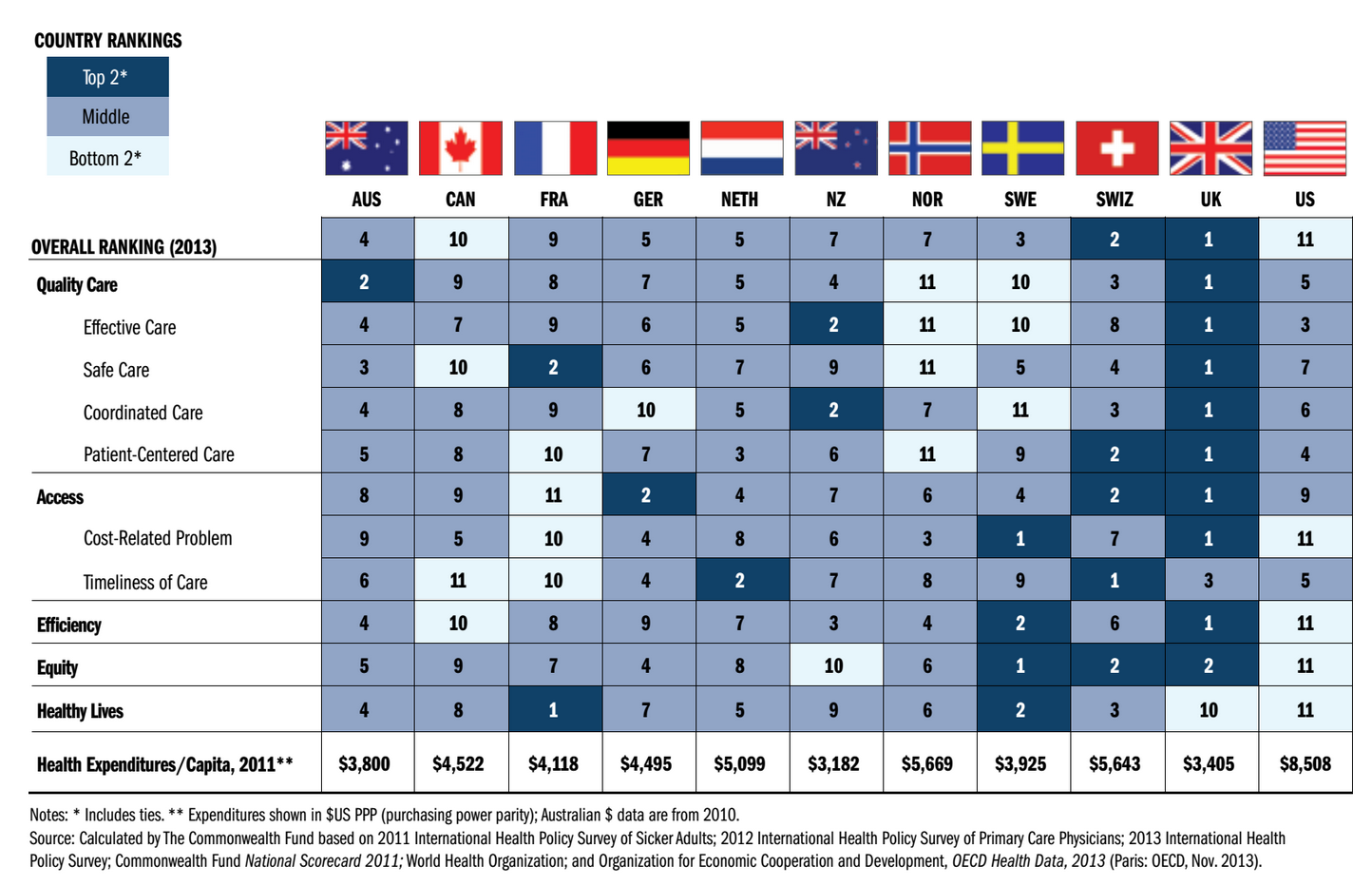
Sarah Kliff unpacks the graphic:
A new Commonwealth Fund report looks at how the United States stacks up against other countries on things like access to doctors and quality of care. It pulls from three separate surveys conducted over the past three years: a 2011 survey of sicker patients, a 2012 survey of doctors and a 2013 survey of adults over 18. It also uses health outcome data from the OECD and World Health Organization. This means it captures the experience of the medical system from the people who use it a lot, those who use it a little and the doctors treating them.
The American health care system came in last both in the overall rankings, which pull together data on 11 specific measures of success for a health care system. This includes metrics like how easily residents can access health care, if that medical care is affordable and if its effective. There was no measure where the United States came in first place — our best ranking was coming in third in the effectiveness of our medicine …
Phillip Klein rejects the study:
The problem with the Commonwealth Fund study is that it’s rigged to produce a result that favors socialized health care systems.
The study determines that the U.S. system is worse because it lacks universal health insurance coverage and the report emphasizes “equity” as one of the key factors in evaluating a health care system. But it’s an ideological decision to view equity as one of the most important factors in judging a health care system, just as it is for the study to leave out a factor such medical innovation, which would work to the advantage of the U.S., or choice, which would work against the centralized NHS.
Olga Khazan provides more context:
It’s important to note that one reason for America’s lag, as the authors explain, is our historic absence of universal health coverage. But the data for the report was collected before the full implementation of Obamacare, which dramatically expanded health insurance, so it’s possible that the U.S. may rise in future rankings. And notably, both the U.K. and U.S. ranked low on the “Healthy lives” scale, which considers infant mortality, healthy life expectancy at age 60, and mortality from preventable conditions, such as high blood pressure.
Dave Schuler examines the other countries ranked poorly:
Even more importantly from my point of view the second-worst system is Canada’s while the third-worst is France’s. Since Canada is the OECD country that most closely resembles ours culturally and from a lifestyle standpoint, I think that’s a significant finding, suggesting that even if we were to adopt, say, a single-payer system that would be merely the beginning of the reforms that would be needed here if we truly want to have the best of class healthcare system to which we aspire.
Err Strikes
Zack Beauchamp urges observers to be skeptical of the Rasmussen poll suggesting that 46 percent of likely voters favor airstrikes in Iraq:
The wording of the Rasmussen question says something important — that’s also false. Here’s how the Rasmussen question in airstrikes read: Do you favor or oppose the United States making military airstrikes in Iraq to help the government fight al Qaeda-led insurgents? The premise of Rasmussen’s question is wrong. The most important anti-government group, the Islamic State of Syria and the Levant (ISIS), is not al-Qaeda led. They splintered from al-Qaeda in February, essentially over the question of whether al-Qaeda could order ISIS around (ISIS had stopped obeying al-Qaeda orders, including ones to tamp down on civilian casualties).
Not only is this a clear mistake, but it’s a relevant one: al-Qaeda has a particularly bad perception among the American public. Americans believe, rightly, that al-Qaeda is out to attack the American homeland, and would likely be more supportive of fighting it than a separate group of Islamist militants.
Earlier Dish on the distinction between ISIS and al-Qaeda here. Juan Cole rejects the strategy of “shock-and-awe” bombing against ISIS, which he doubts would work:
Air power can be useful if it is employed in lending close air support to an attacking military force on the ground, which is itself made up of good fighters with popular support.
American air power saved Kosovo from a Serbian massacre by helping repel Serbian armor and giving support to Kosovar irregulars. In Afghanistan, US air power helped the Northern Alliance win against the Taliban in fall 2001. But the Taliban were unpopular in Mazar, Herat and Kabul, and the Northern Alliance was welcome in those cities. The same tactics did not succeed in Qandahar, which is in some ways still significantly Taliban territory.
US air power alone would be unlikely to dislodge ISIS from Mosul at this point. The Sunni insurgents look more like Viet Cong (local defenders) than they do like outside attackers (Serbs, Taliban in Mazar). Where the enemy has some local support and is defending, air power has a long history of failure.
Barry Posen also urges a more restrained response:
[W]ar is war: not a scalpel but a battle axe. And once you start swinging that axe, there may be unintended consequences. If the United States were to go so far as to help the Baghdad forces retake Mosul and other cities by providing air support, the Sunni Arabs who live there are not likely to think more kindly of us. If the United States provides such air support, and intelligence support, the Iraqi military will never grow up. The combination will be deadly to U.S. interests. All Sunni Arabs will know that we are the pillar of Shiite hegemony in Iraq. If one is interested in the safety of American citizens, this is not a particularly smart role to assume.
An ISIS statelet straddling Iraq and Syria might provide haven for Islamic terrorists who ultimately decide that attacks on Western targets are in their interests, though there is little sign presently that this is ISIS’s program. But “ISISstan” will not be a great base, or a safe one.
Ryan Cooper reminds us that we have several non-violent options at our disposal, including what should be an undisputed US responsibility toward Iraq:
[W]e can streamline the process for Iraqis applying for refugee status, especially those who worked with the U.S. during the occupation. We have already resettled about 85,000 Iraqis here, but as this famous This American Life episode detailed, the application process is very slow and the red tape is hellish. Vulnerable Iraqis who helped America may not have two years to wait for their first interview.
Jihad 2.0
The above video, produced by what is ostensibly ISIS’s English and German propaganda outlet, is one example of how the militants are selling the cause to young Westerners. Meanwhile, J.M. Berger unpacks ISIS’s Twitter strategy, which is among the most effective of any Jihadi organization:
[A custom-built Android] app is just one way ISIS games Twitter to magnify its message. Another is the use of organized hashtag campaigns, in which the group enlists hundreds and sometimes thousands of activists to repetitively tweet hashtags at certain times of day so that they trend on the social network. This approach also skews the results of a popular Arabic Twitter account called @ActiveHashtags that tweets each day’s top trending tags. …
As a result of these strategies, and others, ISIS is able to project strength and promote engagement online. For instance, the ISIS hashtag consistently outperforms that of the group’s main competitor in Syria, Jabhat al-Nusra, even though the two groups have a similar number of supporters online. In data I analyzed in February, ISIS often registered more than 10,000 mentions of its hashtag per day, while the number of al-Nusra mentions generally ranged between 2,500 and 5,000. ISIS also uses hashtags to focus-group messaging and branding concepts, much like a Western corporation might.
Here’s an example of how effective that strategy has been:
https://twitter.com/intelwire/statuses/478310946385850370
But, much like a Western corporation, ISIS doesn’t have complete control of its online image, and tries to limit the “bad press” that makes it onto social media. Shiraz Maher provides some examples:
Social media, coupled with the ubiquity of smartphones, has meant that individual fighters can now film and upload events to the internet in an instant, often with little thought. Isis is not always happy about this. Just a few weeks ago, the group crucified two men in Manbij, Syria, for alleged apostasy (although supporters say the men were regime spies). A Spanish foreign fighter who had promised his followers a video of the spectacle had to make do with only providing pictures of the sadistic act. “Our leadership forbade anyone from filming it,” he said.
This is not the first time Isis has warned its members about their online activity. Earlier this year, the group chopped off the hand of a man in Raqqa. It was a dark, torrid affair with the swordsman requiring several attempts before finally severing the man’s hand. After understandable public outcry, the group has now prohibited anyone from filming similar events. It still goes on, of course, but anyone brandishing a smartphone will be censured. In many senses, this represents the “pluralising” of the global jihad. Whereas we had one or two voices to analyse in the past, we now have hundreds.
In response to the online jihad, Iraq has turned off the Internet in five provinces:
First, Internet service providers are instructed to fully cut access to Anbar, Diyalah, Kirkuk, Ninawa, and Saleh El Din provinces in their entirety, as well as to eleven other areas of the country. According to international Internet tracking firm Renesys, some of these areas, but not all, saw their access blocked a few days earlier. And at least some of the blocked areas are known to be spots of heavy fighting between the Iraqi government and the surging militant group known as Islamic State of Iraq and Syria (ISIS).
The Iraqi government also instructed Internet service providers (ISPs) to reinstate or maintain the existing bans on Facebook, Twitter, YouTube, and Skype, and to create new bans on other communication and social media services like Tango and Instagram. Finally, just in case anyone’s trying to use basic technology to get around those bans, the ban tells ISPs to try to block any use of virtual private networks (VPNs)—a way to reroute your Internet connection to access sites from a middle location—during the local hours of 4 pm to 7 am.
Twitter has also been shutting down accounts linked to the Islamic State that have been posting pictures of their atrocities, but Adam Chandler wonders if that’s a mistake:
While ISIS’ use of a social media platform to show pictures of grisly executions is repugnant, if anything, we’ve learned in recent weeks that social media campaigns (however problematic) have the power to impel the international community act on issues where awareness is typically low or muddied by the complexity of a particular situation. There is very little divining needed when mass executions are being documented and publicly glorified by a terrorist group. With the Twitter account suspended, the pictures of the ISIS insurgency and many of its horrific consequences have been preserved. They may be more useful out in the open.
 The Dish