Drug War And Peace In Colombia

A new approach to combating the cocaine trade, embedded in peace talks between the Colombian government and FARC rebels, raises the hopes of Oliver Kaplan that “the drug war may soon be coming to an end”:

In early May, negotiators from the Colombian government and the rebel group Fuerzas Armadas Revolucionarias de Colombia (FARC) reached an agreement on drug trafficking as part of their effort to end the country’s 50-year old conflict. Shifting away from old, controversial methods like crop fumigation, the new deal focuses on substituting crops, taking on organized crime and cartels, and treating drugs as a public health issue to treat addicts and reduce demand. It’s a historic move — and good news for President Juan Manuel Santos, who faces an increasingly popular opposition candidate in second-round elections on June 15.

Santos’ re-election yesterday bodes well for the peace process, which his opponent had threatened to halt:

Santos got 53 percent of the votes for candidates, against 47 percent for right-wing challenger Oscar Ivan Zuluaga, the hand-picked candidate of former two-term President Alvaro Uribe, who many considered the true challenger. More than 600,000 voters cast “blank” ballots, a protest vote for neither candidate. Zuluaga and Uribe accused Santos of selling Colombia out in slow-slogging Cuba-based negotiations, and said Zuluaga would halt the talks unless [FARC] ceased all hostilities and some of its leaders accepted jail time. Santos said the win affirmed his claim to be ably steering Colombia through a historic moment — out of a crippling conflict that has claimed more than 200,000 lives, mostly civilians.

But if coca cultivation in Colombia declines, Reid Standish suspects that Peruvians will increase theirs:

Drug researchers call this the “balloon effect” — where pressure from the authorities in one country or region pushes drug production elsewhere. Squeezing the balloon at one end causes drug producers to compensate and expand into another. Since the U.S.-led war on drugs began in the 1980s, the balloon effect has shaped the cocaine trade.

In 2013, fumigation and forced eradication of coca crops in Colombia finally hit a turning point and the South American nation bequeathed its crown as the world’s top coca producer to its neighbor, Peru. Both the United States and the U.N. declared it a milestone. Unsaid was that the Colombian government’s efforts to crack down on production — in part under the banner of Plan Colombia, the U.S.-backed effort to combat left-wing guerrillas and drug traffickers — simply shifted production to Peru.

Colombia and Peru have swapped the coca-producer champion crown for decades. In the mid-90s Peru launched an intense eradication campaign and Colombia was back on top. In 1990, Colombia was only responsible for 19 percent of the global coca market, behind top producers Bolivia and Peru. By 1997, it was the world’s top producer. See the pattern here?
Happy Bloomsday!

Every June 16, fans of James Joyce celebrate his famously demanding Ulysses, which takes place on this day in 1904. Jonathan Goldman assures revelers that the point of celebrating Bloomsday “is to recognize the stature of a book without necessarily comprehending it. All you need to understand is its un-understandability.” Dan Chiasson explains why the date particulary appealed to Joyce:

By setting the novel on the day his first inklings of it formed, Joyce ensured that the book would always be, whatever else it would be, a book about its own conception and growth. He had dreamed of writing “Ulysses” since at least 1904, the year two things happened:

a Dublin Jew named Alfred Hunter dusted him off after a brawl and walked him all the way home; and a beautiful barmaid, Nora Barnacle, on their first date—the first Bloomsday—slid her hand “down down inside my trousers,” as Joyce reminded her, later, in a letter, “and pulled my shirt softly aside … and touched my prick with your long tickling fingers and frigged me slowly till I came off through your fingers.”

Each of these courtesies was performed by a stranger for a stranger, though Nora would become Joyce’s lifelong companion and eventual wife. Neither one was an act of specific personal connection or love. Kindness, sexual willingness, patience, forbearance, and especially “equanimity”—that beautiful word that so comforts [character Leopold] Bloom in the end, and perhaps the most important word in the novel—all exist quite independent of personal bonds and the private economies of friendship, family, and marriage. That these lovely traits exist outside of the exchange market of human frailties—that they exist at all, in fact—would have been news to Henry James or, for that matter, to Jane Austen; it is almost hard to conceive of the novel as a genre without the idea that human virtues are always tactical, and spent with the expectation of handsome returns. It may sound sappy, but for me “Ulysses” is chiefly valuable as the most moving tribute in literature to kindness.

Jason Diamond offers tips on how to celebrate the occasion “without totally embarrassing yourself”:

The first, and most important thing, of course, is drinking. If you’re an American, then congratulations — this is one of those rare instances when you can accept a pint of beer in an Irish pub with a hearty “Cheers,” and not have it sound touristy and amateurish.

What do you order? Obviously, there’s always Guinness, but consider this delicious act of sacrilege: change things up this year and drink something like Left Hand’s wonderful Milk Stout. Your beer, of course, should also be accompanied by a whiskey, and this is where you can’t accept any substitutes. No Kentucky bourbon, no scotch from Scotland: Irish whiskey only. So if somebody says they’re getting a Jameson on the rocks, you had better order the same damn thing. To be honest, you could, in theory, get away with drinking anything today — but we’d suggest is you stay away from cider, since that stuff made Bloom gassy. The most important thing is to get at least a solid two drinks in your belly before you’ll be ready for a reading from the book itself.

But James S. Murphy considers such celebrations a “travesty”:

It would be nice to think that swelling readership of Ulysses drives the Bloomsday boom, but it’s more likely that Bloomsday provides an opportunity for cultural validation that’s about as substantial as sharing an author quote on Instagram. Reading Ulysses is a slow, immersive, and ultimately private experience; Bloomsday is a social-media-ready event, where like-minded people convene to celebrate their own taste.

And yet, the silliness might not have bothered Joyce so much. If anything, the aspect of Bloomsday that would have bothered him is its holiness.  Bloomsday celebrations treat Joyce too much like a saint and his book too much like a gospel to be revered first and read later, if at all. By placing Ulysses on a pedestal, we lose sight of both its vulgar origins and its power to tell us deep truths about our world and ourselves precisely by keeping the earthy and obscene aspects of ourselves in view.

Listen to Joyce fans around the world read from the book here. Recent Dish on the author here, here, and here.

The War Beyond Iraq

Mohammad Ballout examines the effect that ISIS’s blitzkrieg in Iraq is having on the war in Syria:

The results of the “Mosul invasion” will soon change the nature of the battle in the battlefields between the “jihadist” brothers in the Syrian east.

If Mosul is not recovered, ISIS may find more than it needs of land, financial resources and human resources to revive the “rule of the caliphate in Badiyat al-Sham.” Controlling Mosul has doubled ISIS’ ability to recruit thousands of fighters from the new Iraqi human reservoir, after annexing the large Ninevah province. All that depends on tribal alliances stretching from Anbar to Deir ez-Zour. And there are inexhaustible oil resources. The Turkish market will buy looted Syrian oil at the cheapest price across the Tell Abyad crossing, taking advantage of the European Union’s decision to facilitate the sale of Syrian oil to finance the opposition.

On the other hand, Fabrice Balanche considers the rise of ISIS a boon for the Assad regime:

Bashar al-Assad is clearly on the path to victory by way of continuing gains since Qusayr in June 2013. From the spring of 2013, the Syrian army, helped by Hezbollah, has been retaking territories: the southern suburbs of Damascus, the Qalamoun, and most recently, the center of Homs. The Syrian regime is not only massively supported by Iran and Russia (something the insurgency lacks), but Assad also applies a highly effective strategy of counterinsurgency. The rise of Islamists against him provided the ideology that Bashar al-Assad needed, i.e. the fight against Islamist terrorists supported from abroad. By demonstrating his resoluteness, Bashar al-Assad wants to reassure his supporters and win over the silent majority. The latter no longer seek the return of peace, but are falling into line behind the force that can ensure their security and is most likely to win.

But that second “S” in ISIS doesn’t really stand for “Syria” the country, but rather for “al-Sham”, i.e., “greater Syria” or the Levant (hence the alternate acronym ISIL). Dexter Filkins illustrates the conflict’s regional dimension:

The extremist groups dominating the fighting are beginning to take their war beyond the two countries that they now freely traverse. In January, isis carried out a car-bomb attack in Beirut near the offices of Hezbollah, the Lebanese militant group that has been fighting on behalf of Assad. The Nusra front has also carried out attacks in Lebanon. Meanwhile, the number of Syrian refugees who have fled to that nation exceeds twenty per cent of its population, which is not something that a state as weak and as fractious as Lebanon can be expected to sustain. In Jordan, the presence of half a million Syrian refugees is putting an enormous strain on the fragile monarchy.

Taylor Luck reports on ISIS’s plans for Jordan:

Islamist sources claim that the Islamic State is preparing for “expansion into Jordan” as it continues to push westward through Iraq. According to jihadist sources close to ISIL, the former Al Qaeda affiliate opened on Friday an “unofficial” office and branch in Jordan to usher what sources claim as expansion of the Islamic “caliphate”.

Despite having a low-profile presence in Jordan over the past six months, with over 800 Jordanian nationals reportedly serving under the ranks of ISIL, the movement has allegedly been reluctant to open an official branch in Jordan due to its ongoing rivalry with Al Qaeda, which retains larger popularity and support among hard-line Islamists in the country. Senior members of Jordan’s hard-line Salafist movement, which keep strong ties with both Al Qaeda and the Baghdad-based ISIL, had previously mediated “understandings” with the Islamic State to forego expansion into the country in a bid to prevent ongoing jihadist civil war in Syria to spill over into the country.

A Shot At Self-Determination For Afghans

James Stavridis and Craig Charney call the Afghan presidential election, the second round of which was held successfully on Saturday, a major sign of progress:

The Taliban’s impotence was obvious during the first round of this year’s elections, which they had promised to violently disrupt — and failed to. Their inability to engage in large-scale disruption was underlined last week by a desperate attempt to abort the runoff by killing Abdullah in a suicide bombing, which left the candidate unharmed in his armored car but killed a dozen passersby and bodyguards.

This failure is also echoed in the 90 percent drop in coalition casualties since 2010 and the rise in attacks on “soft targets” by frustrated insurgents. The Taliban may be a continuing problem, but they do not seriously threaten a military takeover of the country. Afghans noticed the change: In the Dec. 2013 polling, nearly two-thirds rated local security as good. In fact, security no longer tops their concerns. Rather, the leading issues are the economy, infrastructure, and corruption — as in other poor South Asian countries.

Emily Schneider summarizes the news from election day, which saw no major acts of violence:

During the first round of voting, about 375,000 votes were disqualified because they were deemed fraudulent. Camps for both candidates, Abdullah Abdullah and Ashraf Ghani, have said that fraud would be the only reason for their candidate’s defeat, so getting the campaigns, and their followers, to accept the final results may prove challenging.

While the voter turnout was high, scattered violence was reported throughout the country: the country’s Interior Ministry reported that 10 Afghan soldiers and at least 20 civilians died in gun battles and bombings; After the polls closed, authorities in Herat Province reported that the Taliban had cut off the fingers of 13 people who had voted  (CNN,AP). But, as the polls closed, it appeared that the Taliban had failed to carry out any major attack in an urban area.

The final results will take weeks to come in. In a preview of the runoff last week, Kevin Sieff profiled the two remaining candidates:

[I]n the absence of concrete platforms, Afghans are looking closely at the biographies of Abdullah Abdullah and Ashraf Ghani, speculating about what their lives say about their ability to lead. Afghan politicians are still judged to a large extent by their roles in the nation’s recent history, particularly the anti-Soviet uprising of the 1980s. At that time, Abdullah was an aide to the mujahideen leader, Ahmad Shah Massoud, a relationship he advertises in speeches and campaign posters. Ghani, on the other hand, was launching an impressive academic career that led to professorships as well as World Bank positions. From those experiences, their supporters and detractors have drawn conclusions. Abdullah is seen either as a patriotic war hero, willing to die for his country, or a representative of old-school Afghan politics, based in muscle rather than policy. Ghani is seen as a well-educated reformer, or a Western intellectual without deep Afghan roots.

Regardless of who wins, Scott Smith wants assurances that the US will continue to support the Afghan government:

If the next Afghan government is seen as vulnerable because it lacks international support, the predatory currents of Afghan politics will combine with the unhelpful rivalries of Afghanistan’s neighbors conditioned to use Afghanistan as a proxy battlefield. This, in combination with a still-resilient Taliban, may prevent the government from functioning, leading to a breakdown of order. Every major actor, including the Taliban, is basing their strategies and next moves on their perception of whether the government in Kabul will hold together. Much of that perception hinges on whether or not the Afghan government will have sustained international backing.

Who Are These ISIS Chappies, Anyway? Ctd

In a lengthy but essential overview of the dynamics at play in Iraq, Kenneth Pollack cuts through some of the rhetorical bullshit, noting, for instance, that ISIS isn’t just made up of foreign fighters:

This is important because Prime Minister Maliki and his apologists have tried to paint ISIS as a group of foreigners who were waging the Syrian civil war and suddenly decided to launch an invasion of neighboring Iraq. If that narrative were true, it would suggest that a pure (and immediate) military response were warranted since such a group would have a great deal of difficulty holding territory conquered in Iraq. It would obviate the need for far-reaching political changes, which Maliki seeks to avoid.

He also explains how the “terrorist” label obscures the group’s true purpose:

[T]his is a traditional ethno-sectarian militia waging an intercommunal civil war. (They are also not an insurgency.) They are looking to conquer territory. They will do so using guerrilla tactics or conventional tactics—and they have been principally using conventional tactics since the seizure of Fallujah over six months ago. Their entire advance south over the past week has been a conventional, motorized light-infantry offensive; not a terrorist campaign, not a guerrilla warfare campaign. … That is important because defining the Sunni militants as terrorists implies that they need to be attacked immediately and directly by the United States.

Seeing them for what they are, first and foremost a sectarian militia waging a civil war, puts the emphasis on where it needs to be: finding an integrated political-military solution to the internal Iraqi problems that sparked the civil war. And that is a set of problems that is unlikely to be solved by immediate, direct American attacks on the Sunni militants. Indeed, such attacks could easily make the situation worse.

Juan Cole agrees about the terrorist misnomer, at least for now, and he rejects some other popular assertions as well, including that ISIS is somehow popular:

They are not. Opinion polling shows that most Iraqi Sunnis are secular-minded. The ISIS is brutal and fundamentalist. Where the Sunnis have rallied to it, it is because of severe discontents with their situation after the fall of the Baath Party in 2003 with the American invasion. The appearance of video showing ISIS massacring police (most of them Sunnis) in Tikrit will severely detract from such popularity as they enjoyed.

He also contextualizes the idea that “ISIS fighters achieved victory after victory in the Sunni north”:

While this assertion is true, and towns continue to fall to it, it is simplistic. The central government troops, many of them Shiite, in Mosul and in towns of the north, were unpopular because representatives of a sectarian Shiite regime. The populace of Mosul, including town quarters and clan groups (‘tribes’) on the city’s outskirts, appear to have risen up in conjunction with the ISIS advance, as Patrick Cockburn argues. It was a pluralist urban rebellion, with nationalists of a socialist bent (former Baathists) joining in. In some instances locals were suppressed by the fundamentalist guerrillas and there already have been instances of local Sunnis helping the Iraqi army reassert itself in Salahuddin Province and then celebrating the departure of ISIS.

Aaron Zelin tries to figure out how many of the militants came from abroad:

Similar to [al-Qaeda in Iraq’s] original practice of posting official martyrdom notices, ISIS began doing so itself earlier this year, highlighting its comfort in sharing such information. Since early March, the group has released 201 martyrdom notices on its official province-level Twitter accounts for foreign fighters killed in Iraq (most of the notices were also posted on online jihadist forums). Although some of these notices were for individuals who died as far back as September 2012, the vast majority were for deaths that occurred after April 2013.

Since this information is self-reported by ISIS, and because the group continues to release older notices, the actual number of foreigners who have died in Iraq is likely higher. Further, some notices do not name a specific country of origin, instead using phrases such as “al-Shami” (which could denote anyone in the Levant) and “al-Muhajir” (meaning simply “emigrant”). In any case, this year’s jihadist death toll is set to exceed last year’s — if the current pace continues, some 233 foreign fighters will have been killed in Iraq by the end of 2014, or two-and-a-half times more than 2013. And the pace will likely accelerate given the increased fighting.

Josh Rogin traces most of the group’s funding back to wealthy donors in Kuwait, Qatar, and Saudi Arabia:

Gulf donors support ISIS, the Syrian branch of al Qaeda called the al Nusrah Front, and other Islamic groups fighting on the ground in Syria because they feel an obligation to protect Sunnis suffering under the atrocities of the Assad regime. Many of these backers don’t trust or like the American backed moderate opposition, which the West has refused to provide significant arms to. Under significant U.S. pressure, the Arab Gulf governments have belatedly been cracking down on funding to Sunni extremist groups, but Gulf regimes are also under domestic pressure to fight in what many Sunnis see as an unavoidable Shiite-Sunni regional war that is only getting worse by the day.

Previous Dish on ISIS’s origins and objectives here and here.

American Fútbol, Ctd

Massie loathes American soccer fans, whose ranks are growing:

Honestly, is there a prissier shower of whining jackanapes in world football than the oh-so-wearisomely precious types who attach themselves to Team USA’s fortunes? No, there is not. … They want to be respected even as they whine that the system is rigged against them. A referee’s mistake? Obvious anti-American bias! A tougher draw than some teams have received? More anti-Americanism! FIFA, you see, are scared of what might happen if the Yanks ever get too successful. So they won’t let it happen. Because, obviously. FIFA no like the money.

Nico Hines complains that Americans don’t understand how to follow the game properly:

Americans’ obsession with viewing sports through the prism of individual records is ruining their enjoyment of the world’s favorite game. It doesn’t matter who has the highest shot conversion ratio; these players aren’t trying to win themselves a berth in the All Star team, or a place in the Hall of Fame. The only thing that counts is the team: Did they win?

Just look at the captain that holds the trophy aloft at the end of the tournament. As Brazil celebrated in 1970, it wasn’t Pele, the greatest goal scorer of all time, who collected the World Cup trophy, it was his harder-working, less well-known colleague Carlos Alberto, a defender. If the sport was ruled by U.S. sports fans, perhaps Alberto would have boasted the most sacks or rebounds or something, but nobody was counting his tackles, headers or interceptions. It didn’t matter. Sure, football fans everywhere gather with ice-cold beverages to debate which players are best but there is nothing like the same cult of individuality.

Meanwhile, Matthew Futterman profiles who he calls “soccer’s Alexis de Tocqueville” – Jurgen Klinsmann, the German-born coach of the American soccer team who came to the US “to create a squad that represented what he sees as the defining American characteristic—a visceral hatred of being dictated to.” How he’s overhauling the way Americans play soccer:

As coach of Germany’s national team, he took a youthful group to the 2006 semifinal by transforming it from a defensive-minded squad to a free-flowing attacking one. He believed the modern game had no place for teams that hang back and try merely to survive—”parking the bus in front of the goal” in soccer-speak. For the U.S. team, he felt this strategy was wrong on another level: it was un-American. “You want to take things in your own hands,” he says of American behavior on and off the field.

Mr. Klinsmann taught the U.S. players to see the field differently—to impose themselves on opposing defenses, and for defenders to push high into the middle of the field and even to join the attack. Midfielders, who have to both attack and defend, were sent down the sides of the field where they could send crossing passes in front of their opponent’s goal. Most important, he implored them to keep the ball moving around the field, and the only way to do that, he explained, was to stay in near perpetual motion, to search constantly for the open space where they can receive a pass.

Iraq: You Broke It, You Bought It? Ctd

Bush Asks Congress For $74.7 Billion In War Aid

Noah Millman responds to me by insisting he does not favor military intervention in what’s left of Iraq, but that my own formulation of “letting go of global hegemony” is too glib and too blithe. As for the US having an indirect responsibility to the people of Iraq, having invaded their country eleven years ago, here’s the money quote:

My definition of “indirect responsibility” is simply to say that once you have positioned yourself as a global hegemon, declared yourself “indispensable” and arrogated to yourself rights that are not granted to any other state, of course you are indirectly responsible for just about everything that happens, to a greater or lesser degree depending on the situation. The madness lies not in my description of reality but in the reality itself. We should seek to change that reality. Perhaps I am overly pessimistic, but I assume that this will be a difficult and lengthy labor, with many setbacks along the way. I am hard-pressed to name another hegemonic power that acceded peacefully to a more multi-polar reality.

And on that point, we can surely agree. There are, indeed, very few empires that “let go” without hanging on indefinitely and then succumbing to a sudden collapse. One wonders what would have happened to the British Empire without the Second World War. But that’s only the case with respect to meddling in other countries’ internal affairs, trying to shape the form of government in other countries, or feeling obliged to prevent evil whenever it emerges. It seems to me perfectly possible for the US, by virtue of its naval and air power to secure the critical shipping lanes for international trade and travel, to bolster democratic allies with trade, intelligence, and mutual security arrangements, while eschewing the kind of global micro-management that was once justified by the Cold War or rationalized by unchallenged unipolar power from 1989 – 2001. Will that mean some regional actors filling the vacuum?

Of course. Hence Russia’s bullying of its near abroad and the Chinese attitude in the Pacific.

But these regional shifts do not, it seems to me, directly injure American national interests – what on earth did meddling in Libya achieve? – and can, in fact, lead to somewhat better outcomes, in as much as they might facilitate a more stable balance of power between countries with a much better grasp of their own neighborhoods than we have. Will this mean unpleasant outcomes for some? Alas, yes. But a foreign policy based on preventing unpleasant outcomes for millions of foreigners is not a foreign policy at all. It is a pretentious posture, underwritten by solipsism and hubris.

So, yes, there will be blood. But given our massive – historically unprecedented – global over-reach, some of this is inevitable as we retrench to saner, more sustainable limits. Is this difficult and nerve-wracking process without risk? Of course not. Is the alternative begging for the sudden collapse so many over-reaching, self-bankrupting empires have experienced? You bet it is.

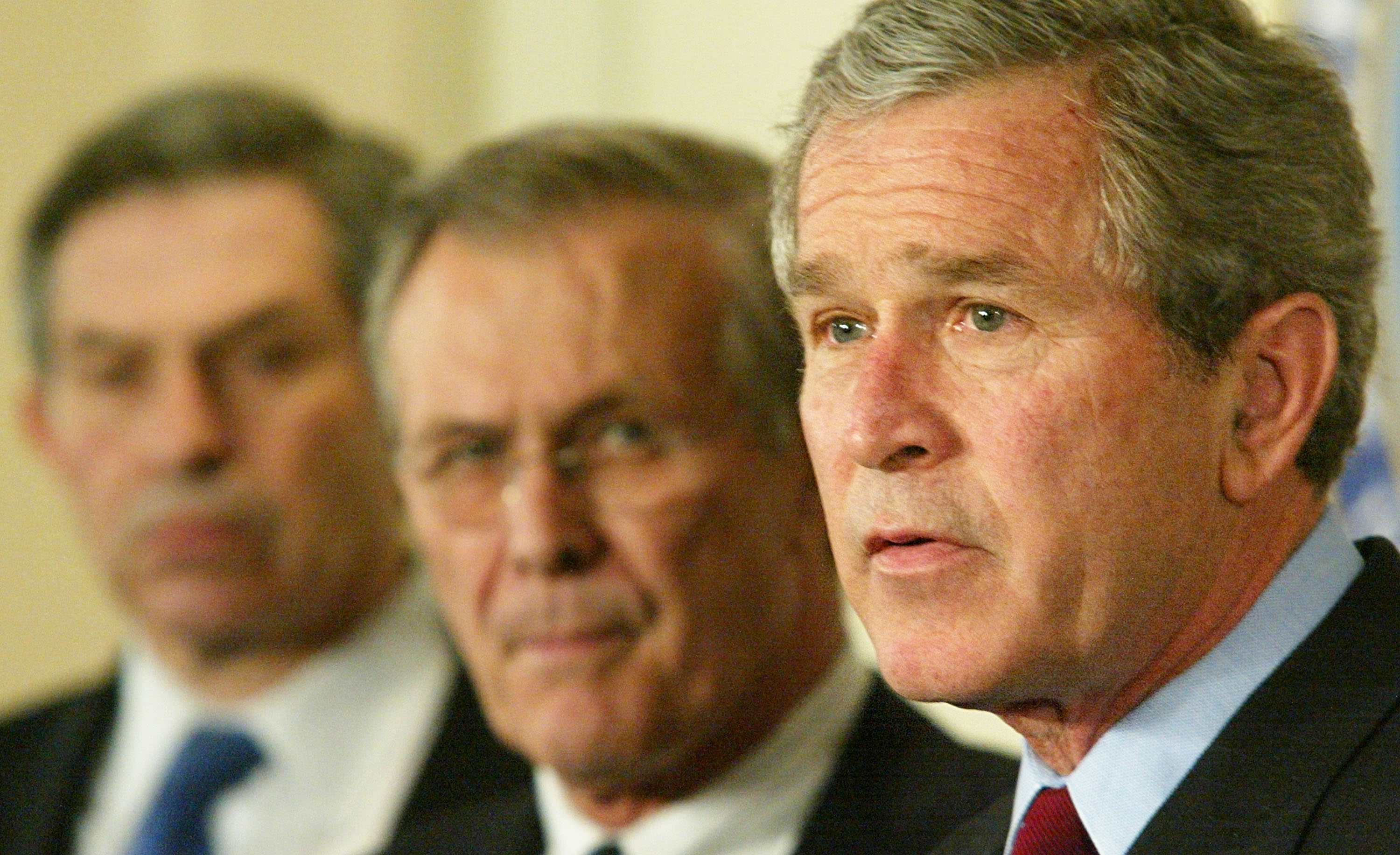
(Photo: three neocon musketeers in 2003, by Alex Wong/Getty.)

If You Thought Obama’s Syria Policy Was Bad …

Try Erdogan’s. The Turkish prime minister’s decision to go all-in against Assad, Henri Barkey remarks, has backfired pretty severely:

At the start of the conflict, Erdoğan presumed that by putting his weight behind the rebels he would be speeding up regime change in Damascus; in fact, he and many others were confident that change would occur within six months. Obviously, they were wrong. The costs to Turkey range from the ever-increasing numbers of refugees severely taxing the social fabric in certain locations—not to mention the financial burden—to the loss of face for Erdoğan at home and in the region to fragmenting relations with regional powers such as Iran and Saudi Arabia. According to a recent Brookings report, there are a million Syrian refugees, most of whom have blended into Turkey and do not reside in camps. The cost to the Turkish treasury has already exceeded $2.5 billion. Furthermore, the Syrian crisis touches all the hot buttons of Turkish politics: the sectarian differences between the majority Sunni population and the Shi’a offshoot Alevis and the ethnic divisions along Turkish-Kurdish lines.

Meanwhile, ISIS militants continue to hold hostage 80 Turkish citizens captured in Mosul, most of them diplomats and staff from the Turkish consulate and their families. Tulin Daloglu plays up the irony that Turkey is now threatened by the same jihadist elements it has been tacitly supporting in Syria for several years:

Turkey’s Foreign Minister Ahmet Davutoglu has been on the defensive for over a year about Turkey’s potential links to these radical extremist groups in their fight to bring down Syrian President Bashar al-Assad. Although it is improbable that Turkey directly provided support to these groups, it wasn’t until June 3 that Turkey finally designated Jabhat al-Nusra, another al-Qaeda spin-off group, as a terrorist organization. Turkey officially stated that the May 2013 Reyhanli car-bomb attack — the worst terror attack this country has ever seen, killing 52 Turkish citizens — was the work of the Assad regime, but the widespread belief was that it was an al-Qaeda attack.

Turkish authorities speaking on condition of anonymity, however, told Al-Monitor that the ruling Justice and Development Party could not admit it as such back then, and could not spell it out this time in Mosul. “They can’t say it because it would contradict the whole belief system of their core base,” one official said. “But the fact of the matter is that Turkey is certainly being threatened by al-Qaeda offshoots.”

Aaron Stein considers the manifold problems the implosion of Syria and Iraq has created for Turkey:

The major overland routes to Basra from Turkey run through Mosul. Ankara has already lost its ability to truck goods to the Gulf through Syria and may now have to deal with the same issue in Iraq. If  Turkey loses this route – and I think the taking hostage of 28 truck drivers may mean that this is inevitable – it could have some impact on Turkish trade with the region. In this regard, the importance of the KRG’s stability becomes even more paramount. In addition to the aforementioned security issues, the maintenance of a stable area of export is always near the top of the Turkish foreign minister’s agenda.

Turkey must also be concerned about the abysmal performance of the Iraqi security services. If Iraq descends further into chaos, Turkey will have to contend with two failed states on its borders. And in the absence of centralized authority, the expansion of ISIS territory could continue. However, in a perverse way, Turkey also does not want to see the rapid influx of advanced weaponry into Baghdad to support a fight against ISIS. Turkey is wary of Maliki’s sectarian agenda and does not want the Iraqi strongman to acquire the means to further solidify his hold on power. And any influx of modern weaponry erodes Turkey’s massive conventional superiority over the Iraqi state and could lessen Ankara’s air superiority over Kurdistan.

And, while the crisis may force a rapprochement between Turkey and Iran, Semih Idiz frames this as a product of Ankara’s weak position in the region:

It is no secret that Turkey and Iran are at odds over Syria, not to mention other issues, and have been engaged in what amounts to a proxy war, supporting opposing factions in that country’s sectarian civil war. The picture may be changing, however, with Syrian President Bashar al-Assad consolidating his power in regions under his control, while jihadist groups establish themselves in parts of northern Syria along the Turkish border as well as Iraq’s Nineveh province. …

Ankara and Tehran still disagree, of course, on Syria and Egypt, but it is Turkey that appears to be on weak ground in these respects. Ankara is therefore likely to be the party that gradually modifies its policies to match the reality on the ground. The belated designation of Jabhat al-Nusra as a terrorist organization, after numerous warnings from Washington and Tehran, already hints at change in this respect.

De Niro’s Gay Dad

Cynthia Fuchs reviews a new HBO documentary on the subject:

He reads from his [artist] father’s journals, as these might provide some insight into his father’s personal and professional struggles, insights his father didn’t share when he was alive. “Maybe his sexuality,” De Niro, Jr. offers. “I don’t know where that stood at that point.,” a reticence that may have had to do with his father’s sense of “guilt.”

As difficult as the subject might have been for the father to discuss with his son, and as difficult as it may be for his son now to detail in public, the film maintains a sort of respectful distance, leaving most of the artist’s self-representation to his paintings, his enduring engagements with the world. However this “guilt” might be working, across time and sensibilities, the film offers occasions to ponder the complexities yourself. These moments are the movie’s most resonant and least simple, exemplified when a combination of De Niro, Jr. reading from the journals and Philip Glass’ piano score, accompanies examples of his father’s work, crucifixions and pink figures, women and men, seated and faceless.

If his father was proud of him, as the actor’s career took off, the two men also lived separate lives; De Niro, Jr. suspects his father felt some concern that it was the son making the name famous, not him.

Rich Juzwiak highlights some touching moments:

Perri Peltz and Geeta Grandbhir’s doc also featured excerpts from De Niro, Sr.’s journals, and this one linking his hopelessness as an artist and as a gay man in pre-Stonewall society was particularly poignant:

Being a painter is an affection like being a homosexual. One had to have the strength to continue working without the thought of recognition even before or after death, just as one had to have the strength to accept life alone without the thought of a romantic attachment.

In another, he wrote, “Will I be recognized in my lifetime?” His son sought to make that happen—the goal of this doc stated in its first moments is to give De Niro, Sr., his due. He died of prostate cancer in 1993 at the age of 71.

De Niro discussed the documentary with Jerry Portwood:

I think people may be curious because, in a way, you are coming out for your father. He may not have been hiding his lifestyle or who he was, but it’s not something that is common knowledge.

I felt I had to. I felt obligated. It was my responsibility to make a documentary about him. I was always planning on doing it, but never did. Then Jane Rosenthal, my partner at Tribeca [Enterprises], said, “We should start doing that now.” It was not intended to be on HBO. It was just something I wanted to do.

I had footage from a guy who used to follow my father around in the ’70s. We started with that. I bought it from him and gave the footage to Thelma Schoonmaker, who was Marty Scorsese’s editor. I asked her what she could do with it, and she assembled it and put it together — it was falling apart. Then we started the documentary [with director Perri Peltz], really working, using pieces that would make sense. My original idea was to do it for the kids, about my father — whatever it would be. I didn’t know how long it would be. The thing with HBO is, I felt they would be objective about certain things. I said, “Let’s see what we come up with.”

Is there a piece of your father’s that’s your favorite?

Oh, I have a lot. I have Venice by Night at my house. I love the ones at Locanda Verde, at the grill upstairs on the second floor. There are a lot of black-and-whites that are terrific. I like the delicacy of them, the refinement. They have a certain kind of clarity. They’re really great.