A Failed State In The Making?

Refugees Flee Iraq After Recent Insugent Attacks

Daniel Byman doesn’t see how ISIS will be able to handle actual governing:

ISIS may be good at preaching fire and brimstone to motivate its followers to kill themselves and their enemies, but the bloodthirsty thug with an AK-47 isn’t much good at helping you find health care or repair your house after it’s been shelled. It can loot and terrorize, but the patient work of providing services or otherwise running a country are beyond it. Even more damning, the movement itself is prone to divisions—violent ones. Power is a function of charisma, not institutions, making rivalries more likely and creating vacuums when a leader is killed. Moreover, having opened the door to declaring other Muslims apostate, it is impossible to close it: You can always find some deviation to fight over or declare a rival insufficiently zealous. The presence of so many foreign fighters often makes this worse. Locals’ zealotry is tempered by their relatives and other personal connections to home; the true-believing foreigners often accept no compromises and, at the same time, their presence exacerbates local resentment and nationalism.

But, in Aaron Zelin’s examination of how ISIS has run Syria’s Raqqa governorate, he points out that the group seems pretty well-organized, in both brutality and road maintenance:

The group … has a surprisingly sophisticated bureaucracy, which typically includes an Islamic court system and a roving police force. In the Syrian town of Manbij, for example, ISIS officials cut off the hands of four robbers. In Raqqa, they forced shops to close for selling poor products in the suq (market) as well as regular supermarkets and kebab stands—a move that was likely the work of its Consumer Protection Authority office.

ISIS has also whipped individuals for insulting their neighbors, confiscated and destroyed counterfeit medicine, and on multiple occasions summarily executed and crucified individuals for apostasy. Members have burned cartons of cigarettes and destroyed shrines and graves, including the famous Uways al-Qarani shrine in Raqqa.

Beyond these judicial measures, ISIS also invests in public works. In April, for instance, it completed a new suq in al-Raqqa for locals to exchange goods. Additionally, the group runs an electricity office that monitors electricity-use levels, installs new power lines, and hosts workshops on how to repair old ones. The militants fix potholesbus people between the territories they control, rehabilitate blighted medians to make roads more aesthetically pleasing, and operate a post office and zakat (almsgiving) office (which the group claims has helped farmers with their harvests). Most importantly for Syrians and Iraqis downriver, ISIS has continued operating the Tishrin dam (renaming it al-Faruq) on the Euphrates River. Through all of these offices and departments, ISIS is able to offer a semblance of stability in unstable and marginalized areas, even if many locals do not like its ideological program.

But, even if it’s sustainable, Angelo M. Codevilla doubts that “Sunni-stan” will pose much of a threat to the region:

Pushed into Syria’s eastern end, the international Sunni brigade flowed into Iraq and joined with their local brethren. Jointly, they control a compact area comparable in size to that which Iraqi Shia control to the Southwest, to what the Syrian regime controls to the West, and larger than what the Kurds control in the North. This Mesopotamian Sunni-stan is poor, however, land-locked, and surrounded by peoples who are very much on guard against its conquerors. It is difficult to imagine what power these people might wield once money from the Gulf stops coming in.

It would behoove U.S. policy makers to stop impotent regrets about the loss of a “united, democratic, progressive Iraq,” which ever existed only in their own minds. Rather, they should get used to the region’s new map and demand of Sunni-stan’s sponsors in the Gulf that they guide it to getting along with its neighbors.

(Photo: Iraqi children carry water to their tent at a temporary displacement camp set up next to a Kurdish checkpoint on June 13, 2014 in Kalak, Iraq. Thousands of people have fled Iraq’s second city of Mosul after it was overrun by ISIS militants. Many have been temporarily housed at various IDP (internally displaced persons) camps around the region including the area close to Erbil, as they hope to enter the safety of the nearby Kurdish region. By Dan Kitwood/Getty Images.)

Fatherless On Father’s Day, Ctd

A reader writes:

Weldon’s piece hit close to home.  As the son of an absent father (my parents’ divorce became final before I turned 2) who had no relationship with his father, Fathers’ Day seldom had meaning for me.  To this day, I just know the day happens sometime in June. I know my mother felt compelled to fill the role of father, either herself or through groups like Big Brothers of America. I know she felt guilt and shame over my fatherless upbringing. Because her divorce occurred in the mid-1970s, before the vogue wave of divorce in the 1980s, people treated her, and my sister and me, differently.  People pitied us and thought we kids were fragile. Teachers and good Catholic church members condescended towards us. When the wave of divorce in the 1980s hit, I had teachers ask me if I could talk to affected peers about what they should expect (like I knew).

Organized sports became my father replacement.

My all-male high school experience shaped my sense of being a man for others (a great Jesuit high school!). Being the child of a fatherless upbringing caused me quite a bit of anxiety as I became a father myself. I had no role model (positive or negative). My wife and kids get excited on Fathers’ Day, but I feel conflicted about it. I feel it’s more for them than me. The 30 years of being fatherless has yet to condition me to appreciate the celebration of now 10 years of being a father on Fathers’ Day.  It’s odd.

Another takes a much darker turn:

I’m glad you brought this topic up, because you’ve given me a place to vent on an adjacent topic: those of us who did grow up with a father at home, but who may have been better off if we had not. Every Fathers Day, when I see the parade of old black-and-white photos with “I miss you, Dad” posted on Facebook, here’s what I want to post: “I don’t miss my father. If you do, you are blessed.” (My wife wisely talks me out of it.)

My father was either absent and cheating, or home and beating. Or molesting my sister. His passing was mostly a relief. I attempt to conjure up positive memories but find mostly scraps. The closest thing to a compliment I can make is that his insistence on my living a life of integrity, honesty and respect was successful enough so that it stuck even when, in my 20s, I realized that his own character had none of these things. And that my own successful fatherhood can be partly credited to doing the opposite of what he did.

Send In The Kurds?

That’s what Michael Knights proposes to fend off the ISIS menace:

The geometry of the battlefield makes the Kurds particularly vital: ISIS pursued Iraq’s retreating forces south of Mosul for over 200 miles, with most units ordered to rally on Taji in Baghdad’s northern suburbs. This has given ISIS significant depth on the north-south axis, meaning that the government may need to painstakingly retake a sequence of key insurgent-held cities in turn. But due to the Kurds’ advanced positions all along ISIS’ eastern flank, the jihadist movement has very little west-east strategic depth if key centres like Mosul were counterattacked from the Kurdish-held areas. Kurdistan has offered the use of its airbases to U.S. forces many times, and they would be an ideal place from which to conduct limited U.S. airstrikes. This was precisely the formula – U.S. special forces advisers and pesh mergas – that crumbled Saddam’s hold on Mosul and northern Iraq in a matter of days in 2003.

The Iraqi Kurds are generous and brave: they hate the extremism of radical jihadist groups and will not tolerate a major jihadist center in Mosul, located just an hour’s drive east of the shining new skyscrapers of Erbil, the Kurdish capital. Indeed social media reporting of Kurdish martyrs in the fight against ISIS are proliferating. The Kurdish pesh merga are already fighting ISIS at half a dozen points from the Syrian border to Iran, with Baghdad’s air forces in support in some areas.

Jay Newton-Small takes a closer look at what the Kurds stand to gain from this conflict:

The fact that an estimated 5,000 ISIS fighters now stand between Erbil and Baghdad only serves as a physical barricade of a partition that has been in effect for at least six months, if not years. As Iraq falls apart, the Kurds are discretely moving towards their long-sought-after goal of an independent state. “We’ve said all along that we won’t break away from Iraq but Iraq may break away from us, and it seems that it is,” Qubad Talabani, deputy prime minister of the Kurdish Regional Government, tells TIME. “There’s been many times that we felt it could happen, that it was only a matter of time that it would happen, and it has.”

Talabani also argues that his government would be a better ally for the US than Maliki’s. In an interview with Eli Lake, he claims that the Kurds aren’t gunning for a land grab:

Talabani told The Daily Beast that the Peshmerga deployment to Kirkuk was actually approved by Prime Minister Nouri al-Maliki. “No one has asked us to abandon those posts in Kirkuk,” Talabani said. “On the contrary, the Iraqi prime minister’s office gave us the green light to do what we can to protect as much territory as we can in the north.” The fact that Peshmerga secured positions in Kirkuk with the blessing of Maliki’s Shi’ite-dominated government is in itself a sign of how desperate things have become. …

Talabani said the presence of Peshmerga troops at Kirkuk—which has significant oil resources itself—does not change its status. “It doesn’t change anything on the ground, ultimately we have said Kirkuk belongs to the Kirkukis,” he said. “It’s something we always felt rests with the people of Kirkuk. The fact that there are no longer Iraqi units outside the city, it does not change Kirkuk’s status in the country.”

Keating, however, doubts the Kurds will hand their gains back to Baghdad without extracting some major concessions:

If ISIS is eventually beaten back, it’s likely going to require the help of what seems to be the country’s most organized fighting force, and the conflict will likely end with Kirkuk and several other cities under the control of Kurdish forces. The Kurds may cede these gains back to Baghdad, but I’d expect their price to be high.

Finally, in an interview we highlighted earlier today, Kirk Sowell pushes back on the notion that the Kurds have been operating some kind of autonomous paradise, noting that after an oil dispute the Maliki government had stopped making the monthly payments on which the Kurds were deeply dependent:

[C]oming in to this crisis, the Kurds were on the verge of insolvency. Like, complete insolvency. The only thing that kept them alive was that the Barzanis and the Talabanis [leading Kurdish families] have massive amounts of money stored back that they’d been stealing all of these years. They used it to keep the Kurdish region afloat, or at least pay the peshmerga [independent Kurdish militias].

He calls the new conflict with ISIS a “lifeline” for the Kurds:

Maybe they can get Baghdad to restore their payments, maybe they can’t. If Baghdad doesn’t restore their payments, they might as well declare independence right now. Now that they control Kirkuk, they can export the oil they control to Turkey. They don’t yet have the infrastructure to replace what they were getting from Baghdad, so it would be rough for a year or two. But eventually they’d do OK. So they’re really the big winners here.

America Is Armed To The Teeth

gun_ownership_map

Zack Beauchamp maps American exceptionalism when it comes to gun ownership:

Here’s a map of firearm ownership around the world, using 2012 data compiled by The Guardian. The United States has nearly twice as many guns per 100 people as the next closest, Yemen — 88.8 guns per 100 as opposed to 54.8 in Yemen. … How does this relate to homicide rates? Not simply. For instance, the United States has over 12 times as many guns per person as Honduras, but the 2012 US gun homicide rate per 100,000 people (2.97) is 1/22 of Honduras’ (68.43). That’s because, while guns make murder easier, wealthy industrialized countries generally have significantly lower rates of violent crime than comparatively impoverished ones. But when you compare the United States to nations like Britain and Japan, it becomes clear that firearm ownership contributes to America’s murder problem. The American homicide rate is about 20 times the average among Organization for Economic Cooperation and Development countries (excluding Mexico).

Also, although mass shootings are getting more media coverage, they actually aren’t on the rise:

12-massshootingsnew.w1120.h1472It’s clear that there is no major upward trend. And slicing the data differently doesn’t make a difference — [James Alan Fox, a criminologist at Northeastern University] said that since homicides are on the downswing in general, the overall shape of the graph wouldn’t change much if you changed the definition of a mass shooting to, say, three victims or more. There isn’t even any upswing in the number of school shooting victims, at least based on the Department of Education’s own official statistics (PDF).

Why, then, is there such a powerful feeling that things are getting worse? Media coverage plays a big role. It’s almost hard to believe today, but there was a time in the not too distant past when people in New York might not even hear about a school shooting that happened across the country.

Drum puts Fox’s statistics in context:

Since 1993, the rate of violent crime in America has plummeted by half. That’s the background to measure this against. In general, America has become a much safer, much less lethal place, and yet mass shootings have remained steady. Compared to the background rate of violent crime, mass shootings have doubled. Why?

And here’s an equally interesting question: between 1976 and 1993, violent crime increased by a significant amount, but mass shootings remained steady. Again, why? Raw numbers are a starting point, but they don’t tell the whole story

Between A Rock And A Sectarian Bloodbath

IRAQ-UNREST

Harith Hasan examines how Iraq’s Sunni population views ISIS:

Most Sunnis maintain their suspicious view of the Shiite-dominated government in Baghdad, but they do not see ISIS as a good alternative. It is true that ISIS has largely invested in the sectarian tension in Iraq and the region, but its objectives go beyond the Iraqi borders or the major concerns of Iraq’s Sunni community. Through its simultaneous involvement in Syria and Iraq, ISIS established its distinct entity and identity with an agenda that is largely indifferent to Iraqi politics.

However, fighting ISIS has yet to become a Sunni priority. One reason is the growing strength of the organization and its proven ability to carry out revenge against “traitors,” as was the case with the assassination of Khamis Abu Risha, a leader in the anti al-Qaeda awakening groups (Sahwa) which previously were a key voice in the anti-government rallies in Anbar. Second, the Sunni elite is divided and increasingly incapable of determining its communal priorities, and some of its members think that the main problem lies in the policies of Prime Minister Nouri al-Maliki’s government.

Joshua Landis offers an ominous prediction about the coming Shiite backlash:

I would not be shocked to see significant ethnic cleansing of Sunni neighborhoods in Baghdad should ISIS attack and give the Iraqi Army a run for its money.

After all, the Iraqi army is large, has helicopters, sophisticated intelligence capabilities, tanks, artillery and all the rest. They were caught napping and without esprit de corps, much as the Syrian army was. But capable officers will emerge who will strip down the “power-sharing” fat that the US built and rebuild it based on loyalty to Maliki and Shiism, if most of that has not been done already. This is what happened in Syria, when we saw the Syrian Army unravel at the base during the first year of the Sunni uprising. The Syrian military was quickly rebuilt along sectarian and regional lines to make it much stronger and more loyal, with locally recruited Iranian style National Defense Forces modeled on the Islamic Guard. If Sunnis choose to form such local militias and ally with the Shiite regime, so much the better. If they do not and choose to lay low until they figure out whether ISIS can win in their regions, the Shiites will go it alone and assume all Sunnis are a fifth column.

In an fascinating interview with Zack Beauchamp, Iraqi politics expert Kirk Sowell highlights the near-complete unviability of ISIS-controlled Iraq:

[T]here’s no money [in northwest Sunni Iraq]. All these provinces are dependent on Baghdad for their budgets. This is what held Iraq together all these years — it would have fallen apart years ago had it not been for this financial dependence. Anbar [an insurgent-controlled Sunni province] is totally dependent; over 95 percent of their money comes from Baghdad. They got a little bit of money from customs when they controlled the [Syrian] border, but they don’t even get that now. Ninevah [the insurgent-controlled province containing Mosul] is going to suffer a complete economic collapse. …

[E]ven if the insurgents had some oil, [which they don’t,] they couldn’t develop it. They’re able to make use of the Syrian oil infrastructure because it’s already developed; but to the extent that there are oil reserves in the insurgent-controlled territory they’re not developed. So there’s nothing to sell.

So in principle they could make their own state, but only if they’d be willing to starve. It’d be a permanent downward economic spiral — like Gaza, basically.

Meanwhile, Shireen T. Hunter argues that the most significant factor in Iraq’s political instability is “the inability of Iraq’s Sunni Arabs and its Sunni neighbors to come to terms with a government in which the Shias, by virtue of their considerable majority in Iraq’s population, hold the leading role.” She even claims that the Maliki government’s closeness to Iran was not so much a choice as a necessity after being isolated by the country’s Sunni neighbors:

In short, by exaggerating the sectarian factor, Iraq’s Sunni neighbors have exacerbated Shia fears and made it more difficult for them to pursue a more inclusive policy vis-à-vis the Sunnis. Further, most killings in Iraq have been in Shia areas, undertaken by Sunni extremists of various kinds who are funded by Sunni governments in the region. The plight of the Shias has also not been limited to Iraq. Similar mistreatment in Bahrain, Saudi Arabia, and Pakistan has gone unnoticed by the West, while the exclusion of Iraq’s Sunnis from leadership posts in Baghdad has been blown out of proportion. Western and especially US dislike of Iran has been a major cause for the disregarding of mass killings and assassination of Shias.

But Nussaibah Younis insists that most Sunni grievances are legitimate and must be treated seriously, especially now:

Iraqi Sunnis don’t want to be governed by Isis, they don’t support the massacre of Shia civilians and they don’t want another civil war. But they also don’t believe there is a place for them in Maliki’s Iraq. Iraq’s politicians must persuade them that a future does exist in which Sunnis can participate as equal citizens in an Iraqi state, and that this is something worth fighting for.

I glean from much of this that Obama’s caution is easily the smartest posture. ISIS may well have begun a process by which they are destroyed. And allowing your foes to self-destruct is a talent of the president’s over the years.

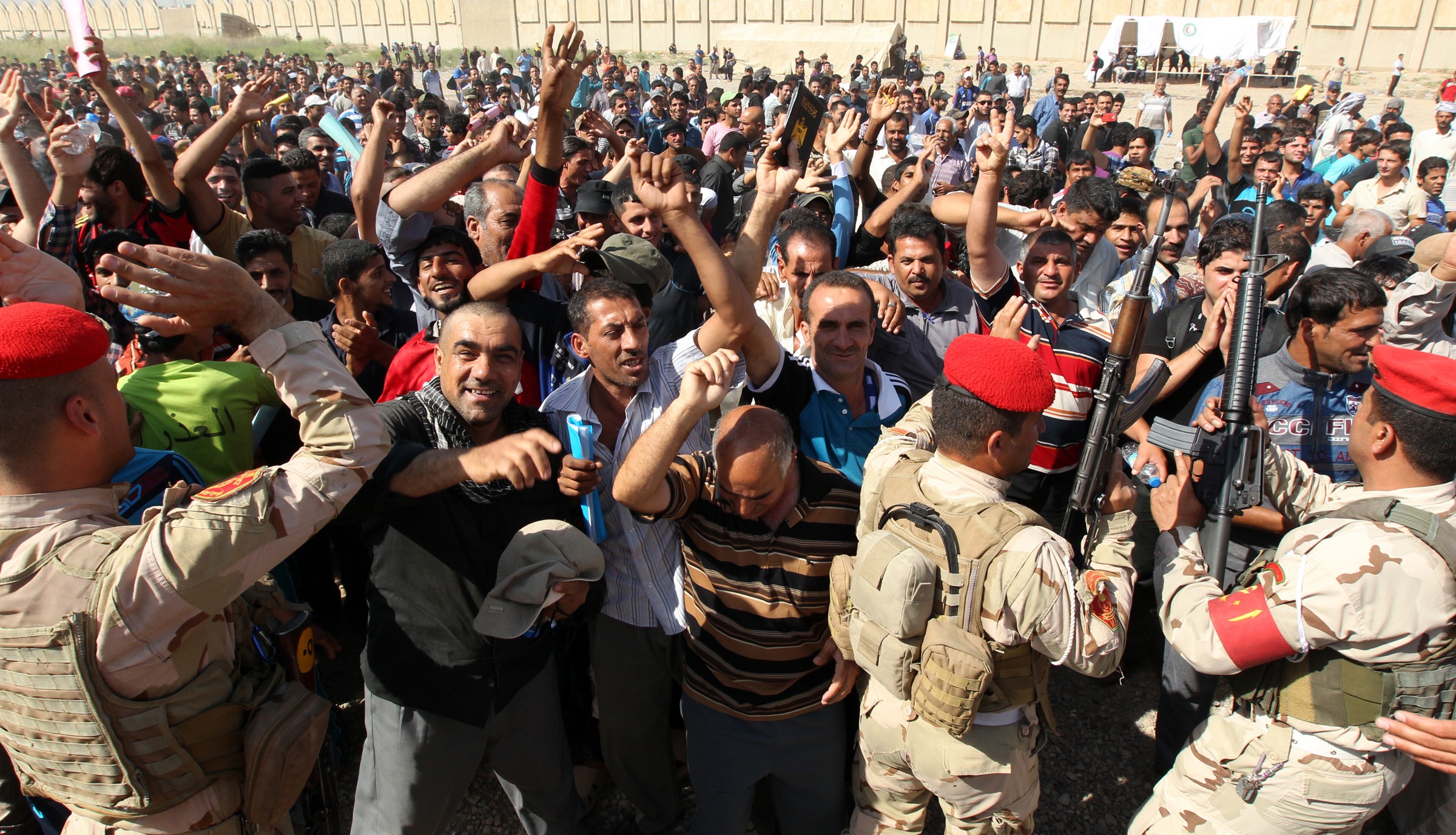
(Photo: Iraqi men, who volunteered to fight against the Jihadist militants, gather around buses in Baghdad, ahead of being transported for training at Taji infantry camp on the outskirts of Baghdad, on June 16, 2014, as security forces are bolstering defenses in the capital. By Sabah Arar/AFP/Getty Images.)

Will Global Warming Defeat Us? Ctd

In response to Ezra’s climate pessimism, Jim Manzi claims that “the American approach to the interrelated issues of energy and climate has been, in terms of results rather than rhetoric, the most successful in the world”:

America has created a technology-led energy revolution, which has successfully: reduced emissions more than any other major country in the world since 2006; achieved a permanently lower absolute emissions level than the benchmark year of 2005; green.jpgincreased economic growth and jobs; and improved the balance of trade. North America is now projected to achieve effective energy independence by 2030.

None of this was anticipated by national or international authorities as recently as 2008. I described this process in detail, and set it in the context of deep American attitudes and capabilities, in the current National Affairs. But in summary, it was enabled by policies very different than carbon rationing advocates would want to impose: a foundation of freer markets and stronger property rights than other major economies; the new-economy innovation paradigm of entrepreneurial start-ups with independent financing and competitive-cooperative relationships with industry leaders; and support by direct government technology investments. We should be reinforcing each of these strengths, not despairing over our imagined helplessness.

Or to take a more modest position: the revolution in energy since 2008 should teach us that this is a dynamic area and that prognostications of certain doom are often overly bleak. But it’s good to see a conservative of doubt like Jim acknowledging the usefulness of government technology investments.

Diplomacy Instead Of Drones?

When it comes to confronting ISIS, Matt Steinglass encourages the US to embrace a supporting, rather than primary, role:

It is much easier and less risky for America to aid the Iraqi government as part of an anti-ISIS coalition with Turkey and Iran than to do so in the guise of Iraq’s leading patron or ISIS’s archenemy. And a limited programme of military aid might be enough to ward off Republican attacks that the administration is doing nothing about ISIS; critics will be hard pressed to explain to a war-weary public why America should be doing even more to reinsert itself into Sunni-Shiite bloodshed in Iraq. This, in fact, appears to be the policy the Obama administration has selected.

I don’t see why the president should do anything to satiate the desires of the neocons – even a “limited program” of military aid. We’ve already given Maliki a huge amount of aid and he has proven unable to use it wisely. Without some serious concession to the Sunni minority – something I cannot see happening for real – it would merely increase the likelihood of ISIS getting its hands on our aid, rather than having it actually making the slightest bit of difference. But if this scenario rings a bell for you, you’re not hallucinating:

Iran, Turkey, and other regional players will have to take the lead in backing the Iraqi government and combating ISIS, because America lacks the expertise, the political will, and ultimately the capacity to do that job. We’ve tried it; it didn’t work. Perhaps the endgame will end up looking something like what happened in South-East Asia 40 years ago. After America’s departure and the collapse of its hapless proxies, regional powers moved in to assert their interests and create a new geopolitical order.

It’s not an accident that the latest Kagan war-manifesto also argues that we should never have left Vietnam either. Janine Davidson, who rejects the viability of airstrikes, thinks pre-conditioned aid is probably America’s only rational play:

[W]e can help Iraq get its security forces back in order.  The uncomfortable truth is that it will take time. Iraq is in for a long, hard fight; any assistance the United States provides cannot be a quick, one-off effort.

More importantly, a successful strategy will require pressure on Maliki, whose horrifying treatment of the Sunni minority is largely attributable to Iraq’s current woes. As Dr. Walter Ladwig observed in his review of the United States’ new counterinsurgency doctrine, outside intervention in such conflicts can only succeed if the host nation is willing to change its ways—this, in turn, requires a motivating event and outside pressure[.]

Meanwhile, Gordan Chang is waiting for China to finally throw its weight around:

[The Chinese] would have a much harder time [than the US]  if Iraq’s 3.7% of global production suddenly went offline.  China, which is increasingly dependent on energy imports, is now that country’s largest foreign customer, taking an average 1.5 million barrels a day, almost half of Iraq’s production. China National Petroleum Corp., a state enterprise, swooped up Iraqi oil after last decade’s war—Beijing, by the way, sold arms that ended up in the hands of insurgents fighting Americans—by accepting Baghdad’s razor-thin margins and onerous conditions.

Then, many said it was China that won the Iraq War because it signed the major oil deals afterwards. As a result, Beijing now has a lot riding on the outcome in Iraq as ISIS takes on the Shiite-dominated ruling group in Baghdad.

But Russia, according to Fyodor Lukyanov, is likely to butt out:

Despite the serious Russian-US standoff over Ukraine, Moscow will definitely not try to play the role of spoiler and exacerbate the problems the United States faces in the region. There is too high a risk of collapse of the entire regional system, so close to the Russian borders. This is even more so because Russia-friendly Iran in this situation is as interested as the United States in maintaining the status quo in Iraq.

Moscow, however, is unlikely to undertake active efforts to assist Washington. For the Russian leadership, as well as for Russian public opinion, what is happening in Iraq is a verdict on the entire US policy after the Cold War, and the symbol of the resounding failure of those who only recently displayed the utmost arrogance toward everyone who disagreed with their policies. Putin sees in Iraq yet further proof of how right he was.

Ask Me Anything: Ready For Hillary?

You asked, I answered:

My “Ask Anything” answers from previous years are here.

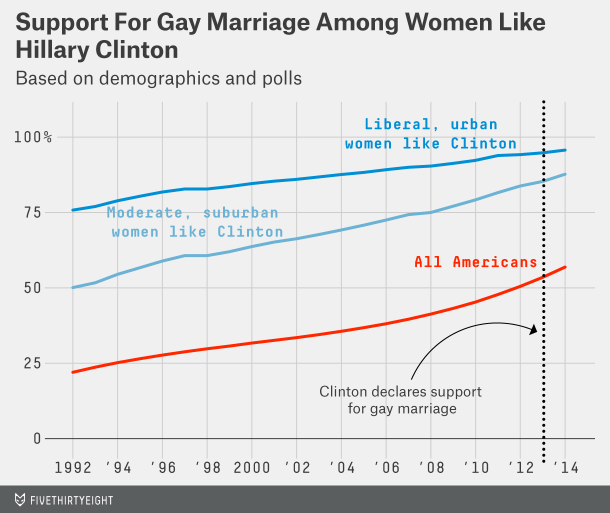
On the latest proof that a Clinton doesn’t really change, Hillary’s inability to own her own anti-gay past, apologize, explain and move forward is still dogging her proto-campaign. As Nate Silver notes, Clinton’s support “on moral and religious grounds” for banning marriage equality for gay couples might have been politically expedient, but it was out of sync with the demographic Clinton is in:

silver-datalab-clintonssm-11

So when women in Clinton’s demographic were roughly between 60 percent and 80 percent likely to back marriage equality (1996), Clinton was backing the Defense of Marriage Act. Or to put it another way, Clinton fits into the ten-to-fifteen percent in her demographic most hostile to marriage equality over time. She can’t really win, of course. But the idea that she has ever risked an iota of her own power to back the equality of gays and lesbians is preposterous. That some gays still regard her as a savior says a lot more about their own delusions and diva-fantasies than anything approaching reality.

Update from a reader:

Not EVERYONE is waiting for you to have an epiphany about Hillary Clinton. As far as I’m concerned, you can wait as long as you like. The really upsetting thing to me is how her presence appears to be depressing any other Democrat from considering a presidential run. Are we not to be presented with any other options? Is it only to be Hillary or nothing? Can it really be that the fractious Democratic Party, which often yields eight or more candidates in a primary, will simple roll over and die for another Clinton? It makes me want to lie down …

Iran’s Quagmire Now?

IRAN-IRAQ-US-UNREST-ROUHANI

Aki Peritz insists that Iran is biting off more than it can chew in Iraq:

Iran can only go so far to pacify Iraq with its own forces. The IRGC and its Shia proxies are reviled in Sunni-majority areas, and an effort to hold territory by these groups would eventually cause a major backlash among the population. So Iran would have to eventually withdraw, leaving a power vacuum, again, in those areas.

More broadly, many of the socio-economic and sectarian drivers that brought Iraq to this horrific juncture would remain in place after the shooting stopped. A semi-failed state containing thousands of virulently anti-Shia veteran fighters on its western border will remain a long-term national-security nightmare for Tehran.

The economic impact of a war-torn Iraq must also be considered, as Iran sends some $5 billion in non-oil exports to their neighbor every year. But, as for the rest of the region, Bruce Riedel believes it will be Iran’s enemies who suffer if the intervention is successful:

Saudi Arabia long ago lost the battle for influence in Iraq, but it will see its role further diminished with both a hostile ISIS and a hostile Iran splitting the pie on its northern border. If Iran emerges as the savior of Iraqi Shiites, the Shiites of Bahrain, Kuwait and the kingdom’s eastern province will be further inclined to see Iran as their savior, too.

Since Israel defines Iran as its greatest regional rival, it is also a loser. Certainly, moderates in the Arab world will be increasingly squeezed between extreme Sunni groups and Shiite Iran. They will be less inclined to take conciliatory steps toward Israel that will be unpopular and dangerous. Jordan is the most vulnerable moderate state.

If Iran helps stop ISIS outside Baghdad, the impact will be felt in Syria. The Iranians and their Hezbollah allies will gain further credibility as the only force that is actually on the ground resisting al-Qaedaism. Tehran will have emerged as the leader of a block of Shiite-dominated states, each looking to Iran for critical security support.

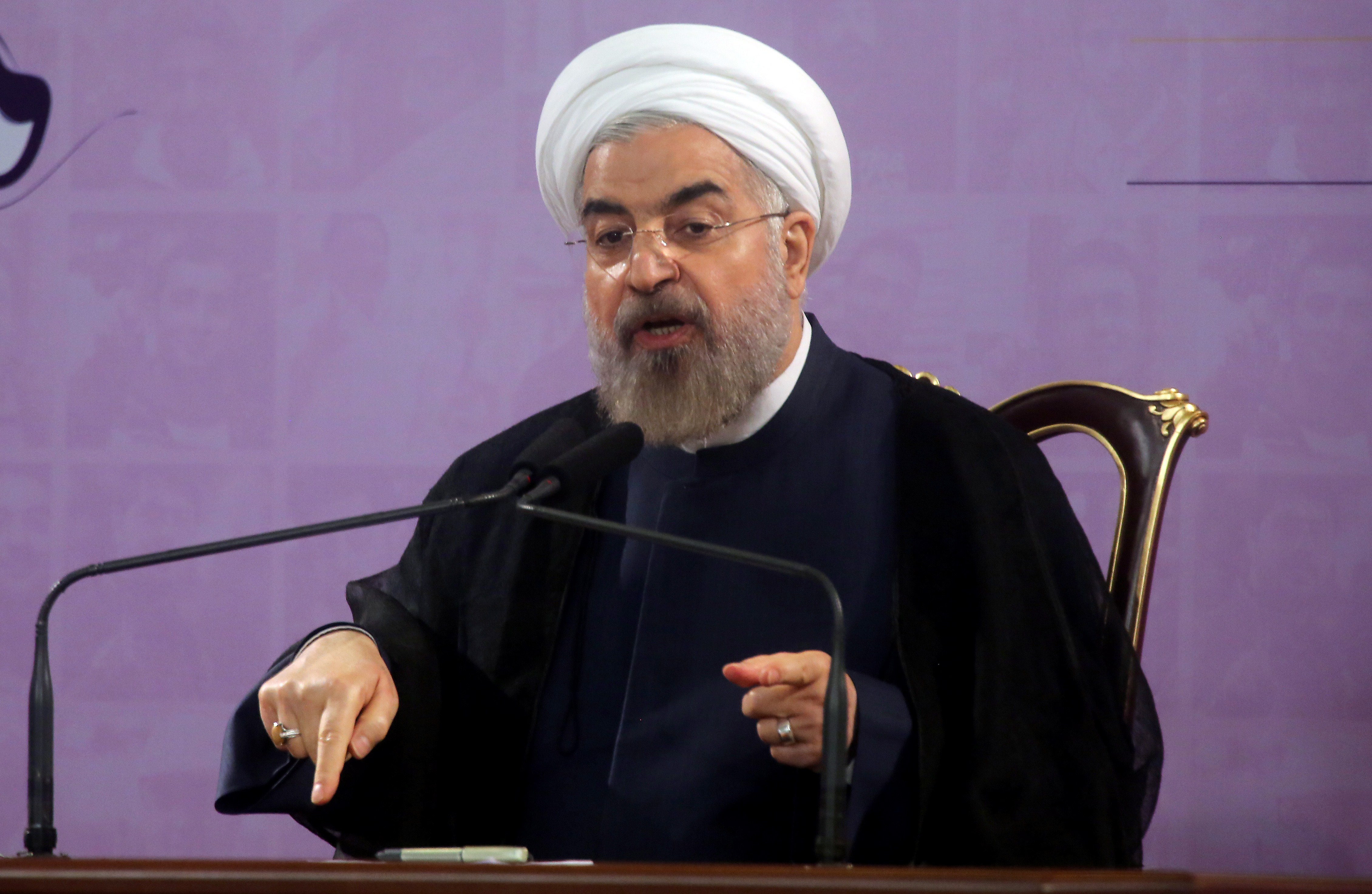
(Photo: Iranian President Hassan Rouhani speaks during a press conference in the capital Tehran on June 14, 2014. Iran may consider cooperating with the United States in fighting Sunni extremist fighters in Iraq if Washington acts against them, Rouhani told journalists. By Atta Kenare/AFP/Getty Images.)