A Big Wynne For Equality

A reader relays the great news from up north:

As you may now be aware, Kathleen Wynne was just elected premier of Ontario, Canada’s largest province (representing over 40% of the national population). That makes her the first woman to lead Ontario, and the first openly gay politician to lead a provincial government in Canada.  This is despite winning the leadership of a tired and scandal-ridden Liberal Party only 18 months ago (the Liberals had been in power since 2003), AND where the previous premier, Dalton McGuinty, had resigned in disgrace.

Premier Wynne’s sexual orientation NEVER came up during the campaign, and her wife Jane was with her every step of the campaign trail (including on the victory stage last night).  No one predicted the size of her victory, and the pundits were falling all over themselves last night describing her “authenticity” and “immense charm,” and referring to her as “everyone’s favourite aunt.”  Yesterday I voted for our openly gay transportation minister (Glen Murray, the former Mayor of Winnipeg) who represents the riding of Toronto Centre, and our first directly elected lesbian premier.  I am old enough (47) to remember when marching in the Toronto Pride parade was a little bit dangerous.

I believe Ontario (pop. 14 million) is now the largest jurisdiction in the Western world to have an openly gay leader, after Belgium (pop 11 million) and Iceland (pop 350,000).  Know hope!

Update from a reader:

Regarding this: “I believe Ontario (pop. 14 million) is now the largest jurisdiction in the Western world to have an openly gay leader, after Belgium (pop 11 million) and Iceland (pop 350,000).” Annise Parker, mayor of Houston (pop 2.161 million) is way ahead of the leader of Iceland.

Previous Dish on Parker here.
The Best Of The Dish This Weekend

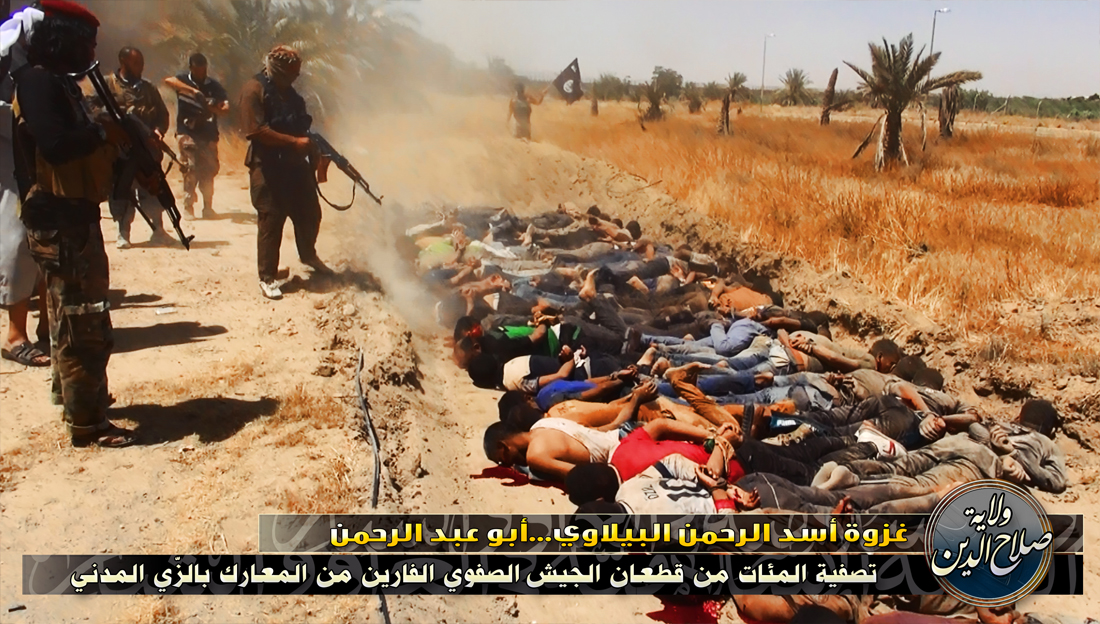
ISIS-Salahaddin-Division-WC-12-thumb-560x317-3199

We can only hope and pray that the summary executions of members of the Iraqi army shown above and here are not what they appear to be. Because what they appear to be is an incendiary attempt to reignite the most brutal and vicious of sectarian wars. On that front, the sudden attempt by Ayatollah Sistani to rein back in his call to arms last week in order to avoid the worst type of sectarian conflict does not bode well either. Our coverage on Saturday is here and here.

My only and continuing concern is that we do not continue to believe, as Tony Blair apparently does, that further Western intervention on any side – Iran’s? Assad’s? Saudi Arabia’s? it gets surreal when you play it all out – can do anything but hurt us. The lesson to be drawn from the last decade is not that we somehow managed to pull off the impossible in Iraq and then, for some unfathomable reason, it fell apart, but that Iraq itself is a deeply divided country, has long been riven by sectarian hatred, was constructed precisely to exploit those divisions, and, without thorough secularization, is impossible to govern in one piece without despotism.

This is what we discovered while occupying it, and lifting up the rock on ancient, deep and resurgent cycles of sectarian fear and revenge. And if we could not truly change that deep dynamic with over 100,000 troops in the country over a decade at the cost of trillions – and it was an impossible task – there’s no way it can be changed with some weapons or humvees. Just look at who has our weapons and humvees now anyway: ISIS.

You have two choices there: a dictator or a constantly simmering civil war. And they tend to go together over time.

On saner, calmer notes, we introduced the poetry of Kevin Simmonds this weekend (here and here); the great Alan Watts explained what God is; Los Angeles never looked so serene; and someone actually had the bright idea of getting the government to create a safe and cool designer drug.

The most popular post of the day was Iraq: You Broke It, You Bought It? followed by Our Cold Civil War intensifies.

See you in the morning.

1,700 Slaughtered?

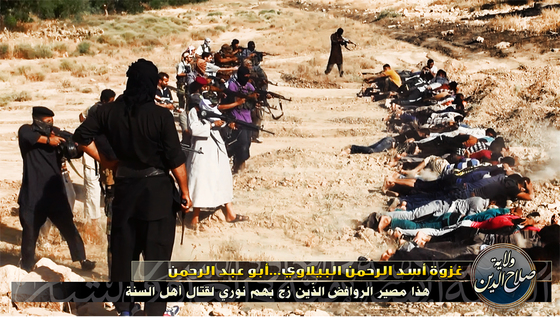
ISIS-Salahaddin-Division-WC-10

That’s the number ISIS claims to have killed in its ongoing rampage through Iraq. Yesterday the group released a disturbing series of images they claim shows the capture and execution of numerous Iraqi troops last week. Bill Roggio has full details. A glimpse from the NYT:

The photographs showed at least five massacre sites, with the victims lying in shallow mass graves with their hands tied behind their backs. The number of victims that could be seen in any of the pictures numbered between 20 and 60 in each of the sites, although it was not clear whether the photographs showed the entire graves. Some appeared to be long ditches. The photographs showed the executioners flying the ISIS black flag, with captions such as “the filthy Shiites are killed in the hundreds,” “The liquidation of the Shiites who ran away from their military bases,” and “This is the destiny of Maliki’s Shiites,” referring to Prime Minister Nuri Kamal al-Maliki.

If the alleged executions prove accurate, the atrocity would surpass Assad’s chemical weapon attack in Syria last year, which killed 1,400:

The latest attack … would also raise the specter of the war in Iraq turning genocidal, particularly because the insurgents boasted that their victims were all Shiites. There were also fears that it could usher in a series of reprisal killings of Shiites and Sunnis, like those seen in the Iraq war in 2005-7.

A reputable theory explaining the publicity ISIS seeks with these photos:

Face Of The Day

slide_350349_3760098_face

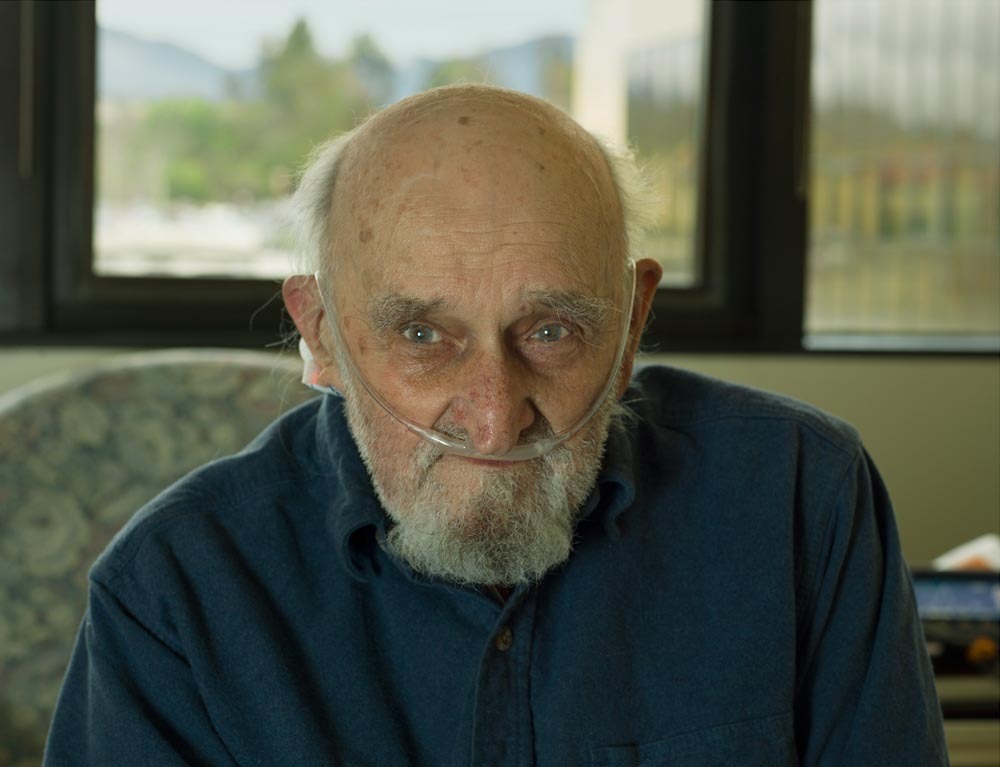
Andrew George photographs people at peace with their impending deaths:

“When the idea for this project came to me, the mother of a friend had recently passed away and at her memorial, I marveled at how there was so much genuine love for her,” George explained to The Huffington Post. “I began to wonder what it was about this woman that brought that out. She had this magic in the clear and wise way she spoke and never took herself too seriously. She laughed more than anyone I knew, reacted with sincerity and interest to her friends, and had so much passion in her fearless curiosity to travel and explore different cultures of the world. She was, quite simply, one of the best people I’ve known, yet, regrettably, was no one you’d ever learn about if you didn’t know her because her material accomplishments did not include fame.”

See more of the project here and more of George’s work here.

Happy Father’s Day! Now Get Back To Work.

James Poniewozik stresses the need for paid paternity leave:

A new study from the Boston College Center for Work and Family has found that new dads take paternity leave only to the extent that they’re paid to – i.e., not a lot. As the Washington Post reports, the majority of men who get two weeks’ paid leave take two weeks, those with three weeks take three, and so on. And per the Families and Work Institute, those lucky guys are few; only 14 percent of employers offer any pay for “spouse or partner” leave, compared with 58 percent for maternity leave (mostly through temporary disability insurance and very rarely at full salary).

Bryce Covert digs into the new research:

The report notes that in a study of 34 developed countries, the United States is one of just two that doesn’t ensure all fathers can access paid family leave. Here, both parents are only guaranteed 12 weeks of unpaid leave for the arrival of a new child, but even that only covers about half of all workers thanks to restrictions. Only 12 percent of workers get paid leave through their employers, although three states — California, New Jersey, and Rhode Island –  have instituted paid family leave programs for everyone. This past December, Sen. Kirsten Gillibrand (D-NY) and Rep. Rosa DeLauro (D-CT) introduced a bill that would give all workers access to paid family leave.

A past study from the Center for Work & Family found that 85 percent of fathers still take time off when their child arrives, but three-quarters take a week or less. California’s experience, meanwhile, backs up the most recent survey’s finding that paid leave increases leave taking. Just 35 percent of fathers took leave before the program began, but now three-quarters do, taking an average of three weeks.

Jena McGregor adds:

The vast majority of respondents – 86 percent – said they wouldn’t use paternity leave or parental leave unless they were paid at least 70 percent of their normal salaries. Roughly 45 percent said they wouldn’t use it unless they received all of their regular pay. Much of the explanation for those numbers is likely an economic one, as many of these fathers may be the primary breadwinner in their families.

Meanwhile, Aaron Gouveia praises his employers for letting him take paid leave as a new father:

By the time my second child was born last year, I had switched companies and had access to two weeks of fully paid paternity leave in addition to vacation time — all of which I was encouraged to take if I needed it. That extra time (and positive company attitude) was invaluable to me; it gave me peace of mind.

I was able to take care of my wife. I was able to supervise my oldest’s transition from only child to big brother. But most importantly, I was free to bond with my baby. I held him, changed him, got up at night to support my wife during feedings, learned his sounds, and developed a routine. Whether it’s moms striving for perfection or dads being hesitant (or already back at work) during those first few weeks, uninvolved dads lose out on so much of that initial experience that serves as a foundation for fatherhood. But paternity leave allowed me to be an active participant in parenting, as opposed to a bystander.

A Ledger For The Soul

death-and-the-miser

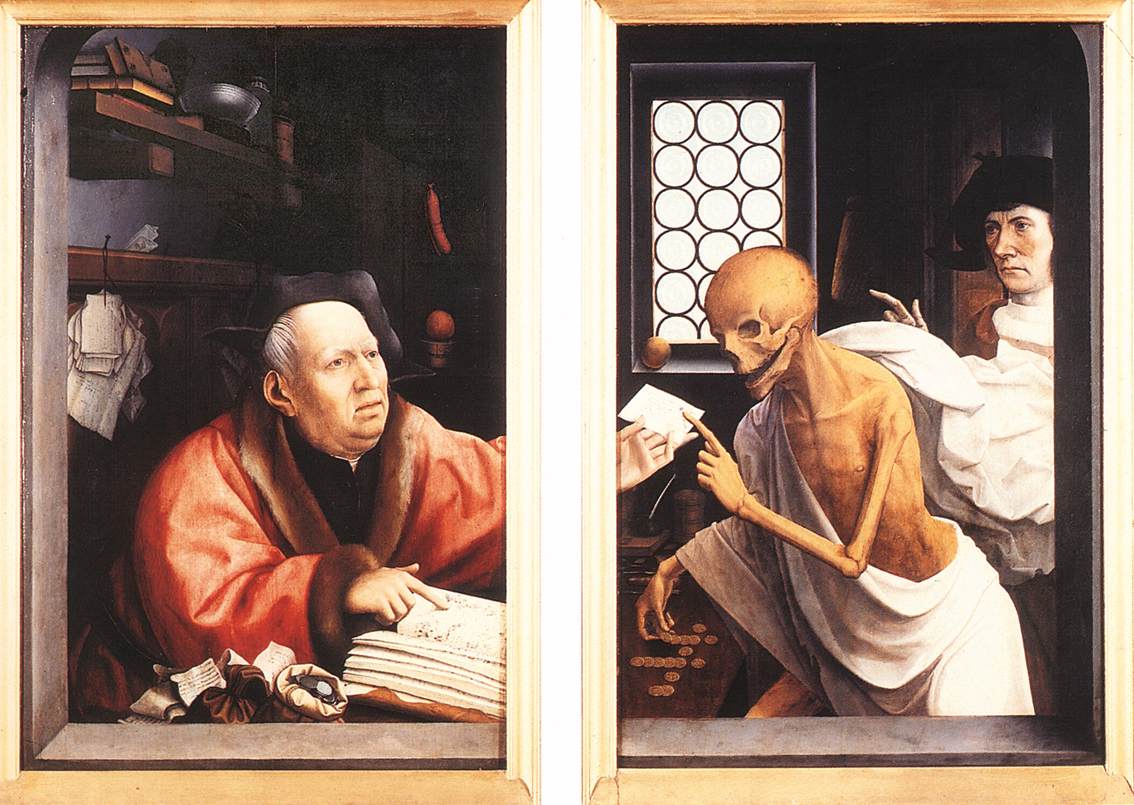
Jacob Soll explores the penchant 16th and 17th century Dutch artists had for portraying accounting in their paintings, claiming that “the tradition of accounting in art shows just how much is at stake in ‘good accounting,’ and how much society can gain from seeing it, like the Dutch, not just as a tool but as a cultural principle and a moral position”:

Double-entry accounting made it possible to calculate profit and capital and for managers, investors, and authorities to verify books. But at the time, it also had a moral implication. Keeping one’s books balanced wasn’t simply a matter of law, but an imitation of God, who kept moral accounts of humanity and tallied them in the Books of Life and Death. It was a financial technique whose power lay beyond the accountants, and beyond even the wealthy people who employed them.

Accounting was closely tied to the notion of human audits and spiritual reckonings. Dutch artists began to paint what could be called a warning genre of accounting paintings. In Jan Provost’s “Death and Merchant,” a businessman sits behind his sacks of gold doing his books, but he cannot balance them, for there is a missing entry. He reaches out for payment, not from the man who owes him the money, but from the grim reaper, death himself, the only one who can pay the final debts and balance the books. The message is clear: Humans cannot truly balance their books in the end, for they are accountable to the final auditor.

(Image: Death and Merchant by Jan Provost, via WikiArt)

The Sons And Daughters Of Abraham

Pulitzer Prize-winning playwright Ayad Akhtar, whose The Who And The What recently opened in New York, considers the similarities between Jewish and Muslim identity, particularly in America:

My relationship to Jewish artists and writers began when I was very young. It started with Chaim Potok, and in college I discovered Saul Bellow, Philip Roth, Woody Allen, Seinfeld. All of that stuff was hugely influential in helping me think about my experience. There seemed to be so many commonalities; I found myself and my community in those works, oddly.

I think there is a lot of continuity between the Jewish and the Islamic traditions. We know this historically, though people don’t want to talk about that – especially Muslims. There is a common source for both Judaism and Islam, or let’s say that Islam finds its source in Judaism. The commonalities of practice and sensibility, ethos and mythos, create a lot of overlap.

Post-9/11, the notion of “Muslims” taking on a potential truculence [corresponds to] – although it’s different – ways in which Jews were seen pejoratively within dominant Western cultures. Something about the orientation of faith being your identity marker as opposed to nationality or ethnicity. Post-9/11, that is an issue: folks get labeled “Muslim” no matter where they’re from. If you are Muslim, then that is part of it, but here’s the complicating factor for me: growing up, the only part of my identity that mattered was being Muslim, and I knew that. Being Pakistani was not as important as being Muslim. So the black guy whom I met who’s a Muslim, I’m much closer to him than the Christian Pakistani guy who is my dad’s friend. We have a closer bond. This was innate to me as a kid.

I don’t know what it’s like to be Jewish, but I suspect there is some aspect of that: being Jewish is the thing that bonds you as opposed to being Jewish from Poland, or Jewish from Hungary.

Pop Rocks

Jillian Mapes reflects on the musical taste she inherited from her father:

These days, there’s a phrase for the classic rock my Baby Boomer father raised me on: Dad Rock. Some say Dad Rockers are forever stuck in 1976 or 1985 or even 1994, when the music was real, man. Prominent in Urban Dictionary’s most up-voted definition of Dad Rock is this phrase: “Dad Rockers have no desire to listen to recent music and are stuck in the past.” But I can assure you it is possible to teach an old dad new tricks when it comes to matters of rock ‘n’ roll.

I prefer this definition from Wilco’s Jeff Tweedy, the leader of a band often dubbed New Dad Rock: “When people say Dad Rock, they actually just mean rock. There are a lot of things today that don’t have anything to do with rock music, so when people hear something that makes them think, ‘This is derived from some sort of continuation of the rock ethos,’ it gets labeled Dad Rock. And, to me, those people are misguided. I don’t find anything undignified about being a dad or being rocking, you know?”

Mapes’ advice for teaching an old dad new tunes:

The key is to mix familiar sounds and structures (perhaps a current band who makes room for guitar solos) with something new or slightly experimental (could be as simple as electro-pop synths). Still, if your Dad Rock dad was as obsessive over music as my pops was in his day, trust that his tastes are not as narrow as they may seem now that he’s past his prime music discovery years. (My dad said that for the typical music fan, keeping up with new music slides off the priority list when you have kids and you settle in hard with your all-time favorites.) Present a wide array of new music and see what sticks. It may be a chart-topping rap song about money-grubbing groupies, or it may be the new War on Drugs album (which I will be sending dad).

More suggestions here.

(Video: Bruce Springsteen, Dad Rocker extraordinaire, performs “The River” in 1980)

Fairy Tales Can’t Come True

So Richard Dawkins would rather do without them:

Speaking at the Cheltenham Science Festival, Dawkins, a prominent atheist, said that it was ‘pernicious’ to teach children about facts that were ‘statistically improbable’ such as a frog turning into a prince. … Speaking about his early childhood he said: “Is it a good thing to go along with the fantasies of childhood, magical as they are? Or should we be fostering a spirit of skepticism?” “I think it’s rather pernicious to inculcate into a child a view of the world which includes supernaturalism – we get enough of that anyway,” the 73-year-old said. “Even fairy tales, the ones we all love, with wizards or princesses turning into frogs or whatever it was. There’s a very interesting reason why a prince could not turn into a frog – it’s statistically too improbable.”

Nothing but Zola for the kiddies, then? Gracy Olmstead ripostes:

[T]his is the argument for fairy tales that I don’t think you’ll like – because the more you appreciate the pattern and beauty, the magic and charm of the empirical world, the less likely you are to chalk such things up to statistical probabilities. When you see the wonder of nature and people, the potency of words, the luminosity of our world, it’s very hard to return to a merely statistical, empirical vision. Things do become enchanted and mysterious. We begin to consider visions and miracles. These things are very dangerous, so I can understand why you’re alarmed by them.

Perhaps you’re right – perhaps it’s better for us to just abandon the tales and fantasies. After all, the more we dabble in “creating worlds,” the more likely we are to consider whether our own world had a Creator. The more we construct and tell stories, the more likely we are to ponder the possibility of our own Storyteller.

Update from a reader:

On one hand, I’m amenable to what Dawkins is saying. But the death of the fairy tale is the death of science. The actual practice of being a scientist who advances knowledge demands a kind of imagination, creativity, and questing that can’t be contained in a regression equation. The tools we use to prove hypotheses are profound in their own right, but inculcating a sense of magical possibility and hidden reality in children is the first necessary condition in preparing them to make the next generation of rigorously tested leaps forward.