The Good Book, Without God

Valerie Tarico asked a number of prominent atheists and secularists what their favorite verses in the Bible were, reasoning that “if clear-eyed Christians can take the risk of exposing the Bible’s nasty bits, the converse should also be true—atheists should be able to acknowledge the parts that are timeless and wise.” Greta Christina, author of Coming Out Atheist, was one of a number of respondents who pointed to Ecclesiastes:

I actually have an entire favorite book: Ecclesiastes. There’s lots of beautiful stuff in it about nature, human nature, and good ways to live life. It has plenty of stuff I have serious problems with, too — the God stuff, obviously, and some other stuff as well — but much of the philosophy and poetry is quite lovely and moving. And much of it is oddly humanist, with an awareness of how small humans really are in the scheme of things, and how fragile our lives are, and the absurdity of how important we think we are (“all is vanity”), and how much our lives are shaped by chance, and the repeated reminders of our mortality.

I deeply love 4:9-12: “Two are better than one; because they have a good reward for their labour. For if they fall, the one will lift up his fellow: but woe to him that is alone when he falleth; for he hath not another to help him up. Again, if two lie together, then they have heat: but how can one be warm alone? And if one prevail against him, two shall withstand him; and a threefold cord is not quickly broken.”

Passages about social justice also appeared with some frequency. Here’s Kim Veal’s selection:

I sometimes read Gospel passages in the tradition of Zen koans. I like John 14:2, where Jesus says, “In my Father’s house there are many mansions.” Holding the paradox of many mansions inside a house gives me a sense of spaciousness, of welcome, of saying, “Everyone can find a home in my heart.” I have no idea if that’s what Jesus meant—it doesn’t seem to be what Christians mean sometimes—but it reminds me that we’re all one grand, human family and that we need to care for each other.

A Poem For Sunday

2410771182_33507e1383_b

“Soon I will be done” by Kevin Simmonds:

Negro Spiritual

I go down where it’s still sung
by the mother of the block
lifting her tremulous contralto
from the screened porch that leans
such that the latch won’t lock

I’ve grown mean without its milk
that saved masters from their slaves
salve rubbed into the pink tears
where rot should’ve set in
the revolt

Ask some black kid if they know it
& they might say the title
rings a bell but that doesn’t matter
it runs mad in the ruby fractals
of their capillaries & in their spit

Never mind the tempo, child
the stride began with Soon
from your upbeat
of breath & the ancestors
already galloping

(From Bend to It © Kevin Simmonds, 2014. Reprinted with permission by Salmon Poetry. Photo by Jennie Zell)

Reading The Bible With Fresh Eyes

The Anglican theologian and priest N.T. Wright explains why he understands scripture’s place in the Christian life in dynamic, rather than static, terms:

One of the wonderful things about the Bible is the way no generation can complete the task of studying and understanding it. We never get to a point where we can say, “Well, the theologians have sorted it all out, so we just put the results in our pockets or on the shelves, and the next generation won’t have to worry — they can just pull it out and look it up.” No, the Bible seems designed to challenge and provoke each generation to do its own fresh business, to struggle and wrestle with the text. I think that is the true meaning of the literal sense, in Augustine’s sense of “what the writers really meant”: we have to acquire those old eyes, the historian’s quest to understand Genesis and Matthew and Romans in their historical context. I know that is strongly resisted today by many conservatives, but this is ridiculous: without historical inquiry, parallels, lexicography, and so on, we wouldn’t even be able to translate the text.

And, yes, I know that there are many secularizing biblical scholars, and indeed many left-brain dominated conservative ones, who produce a kind of biblical scholarship that the church either shouldn’t use or couldn’t use. But just because the garden grows weeds, that doesn’t mean we shouldn’t plant fresh flowers, instead paving the whole thing over with concrete. No, each generation must do its own fresh historically grounded reading, because each generation needs to grow up, not simply to look up the right answers and remain in an infantile condition.

Recent Dish on Wright’s work here and here.

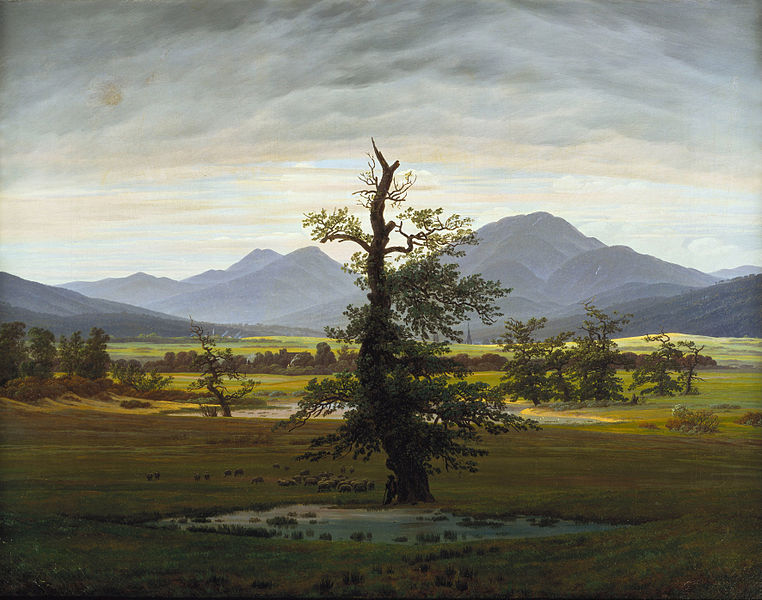
Romantic Branches

dish_lonetree

“In the form of the tree,” writes Allison Meier, “artists found expressions of life, death, and the great beyond.” In a review of the Morgan Library & Museum’s exhibit on Romantic landscape art, she taxonomizes the various kinds of tree art on display:

One of the frequent, ominous tree symbols is the blasted tree. [In Hubert Robert’s La Cascade] a poor tree has been terribly wounded, perhaps by a recent lightning strike, although it’s often an old battle scar. What’s important is that the tree is usually still living, leaves clinging to its battered branches. To the Romantics it represented the cycle of nature, from death to life, all at once. It could also be a foreboding symbol for those venturing into the wild, a disruption of the pastoral peace, as the wrath of God can fell even these timber giants. In Mary Shelley’s Frankenstein, Victor Frankenstein declares himself a “blasted tree” in regards to his own destruction.

The blasted tree often crosses over with the lone tree. Here [above] Caspar David Friedrich has depicted a survivor. Its peak is fractured, yet it has endured. Below it stands a solitary shepherd, and there’s a subtext that as this man lives and dies, the tree will continue in its longer life. Also notice the church off in the distance, dwarfed by the tree. Friedrich wasn’t diminishing the spiritual, he was showing that it was deeper and more universal than the faith of one church.

(Image: Village Landscape in Morning Light (The Lone Tree) by Caspar David Friedrich, 1822, via Wikimedia Commons)

“I Couldn’t Stay Frozen Around Her”

Lev Grossman meditates on how fatherhood transformed his writing:

When I came back to my book, after Lily was born, I saw it for what it was: cold, dull, lifeless, massively overthought – a labyrinth with no minotaur inside. I told myself I was just taking a break from it, but the truth was I binned it and started something new. I picked up an idea I’d had years before but hadn’t taken seriously at the time, because it was fresh and weird and risky and different from anything I’d ever tried before. Six months after Lily was born, I took a week off from work to explore it, and I wound up writing 25,000 words in five days. I’d hit an artery, and the story came surging out hot and strong. Not only was it the most productive week I’d ever had, I enjoyed it more than I’d enjoyed doing anything for literally years. I was more proud of it than anything I’d done in my entire life.

Something was afoot. I was waking up. Somewhere inside me the emotional pack ice was cracking and melting, ice that had formed long ago in the Fimbulwinter of my childhood, and feelings that I’d been avoiding for decades were thawing out and leaking through, both good and bad: joy, grief, anger, hope, longing. I was like some frozen extrasolar planet, where even gases exist only in neat, handy solid forms. But now I was warming up, and buried things were surfacing.

The cause of this cosmic disturbance was Lily. I didn’t see it at the time, probably because I had the emotional intelligence of a sea slug, but it was all her – she was the sun that was warming me. I couldn’t stay frozen around her. She wouldn’t have it.

Less Is More

A study indicates that we rate art more highly when we think fewer people were behind the work:

Starry Night by Vincent Van Gogh is a monumentally famous painting. It is beloved by starrypeople around the world. If tomorrow, it was revealed that Van Gogh had actually worked with two other madly talented painters to create the masterpiece, would we think it any less beautiful?

The answer, according to findings in newly published research by Rosanna K. Smith and George E. Newman, is yes. In their study, Drs. Smith and Newman seek to understand whether viewers value single creator art better than art created through a collaborative process. Our perception of art, they found,  is largely dictated by the amount of time and effort we think went into it. This notion was first put forth by Denis Dutton in his book The Art Instinct: Beauty, Pleasure, and Human Evolution, where he argued that we evaluate art not just by the final product, but also by the process that created it. We then use our evaluation of the process and final product to determine the quality of the piece we are admiring.

(Image: Starry Night by van Gogh, 1889, via Wikimedia Commons)

There’s No Wrong Way To Pray

That’s one of the conclusions Pascal-Emmanuel Gobry came to after diving into the work of Ruth Burrows, a Carmelite nun known in her order as Sister Rachel, who’s written a number of classic books about prayer:

Whenever we think about prayer, or our prayer life, we think of prayer as a performance–as something we do for God. And we wonder whether we do it “right.” And we fuss and wonder about technique. This is quasi-Pelagianism. We Christians are under the order of grace. Our relationship with God is–must be–totally marked by grace. We are saved by God by sheer grace through Jesus Christ. God does not want performance from us. God only wants us to agree to receive his grace, which is in many ways a lot harder, because it means surrendering control, and surrendering our idolatry of ourselves. But it is also liberating, because it means there is no “wrong” way to pray. We don’t have to worry about praying “wrongly”, because whatever we do, what matters is what God does to us, not the other way around. … [Burrows] stresses that even the great “mystics” and saints of this highly-mystical Tradition mostly had basically the same prayer experience as most of us every day: dryness, distraction, frustration, and so on.

In an interview in 2012, after the release of her book Love Unknown, Burrow expanded on this point:

Prayer can never be a failure. If I used that expression it would refer to how people express themselves: “I can’t pray”; “my prayer is a failure”; “I pray and nothing happens; I’m praying to myself.” This is to have a completely false idea of prayer. To believe in the God of Jesus Christ is to know that, through what God in his love has done for us, there is absolutely no barrier between God and ourselves. We have free access. God is always available, always there, always with us—with you, with me. …

Prayer is essentially God’s work. Our part is to give time, do our best to keep attention, surrender ourselves as best we can. Then we can be sure that God works. Faith does not ask for signs, for tokens. When we really grasp that prayer is essentially God’s business, not ours, we will never talk of failure, no matter how unsatisfactory prayer seems to us.

Walking Towards The Light

dish_wayofstjames

Reflecting on the “massive renaissance” that walking pilgrimages, such as the Way of St. James, have undergone since the 1980s, Matthew R. Anderson ponders just who is treading these centuries-old Christian paths:

The majority of modern walking pilgrims are not church-goers. Most even shy away from the title “religious”. Yet these pilgrims, many of them catalyzed to action by a milestone birthday, the death of a family member, or the loss of job or spouse, still follow ancient pilgrimage routes and find themselves open to questions of ultimate meaning. The shrines still exist. But most modern pilgrims emphasize the walk more than the arrival, and interior spirituality more than the bones of any saint. In this way, modern walking pilgrims, at least along western routes, are evidence of the religious revolution that swept western societies especially in the 1960s. The result of the “Is God Dead?” movement wasn’t so much that God was dead, but that the traditional churches were. They no longer met the needs of people who were moving from institutional religion to personal spirituality, and from a focus on tradition and culture to practices focused on personal growth.

Today’s spirituality is inner-directed, personal, ecumenical or inter-faith, and less worried about the destination than the voyage. In other words, perfect for a revival of walking pilgrimage. The modern western walking pilgrim doesn’t believe that a saint’s bones will provide a spiritual boon. His or her questions are more basic and existential: what is a good life, and am I living it? What will be my legacy? What is true friendship? Is what I am doing worthwhile?

(Hat tip: Micah Mattix. Photo of Monte de Gozo (Hill of Joy), part of the Way of St. James, by José Antonio Gil Martínez)

The Fatherless On Father’s Day

Michele Weldon speaks out for them:

Yes, a life without a father – or a mother – can be difficult. A litany of factors can contribute to a confluence of perilous outcomes stemming from economics, education, and health if there is no father in the family tree. Still, a motherless life does not assign guilt or invite shame the way a fatherless life does. The expectation is that without a father, like pouring dye in a river, you cannot emerge undamaged, unchanged. We do not damn motherless children the same way; we pity them and offer our sympathy, but do not assume they will fail at every turn. The problem is that with this singular belief in Fatherless Doom, we mandate that those who have lost fathers – or simply never found them – are permanently damaged. And that is not the wholesale truth. Salvation is not reserved only for those children with fathers and mothers at home.

Recent Dish on motherlessness on Mother’s Day here and here.

Beyond The Neck Tie

Ian Crouch traces the history of Father’s Day, noting that its early iterations downplayed the commercial aspects of the holiday, given that men’s “comparative economic autonomy created a kind of anxiety about gift-giving” – an anxiety ad men would seize upon:

Father’s Day got a significant boost, and a final push toward general recognition, in the early thirties, when the Associated Men’s Wear Retailers, a New York trade group, formed a Father’s Day Committee and débuted a new slogan, “Give Dad Something to Wear.” In 1938, the trade group redoubled its efforts, forming the National Council for the Formation of Father’s Day and hiring a retired adman, Alvin Austin, to marshall its promotion. This is the holiday’s other origin story, and it is a plainly commercial one: Father’s Day would become what Schmidt identifies as a “second Christmas” for men’s retailers. In 1972, Father’s Day was made official, signed into law by Richard Nixon, who wrote, grandly, “In fatherhood we know the elemental magic and joy of humanity.”

The custom of buying Dad a necktie (or another manly present, such as tobacco, cologne, or, later, power tools and gadgets), aided by yearly ad blitzes, became the midcentury’s middle-class standard, with mothers taking their kids to the department store to pick out a tie, a razor, or a bottle of Old Spice. They were rather gloomy offerings, and symbols of the white-collar dad’s professional life: his routine, his absence, and his almost generic unknowability.

Commenting on the Dove commercial seen above, Crouch points to the changing images of fathers it’s responding to:

The Dove commercial, however, is a celebration of the value of the soccer dad—and of the dad who changes diapers and kisses his children. From a brand perspective, it makes sense: buying your father moisturizer anticipates closeness; skin-care products are, in large part, about the value of softness and intimacy. It may not be revolutionary, but its sincerity stands out compared to another high-profile Father’s Day campaign from this year, which continues to emphasize fatherhood as a fraught and unsettled emotional enterprise. The American Greetings card company has produced a response ad to its own Mother’s Day commercial, called “World’s Toughest Job,” which showed women taking part in mock job interviews that emphasized the daunting nature of motherhood. In “World’s Toughest Job-Dad Casting,” actors bumble through scenes of domestic conflict, flubbing their lines, revealing themselves to be clueless, emotionally stunted, and largely bewildered by the customs of middle-class American parenthood. At the end, the moment of sincerity is simply that they are there to listen—“I’m here for you”—like dumb sounding boards, holding down the fort until Mom gets home from work to sort things out. These dads are goofballs, and probably, at best, deserve another necktie.