
Urfa, Turkey, 7.10 am
Urfa, Turkey, 7.10 am
“God is the most obvious thing in the world. He is absolutely self-evident – the simplest, clearest and closest reality of life and consciousness. We are only unaware of him because we are too complicated, for our vision is darkened by the complexity of pride. We seek him beyond the horizon with our noses lifted high in the air, and fail to see that he lies at our vary feet. We flatter ourselves in premeditating the long, long journey we are going to take in order to find him, the giddy heights of spiritual progress we are going to scale, and all the time are unaware of the truth that ‘God is nearer to us than we are to ourselves.’ We are like birds flying in quest of the air, or men with lighted candles searching through the darkness for fire,” – Alan Watts, from Behold The Spirit: A Study in the Necessity of Mystical Religion.
(Hat tip: James Ford)
Jon Rafman‘s creepy short film “Still Life (Betamale)” is NSFW:
Ben Valentine details how Rafman’s film captures the dark art of the Internet:
“Still Life (Betamale)” confronts some of humanity’s newer and more obsessive activities, all things that may be unique to the web (though we’re never sure). The video sets the stage with shots of disgustingly lived-at computer desks covered in bits of food and cigarette ashes, surrounded by energy drinks and dirty dishes. The main character, the fat man with panties covering his face, pointing two guns at his own head, is leading us on a nearly psychosis-inducing stream of various types of fetish and subculture porn — some of the web’s darkest and strangest corners. This is not the safe and corporate internet of Facebook or Google; “Still Life (Betamale)” is drawn from the visually overloaded world of 4chan, as obsessively browsed by a man who lives in his mother’s basement.
The video paints a clear picture of the stereotype we associate with 4chan users:
smelly men who obsessively consume, produce, and share socially unaccepted media, never AFK. By splicing together footage and images from these online communities, Rafman places the viewer at the center of a mind-numbing search for meaning in some of the most socially questionable places. … Rafman shows how these creations were made in a sincere search for pleasure, meaning, community, and self-expression, as grotesque as they may look to some of us.
Brandon Soderberg reviewed the film back in October:
The 8-bit imagery (recalling the digital pixel art of Uno Moralez) brings with it an ambiguous menace. Moments of joy and humor creep in as well: Can you deny that a guy in a bunny suit bouncing up and down in his ground floor apartment isn’t having the time of his life?
The more you sit with this collection of clips and images, the harder it is to LULZ away. You gain empathy even as you grow more creeped out. The combined pile-up of seeing suicidal panties dude a few times, and the long-as-hell clip of someone in a fox costume, stuck in a mudpit in the middle of the woods, is mind-cracking. A sense of overabundance sits in your gut long after “Still Life (Betamale)” (which climaxes by finding infinity in piss-soaked panties) ends. You’re overwhelmed and engulfed by the unlimited. If you want a picture of the future, imagine a furry flailing about in quicksand—forever.
Leah Reich considers how sex robots could alter human relationships – or keep them trapped in the strictures of the past:
Perhaps the best-known work on intimate relationships with robots is by the British author, chessmaster, and CEO of Intelligent Toys Ltd, David Levy. Most of the discussion regarding the ethics of robot sex centers on his article ‘The Ethics of Robot Prostitutes’ from Robot Ethics (2011), wherein he separates types of sexbots according to their sophistication. Levy argues that as long as sexbots are artifacts, without ‘artificial consciousness,’ there are no ethical implications in having sex with them or using them for prostitution. …
But even if sexbots are not currently conscious, they do have the external markings of personhood, and we are programming them to be person-like. Indeed, we are programming them to be like a specific type of person: the type of woman who can be owned by a heterosexual man. If women are the model on which most sexbots are based, we run the risk of recreating essentialized gender roles, especially around sex. And that would be too bad, because sex technology has the potential to alleviate longstanding human problems, for both men and women. Sex tech can help us take on sexual dysfunction and profound loneliness, but if we simply create a new variety of second-class citizen, a sexual creature to be owned, we risk alienating ourselves from each other all over again.
In other high-tech sex news, Victoria Turk investigates “the DIY side of the 3D-printed sex toy revolution”:
The descriptively named ‘Dildo Generator’ lets you tweak a phallic model until it fits your preferences just so, ready to be saved and exported so the 3D file of your fantasy can be forever solidified in silicone. I reached out to Ikaros Kappler, the Berlin-based programmer behind the project, to ask why. Fittingly, the idea came to him while he was hanging out with friends, drinking beer, and listening to techno at a maker space. “It was the aim to print something more useful instead of printing small figurines to put on your windowsill,” he told me over email. He also wanted to explore the new features of HTML5. “Oh, and I love Bézier curves!” he added. Those are the curves you can make by adjusting points at either end on a computer model, always resulting in a nice smooth finish. Pretty important to dildo design, I guess.
Previous Dish on futuristic fornication here.
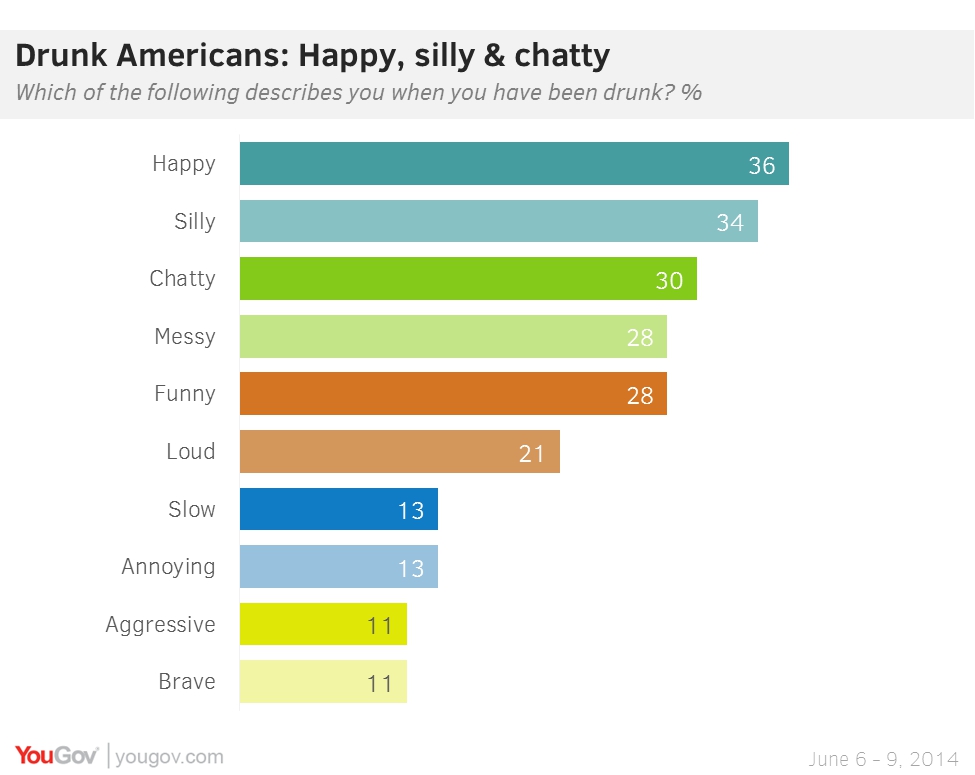
A new YouGov poll shows that Americans consider themselves fun drunks. But what about the next morning?
On the whole, most Americans have avoided double hangovers where you feel bad both due to excessive drinking and because of something stupid or mean you did the night before. 26% of Americans say that they have never been drunk, while out of the 71% who say that they have been drunk before most (42% of the entire country) haven’t had to apologize for something they’ve done the night before. Only 31% have had to apologize for the night before. 23% of Americans say that they’ve had to apologize for doing something that they were too drunk to even remember doing.
Allison P. Davis mulls over Wyldfire, a new app where female users double as gatekeepers:
[F]emale users can sign up freely, but any man on the app has to be invited, theoretically creating a network of only women-selected desirable, dateable, single men. “Everyone has that one friend who they think is a great-quality guy but they either don’t want to date themselves or want someone else they know to date,” says brand manager Jesse Shiffman. Founders Brian Freeman and Andrew White created the app, “designed specifically around the needs of women,” after hearing several of their female friends complain about “getting creeped on” whenever they used Tinder. … By using existing social networks to build an expanded dating pool, it simulates a more desirable, “organic” dating experience – like Hinge, but with more options. …
But here’s a problem:
How many men in your inner circle do you consider dateable that you don’t want to date yourself? I have maybe two. On a good day. Will “female-centric” dating networks turn into a smorgasboard for dudes? They might be “safer,” but they don’t necessarily increase chances of dating success for the female user.
Amanda Hess is similarly skeptical:
As Davis notes, that type of eligible bachelor – the single, straight guy you don’t want to date, don’t want to set up with any of your friends, and yet are eager to recommend to all female strangers in your general area – may be even more elusive than the guy who actually sparks your interest.
But let’s say we all have these men in our lives: Identifying a guy as an obvious creep isn’t easy, either. The Wyldfire system operates on the assumption that men who text aggressively crude material to strangers on the internet have no female friends in real life. While it’s tempting to believe that men who type with their penises have simply never had any contact with female human beings, who really knows what lies in the dark recesses of your friend’s Tinder messages? Not you – you just hang out at parties.
Update from a reader:
I wonder how many men are going to want to participate in an app where merely being invited to it means you’ve been implicitly turned down by the person who invited you.

Can a museum dedicated to all things phallic serve as a center of learning? As Julie Beck finds, the answer is … sort of:
By the time Siggi’s private collection became a museum, in 1997, he had 62 specimens. The museum now boasts 283 biological specimens, including at least one from every species of mammal found in Iceland.
And I mean every mammal. The documentary The Final Member, which comes out on DVD June 17, profiles Siggi and his museum’s quest to complete his collection by acquiring—you guessed it—a human penis. The film portrays an apparent race against time between a 95-year-old Icelandic adventurer (and, seemingly, notorious womanizer) named Pall Arason, who has promised his organ to the collection when he dies, and an American named Tom Mitchell, who so desperately wants his penis, which he calls Elmo, to be famous, that he considers cutting it off while he’s still alive, so his can be the first on display. “I’ve always thought it’d be really cool for my penis to be the first true penis celebrity,” Mitchell says in the movie. …
[T]here is a strange tension [in the museum] between the spectacle and the scientific.
The spectacle gets people in the door, but the museum’s purpose seems to be more sincere. The “About” section of its website states: “Now, thanks to The Icelandic Phallological Museum, it is finally possible for individuals to undertake serious study into the field of phallology in an organized, scientific fashion.” It’s certainly not pornographic. …
“It is very very important for me to inform people or educate people,” Hjartarson says in the film. “I think this serves and helps decrease taboos about the human body. Especially about this organ, I’m presenting here… I was a professional teacher for 37 years. I like telling people, I like informing people.”
“My father is a teacher, not only by learning, but by heart, in his soul,” Sigurdsson agrees. “There’s nothing lewd or pornographic about [what he’s doing]. It’s an educational and funny sort of way to display something that isn’t seen every day. If you take something like the penis and just treat it like any other thing, it becomes more ordinary.”
Previous Dish on the museum here.
(Photo by Flickr user JasonParis)
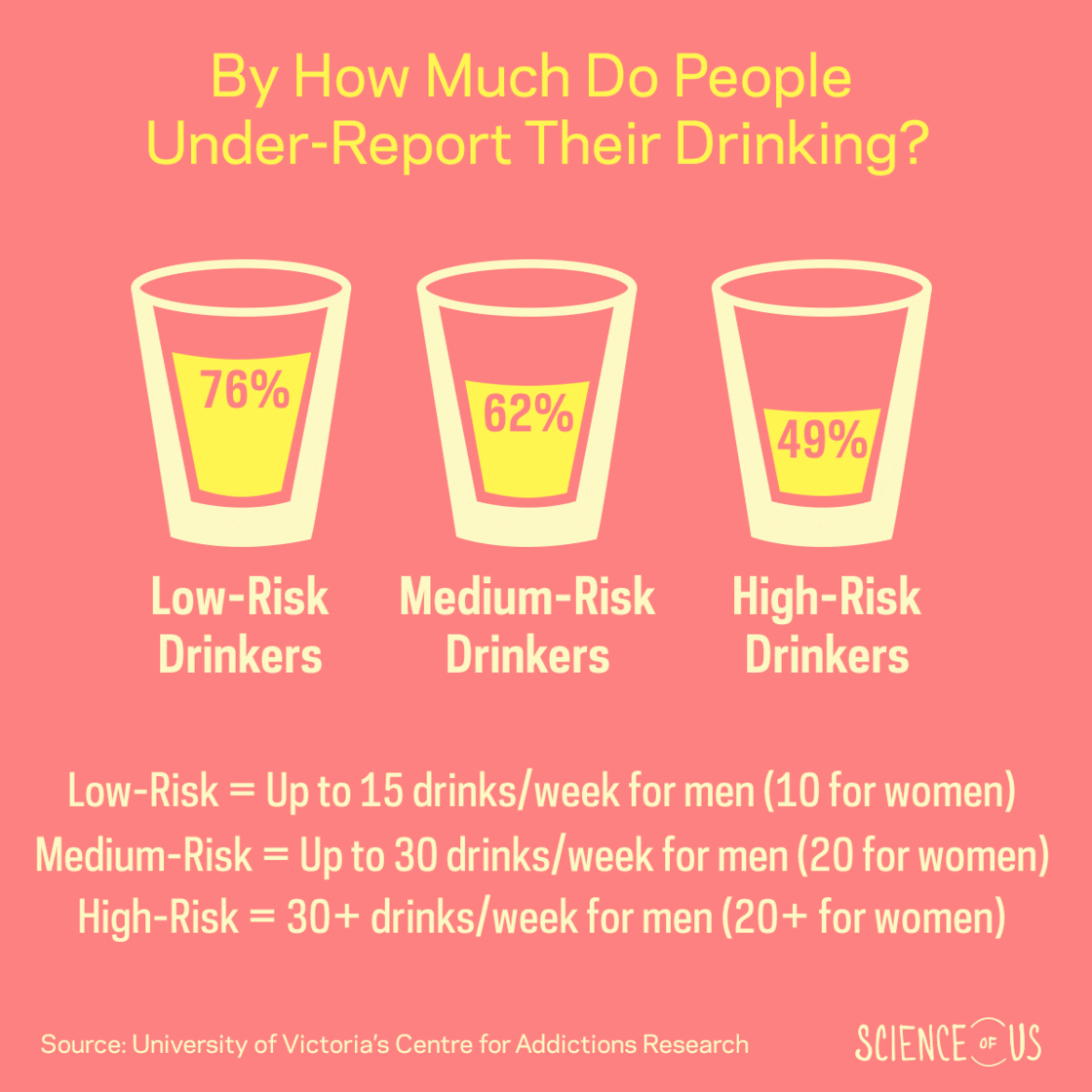
Many drinkers seriously underestimate the amount of alcohol they consume:
[R]esearchers surveyed over 40,000 people with standard alcohol survey questions about their quantity and frequency of alcohol consumption — “How many drinks have you had in the past month?” and so on. But in a smart twist, they then asked a more immediate question: “How many drinks did you have yesterday?” This method is useful for detecting under-reporting because of the improbabilities it reveals. For example, if 50 percent of people who say they drink once a month acknowledge drinking yesterday, one can infer that this group is severely under-reporting their consumption: If they were truly once-a-month drinkers, only about 3 percent should acknowledge drinking on a particular randomly selected day of the month.
Men and women were comparably good (or bad, depending on your perspective) at accurately reporting their drinking. But as the chart above shows, a large difference emerged when types of drinkers were compared. Putatively low-risk drinkers grossly under-reported, acknowledging only about one in four of their actual drinks consumed. The heaviest drinkers actually recalled their consumption most accurately, but in absolute terms they still only reported about half of it.
What if the government held a billion-dollar competition to create a safe and effective designer drug? Greg Beato thinks it’s a great idea:
Pipe dream? Certainly innovation has never been a part of the federal government’s drug policy mandate. In 1986, in response to “designer drugs” intended to mimic the effects of heroin and other illegal drugs, Congress passed legislation making it illegal to produce substances that are “substantially similar,” or chemical “analogues,” to Schedule I and Schedule II drugs. …
[But] imagine if, instead of trying to thwart the entrepreneurs behind products like “Bomb Marley Jungle Juice” and “AK-47 Cherry Popper,” the [Office of National Drug Control Policy] tried to actively incentivize them, by offering a billion-dollar prize to the first manufacturer who successfully produces the kind of safely domesticated mood enhancer that Dr. Siegel envisioned 25 years ago. Under the current regulatory environment, manufacturers are only rewarded for creating substances that are different enough from existing Schedule I drugs to claim, at least temporarily, shelf space in head shops, gas stations, and cyberspace. A billion-dollar prize for a safer intoxicant would give them a tangible reason to aim much higher.
Meeting people is easy:
 The Dish