Two weeks ago, the English broadcaster Jeremy Paxman ignited a furor by arguing that contemporary verse “connives at its own irrelevance” and needs to “raise its game a little bit, raise its sights.” One word in particular rankled poets:
Paxman suggest[ed] (not, it would appear, entirely ironically) setting up “inquisition” panels before which poets would be forced to justify their decisions, including “why they chose to write about the particular subject they wrote about, and why they chose the particular form and language, idiom, the rest of it.” This, Paxman claims, would be “a really illuminating experience for everybody.”
On Twitter, Paxman’s comments were fodder for some choice responses from poets, including Canada’s own David McGimpsey, who wrote, “Asking poets to appeal more to the common person is like asking Colonel Sanders to appeal more to chickens.” And Q&Q’s April cover subject, Sina Queyras, responded, “Jeremy Paxman can kiss my obscurity.”
What really got some poets angry was when Paxman called for an “inquisition” in which poets would be “called to account for their poetry.” The language of “inquisitions” and being “called to account” has ugly resonances – that is why the provocative Paxman used it – and it has led some poets to denounce Paxman: George Szirtes saw it as an allusion to McCarthy and Stalinism. But if we take the element of compulsion out of it, there is nothing wrong with Paxman’s suggestion. Indeed, not only is there nothing wrong with it, it’s already, as Shakespeare once said in a different context, lawful as eating. Poetry magazine publishes issues in which poets are interviewed about their poems; anthologies feature poets explaining their work; poets clamor to get the chance to talk on panels, to read their work aloud and discuss it; and the whole creative-writing industry is premised on the idea that poets learn by explaining and defending what they’ve written. …
The real problem with Paxman’s comments lies in their incoherence: He is complaining about two different things as if they were the same thing. On the one hand, he urges poets to open up, to write for the general public, to be more accessible; on the other hand, he wants poetry to be better, to be more interesting and captivating. Both are understandable demands, but it’s important to recognize that they contradict one another. The best poetry is not always accessible, and the most accessible poetry is usually not good.
Maliki’s forces may have halted, or at least slowed, ISIS’s advance:
Security sources said Iraqi troops attacked an ISIL [ISIS] formation in the town of al-Mutasim, 22 km (14 miles) southeast of Samarra, driving militants out into the surrounding desert. They said army forces reasserted control over the small town of Ishaqi, also southeast of Samarra, to secure a road that links Baghdad to Samarra and the now ISIL-held cities of Tikrit and Mosul further north. Troops backed by the Shi’ite Asaib Ahl al-Haq militia also retook the town of Muqdadiya northeast of Baghdad, and ISIL was dislodged from Dhuluiya after three hours of fighting with tribesmen, local police and residents, a tribal leader said.
It was far from clear whether government forces could sustain their reported revival against ISIL, given serious weaknesses including poor morale and corruption, and the risk of Iraq sundering into hostile sectarian entities remains high. ISIL insurgents kept up their assaults on some fronts.
The biggest questions center on whether the United States will carry out air strikes, either with warplanes or unmanned drones, against militants of [ISIS], which moved swiftly to seize the northern cities of Mosul and Tikrit this week and now threaten Baghdad. Such attacks, an option the Pentagon described on Friday as “kinetic strikes”, could be launched from aircraft carriers or from the sprawling U.S. air base at Incirlik in Turkey. The carrier USS George H.W. Bush and its strike group are already “in the region,” the Pentagon said on Friday.
Last night, Clinton basically agreed with Obama’s reluctance to get re-involved with Iraq or to further support the Maliki government:
“You’d be fighting for a dysfunctional, unrepresentative, authoritarian government,” she said on Friday at George Washington University. Clinton talked at length about the unfolding crisis in Iraq, where the extremist group, the Islamic State of Iraq and Syria, has moved from Syria, taking hold of cities north of Baghdad. “There’s no reason on earth that I know of that we would ever sacrifice a single American life for that,” Clinton added.
Amen. Meanwhile, Kilgore is not liking the deja vu:
Moqutada al-Sadr and his Mahdi Army, which may be reforming; Grand Ayatollah Ali al-Sistani, who has now called Iraqis to arms to resist the ISIS breakup of the country; the Kurdish Peshmerga militia, which just seized the oil city of Kirkuk that the semi-autonomous Kurdish regional government has long coveted; the “holy sites,” which Shi’a revere but that the ISIS would just as soon destroy as “idolotrous.” And yes, among the bad returning memories is the daily hectoring from John McCain about the need for U.S. troops in Iraq forever—this time, presumably, in a more explicit and highly ironic alliance with Tehran, which many of McCain’s neocon buddies would love to see reduced to radioactive ash.
The Obama administration seems to be treating the Iraq crisis as it would an adverse breakdown in the military balance in Syria, not as some sort of implicit repudiation of the U.S. decision to shut down its part of the Iraq War. That makes sense. But it will be interesting to see how U.S. public opinion reacts to any sort of return engagement with Iraq in all its complexity. The bad memories are just too recent to have faded entirely.
To wit, Aaron Blake notes that if Obama does attack, the US public will likely respond in kind:
[A] Washington Post-ABC News poll last week found his ratings in this area sinking to a new low. Just 41 percent approved of his job on international affairs, down six points in three months and currently five points below his overall approval rating. Layered on top of Obama’s weakness on foreign affairs is the long-standing unpopularity of the war in Iraq. As of March 2013, just 38 percent said the costs of the war were worth the effort and 58 percent said they were not.
Back in Iraq, the government has instituted a social media blackout in an effort to cut down ISIS’s communication network, though as Craig Timberg notes, it’s unclear how effective that will be:
Regions beyond government control often rely on alternative sources, such as satellite links and fiber-optic lines coming from telecommunications providers in Turkey, Iran and Jordan, analysts said. Service in semiautonomous Kurdish regions, for example, appeared to be flowing without a blip.
“It kind of echoes the larger themes in Iraq, of how little the Iraqi government controls in that country,” said Doug Madory, a senior analyst with Renesys, a New Hampshire-based company that tracks Internet performance worldwide.
Read all Dish coverage of ISIS here. Mackey is live-blogging the latest developments.
It makes sense the short form … lacks a sturdy name: It’s varied, shifting, and hard to define, and its parameters are continually up for debate. Flash fictions have a narrative quality that makes them different from classical prose poems; at the same time, they tend to have a strong lyric element that aligns them with poetry. This formal uncertainty can be an attractive quality: It helps create the possibility for formal and emotional surprise. But you also don’t want to have too much carte blanche. You never want to enter the territory where you think, “Well, I can write anything and get away with it.” …
I’m interested in writers who are able to create a more blended kind of integration between the narrative and lyric drives—and I’ve noticed that in the short form, the lyric impulse becomes more pronounced. … One source of inspiration was Italo Calvino’s Invisible Cities, though it’s tricky to separate that book’s short sections from one another (the work really functions as a novel). Isaac Babel, who is in many ways my favorite writer, demonstrates the extreme compression I look for in very short fiction—whenever a writer can compress that much into a short space, I always feel that what we call “poetry” is lurking close by.
Previous Dish on flash fiction here. We also featured a piece of flash fiction as A Short Story For Saturday here.
On Thursday, James H. Billington, the Librarian of Congress, announced the appointment of Charles Wright as the new Poet Laureate Consultant in Poetry:
Charles Wright is a master of the meditative, image-driven lyric. For almost 50 years his poems have reckoned with what he calls ‘language, landscape, and the idea of God.’ Wright’s body of work combines a Southern sensibility with an allusive expansiveness, for moments of singular musicality.
Truly, is there anybody better? No — though some equals among his peers come to mind. His body of work takes in Dante, the Civil War, Eastern philosophy, manhood, poetry and poets, and the superaliveness of a certain American mind in the second half of the twentieth century and the first half of the twenty-first.
Wright was born in 1935 in Tennessee and served with the U.S. Army, first exploring poetry while stationed in Italy, and was later a professor at the University of Virginia. His influences range from the work of Ezra Pound to that of ancient Chinese poets. In 2011, he told PBS that the content of all of his poems, no matter their precise subject matter, is “language, landscape and the idea of God.” He also noted that his poems have gotten less “loquacious” as he’s gotten older. “I once said if a guy can’t say what he has to say in three lines, he better change his job,” he joked. “I haven’t gotten that far yet, but I’m down to six lines.”
His poetic bona fides are many: 24 poetry collections and two books of essays. A Pulitzer Prize. A National Book Critics Circle Award. A National Book Award. The International Griffin Poetry Prize. A Guggenheim Foundation fellowship. A National Endowment for the Arts fellowship. A term as chancellor of the Academy of American Poets. The Library of Congress’ own award for lifetime achievement in the form. (And lots more.)
In an NPR interview about this appointment, Wright describes his sources of inspiration:
It’s always been the idea of landscape that’s around me, that I look at; the idea of the music of language; and then the idea of God, or of that spiritual mystery that we doggedly follow, some of us, all of our days, and which we won’t find the answer to until it’s too late — or maybe it’s not too late. Maybe it’s just the start, I don’t know.
In any case, that’s what I’ve always written about, and those three things are the meanings of my poems. The content changes — you know, what it’s about, this, that and the other — but the meaning has always been the same, the same thing I’ve been after. Ever since I was a tongue-tied altar boy in the Episcopal Church.
Wright hopes to bring a fresh perspective to the job:
As the new poet laureate, Wright will have few required duties. The library provides an office and allows each poet to define the job however he or she would like. (The salary is $35,000, plus $5,000 for travel — meager, even for a poet.) Some laureates stay in Washington and use the office, some don’t. “The most important thing that they do,” Billington says, “is to provide an inspirational example of how powerful poetry can be.”
Billy Collins (2001-2003) began a program to bring a poem a day into high school classrooms across the country. Ted Kooser (2004-2006) wrote a weekly newspaper column. And the most recent poet laureate, Natasha Trethewey (2012-2014), toured the country for a regular feature on the PBS NewsHour called “Where Poetry Lives.”
Wright has something quieter in mind. “I’m not going to be an activist laureate the way Natasha was,” he says. “She was great at it, but I’ve been around the block more than twice — I’m 79. I guess I’ll bring wisdom and good luck. It’s all a new experience for me. Basically, one has to pull up one’s socks and say, ‘I’ll do it.’ My wife wanted me to. She wouldn’t say so, but she wanted me to. I think she thought we’d be coming up to D.C. and going to museums.”
In his 1989 Paris Review interview, Wright had this to say about what he looks for in poetry:
Music and substance, I guess, as most anyone would. One man’s music, naturally, is another man’s Muzak. One’s ear is one’s Virgil, however, leading you on. … One looks for a reach, an ambition. One looks for language, an exuberance. Well, one looks for Hart Crane and Emily Dickinson, for Ezra Pound and Walt Whitman. There seem to me to be certain absolutes in whatever field of endeavor one is in. In business and banking they may be availability and convertibility, security and safekeeping, minimal loss and steady, incremental accession. I don’t think it’s that way in poetry, though such values will get you to temporary high places. Brilliance is what you reach for, language that has a life of its own, seriousness of subject matter beyond the momentary gasp and glitter, a willingness to take on what’s difficult and beautiful, a willingness to be different and abstract, a willingness to put on the hair shirt and go into the desert and sit still, and listen hard, and write it down, and tell no one … Is that asking too much? Probably. Is there going to be someone to come along who fits this description? Probably. Will we recognize him when he comes? Probably not.
You can read over fifty of Wright’s poems here. His most recent collection is Caribou: Poems.
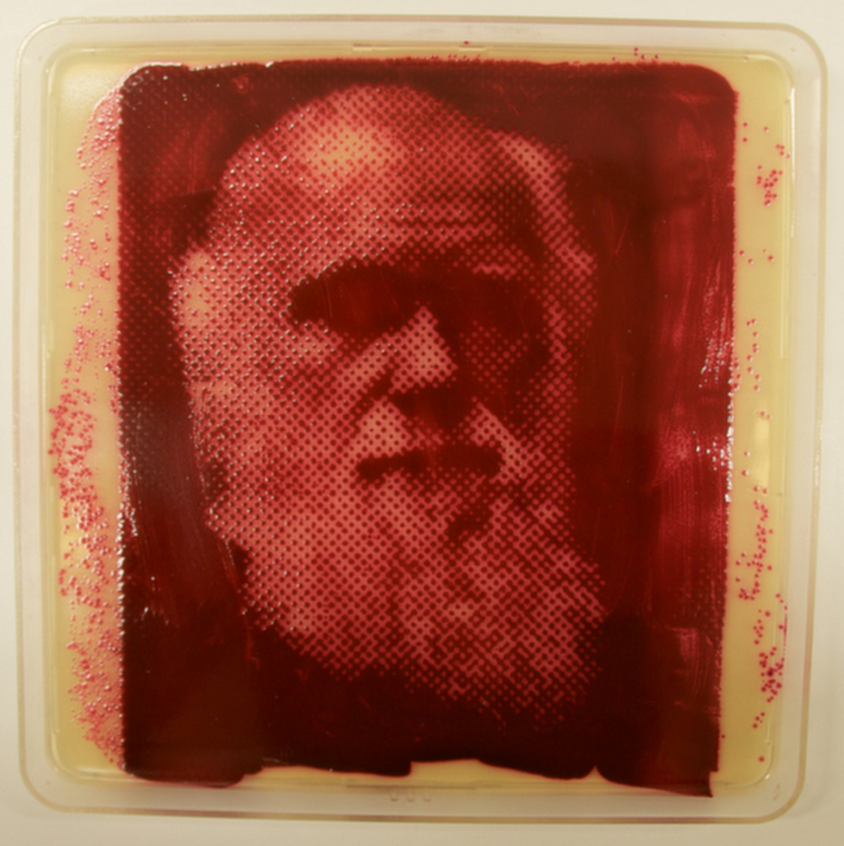
Zachary Copfer gives deceased figures, such as Darwin, a living tribute:
During his graduate studies in microbiology, artist Zachary Copfer invented a new type of photography, one grown entirely of living bacteria.
By exposing sections of microscopic organisms to radiation, he accelerates their growth, allowing them to multiply and compose vivid photographic portraits. Copfer’s subjects include both artists and scientists who inspire him; famous images Albert Einstein and Pablo Picasso are replicated in Serratia marcescens, a human pathogen often associated with infections of the urinary tract and respiratory systems. …
Copfer’s portraits closely resemble the art of Roy Lichtenstein; his faces bear the same comic book-style polka dots made famous by the legendary pop artist. Also like Lichtenstein’s paintings and prints, they are duplicates of mass-produced, iconic public domain images. But quite unlike the work of Lichenstein and his colleagues, Copfer’s images are imbued with an undeniably unique and human tenor. These bacterial cells, some drawn from the bodies of the subjects they portray, are corporeal and therefore inevitably personal.
The New Yorker just made available Saul Bellow’s “A Silver Dish” from their archive, first published in September 1978. How it begins:
What do you do about death—in this case, the death of an old father? If you’re a modern person, sixty years of age, and a man who’s been around, like Woody Selbst, what do you do? Take this matter of mourning, and take it against a contemporary background. How, against a contemporary background, do you mourn an octogenarian father, nearly blind, his heart enlarged, his lungs filling with fluid, who creeps, stumbles, gives off the odors, the moldiness or gassiness of old men. I mean! As Woody put it, be realistic. Think what times these are. The papers daily give it to you—the Lufthansa pilot in Aden is described by the hostages on his knees, begging the Palestinian terrorists not to execute him, but they shoot him through the head. Later they themselves are killed. And still others shoot others, or shoot themselves. That’s what you read in the press, see on the tube, mention at dinner. We know now what goes daily through the whole of the human community, like a global death-peristalsis.
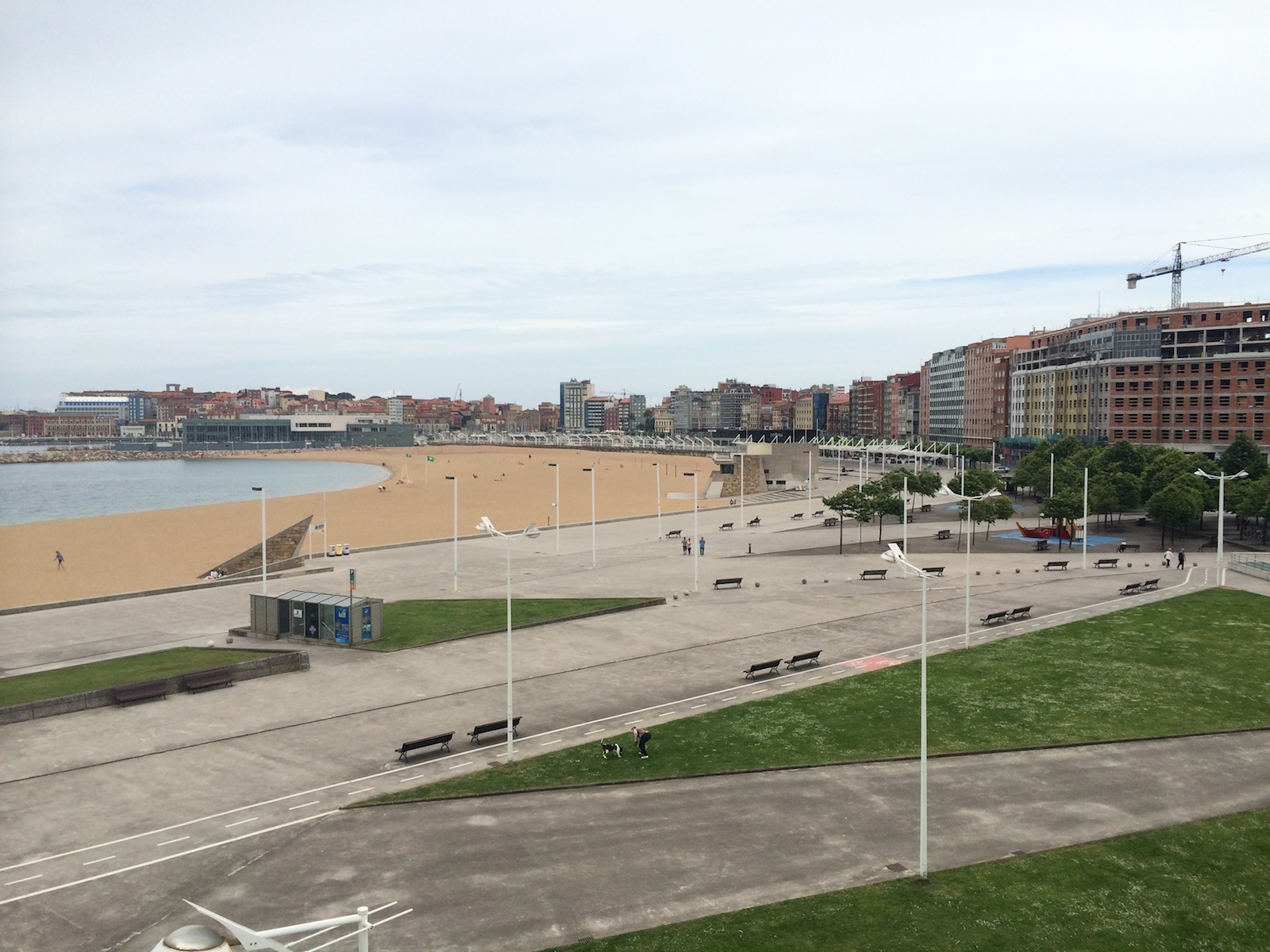
You have until noon on Tuesday to guess it. City and/or state first, then country. Please put the location in the subject heading, along with any description within the email. If no one guesses the exact location, proximity counts. Be sure to email entries to contest@andrewsullivan.com. Winner gets a free The View From Your Window book or two free gift subscriptions to the Dish. Have at it.
Isaac Chotiner is willing to consider some sort of response:
[I]t’s not clear what America can or should do, which is why remarks like those from John McCain, who called this “an existential threat” and seems to want some sort of huge response, are alarming. But that doesn’t let the United States off the hook, and certainly not at the rhetorical level. Would Obama say that the Cambodian genocide was ultimately up to the Cambodians to solve, after America bombed and destabilized the country? Was the genocide in the former Yugoslavia a Bosnian problem, even though the West kept an arms embargo on the Bosnians, essentially preventing them from defending themselves?
Wieseltierism really has taken over that magazine, from top to bottom. I’d say eight years of blood and treasure and failure in Iraq is enough. Unless, like Wieseltier, you see the entire planet as a patient and America as the only nurse. Relatedly, Noah Millman declares that people “who think the world will swiftly get more peaceful if we mind our own business may well be just as wrong as the people who think that by sticking our nose into other people’s business we can force the world to be peaceful”:
[W]e are responsible for the situation in Iraq.
We are directly responsible in that we broke the existing arrangement of power and installed ourselves as the occupier. We are also indirectly responsible inasmuch as our overweening hegemonic influence in the region means that inaction is also a kind of action. So, because the Syrian civil war has not resolved, but expanded and become more violent and extreme, and because that civil war and Iraq’s are, with the rise of ISIS, effectively merging, to the extent that we may be “blamed” for not resolving that civil war, we may also be “blamed” indirectly for the deterioration in Iraq.
None of which means we should make feel obliged to do something stupid and counter-productive, but it provides and genuine moral explanation for why we might feel obliged to do something.
I love this formulation: hegemony means inaction is action, so there’s no difference between the two! So let me put this as kindly as I can. We lost 5,000 young Americans trying to keep this centrifugal country in one piece. After eight years, and huge expenses in training and equipping the Iraqi army, we bear no blame and never have for the pathological sectarianism of so many Arab countries, culturally or politically. And it’s time to have enough self-respect to say so. The sanest, wisest way to wriggle out of this trap is precisely to do nothing – again and again – until the pathology of dependence is finished.
If there is something we can do, it should be to ratchet up our ability to monitor these groups – sorry, NSA-haters, but spying is one of our strongest and least disruptive tools in preventing attacks on the homeland – and to provide as much diplomatic and political advice, if asked, as to how to render the situation less volatile. But even there, the limits of our behavior are so much more profound than the potential. If you think Maliki pursued text-book sectarianism out of a whim, or could have been effectively dissuaded by a few American military officials, you are only missing the entire modern history of Iraq. And in sectarian warfare, there is usually very little magnanimity. Just payback – again and again and again.
Leave it alone. And do what we can to protect ourselves. That doesn’t guarantee anything. But intervention guarantees far worse.
A new volume of poetry by Kevin Simmonds, Bend to It, arrives with praise from the celebrated California poet D.A.Powell, winner of both the National Book Critics Circle Award and the Kingsley Tufts Award, who has said of Simmonds’ new poems, “Piercing the veil of a culture of silence, Kevin Simmonds brilliantly fuses quiet meditative traditions with a courageous impulse to dare beyond the boundaries of convention, to combine the bel canto of Italian art songs with the dynamic energy of James Brown; the tranquility of the zen masters with the fire and heat of the enraptured body.” We’ll post three of Kevin Simmonds’ poems this weekend.
“Lie” by Kevin Simmonds:
I’d write fewer poems
for my father to say
over the flat cell phone
he’s thinking of me
remembers some vital time
now history
when I was a small brown promise
with his wide nostrils flat feet
just like his daddy
all the women would say & feel good
about saying it
I would give up all the mouths
I’ve fallen into
even the soft ambulance
of a man’s body
 The Dish