Putting A Stop To Stop-Motion

Jurassic Park was released 21 years ago this week. Kottke recommends the above short documentary that reveals the technology behind the remarkably convincing special effects:

When Spielberg originally conceived the movie, he was going to use stop-motion dinosaurs. [Visual effects company Industrial Light & Magic] was tasked with providing motion blur to make them look more realistic. But in their spare time, a few engineers made a fully digital T. Rex skeleton and when the producers saw it, they flipped out and scrapped the stop-motion entirely. Fun story.

Elon Musk Has No Secrets Left

At least when it comes to Tesla:

Tesla Motors CEO Elon Musk has just opened up his company’s patents, saying that the company will not “initiate patent lawsuits against anyone who, in good faith, wants to use our technology.” In a conference call with reporters also on Thursday, Musk added that the company plans on aggressively filing electric car-related patents and opening them to the public as a pre-emptive measure to thwart other companies or potential patent trolls. This also applies retroactively to all currently held Tesla patents.

Will Oremus thinks the move makes perfect sense:

Musk isn’t naive, and Tesla isn’t a charity. Rather, he knows that Tesla’s real battle isn’t with other automakers for leadership of today’s niche market for electric cars. It’s the much greater struggle between electric cars and their gas-powered counterparts.

Viewed in that context, the obstacles to Tesla’s success aren’t the Nissan Leaf and the BMW i3—they’re the constraints of technology, cost, infrastructure, and customer expectations. The more money is put into electric batteries, the cheaper and more powerful they’ll become. The more electric cars there are on the road, the greater will be the demand for regional and national networks of electric charging stations. And guess what company will stand to benefit the most.

Jordan Golson nods:

Tesla needs widespread adoption of electric cars and the easiest way to do that is to get other automakers to sell them too. More electric cars in the world means Tesla’s cars aren’t so weird, and they become an easier sell to a skeptical public. … At the end of the day, the biggest risk for Musk isn’t that BMW or Toyota will steal his technology. It’s that the big automakers might not be interested in electric cars enough to bother building them at all.

Meanwhile, Timothy Lee suggests that electric cars aren’t such a unique case after all:

The standard economic argument for patents assumes that without them, new inventions will be quickly imitated by competitors, destroying the ability of the original inventor to turn a profit. But if you look at the history of actual inventions, this is often not how things work out.

In practice, the biggest challenge many inventors face isn’t fending off copycats, it’s developing a market for the product in the first place. For major inventions, the potential market is usually much larger than the first few firms can hope to serve. The challenge is converting all those potential customers into actual customers. In a new industry, competitors can actually help with this by helping spread news about the invention, pioneering better sales techniques, and developing improvements that make the product more attractive.

A Taxonomy Of Tints

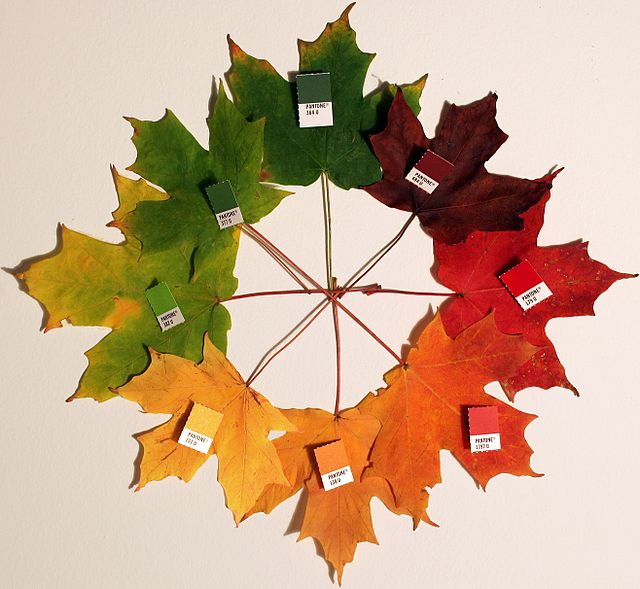
640px-Autumn_leaves_(pantone)_crop

Daniel Lewis, author of a biography of the Smithsonian’s first curator of birds, considers the importance of color dictionaries in the history of science:

Shy, retiring, and nerdy in the extreme, [ornithologist Robert Ridgway] was an astonishingly talented identifier and user of colors. This gift was key in a field where distinguishing among subspecies of birds with slight color variations was essential to understanding the mechanisms of evolution, speciation, and other scientific aspects of the natural world.

Ridgway wrote a short color dictionary in 1886, just as he finished work on a groundbreaking set of rules and guidelines for naming birds. He worked quietly on his color project for decades, until 1912, when he self-published a work with 1,115 named colors: Color Standards and Color Nomenclature. The book is filled with color swatches with names like Dragon’s-blood Red, which makes me think of blood dripping from a sword; or Light Paris Green, which seems like a holiday. …

These color dictionaries have a deep, personal, and complicated history – even though they emerged from a strong desire to quantify the world, as taxonomic publications tried to do in the 19th and early 20th centuries. Colors are slippery, and they say something about the personal prejudices and interests of the namers, at least as much as they speak to the qualities of colors themselves. We don’t use them anymore because in book form they would be impossibly unwieldy: There are now more named colors than you can shake a dragon at – far more than would fit into a single volume. But Ridgway’s legacy lives on – his book evolved into the Pantone color chart relied upon by graphic designers, house paint creators, interior designers, fashion mavens, flag makers, and anyone looking to identify colors.

(Image: “Pantone Autumn” by Chris Glass)

Wilde For Women

As a journalist, Oscar Wilde took a special interest in women’s issues:

[I]t is revealing to see just how many of Wilde’s journalistic writings are for and about women. This activity peaks when Wilde takes over the editorship of the Lady’s World, an illustrated monthly that advertised itself as a “high-class magazine for ladies”. Famously, the first thing Wilde did when he took charge of the journal was to change its title: Lady’s World became Woman’s World – a shift that signals a different target audience and different political ambitions. The revamped journal was to provide high-quality journalism aimed at modern middle-class female readers who did not think of themselves as “ladies”. These women were keen to read about culture, education and employment, and Wilde catered for their advanced tastes. Wilde’s editorship of Woman’s World from 1887 to 1889 was a crucial step not only in his career as a journalist but in his development as a writer in a broader sense. It was the only period in his life in which Wilde received a regular salary. More importantly, though, he was now in charge of commissioning essays and reviews, which he did by recruiting an impressive array of women contributors ranging from successful novelists to graduates of the new women’s colleges in Cambridge and Oxford.

In a review of the volumes of The Complete Works of Oscar Wilde that cover the writer’s journalism, Stefano Evangelista observes that the genre proved a good training grounds for Wilde’s later literary experiments:

It is in the journalism that Wilde comes up for the first time with many of the ideas and phrases that he would reuse in critical essays such as “The Decay of Lying” or “The Critic as Artist”. The traffic between his journalism and criticism makes us realize that to draw a sharp divide between these two fields in the Victorian age is a rather arbitrary affair. It is also in the journalism that Wilde learns to play with the epigram – a literary device that he would perfect in his society comedies. He learns to cultivate an effortless style, which mixes critical acumen with silliness, balances learning with superficiality, and tempers natural donnishness by means of studied flippancy. He learns to master that characteristic blend of praise and ridicule. He learns, in other words, to establish that easy, direct contact with the audience that made him a successful dramatist in his own time and that still makes him, on the stage and in print, so appealing to many today.

Email Of The Day

[Re-posted from earlier today]

A reader writes:

I have been a subscriber since very early on. This winter I purchased a subscription for my father. He is an evangelical, as well as a thoughtful conservative. He and I have had our fair share of clashes over the years as I have moved more to the left, but we have always worked hard to hear, and be heard by each other.

dish-gift-sidebar-FDA couple months ago they moved across the country to the same area that my wife and I live. We have obviously spent a lot more time together since that move. I cannot tell you how many conversations we have that are based on something one or the other of us read on the Dish. Neither of us totally agree with you, but it gives us a good jumping off point to have healthy discussions, where both of us are fleshing out our ideas. I think over the last couple of years we are actually moving closer to the same way of thinking. I, through reading your blog, have become somewhat more conservative (small c) and I think he has moved away from the GOP and certainly from FOX news.

Anyways, thanks for thoughtful commentary and conversation starters.

To give the gift of Dish for your father or grandfather or stepfather or father-in-law or any other father on Father’s Day, click here. He, like all subscribers, will get full access to the Dish, including the thousands of words below all the readons each day, in addition to all the writings and podcasts in Deep Dish, including long conversations with Hitch, Dan Savage, and Iraq vet Mikey Piro.

A Poem For Friday

8552674800_4d07606148_b

Another selection from Patrizia Cavalli translated, from the Italian, by Gini Alhadeff:

I had cut my hair, darkened my eyebrows,
adjusted the right fold of my mouth, thinned
my body, raised my height. I had even lent
the shoulders a triumphant bent. A girl
boy
again, on the streets, a workman’s gait,
no superfluous embellishments. But I hadn’t forgotten
the languor of the chair, a clouded vision.
And I distributed caresses, not knowing I did. My secret
body untouchable. In the lower back
expectation condensed without satisfaction; in the gardens
long walks, advice repeated,
the sky sometimes blue
sometimes not.

(From My Poems Won’t Change the World: Selected Poems of Patrizia Cavalli, edited by Gina Alhadeff. Translation © 2013 by Gini Alhadeff. Reprinted by permission of Farrar, Straus & Giroux, LLC. All rights reserved. Photo by Lauren Finkel)

European Cabbies Are Uber-Angry

Traffic was worse than usual in Europe’s major cities on Wednesday, as tens of thousands of taxi and limo drivers in London, Paris, Madrid, and Berlin went on strike to protest the competition they are facing from ride-share services, particularly the astronomically valuated Uber, Alison Griswold outlines their beef:

Taxicab drivers throughout Europe are calling for their governments to crack down on Uber with tougher regulations. London has emerged as the epicenter of the demonstrations: Thousands of drivers are rankled that the city’s public transit authority, Transport for London, or TfL, has determined that the smartphone app used by Uber drivers cannot be classified as a meter because it is not installed in the vehicle. That technical distinction is everything because TfL rules state that only licensed taxis can use a meter—a privilege that comes with strict regulatory hurdles. Drivers feel that because Uber’s app determines fare based on time and distance (and the occasional price surge), it functions like a de facto meter and should be regulated accordingly.

But Richard Read argues that the protesters are missing the point, and that “the taxi industry is overdue for a shake-up” anyway:

Many cab companies still operate using a 20th century model: travelers call for service, step outside, and wait for the cab to arrive. That may be appealing to our parents and grandparents, but for folks under 40, it’s a different story. Like newspapers and record labels, the industry has resisted change for so long, it may be too late to fix it. We understand that there are millions of hard-working cab drivers around the world who find this news unsettling. But Uber isn’t booting them out of a job, it’s changing the way they work to be more in keeping with modern technology and lifestyles.

Ultimately, protests like the ones staged yesterday in Europe make for good news stories, but they do little if anything to reform the industry or boost customer satisfaction. As proof, consider this: Uber said that the protests in London alone resulted in an 850% growth in the company’s user base, as frustrated travelers tried to work around the traffic jams caused by cab drivers.

Likewise, Jim Epstein tells the cabbies they’re wasting their time – in more ways than one:

London mandates that its cabbies pass a 149-year-old exam called “The Knowledge” that requires them to master the city’s maze-like streets and know the precise location of museums, police stations, and theaters. As part of the test, they have to verbally recite detailed explanations of how best to travel from one location to another through the city’s roughly 25,000 arteries. Passing “The Knowledge” takes years of study, and most drivers fail at their first few tries. The test causes the gray matter in applicants’ brains to expand, according to one London researcher.

Perhaps the most compelling case for letting Uber thrive is that London’s brainy cabbies should devote their oversize hippocampi to contributing to fields like computer science and medical research. In an age of ubiquitous GPS devices, many of which also incorporate real-time traffic data, circling the city in a car is a profound waste of such exceptional minds. London may as well also require that cabbies master the art of saddling a horse and mending a harness.
Waters’ World

John Waters shares some of his cross-country exploits with Craig Ferguson:

Choire Sicha entertainingly dresses down the “stunt-writing industry” – books like 52 Loaves: One Man’s Relentless Pursuit of Truth, Meaning, and a Perfect Crust and Living Oprah: My One-Year Experiment to Walk the Walk of the Queen of Talk – but saves praise for John Waters’ new take on the genre:

John Waters is something of a living stunt, in the best possible way. A hero of both America and Americana, Waters has changed the culture of the country as much as any other living filmmaker—Errol Morris, Wes Anderson, or Paul Verhoeven. Having written a couple of memoirs, he now turns his gaze more strictly on himself in a strange stunt book, Carsick: John Waters Hitchhikes Across America (Farrar, Straus & Giroux, $26). After life-stuntist extraordinaire Bill Clegg sold Waters’s idea to FSG head Jonathan Galassi in a bookish velvet-mafia inside job, it took, according to the acknowledgments, two and a half years for Waters “to write and live this adventure.”

The stunt was that Waters, who is now sixty-eight, would hitchhike from his primary home in Baltimore to his San 51l19HWlbrLFrancisco residence. On May 14, 2012, he set out on that expedition. In the end, he arrived. We learn that he is far too cranky and fussy to be doing such things!

In one way, though, Waters tears a mannequin of the stunt genre apart and spits in its face. The actual hitchhiking takes up less than the second half of the book. The first 192 pages consist of two fictional accounts: first his best-case scenario, followed by his worst-case one. These are unimpeachably lewd and Watersian (and, of course, far more entertaining than the actual dreary hitchhiking odyssey). Womb raiders, escaped convicts with priapism, a stripper who shoots up Viagra in a room of truckers gone wild, an alien abduction, and rape—oh, sure, that’s the best-case scenario. The worst-case presentation involves way more pus and goiters.

I can’t wait to see him again in Provincetown this summer, gamely biking up and down Commercial Street and still throwing one of the funkiest parties in town. He may hitchhike across America, but he always ends up here.

Iran’s Soccer Politics

Suhrith Parthasarathy looks at how association football influenced the modern history of Iran:

Drawing links between sport and the larger cultural and political ethos of a nation can often be tenuous and far-fetched. But, in Iran, when soccer returned to the hub of social life in the late 1990s, it served, as David Goldblatt wrote in his book, The Ball Is Round: A Global History of Soccer, as a “rallying point for opponents of the conservative elements in the theocracy.” Tehran’s national soccer stadium, built in 1971 and which can hold more than 100,000 people, is called “Azadi,” meaning “freedom” in Farsi. But ever since the 1979 revolution, which saw the Islamisization of the nation, women were altogether prohibited from watching soccer at Azadi. The boisterous celebrations following the team’s victory in Melbourne, therefore, served as much as a means to help break such shackles as it has to entrench a new form of expressing not only joy but also political protest in the country. Next month, when Iran plays in the 2014 World Cup in Brazil, its matches will reverberate in significance well beyond the soccer pitch.

John Duerden fast forwards to today, when the sport remains just as politically significant:

Popular passion for the game is such that no leader can afford to ignore it. One of the first international figures that President Hassan Rouhani met after taking office last August was Sepp Blatter, the controversial chief of the International Federation of Association Football (FIFA), football’s international governing body, who backed Iran’s bid to host the 2019 Asian Cup.

If Rouhani hadn’t immediately grasped the power of the game, it was made abundantly clear soon enough. Just one week after his historic election inspired thousands to take to the streets, crowds of roughly equal size turned out to celebrate Iran’s qualification for the 2014 World Cup. By scoring political points in his meeting with Blatter, however, the new Iranian president was just following the example set by his predecessor. According to a diplomatic cable published by Wikileaks, Mahmoud Ahmadinejad “has staked a great deal of political capital in Iranian soccer … in an effort to capitalize on soccer’s popularity with constituents.”

Yet Iranians (NYT) don’t seem all that excited about the World Cup this year. That’s no coincidence:

It is more than the daunting competition and the controversies surrounding Team Melli that keep the Iranians from warming to the World Cup. The authorities have been working hard to nix any soccer related excitement.

Tehran’s cinemas have been told by the police that they are not allowed to show World Cup matches to a mixed audience of men and women, “out of respect for Islamic morals.” A plan to show Iran’s games on some of the large electronic billboards across the city was canceled, and on Wednesday, restaurant and coffee shop owners said they had been told by the Ministry of Islamic Guidance and Culture to refrain from decorating their establishments with the national flag or the colors of other countries.

“We want to decorate our restaurant with German flags,” said one restaurant owner who asked to be identified only by his first name, Farhad. “But even that is not allowed. Fun, people gathering in large groups, such things make the authorities nervous.”