Are Steady Jobs Obsolete?

Screen_Shot_2014-06-09_at_11.34.18_AM

Danielle Kurtzleben worries that the growth of on-demand service startups like TaskRabbit and Instacart points to “deeper, unsettling trends going on in the US economy”:

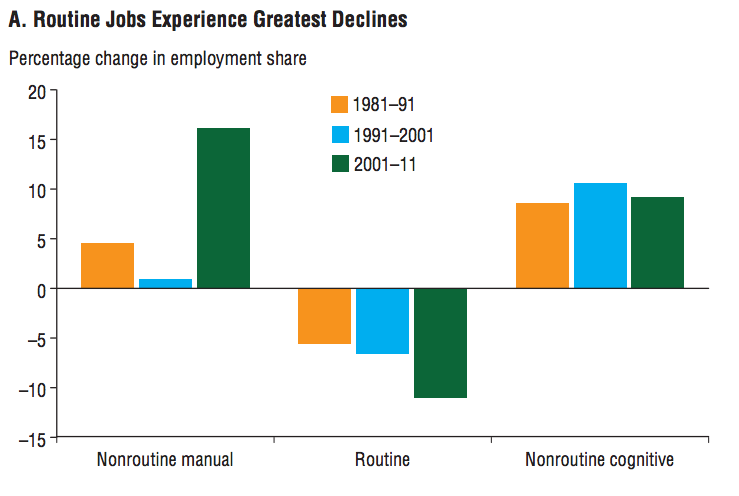
The New York Times’ Farhad Manjoo wrote in May that Instacart and services like it could “redefine how we think about the future of labor.” That sounds great in an era when technology replaces cashiers withself-check-out machines and automates assembly-line jobs out of existence. But the growth of TaskRabbit and other similar firms could mostly mean yet more job growth at the lower end of the spectrum. These low-skill jobs have made up the bulk of job growth over the last decade or so, as the Dallas Fed showed in a recent paper.

While jobs fall out of the middle, new jobs are created at the top and bottom. And those jobs at the bottom tend to be “nonroutine manual” jobs: those that require few skills and little problem-solving. Many of these errand jobs fit this bill perfectly, involving deliveries and other rote tasks. These new errand jobs can feature high pay — Instacart, Manjoo noted, can pay $30 an hour. But a major problem is finding steady work — no grocery run takes eight hours.

Iraq Needs A Political Solution

And Barbara Walter believes it’s a real possibility:

The key to preventing a long and bloody war in Iraq is to create disincentives for Sunnis to fight for complete control over the government. This may not be as hard as it sounds. True, the Sunnis’ number one goal is to regain full control over the government — but Sunnis understand that this is risky and costly. Their second best solution would be to gain a significant voice in government such that Sunnis could ensure that they will not be exploited by the demographically larger Shiite population. This will require a negotiated settlement with al-Maliki and his government that offers real power-sharing guarantees to the Sunni population. A negotiated settlement with moderate Sunnis has the added benefit of undercutting their support for more extreme elements. Studies by Walter 1997 and Harzell and Hodie 2003 have found that civil war combatants are significantly more likely to sign and implement peace settlements that include specific power-sharing guarantees.

But how do you convince al-Maliki to share power when he has shown no inclination to do so to date? As Marc Lynch wrote yesterday, al-Maliki has been urged to build a political accord for a half-decade, but has not done so. The key, I believe, is to make any aid or assistance to him contingent on good behavior. Once it is clear to al-Maliki that he and his army cannot defeat the Sunnis, it will also become clear to him that a deal is his best option.

Walter Russell Mead wonders if Maliki will instead turn towards Iran:

A major thrust of [Obama’s] speech is a political ultimatum to Maliki and his government: we will only help you if you get serious about an inclusive government and system in Iraq that offers real accommodation for the Sunnis.

This means Maliki has a choice. Iran is willing to bolster his government without any requiring any concessions to the Sunnis, having already dispatched two Revolutionary Guard units to protect Baghdad and the Shia holy cities of Karbala and Najaf. So for Maliki, do the advantages of American help offset the concessions he would have to make? If so, he’ll respond positively to Obama and the U.S. will get more deeply engaged in the contest. If not, he will turn to Iran and Iran’s involvement in Iraq will grow exponentially—and in effect the entire war in Syria and Iraq will turn into a war of Iranian expansion.

Peter Van Buren imagines a possible future:

The Kurds are the easy ones; they will keep on doing what they have been doing. They will fight back effectively and keep their oil flowing. They’ll see Baghdad’s influence only in the rear-view mirror.

The Sunnis will at least retain de facto control of western Iraq, maybe more. They are unlikely to be set up to govern in any formal way, but may create some sort of informal structure to collect taxes, enforce parts of the law and chase away as many Shias as they can. Violence will continue, sometimes hot and nasty, sometimes low-level score settling.

The Shias are the big variable. Maliki’s army seems in disarray, but if he only needs it to punish the Sunnis with violence it may prove up to that. Baghdad will not “fall.” The city is a Shia bastion now, and the militias will not give up their homes. A lot of blood may be spilled, but Baghdad will remain Shia-controlled and Maliki will remain in charge in some sort of limited way.


A Well-Oiled Warzone

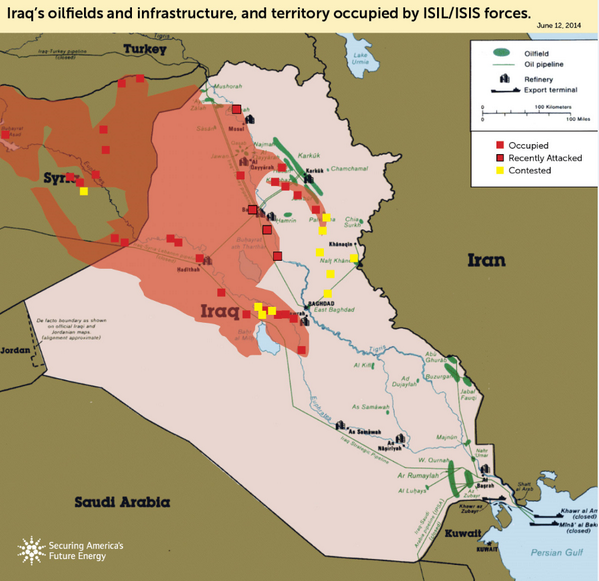
ISIS_control_june_12

Plumer takes a look at a slippery dimension of the Iraq conflict:

Some basics: Iraq has the world’s fifth-largest proven oil reserves. But the country has only very recently begun churning out significant amounts of crude oil again (production dropped sharply during the 2003 US invasion and its bloody aftermath). By April 2014, Iraq was producing an estimated 3.3 million barrels per day — equal to about 4 percent of global supply. And the country was expected to keep ramping up production, with plans to produce at least 5 million barrels per day in the years to come.

Or at least that was the idea. The recent takeover of northwestern Iraq by the Islamic State of Iraq and the Levant (ISIS) has complicated those plans considerably.

True, as the map above shows, ISIS isn’t close to any of the massive oil fields in the southern regions of Iraq, which produce 75 percent of the country’s oil. And ISIS has yet to enter the Kurdish regions in the north, another major oil-producing area. But the fighting has threatened some of Iraq’s other oil infrastructure, including a pipeline that can deliver 600,000 barrels of oil per day from Kirkuk to the Turkish port city of Ceyhan. (That pipeline had been damaged by a 2013 attack and was offline receiving repairs — that work has now been halted.)

In terms of oil as well as land, Iraq’s Kurds stand to benefit from the crisis:

The Kurds have an estimated 45 billion barrels of oil and have a long planned to be exporting 400,000 barrels a day this year, but until now dividends have been limited. Kurdistan and foreign oil companies have managed to export some of the crude, transported first by truck and then tanker, despite the Baghdad government’s declaration that all their activities are illegal. But, although a big export pipeline is now complete and millions of barrels of oil have been shipped through it to the Mediterranean port of Ceyhan, none of these volumes has been actually sold.

Tankers containing 2 million barrels of Kurdish oil are at sea awaiting buyers, who are apprehensive while Baghdad threatens to sue anyone who purchases it. The current offensive by an al-Qaeda affiliate may be the tipping point. Disciplined Kurdish forces now control not only Kurdistan but the disputed, oil-rich region of Kirkuk, which lies just to its west. The region has been autonomous since the first Gulf War in 1991, and its army has steeled itself to defend Kurdistan against Baghdad’s forces.

Previous Dish on the economic angle of the conflict here.

Responding To Student Groans, Ctd

A reader adds a personal touch to the blog debate:

What ever happened to working your way through school? I went to college form 1985 through 1994 to get my degree, going to school in the day time and working as a hospital orderly at first, then working for an engineering firm during the day and taking classes at night. I did my first year at a JuCo and the rest at a couple of state schools. Of course, I had to give up the fun campus lifestyle – no time for fraternities and parties (well, I found time for a few). But, when I graduated, I was student-debt free.

I realize that this is not the same as spending four years at at residential college or university, but that’s the breaks. Some people get to eat filet mignon and some of us have to eat hamburger. Bottom line is, maybe it took a bit more time and effort then some have to expend, my education has served me quite well in my career, and I never had the depression that must come from leaving school with the kind of debt that so many now incur.

I understand that tuition has increased, but dammit, everyone isn’t going to get to go to the Ivy League school that dream about. The state school in my town has a non-residential program that costs $8K/year, full time. Anyone should be able to deal with that.

Who Are These ISIS Chappies, Anyway?

In a useful explainer, Margaret Hartmann provides some background on the Islamic State of Iraq and Syria, the jihadist militant group currently overrunning Iraq:

ISIS grew out of Al Qaeda in Iraq, which was founded by Abu Musab al-Zarqawi in 2004 and became one of the most powerful Islamic extremist groups involved in the Iraq War. Shortly after al-Zarqawi was killed by U.S. forces in 2006, Al Qaeda in Iraq merged with several other insurgent groups and became known as the Islamic State of Iraq.

The group was decimated by U.S. forces, but as the last U.S. troops left in 2011, it staged a comeback. Michael Knights, the Lafer Fellow at the Washington Institute for Near East Policy, tells Vox that the group changed its message to focus on Sunni sectarianism, challenging the Shiite majority in Iraq. In an attempt to consolidate power, the Iraqi government persecuted Sunnis and tried to shut down Sunni militias, which “played right into their hands,” according to Knights. He says Iraqi Prime Minister Nouri al-Maliki “made all the ISIS propaganda real, accurate.”

Terrence McCoy profiles the group’s leader, Abu Bakr al-Baghdadi:

Born a Sunni in 1971 in Samarra with the name Awwad Ibrahim Ali al-Badri al-Samarrai, he claims to be a direct descendant of the prophet Muhammad. According to a widely cited biography released by jihadists, “he is a man from a religious family. His brothers and uncles include preachers and professors of Arabic language, rhetoric and logic.” The biography and Arabic-language accounts claim he obtained a doctorate at Islamic University in Baghdad — which is presumably why several of his many aliases include the title “Dr.” Holding degrees in Islamic studies and history, he is believed to have been an Islamic preacher around the time of the 2003 U.S. invasion of Iraq. The chaos of those months drove the 30-something into militancy, and he formed an armed group in eastern Iraq, one that reportedly never rose out of obscurity.

The opacity of his background, analysts say, suggests a broader truth of rising militant Islamists. “The mystery surrounding Abu Bakr al-Baghdadi — at the level of his personality, his movements, or even his relatives, his family, and those close to him — came as a result of what happened to previous leaders, who were killed after their movements were detected,” wrote Mushreq Abbas in al-Monitor. He is the “invisible jihadist,” according to Le Monde.

The CFR follows the money:

Supporters in the region, including those based in Jordan, Syria, and Saudi Arabia, are believed to have provided the bulk of past funding. Iran has also financed AQI, crossing sectarian lines, as Tehran saw an opportunity to challenge the U.S. military presence in the region, according to the U.S. Treasury and documents confiscated in 2006 from Iranian Revolutionary Guards operatives in northern Iraq. In early 2014, Iran offered to join the United States in offering aid to the Iraqi government to counter al-Qaida gains in Anbar province.

The bulk of AQI’s financing, experts say, comes from sources such as smuggling, extortion, and other crime. AQI has relied in recent years on funding and manpower from internal recruits [PDF]. In Mosul, an important AQI stronghold, the group extorts taxes from businesses small and large, netting upwards of $8 million a month, according to some estimates.

Jacob Siegel emphasizes how ISIS relies on allies of convenience in Iraq:

The standoff in Iraq isn’t between a single militant group and the government. There is a broad coalition of Sunni groups—both nationalist and Islamist—who had been plotting against Iraq’s Shia government for years before ISIS’s rise provided the chance to strike. ISIS and its partners are unnatural allies. Maintaining their unity was the key to their early success, and is the only way they can hold the ground they have taken, but that incentive may prove to be weaker than the force of their natural hostilities.

“ISIS control in Mosul is contingent on political alliances they have made with the Baathists and the tribal groups,” said Brian Fishman, a fellow at the New America Foundation, who has been following ISIS since the group’s early days during the Iraq war. “This alliance marching on Baghdad is not a natural one,” Fishman added. “We can understand how it was put together in opposition to the government but what exactly is holding it together, and how sturdy it is, is an open question,” he said.

Michael Weiss also plays up these alliances in a detailed analysis of the group’s strategy:

How did ISIS manage to accomplish so much in a year? Contrary to some media representations, it has had some help in the form of other tenuous Sunni allies, including Jaysh Rijal al-Tariqah al-Naqshabandia, a Ba’ath insurgency that couches its war against Maliki in tribal terms; and Ansar al-Islam, another Sunni Islamist group. The true nature and extent of other actors’ involvement in this conflict has yet to be fully uncovered, but already it seems clear that ISIS is drawing on local support bases. A kind of shadow Awakening is now in evidence, with Sunni tribes, Islamists, and dead-enders of the ancien regime all in league against Iraq’s new Shiite strongman. But what is also clear is that in Syria ISIS has managed to do what other rebel groups have not: effectively if harshly administer municipal facilities, says Pieter Van Ostaeyen, a Belgian analyst of Syrian jihadis. …

ISIS also appears to be drawing on classical “Desert Power” Arab military doctrine that dates back to the 7th century. “The Bedouin army could go out into the Syrian desert and they could strike either the Mediterranean region or the Euphrates valley or what is now Israel-Palestine,” says Col. Joel Rayburn, who served as a strategic analyst for the US military in Iraq. “They could strike at any of the areas on the edge of that desert, as though the desert were an inland sea that they could cross at will. Think of the Jazira [the territory encompassing eastern Syria and western/central Iraq] as the new desert. ISIS can go out there and project Desert Power into the river valleys and settled areas.”

Previous Dish on at ISIS’s strategy and objectives here.

How Did We Not See This Coming?

Shane Harris explains why the US government was caught off guard by Iraq’s sudden implosion:

The CIA maintains a presence at the U.S. Embassy in Baghdad, but the agency has largely stopped running networks of spies inside the country since U.S. forces left Iraq in December 2011, current and former U.S. officials said. That’s in part because the military’s secretive Joint Special Operations Command had actually taken the lead on hunting down Iraq’s militants. With the JSOC commandos gone, the intelligence agencies have been forced to try to track groups like ISIS through satellite imagery and communications intercepts — methods that have proven practically useless because the militants relay messages using human couriers, rather than phone and email conversations, and move around in such small groups that they easily blend into the civilian population.

Our Cold Civil War Intensifies, Ctd

Readers respond to the new thread – spooled out yesterday here, here, and here:

The Pew polarization GIF you posted is fascinating. Taken alone, it would appear both sides share equal blame for the present political paralysis as each shifts to their ideological poles. But a chart from the same Pew study (highlighted by Chait) demonstrates that polarization does not necessarily equal an inability to compromise; and while both sides may be guilty of running to their respective corners, one is clearly more liable for putting the kibosh on negotiation deal-making.

I feel this chart is just as telling – if not, more so.  Just look at that correlation: as one gets more liberal, the image001more he or she wants elected officials who compromise. It’s the statistical buttress to what we have seen these past few years, culminating this week with Cantor’s ouster: only the Republicans are carrying out a primary purification to fit their no-compromise dispositions. To me, polarization per se is not the current critical crisis – it’s a refusal to compromise, to reach out from one’s ideological end of the spectrum to meet in the middle (where most of us already are), and demanding that one’s representatives refuse to negotiate to get things done and better the country.
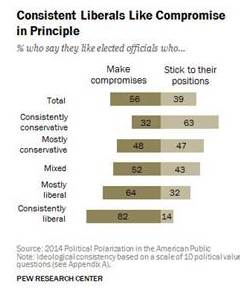
A point well-taken. A consistently liberal position is fine if you’re prepared to meet the other side halfway – and vice-versa of course. In fact, sometimes a strong position can help facilitate a real deal. And in this, it’s the GOP that is the outlier, and long has been. Another isn’t as concerned:

Sorry to say, but you’re suffering from PTSD associated with watching too much Fox News. Thanks to new media, people in general are far better informed than they were in the past when old media ruled. Ask yourself, could gay marriage and pot legalization have happened before new media?

The fact is, most people do not get their news from TV anymore, which is why CNN, MSNBC and Fox News have stopped trying to actually report news. Conservatives rely on talk radio and WSJ (the intellectuals) for their news, then maybe go to Fox to confirm what they already know. Liberals go to the NYT and informative blogs (like yours) and we tend to disdain MSNBC because we don’t like to be pandered to (which is why their ratings are much lower than Fox). About the only people who get their news from TV are what we would call “independents” but are actually low-interest citizen (and voters) who tend to dismiss all politics as hooey. And they jump around confused as to what to believe (unless there is a murder trial or missing plane).

If you must believe in a Cold Civil War, then know that progressive side is winning hands down.

Another notes:

I agree with your broader point regarding the culture war (although we may have a slight disagreement on who the aggressors might be), but your point on immigration is quite simply incorrect. It is simply false to say “That data simply refutes the notion that we are somehow living in an era of lawlessness and massive illegal immigration.” The truth behind the deportation numbers of the Obama administration is murky at best. When members of the administration, and even President Obama himself, admit that the numbers are deceptive (basically an accounting gimmick), I think even such a staunch Obamaite as yourself would make note of that.

Another is on the same page:

Sorry, but total removals of immigrants during the 4 years (2009 – 2012) of the Obama administration are down significantly.  In fact if you add up the two columns in the chart below from the DHS, (Removals and Returns) you’ll note that you have to go back to 1973 to get a total number less than the 2012 statistic:

Screen Shot 2014-06-12 at 12.39.36 PM[1]

I don’t mean to enter into a “Civil Cold War” with you, but to me a deportation is the removal of a person from this country, whether through an order of deportation, or by the simple expedient of putting them on a truck at the border and sending them back to where they started. As usual, both sides are right/wrong telling incomplete truths about this (and every) topic.  SIGH …

Another quotes me:

“It was like slipping into an alternative universe.” That describes how I felt reading your post. One of the things that made me to subscribe to and makes me read your blog everyday is your willingness to challenge whatever the “established narratives” being spun by politicians and abetted by the media. This time, however, I feel that you’ve bought to much into the “Fox News is evil narrative” and cherry-picked your facts to prove your points.

While I don’t like the heated rhetoric Fox uses to take advantage of people’s emotions, they still make some good points that the MSM ignores in order to preserve the president’s image. Is it not a problem that Iraq and Syria are becoming failed states in which terrorists can train and organize? Is it not a problem that illegal immigrants are flooding into the country at a faster clip in recent weeks and being sent off throughout our country that can barely afford to educate Americans and other kids that are here legally? Is the president allowed to ignore the laws he does not like (I seem to remember liberals not liking when Bush did that; I’d like the president to follow the laws regardless of his or her party).

In my opinion, Fox is right to call the president out for not being a strong leader BUT I’m not always a fan of the means they use to do it.

More commentary on our Facebook page. A common complaint:

MSNBC is not even remotely like Fox. They may have an obvious bias in favor of Democrats, but to claim that Hayes or Maddow engage in this kind of reality fabrication is ridiculous.

Another reader, from the in-tray, makes the same argument and goes on to elaborate on the Cold Civil War:

Liberals and conservatives are coming to rely on different worldviews motivated by different interpretations of what “reality” is. The Republican party has clearly decided that the only path open to them is to further embrace the resentment exhibited in rural, displaced white voters – people whose concerns have been unconscionably ignored but who have directed their anger at an entirely inappropriate target. They see Obama as the enemy but they vote for the people who are their real enemies.

If you think about it point by point, it becomes even less sensible. The debt? That was a result of Bush’s unfunded wars, irresponsible tax cuts and his corporatist Medicare expansion (which was itself just a subsidy for drug companies). The recession? A logical endpoint of a decades-long abandonment of responsible financial regulation. Immigration? There have been no significant changes to our immigration law since 1986, when Saint Reagan pushed through a bill that provided legal status to many who were undocumented – and the right conveniently proceeded to forget that. Ditto with gun control, since Reagan supported the Brady Bill publicly, and that clearly must be erased from the record.

The left, by contrast, did not throw Democrats out of office for supporting the Bush tax cuts. It did not throw Democrats out of office for opposing cap-and-trade legislation, immigration reform, or for stonewalling Obamacare until the very last minute when Scott Brown’s surprise election made inaction untenable. The left complained about these realities but never pretended that the reality was any different than what it was; we had the best we could get and that while Obama has let us down on specific issues, he has been a wholly underappreciated president – and history will very likely vindicate him. I don’t know if enough people realize that yet, but if Bush can recover to a 40%+ approval rating then Obama might just be remembered fondly.

I have many friends who are Republicans and they have similarly become militarized about specific issues. It never ceases to amaze me. I see increasingly absolutist statements about gun rights, impeachment and taxes from my right-wing friends and it genuinely scares me.

(The stat in the above tweet is backed up by this link)