McCain’s Alternate Reality

McCain ludicrously claims we  had “won” in Iraq before Obama pulled out:

Waldman remembers how frequently McCain has been wrong:

McCain does provide something important to journalists: whatever the issue of the moment is, he can be counted on to offer angry, bitter criticism of the Obama administration, giving the “balance” every story needs. The fact that he has never demonstrated the slightest bit of understanding of Iraq is no bar at all to being the most quoted person on the topic.

For context, here’s a nice roundup of some of the things McCain said when he was pushing to invade Iraq in the first place.

When asked if Iraqis were going to greet us as liberators, he answered, “Absolutely.” He said, “Post-Saddam Hussein Iraq is going to be paid for by the Iraqis” with their oil wealth (the war ended up costing the American taxpayer upwards of $2 trillion). And my favorite: “There is not a history of clashes that are violent between Sunnis and Shias, so I think they can probably get along.”

The conflict between Sunnis and Shiites is the central dynamic of the Iraq conflict, of course. Yet today, the media once again seek out John McCain’s wisdom and insight on Iraq, which is kind of like saying, “Jeez, it looks like we might be lost — we really need to ask Mr. Magoo for directions.”


The GOP Still Needs The Latino Vote

Immigration Turnout

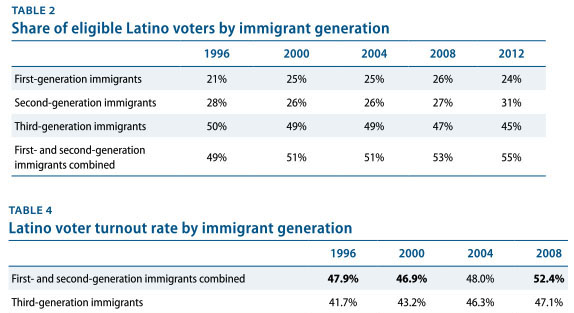
Drum uses the above chart to explain why the GOP establishment is losing sleep over immigration reform:

A new report from the Center for American Progress suggests they’re pretty justified in being scared. Immigration reform is an especially salient voting topic for first- and second-generation immigrants, and that group has two important characteristics: (a) it’s growing as a share of the Latino population, and (b) it’s turning out to vote in ever higher numbers … Republicans may be able to hold onto Congress for a while longer in the face of numbers like these, but winning the presidency is going to get harder and harder. Not impossible. But that’s a mighty big headwind, and it’s getting stronger every year.

Despite Cantor’s loss, Lanhee Chen contends that immigration reform isn’t dead:

[T]he fundamental dynamic that haunted Republicans in 2012 still exists: Unless they are able to demonstrate some leadership on immigration reform, they risk forfeiting the Latino vote in 2016. Even if a perceived moderate on the issue, such as Jeb Bush or Rick Perry, ends up being the Republican presidential nominee, the party will be held liable for inaction. This will have consequences for the nominee and candidates in states with sizable Hispanic populations.

Rand Paul, for one, still supports immigration reform. Allahpundit expects most the other Republican presidential hopefuls to follow his lead:

As traumatized as Republican candidates must be by Cantor’s destruction, they’re more traumatized, I think, by Romney’s margin among Latinos in 2012 after he backed “self-deportation” in the primaries to pander to righties. They’re not going to follow him down the same road, and if they were tempted to, the donor class wouldn’t let them. Unless you’re Ted Cruz or Rand Paul, neither of whom stands a chance of winning the business-lobby primary, your campaign hinges on winning as many rich backers as possible. That means you support legalizing illegals, even if you have to lard up that positions with conditions to stay viable in the primaries. Even Paul, after all, is leery of trying to win a confrontation with the establishment in a national race backed by nothing more than grassroots support. That’s why he’s been moderating his position on foreign policy and why he’s refusing to budge on immigration after Cantor’s beating. He won’t be the donor class’s choice, but maybe he can peel away some members. It’s Cruz, alone among the contenders, who’ll be running a chiefly grassroots campaign. That’ll ensure his status as de facto leader of the tea party, win or lose, but it’s not the obvious path to the nomination in the McCain/Romney era. Because he has little to lose, he’s the only man running who might embrace a firm “security first” position. And needless to say, even he’ll stay away from “self-deportation.”

Chait suspects it’s the “deal” part of an immigration deal that infuriates Republican diehards:

Conservative Republicans may not hate immigration reform, but they hate compromise in general. By an 82-14 margin, liberals want their elected officials to make compromises. By a 63-32 margin, conservatives want elected officials not to compromise. Republicans simply don’t trust bipartisan deals. … The conservative revolt against compromise expresses itself constantly. It comes through in the ever-present trope of citing the length of legislation as a primary reason to oppose it. It likewise comes through in the way conservative intellectuals routinely attack bills as a “stew of deals, payoffs, waivers, and special-interest breaks” — which is to say, they hate the fact that passing bills in Congress requires cutting deals with disparate constituencies, which is how legislation works.

Waldman thinks it’s basically impossible for any Republican to both govern and please the base:

As far as that activist base is concerned, every Republican politician should be nothing but an agent of chaos and destruction, or at least pretend that’s who he is. It’s not only incompatible with governing, it’s barely compatible with holding office. Anyone who actually tries to accomplish anything is quickly turned from hero to traitor, as Marco Rubio was when he attempted to devise an immigration plan; Tea Partiers who once celebrated Rubio now view him with contempt. The only kind of legislator who can stay in their good graces is one who never bothers legislating, like Ted Cruz. Writing laws is for compromisers and turncoats; what matters is that the revolution continue forever.

A Water War In The Desert

dn25722-4_1095

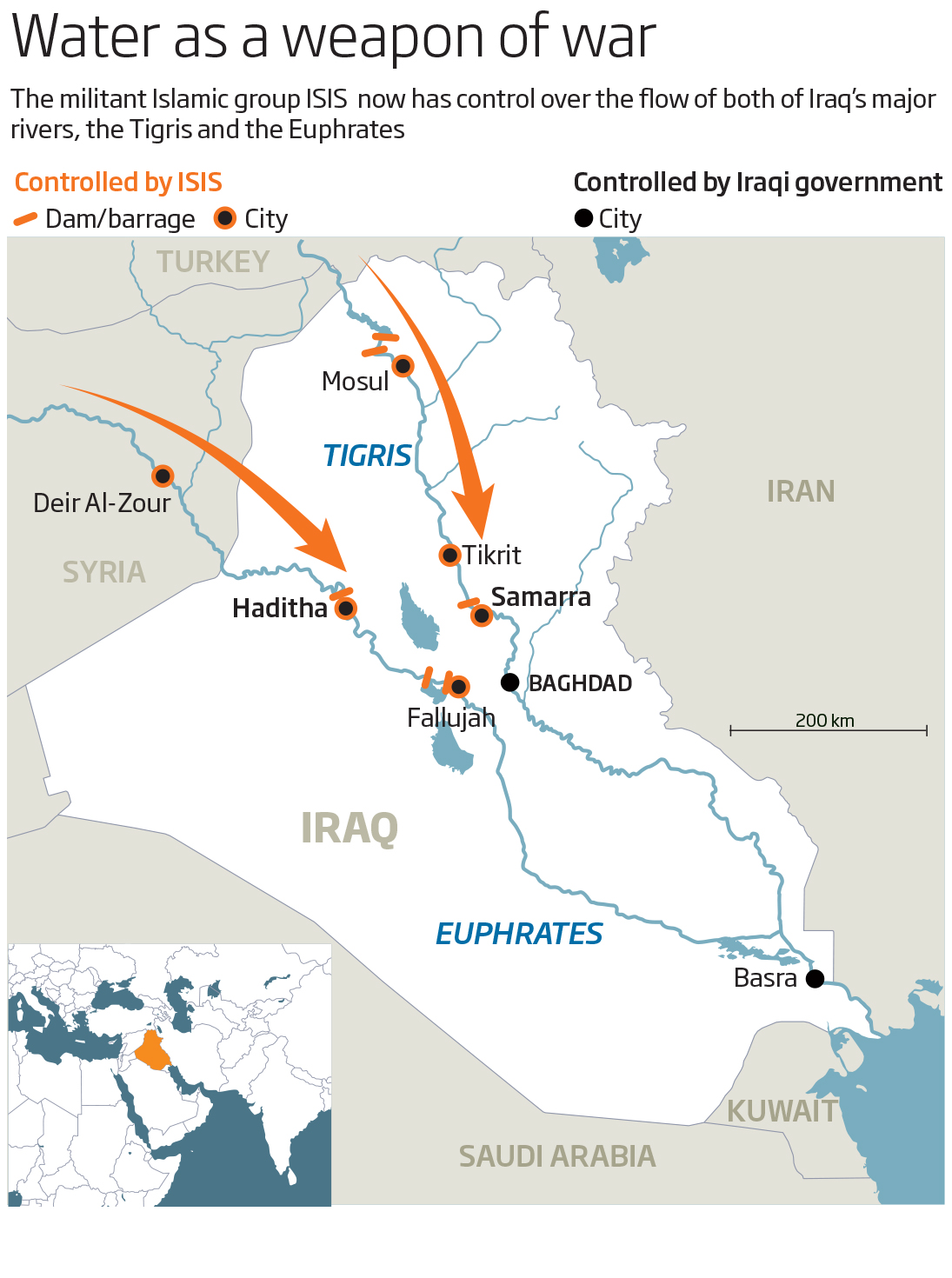
Debora MacKenzie warns that ISIS’s position on the Tigris and Euphrates rivers gives it the ability to cause unimaginable chaos in Iraq:

ISIS now controls several major dams on the rivers, for instance at Haditha and Samarra. It also holds one 30 kilometres north of Mosul that was built on fragile rock and poses a risk of collapse. It holds at least 8 billion cubic metres of water. In 2003, there were fears Iraqi troops might destroy the dam to wipe out invading forces. US military engineers calculated that the resulting wave would obliterate Mosul and even hit Baghdad.

ISIS has already used water as a weapon, in a smaller way. In late April ISIS stopped flow through the relatively small Nuaimiyah dam on the Euphrates in Fallujah, reportedly with the aim of depriving Baghdad and southern Iraq of water. It could also have been to block military approaches to the town. Instead, the river backed up and poured into an irrigation canal, flooding the town of Abu Ghraib and dozens of surrounding villages over 200 square kilometres. Five people died, and 20,000 to 40,000 families fled to Baghdad.

Will Obama Attack?

Tragically, it seems possible:

President Obama announced on Friday that in the “days ahead” he will decide on a package of military and diplomatic options to halt the rapid advance of the Islamic State of Iraq and the Levant (Isis)as the jihadist army’s march from Syria through Sunni Iraq has upended Obama’s achievement of extricating the US military from the Iraq conflict.

Obama has ruled out sending US soldiers and marines back to the Iraqi streets they patrolled from 2003 to 2011, but signaled a new, reluctant openness to returning the US to war in Iraq. .. Options under discussion include an air campaign, using either or both air force or navy warplanes, the potential duration of which has yet to be determined. Drone strikes remain under consideration, but manned aircraft are said to the preferred option, owing to their superiority against moving and manoeuvrable targets.

Zack Beauchamp calls the following sentence the “most important line from Obama’s Iraq speech”:

The US is not simply going to involve itself in a military action in the absence of a political plan by the Iraqis.

I certainly take some comfort from the president’s strong words of caution. But he’s going to have to withstand an army of bedwetter interventionists in the Beltway. Zack comments:

If this is is true, then Obama has ruled out the most likely scenario for military action in Iraq: a short-term drone campaign designed to help the Iraqi military halt ISIS’ momentum. 

Political reform inside Iraq is really complicated, and would involve serious reform from Nuri al-Maliki’s Shia sectarian government to accommodate Sunni demands. Putting together a credible political reform plan will take a long time, and certainly won’t happen in time for the US to get involved in the immediate fighting.

Throughout his speech, Obama took pains to emphasize the importance of Iraqi political reform and minimize the prospects of US military involvement. While he said he was considering military action, he flatly ruled out deploying US troops. He also repeatedly stressed the need for the Iraqi government to reform itself to deal with the root causes of ISIS’ success, sectarian divisions and poor governance.

Tom Ricks is against air strikes:

The last thing we need is American pilots being held prisoner by the new guys. And where would you base your combat search & rescue helicopters, and what do you do when one of them gets show down? I don’t think Obama faces hard choices in Iraq.

The one interesting suggestion I’ve heard is that the U.S. government make military aid to Iraq dependent on Maliki stepping down. But I think Iran has more say in that than we do.

Hayes Brown sees no good options for the US. How airstrikes could backfire:

Air strikes, while often effective in the short-term, are not a long-term strategy for defeating ISIS. It’s also far more expensive than many realize. There is also still the chance of accidentally killing civilians, which would provide backlash so soon after a decade in which the United States occupied the entirety of Iraq. There’s also the risk that air strikes could lead to mission creep and a full reinsertion into Iraq.

On Not Taking The Neocon Bait

IRAQ-UNREST-MOSUL

David Harsanyi sees few good options for salvaging the outcomes of the Iraq War:

Some will, no doubt, argue that doing nothing (and we might very well be doing something soon) means that more than 4,400 U.S. troops and over $700 billion had been wasted in a war that ended but was not won. Perhaps. But a more important matter is this: would the death of another 4,000, or 400, or four, bring about a preferable outcome or a set of conditions that allow the United States to convincingly declare victory? If a decade of nation building brought us this, what could we possible gain by seriously reengaging? Clearly, to make it work the American people would need to be prepared to make a generational commitment – and polls don’t tell us that we’re in the mood for an open-ended conflict in the Middle East.

These are horrible choices, indeed. While millions of civilians no longer experience life under the regime of Saddam Hussein, and we should not forget the sacrifice thousands of soldiers made to allow that to happen, it gets increasingly difficult to imagine that the United States has gained anything worthwhile from its invasion of Iraq. It’s difficult to understand how spending another five or ten years sorting out a sectarian civil war can possible be in our best interests.

The UK, for one, won’t get involved. Les Gelb zooms out to see the core question. The fundamental American blind spot remains what it was in Vietnam:

What happened in Iraq was history as usual. The U.S. fights in Iraq and Afghanistan and Libya and Vietnam and other places (maybe next in Syria), provides billions of dollars in arms, trains the friendly soldiers, then begins to pull out—and what happens? Our good allies on whom we’ve squandered our sacred lives and our wealth fall apart. That’s what’s happening in Iraq now.

The alternative – staying in those countries for ever – is just a euphemism for empire in a world that emphatically does not want us, and with an America that rightly wants us to focus on the struggles at home. As for the question as to whether around 5,000 Jihadists can threaten the security of the United States, the Israelis seem utterly unruffled – and they live much, much closer to the threat. There’s something awry when a continental superpower thousands of miles away is more jittery than Jews on the front lines. Keating identifies one good reason why the American people, with any luck, will not rise to the neocon bait yet again:

More than a decade ago, the U.S. public and political establishment supported a war in Iraq partly based on the false pretense that it was allied with al-Qaida. Now, largely as a result of that war and its aftermath, a large portion of Iraq is under the control of an al-Qaida splinter group and America seems largely indifferent. …

There were discussions of “Iraq fatigue”—the sense that the American public is simply tired of hearing about the country’s troubles—as far back as 2006. Supplanted since then by crises from Libya, to Egypt, to Syria, I’d guess that fatigue is even more entrenched now and while I expect some criticism of the White House on this, I doubt we’re going to see a groundswell of public demand for a robust response to Iraq’s latest crisis.

Although the elites will do their best to whip it up. Which is why one should be grateful that the Washington Post wields a clout far smaller now than it did to such devastating effect in 2003. Gordon Lubold and John Hudson offer another reason for why military intervention – even air-strikes – are unlikely to work at all:

[D]espite the crisis, there is little likelihood that the American government would consider putting any troops on the ground. That means that airstrikes are the only real option for a potential U.S. military intervention into Iraq as the crisis there continues to grow. That’s not a simple endeavor, however. … The Iraqi security forces don’t have troops capable of relaying detailed targeting information, which would likely require the Pentagon or the CIA to send small numbers of American personnel into Iraq to handle that difficult mission. Without adequate ground intelligence, the United States could run the risk of accidentally killing Iraqi security forces or, even worse, civilians.

In a splendidly sane piece, Fareed Zakaria shoots down the hawks’ fantasy that Obama could have kept troops in the country if he had really wanted to:

I would have preferred to see a small American force in Iraq to try to prevent the country’s collapse. But let’s remember why this force is not there. Maliki refused to provide the guarantees that every other country in the world that hosts U.S. forces offers. Some commentators have blamed the Obama administration for negotiating badly or halfheartedly and perhaps this is true. But here’s what a senior Iraqi politician told me in the days when the U.S. withdrawal was being discussed: “It will not happen. Maliki cannot allow American troops to stay on. Iran has made very clear to Maliki that its No. 1 demand is that there be no American troops remaining in Iraq. And Maliki owes them.” He reminded me that Maliki spent 24 years in exile, most of them in Tehran and Damascus, and his party was funded by Iran for most of its existence. And in fact, Maliki’s government has followed policies that have been pro-Iranian and pro-Syrian.

And Larison, echoing Marc Lynch’s insight from last night, is at a loss for why we’d want to double down on the mistake of propping up Maliki:

Maliki was already governing in a sectarian and semi-authoritarian manner when the U.S. had a major military presence in the country, so it seems clear that retaining a smaller presence would have had no effect on him and his allies. It is even more doubtful that the U.S. would use this leverage if it had it. This is the trouble with trying to condition future aid on improvements in Maliki’s behavior: when push comes to shove, the U.S. usually refuses to cut off aid because it doesn’t want to “abandon” its client. …

Intervening militarily to prevent further advances by ISIS would commit the U.S. to acting as Maliki’s protector indefinitely, and the more resources that the U.S. commits to this the harder it will be to pull the plug at some point in the future.

Drum simply marvels at those who still think the US can solve problems like these with brute force:

If we committed US troops to every major trouble spot in the Mideast, we’d have troops in Libya, Lebanon, Syria, Afghanistan, and Iraq. Lots of troops. The hawks won’t admit this outright, but that’s what their rhetoric implies. They simply refuse to believe the obvious: that America doesn’t have that much leverage over what’s happening in the region. Small commitments of trainers and arms won’t make more than a speck of difference. Big commitments are unsustainable. And the US military still doesn’t know how to successfully fight a counterinsurgency. (That’s no knock on the Pentagon, really. No one else knows how to fight a counterinsurgency either.)

This is painfully hard for Americans to accept, but sometimes you can’t just send in the Marines.

There are, after all, other options. Instead of a bombing campaign, Nussaibah Younis argues for a political and diplomatic intervention:

The United States must use its assistance as leverage to prevent Mr. Maliki from becoming, in effect, a dictator. Many young Iraqis who join the Sunni militants already see the government as a sectarian oppressor. The Maliki government has targeted senior Sunni politicians, and failed to respond to Sunni demands for reform. Its exclusionary approach has helped enable extremism, and the United States must ensure that Mr. Maliki does not use the new outbreak of fighting to shore up his authority.

Moreover, the United States must compel the Iraqi Army to adopt a sensitive, population-centered approach to reversing the militants’ conquests. If the Iraqi Army sends Shiite militant groups or Kurdish forces to the heart of Sunni-dominated Mosul, or if it carpet-bombs the city and arbitrarily arrests or kills groups, it will alienate the hearts and minds essential to winning this battle.

Henri J. Barkey argues that the spiraling conflict means that now we really have to do something about Syria, but that does not necessarily mean to go in with guns blazing. He suggests we take advantage of the suddenly aligned interests of Iran and its rivals:

Coincidentally, the fall of Mosul occurred during Iranian President Rouhani’s visit to Turkey. Despite the fact that they are deeply engaged on opposite sides of the Syrian conflict, the two countries have agreed to disagree. The reason is simple: They have other important shared interests, such as oil and gas trade and political support for the Iranian nuclear program. Considering Syria’s importance to both regimes, perhaps Turkish-Iranian pragmatism can be bent in the direction of agreement to construct a transitional arrangement for Syria? Both now need face-saving policy options. The trick is to come up with an interim deal that includes Assad’s departure, though perhaps not immediately, in exchange for the safeguarding of some core Iranian interests in a future Syrian political system.

This may sound improbable, and it is. Nonetheless, the fall of Mosul shows that the Syria crisis, which was almost from the beginning an Iraqi crisis as well, requires a regional solution. The Obama Administration was right not to intervene directly in Syria with military force, but wrong to construe its options as either war-making or what amounts to passivity. The perception of Washington policymaking in Syria as dithering and less-than-professional has arguably spread throughout the region. The Administration can begin to reverse this image if it is willing to encourage the region to come up with its own solution. That effort would have to start in consultation with Turkey and Saudi Arabia, and it would have to include Iran as well in the end

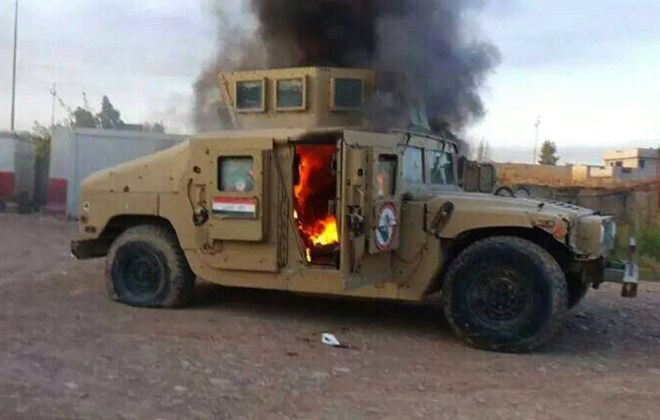
(Photo: A picture taken with a mobile phone shows an armoured vehicle belonging to Iraqi security forces in flames on June 10, 2014, after hundreds of militants from the Islamic State of Iraq and the Levant (ISIL) launched a major assault on the security forces in Mosul. By STR/AFP/Getty Images)
The Neocons Get A War Chubby

Yesterday, Eli Lake breathlessly weighed Nouri al-Maliki’s request for American air strikes to assist in the battle against ISIS that his army appears unwilling to fight. Today, jonesing for more war with Jihadists, he and Tim Mak report that “if Obama changes his mind, U.S. jets could be flying over Iraq in less than a day”:

U.S. air bases, housing dozens of American fighters and bombers, are well within striking distance of Iraq. High-flying spy drones like the Global Hawk can just as easily fly over Iraq as Afghanistan or any other conflict zone in the region. The aircraft carrier U.S.S. George H.W. Bush is a few days’ sail away, in the North Arabian Sea. And it boasts dozens more fighters on board.

That’s why a number of retired high-ranking U.S. Air Force officers, including Lt. Gen. David Deptula, who served as the Air Force’s first deputy chief of staff for intelligence, say any strikes, if ordered, could begin almost immediately. “If you can provide me with the appropriate intelligence we can start doing (air strikes) within 24 hours,” he told The Daily Beast. “There are a variety of means do this, whether you are talking about long-range, high-payload aircraft or smaller aircraft. With the requisite intelligence information you can start again in 24 hours.”

Mercifully, the piece includes some warnings about the unintended consequences of deciding to “re-enter the Iraq War.” Even McCain and Butters are leery of air-strikes, which would sink the US right back into the Iraqi quicksand.

Reihan, meanwhile, has the great idea to see what the architects of the original Iraq catastrophe would have us do, because Ken Pollack and the Kagans – yes, the Kagans! – are still the “experts” we should defer to. He manages to shoe-horn in some Scowcroft while he’s at it, but never addresses the fact that Maliki and the American people were deeply opposed to the occupation continuing, that no protections were even given to US soldiers in such a scenario, and, more crucially, that if our leverage with 100,000 troops had failed to sway Maliki, why would a few hundred be salient now – especially since he has become rightly despised by his Sunni enemies?

In case anyone believed that the right had learned anything from Iraq, the editors at NRO also come out strongly in favor of re-entering the war they helped start:

Maliki needs help now, and the U.S. needs to give it to him. The Obama administration, asked about the country’s impending collapse, noted that it has sent Maliki a few hundred missiles, some rifles, and lots of ammunition. It’s possible ISIS will overextend itself, but all the ammunition in the world may not be enough for the Iraqi army, such as it is, to retake the cities ISIS controls and stamp out the insurgency.

The Iraqi government has a long list of weapons and support it needs. The U.S. ought to meet those requests, at least. The Maliki government may need U.S. advisory support — and possibly even other measures — to stop ISIS’s advance and retake the cities that have been overrun. This is anathema to the Obama administration: It much prefers handwringing to intervention. But deliberation now (not unlike in Syria) will allow the Islamists to solidify their position and amplify their influence.

The Iraqi government has a 250,000 strong army, trained and equipped by the US. But sectarianism meant that, when it came to the defense of Mosul, most of them took off their uniforms and joined the ISIS brigade.Do these delusional partisans actually believe that “advisory support” can somehow reverse this core dynamic?

George Will sums up the position of the right-wing id:

The president is in fact implementing the foreign policy he promised. It was entrenchment by one word, retreat by another. He is implementing the foreign policy that Secretary of State Hillary Clinton facilitated without expressing any qualms. He is implementing a policy that the American public has said in polls it wants right now. It wants it at least until it gets queasy by looking at the pictures they have been seeing tonight.

And one might think an alleged Tory like Will would understand the futility of trying to control an endless sectarian civil war in a country we neither understand fully or could control while occupying with 100,000 troops. But what’s conservative coherence worth when you can bash Obama so easily? In Malkin Award-worthy screed, Robert Tracinski does Will one better and proclaims that Obama wanted America to fail:

So were the Democrats right? Was Iraq a lost cause, inevitably, all along? There’s one big problem with this narrative: Iraq has fallen apart on President Obama’s watch, as a consequence of his own policy of willful neglect. I would say that this was a self-fulfilling prophecy, but that doesn’t quite seem to cover it. Instead, I would characterize this as a wish-fulfilling prophecy. If Iraq is falling to al-Qaeda, it’s because this administration deliberately chose to throw away the victory handed to them by George W. Bush. The left thought we should have lost the war in Iraq, they wanted us to lose it—and finally they’re getting the outcome they wanted.

Yes, the Iraq War was a victory. How on earth did we manage to forget that?

My first take on the debate over whether to re-intervene in Iraq is here.

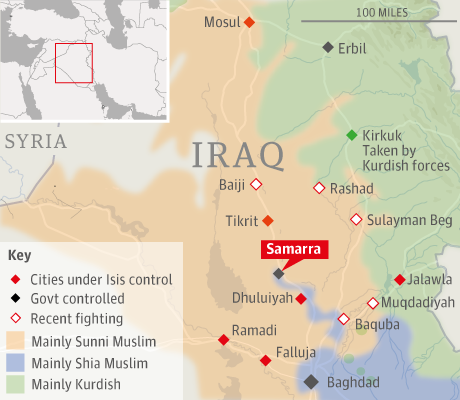
Will Samarra Be An Inflection Point?

The battle for the city is on, raising both the likelihood and the stakes of an ugly sectarian conflict as Shia militias rush to defend holy shrines that they fear ISIS’s Sunni jihadists will destroy:

iraqisissamarra3Thousands of Shia fighters have rushed to the central Iraqi city of Samarra to defend two shrines that were blown up by insurgents eight years ago, triggering the sectarian war that almost destroyed the country. Convoys of fighters were seen being escorted north by Iraqi police trucks from Baghdad early on Friday and many have now reached the city where insurgents – led by the Sunni militant group the Islamic State of Iraq in the Levant (Isis) – were in control after a lightning strike south.

The volunteer Shia fighters were quickly assembled after Iraqi forces abandoned their positions in most of the area, leaving only a small number of troops to guard the Imam al-Askari shrines. Samarra is the fourth northern city to have all but fallen out of government control. The embattled prime minister, Nouri al-Maliki, appears to have drawn battle lines further south in Taiji, hoping to defend Baghdad against insurgents who have occupied the north virtually unopposed.

How ISIS behaves in Samarra might give us a clue as to its endgame:

ISIS operations around Samarra during this phase of its northern offensive will be an important indicator of its ultimate intent and its estimate of its own capabilities. If ISIS means to continue a blitzkrieg offensive toward Baghdad it will likely need to bypass Samarra to maintain momentum and conserve forces. But Samarra is extremely significant in itself.

Al-Qaeda in Iraq’s destruction of the al-Askari Shrine in 2006 ignited the sectarian civil war that had been simmering before then. Prime Minister Nouri al-Maliki will surely feel a great deal of pressure to prevent a repetition of such an event and may well attempt to concentrate forces to prevent it. Iraqi forces, militias, and Iranian proxies have long been in Samarra precisely to protect the shrine. ISIS could therefore attack the shrine for any of several reasons. It could seek to draw the ISF into a meeting engagement in hopes of defeating arriving ISF troops piecemeal. It could intend to destroy the rebuilt shrine to inflame the sectarian war even further. It could even find irresistible the prospect of fighting the actual Iranian forces and proxies thought to be in the city. Any or all of these conditions could lead to a major battle in Samarra, or the ISIS command might instead decide to bypass the shrine and continue south.

Last night, The Guardian’s live blog ran an account from one Samarra resident who seemed pretty happy to see the ISIS militants:

Everyone in Samara is happy with the fighters’ management of the city. They have proved to be professional and competent. We have water and power; there is a shortage in fuel because Maliki’s forces have cut the bridges between Samara and Baghdad. The fighters themselves did not harm or kill anyone as they swept forward. Any man who hands over his arm is safe, whatever his background. This attitude is giving a huge comfort to people here.

Four days ago, Maliki’s military dirty force raided Al-Razaq mosque in the city, brought a few locals whom they picked up from different parts in Samara and killed them in the mosque. What do you think the people feeling would be towards these military forces? We have lived enough years of injustice, revenge and tyranny and we can’t stand any more.

A Wider Sunni-Shia War?

Unrest in Kirkuk, Iraq

It’s been the most powerful narrative in the region for quite some time – exacerbated a million times by the US invasion, and then inflamed by the Arab Spring in Syria. Simon Henderson believes that the Saudis now want Iraq to host a proxy fight against Iran:

ISIS is a ruthless killing machine, taking Sunni contempt for Shiites to its logical, and bloody, extreme. The Saudi monarch may be more careful to avoid direct religious insults than many other of his brethren, but contempt for Shiites no doubt underpinned his Wikileaked comment about “cutting off the head of the snake,” meaning the clerical regime in Tehran. (Prejudice is an equal opportunity avocation in the Middle East: Iraqi government officials have been known to ask Iraqis whether they are Sunni or Shiite before deciding how to treat them.) …

There is an additional and often confusing dimension, although one that’s historically central to Saudi policy: A willingness to support radical Sunnis abroad while containing their activities at home. Hence Riyadh’s arms-length support for Osama bin Laden when he was leading jihadists in Soviet-controlled Afghanistan, and tolerance for jihadists in Chechnya, Bosnia, and Syria.

Tom Ricks tries to make sense of Iraq’s sectarian future:

It boils down to this: The Shiites act like they are a majority in Iraq, or at least the single biggest group. The Sunnis act like they are a majority in the Arab world. Both are right. The question is: Which is more important inside Iraq?

It boils down to this: The Shiites act like they are a majority in Iraq, or at least the single biggest group. The Sunnis act like they are a majority in the Arab world. Both are right. The question is: Which is more important inside Iraq? Unfortunately, the answer likely will come from Iran, in how it supports Maliki in the coming days. I don’t think the U.S. government will conduct air strikes. I don’t even know how it would be done-the big base at Balad will be a juicy target for ISIS, so you can’t use that. So B-1s out of Diego Garcia? Still hard to do and coordinate with someone on the ground.

My guess: We wind up with a de facto partition of Iraq-a Shiite south extending up to the east bank of the Tigris in Baghdad, a Sunni north and west that begins in the western side of Baghdad, and a Kurdish northeast. The Kurds have played this especially well, hanging back and letting Maliki screw up and also cutting a peace deal with the Turks so they can focus on Iraq.

Allahpundit doesn’t think other Sunni states will join the fray:

One obvious possible response [for containing ISIS] is for Jordan, Saudi Arabia, Turkey, and maybe even Egypt to send troops to Iraq to crush [them]. The jihadis are hugely outnumbered: Combined, the Iraqi army and the Kurdish peshmerga in the country top them more than 30 to one. Add multinational Sunni troops and the ratio would skyrocket. I assume it won’t happen, though, partly because the Sunnis would rather let Iran bleed some more in handling this and partly because they may be nervous about being thin on troops at home at a moment when Islamists are running wild in Iraq.

The local Islamists might seize on the security vacuum as an opportunity for mass protests or worse, which could destabilize the country. In the eternal game of Middle Eastern jihadi whack-a-mole, there are always more moles. And even if the Sunni states managed to keep order at home, what happens once they’re done with ISIS in Iraq? Do they go home, or push on into Syria to fight ISIS there — which could eventually lead to a direct confrontation between Iran, on Assad’s side, and the multinational Sunnis on the other?

I’m not going to pretend I have the expertise to know what’s ahead. But the question to me seems merely at what level of heat the Sunni-Shia war will continue. And continue. And continue. And these fights can go on for ever, especially where order and security are imperiled. Look at how long the Catholic-Protestant fight defined Europe. People were dying over it only a few decades ago in Ireland.

(Photo: Kurdish Peshmerga forces and Iraqi special forces deploy their troops outside of the oil-rich city of Kirkuk, Iraq on June 12, 2014. By Feriq Ferec/Anadolu Agency/Getty Images.)

ISIS Against The World

Workbook5

More Iraqi towns fell to “worse-than-al-Qaeda” overnight. The above chart from Hayes Brown and Adam Peck illustrates how ISIS is really at war with everybody:

ISIS is the most committed to taking on every single other actor. Their single-minded focus on creating an Islamic state in the “Greater Syria” region — which generally is considered to include Syria, Iraq, Lebanon, and parts of Jordan — has led them to completely ignore the borders drawn between the modern states that lie on the territory. As a demonstration of their commitment to the metaphor, ISIS fighters on Tuesday symbolically bulldozed a wall between Iraq and Syria.

Meanwhile, Adam Taylor presents the new rules under which citizens of Nineveh, now effectively a province of the Islamic State of Iraq and Syria, are living. These include amputations as punishment for stealing, a ban on alcohol and cigarettes, a pledge to destroy the graves and shrines that Shia Muslims revere but which Sunni fundamentalists like ISIS view as idols, and instructions to women not to leave the house except when absolutely necessary (in Islamic dress, of course).

If history is any guide, this means ISIS will lose. No Jihadist group as extreme as this has ever managed to sustain popular support for very long. Al-Qaeda collapsed in Jordan because of this – and in Iraq, the insane puritanism of the Sunni extremists actually played a part in creating the Sunni Awakening.

Douglas Ollivant considers how this state of affairs might end:

So what could be game changers?

If the United States (or, perhaps, another Western nation) were to launch airstrikes against ISIS convoys and on support bases in western Iraq (or, for that matter, eastern Syria) it could stop the insurgency in its tracks. However, such a step appears unlikely, at least on a scale that would truly shift the chessboard.

Less dramatic, but probably of greater long-term effect, would be a breakthrough in the political stalemate in Baghdad involving at least one major faction from each of the three ethno-sectarian groups (Shiite Arabs, Sunni Arabs, and Kurds). Should this crisis cause cooler heads to decide it is better to hang together than hang separately, then this may be just the crisis that Iraqi politics needed.

A third possibility, much as we might hate to admit it, would be a resurgence in the Assad government in Syria that permits it to attack ISIS bases on their side of the Iraq-Syria border, forcing ISIS to shift forces from Iraq to defend their safe havens in Syria. The Assad government might truly enjoy the opportunity to turn their rhetoric on fighting terrorism into some sort of reality.

Peter Beamount counts the opposing forces:

Estimates put the fighting strength of Isis in Syria and Iraq at around 7,000 but its numbers in Iraq appear to have been bolstered by other groups, including local Sunni militants and Ba’ath nationalists particularly in Tikrit. Despite claims that they have captured helicopters in Mosul, it seems unlikely they would be able to deploy them. Lightly armed with Toyota pickup technicals, RPGs and small arms, Isis has captured some armoured Humvees, although there are suggestions that some equipment has been sent back to Syria. While they have been able to operate easily in largely Sunni areas where they have some support from a population angry and alienated from the Shia-led government in Baghdad, the capital is a different proposition. One district alone, Sadr City, has a Shia population of some 1 million and since the sectarian war that ended in 2008, the sprawling suburbs have been divided along sectarian lines with checkpoints and barriers.

Malaki controls roughly 250,000 forces of unknown readiness and ability. And the Kurds?

Although some 35,000 Kurdish peshmerga are incorporated into the Iraqi security forces, other peshmerga remain outside with published estimates varying from 80,000 to three times that number. Two years ago a Kurdish official suggested the peshmerga numbered 190,000. Increasingly well equipped – including with 2,000 armoured vehicles and rocket artillery systems – they are regarded as motivated, well trained and experienced.

“The Syrian war,” Totten declares, “is no longer the Syrian war. It’s a regional war”:

It spilled into Lebanon at a low level some time ago. It sucked in Iran and Hezbollah some time ago. Now it is spreading with full force at blitzkrieg speed into Iraq and has even drawn in the Kurdistan Regional Government which managed to sit out the entire Iraq war. This could easily suck in Turkey, Jordan, and Israel before it’s over. Or maybe it won’t.

In the future we might see the events of the last few days as the beginning of the end of Iraq as a state, or at least the beginning of the end of Prime Minister Nouri al-Maliki, whose American-trained army has proven utterly useless. Or maybe he’ll survive in an Iranian-backed rump state. Maliki wants an American-backed rump state. … But we are not going to save Iraq and we are not going to save Syria. It’s over. That’s what the Middle East wanted, and it’s what the Middle East is going to get.

And Aryn Baker notes: “It’s not looking good for the 49 Turkish citizens taken from the country’s consulate in Mosul, or the 31 Turkish truck drivers who were also kidnapped.” But the biggest wild card remains Iran. Thomas Erdbrink (NYT) doesn’t confirm reports that the Revolutionary Guard is already fighting in Iraq, but he relays some Iranian officials’ thoughts on the situation:

Should the Islamic State of Iraq and Syria manage to consolidate its power in northern Iraq, Iran would be confronted with the fresh headache of propping up yet another weak ally, along with Syria. But there is a huge emotional difference between Iraq — the site of the defining battles of the Shiite faith and where the holiest of Shiite saints are buried — and the Syria of President Bashar al-Assad, more an ally of convenience, with only the shrine of Zeinab. “I propose we help Iraq by repeating our good experience,” said Hossein Sheikholislami, an aide to the speaker of Parliament, Ali Larijani, and an important figure in Syrian affairs. “Of course, if they ask officially for our help we can send experts to train the trainers, just as we did in Syria.”

Other analysts dismiss both the militants and the costs of intervening in Iraq. “This group is not as big and powerful as they seem,” said Mashallah Shamsolvazein, a reformist journalist and analyst of Arab affairs. “If needed, we can enter Iraq and wipe out ISIS easily, but that won’t be necessary.”

If this does become a second Iran/Iraq war, as he fears, Juan Cole remarks on how dramatically the US position has changed since the first one:

In the looming second Iran-Iraq War, the US will be de facto allied with Iran against the would-be al-Qaeda affiliate (ISIS was rejected by core al-Qaeda for viciously attacking other militant vigilante Sunni fundamentalists in turf wars in Syria). The position of the US is therefore 180 degrees away from what it was under Reagan. In fact, since ISIS is allegedly bankrolled by private Salafi businessmen in Kuwait and elsewhere in the Oil Gulf, the US is on the opposite side of all its former allies of the 1980s. In some ways, some of the alleged stagnation of US policy in the Middle East may derive from a de facto US switch to the Iranian side on most issues, at the same time that US rhetoric supports Iran’s enemies in Syria and elsewhere in the region.

It is possible that a US-Iran alliance against al-Qaeda-like groups in Iraq and Syria could clarify their budding new relationship and lead to a tectonic shift in US policy in the Middle East. One things seems clear. Without Iran, the US is unlikely to be able to roll by al-Qaeda affiliates and would-be affiliates in the Fertile Crescent, who ultimately could pose a danger to US interests.

Paul Iddon remembers the last time American and Iranian interests coincided:

Iran-U.S cooperation post-1979 isn’t at all unprecedented. In November 2001 the Iranian Qods Force then commanded by Pasdaran commander Yahya Rahim Safavi cooperated with United States Special Operations forces in the liberation from Taliban rule of the city of Herat in Afghanistan. …

Common interests between Tehran and Washington in the immediate post-9/11 period briefly trumped long-held animosities as mutual cooperation was feasible and desirable. Iran was then under the more reformist-oriented Khatami. Its president today is one who was elected on the grounds of his advocacy of more productive relations between his regime and the United States. One could argue the finer points of what such a cooperation between U.S. and Iran in Iraq now could entail but for once one thing is sure in that region, that an ISIL victory today in Iraq is detrimental to the majority of Iraqi’s, the majority of Iranians and the United States.

(Map via The Guardian)