FIFA Sucks

John Oliver explains why:

Bershidsky longs for FIFA to kick out Sepp Blatter, who he claims “has run soccer’s governing body like an old-school dictatorship” since 1998:

Blatter has been no visionary in sports terms. His tenure has yielded a few minor rule changes, notably one that penalizes players for pulling off their T-shirts after scoring a goal. Some changes were quickly reversed. In 2007, for example, FIFA banned games at stadiums more than 8,200 feet above sea level. It then raised the limit to 9,840 feet and was forced to grant an exception to Bolivia’s main stadium. By contrast, Blatter’s predecessor, Joao Havelange, boosted FIFA’s membership from 142 to 204 federations, and recast the rules in ways that made the game more dynamic and enjoyable to watch — and less rough.

Blatter has also done little to combat the corruption that flourished under Havelange, who was proved to have taken bribes and forced out as FIFA’s honorary president last year.

The Economist identifies deeper problems with the organization:

It would be good to get rid of Mr Blatter, but that would not solve FIFA’s structural problem. Though legally incorporated as a Swiss non-profit organisation, FIFA has no master. Those who might hold it to account, such as national or regional football organisations, depend on its cash. High barriers to entry make it unlikely that a rival will emerge, so FIFA has a natural monopoly over international football. An entity like this should be regulated, but FIFA answers to no government.

All the same, more could be done. The Swiss should demand a clean-up or withdraw FIFA’s favourable tax status. Sponsors should also weigh in on graft and on the need to push forward with new technology: an immediate video review of every penalty and goal awarded would be a start.

Catherine Addington feels the “fundamental problem is that FIFA is self-regulating, which is to say that it doesn’t self-regulate”:

The only things to keep it in check are vaguely uncomfortable sponsors and only nominally responsible participating governments. (Fans for their part have no other organization to turn to. FIFA has a monopoly on international soccer.) Even FIFA’s upcoming Congress, in which each country has an equal vote, is unlikely to make waves. With few checks and balances in sight, FIFA is under no obligation to be transparent about either its policies or its finances.

FIFA has done the impossible: they have made Brazilians hate soccer. But as Brazilians’ anti-government protests over the past few years have shown, this is about much more than soccer. That’s why this World Cup, and the inevitable spilling over of these anti-cronyism tensions, are crucial to watch, even for those uninterested in soccer. FIFA is running an experiment to find out just how many platitudes people will put up with from the crony capitalists running a global entertainment industry.

Ta-Ta To Teacher Tenure? Ctd

Noah Feldman eviscerates the Vergara ruling:

So how did California’s teacher tenure laws violate the state constitution? The court’s two-part reasoning was thin to the point of being emaciated. First, it observed that the state constitution guarantees a right to education and guarantees equal protection of the laws. Second, it “found” that teacher tenure laws can tenure ineffective teachers – which it said was a violation of California children’s right to education.

The logic of this holding is pretty obviously flawed. All sorts of policies and rules affect the quality of what goes on in the classroom. Do all policies that reduce the quality of education violate the state constitution? Obviously not – or the court would have to take over the state school system and review every lesson plan for effectiveness. There was also no precedent supporting this expansive reading of the state constitution.

Eric Posner remains unimpressed by Judge Treu’s reasoning:

One of the reasons that employers – and not just public schools, but regular commercial firms, as well as universities and many private schools – offer job security is that employees value it so much. They’re willing to accept a lower salary in return for job security. The employer faces a tradeoff: it loses some ability to control employees, but it saves a lot of money, which it can use for other things. And so with the schools. If California is no longer allowed to offer job security, it will either need to pay teachers more (leaving less money to spend on students) or hire fewer teachers. Is that going to advance education? The court has no idea, indeed doesn’t seem to have given any thought to these issues.

The long and the short of it is that a judge is in no position to make these tradeoffs.

Kevin Carey – generally a supporter of education reform – argues that the courts are “an inherently problematic venue in which to resolve fundamental education questions”:

Deciding whether schools are providing children with a good enough learning environment requires us to decide what we want our children to learn and what kind of citizens we want them to be. That, in turn, flows from our convictions and values about the nature of just and civilized society. Such questions can never be resolved with legal finality. They represent the unending project of debate in an open society, the balancing of sometimes irreconcilable priorities that we manage with democratic and inherently political institutions. Which means that we should expect more Vergaras in the future – and expect to never be fully satisfied with the result.

Jill Barshay notes that the research underlying the ruling is controversial:

Many researchers are questioning whether test-score gains are a good measure of teacher effectiveness. Part of the problem are the standardized tests themselves. In some cases, there are ceiling effects where bright students are already scoring near the top and can’t show huge gains year after year. In other cases, struggling students may be learning two years of math in one year, say catching up from a second-grade to a fourth-grade math level. But the fifth-grade test questions can’t capture the gains of kids who are behind. The test instead concludes that the kids have learned nothing. In both of these cases, with top and bottom students, the teachers would be labeled as ineffective. Morgan Polikoff of the University of Southern California and Andrew Porter of the University of Pennsylvania looked at these value-added measures in six districts around the nation and found that there was weak to zero relationship between these new numbers and the content or quality of the teacher’s instruction. Their research was published in May 2014, after the Vegara trial ended.

Freddie sighs:

Teacher attrition is sky-high, with best estimates of between 40 to 50 percent leaving the profession within five years of starting. That amounts to something like a thousand teachers quitting for every school day of a given year. Anecdotally speaking, most successful, Ivy League striver-types do not consider teaching as a serious option. But why would they, when there’s so many more remunerative, less stressful, less emotionally grueling, and better respected options out there? If your argument is that a profession’s problems stems from a talent deficit, you should be doing everything to make the job more attractive, not less.

But Ed Morrissey suggests the ruling could be a mark a turning point:

Treu’s ruling does not rely on the US Constitution, and it has yet to be endorsed by a state appellate court as of yet. It is a signal, though, that people are fed up feeding tens of billions of dollars into educational systems that produce poor results, and that disgust over the priorities of the people within the system has reached a level where even the judiciary can no longer ignore it. California’s legislature had better take this lesson and apply it regardless of whether the ruling holds up on appeal.

And Eric Hanushek sees nothing but positives:

A small percentage of teachers inflicts disproportionate harm on children. Each year a grossly ineffective teacher continues in the classroom reduces the future earnings of the class by thousands of dollars by dramatically lowering the college chances and employment opportunities of students. There is also a national impact. The future economic well being of the United States is entirely dependent on the skills of our population. Replacing the poorest performing 5 to 8 percent of teachers with an average teacher would, by my calculations, yield improved productivity and growth that amounts to trillions of dollars.

The Grilling Of Hillary Clinton On Marriage Equality

A tip of the hat to Terri Gross who simply and persistently tried to get out of Clinton why she supported the Defense Of Marriage Act in 1996, and why and when she changed her mind on marriage equality. Listen to the full exchange here:

Clinton says she didn’t support gay marriage in the 1990s but subsequently changed her mind. When and why she changed her mind is what Gross was trying to get at. Had she changed it by the time she and her husband left the White House? Or when George W Bush endorsed the Federal Marriage Amendment in 2004? Was she still opposed to marriage equality when Massachusetts became the first state to enact it legislatively in the same year? The answers to these questions remain mysterious.

But one thing isn’t mysterious: she was not just another evolving American. She was the second most powerful person in an administration in a critical era for gay rights. And in that era, her husband signed the HIV travel ban into law (it remained on the books for 22 years thereafter), making it the only medical condition ever legislated as a bar to even a tourist entering the US. Clinton also left gay service-members in the lurch, doubling the rate of their discharges from the military, and signed DOMA, the high watermark of anti-gay legislation in American history. Where and when it counted, the Clintons gave critical credibility to the religious right’s jihad against us. And on the day we testified against DOMA in 1996, their Justice Department argued that there were no constitutional problems with DOMA at all (the Supreme Court eventually disagreed).

What I’d like to hear her answer is whether she regrets that period and whether she will ever take responsibility for it. But she got pissed when merely asked how calculated her position on this was.

Here’s my guess:

Unlike Obama, she was personally deeply uncomfortable with this for a long time and politically believed the issue was a Republican wedge issue to torment the Clintons rather than a core civil rights cause. I was editor of TNR for five years of the Clintons, aggressively writing and publishing articles in favor of marriage equality and military service, and saw the Clintons’ irritation with and hostility to gay activists up close. Under my editorship, we were a very early 1991 backer of Clinton – so I sure didn’t start out prejudiced against them. They taught me that skepticism all by themselves, and mainly by lying all the time.

So when did she evolve? Maybe in the middle 2000s. Was political calculation as big an influence as genuine personal wrestling? She’s a Clinton. They poll-tested where to go on vacation. Of course it was. But she’s also a human being and probably came around personally as well. She’s not a robot, after all. But I think of her position as the same as the eponymous gay rights organization the Clintons controlled in the 1990s, the Human Rights Campaign. As long as marriage equality hurt the Democrats, they were against it. Now it may even hurt Republicans, they’re for it. So Hillary is for it now. We’ve just got to hope the polling stays strong.

Iran Is Already Fighting In Iraq

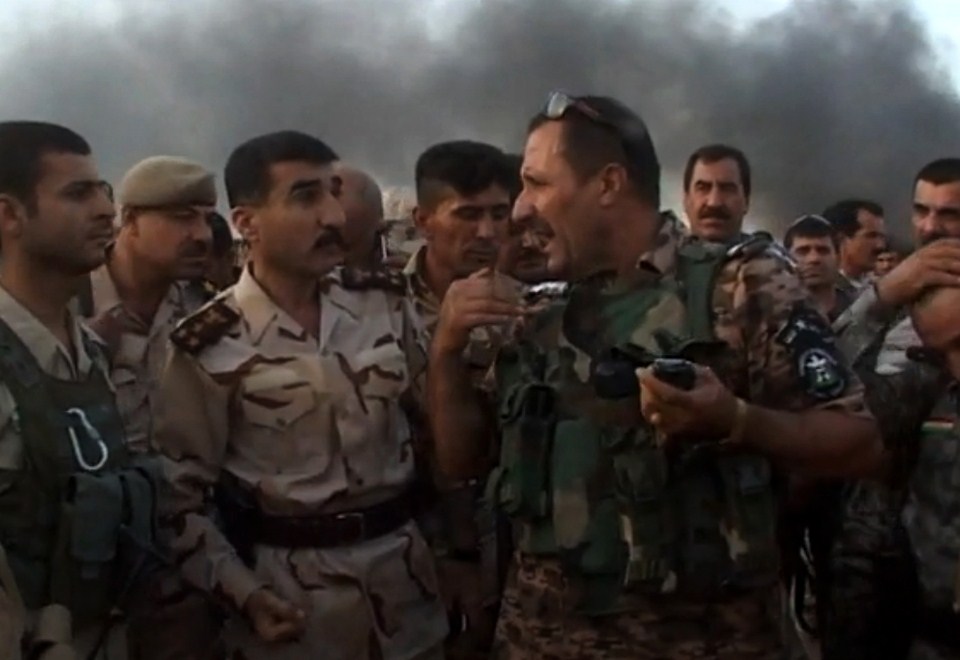
Farnaz Fassihi reports:

Two battalions of the Quds Forces, the overseas branch of Iran’s Revolutionary Guard Corps that has long operated in Iraq, came to the aid of the besieged, Shiite-dominated government of Prime Minister Nouri al-Maliki[.] Combined Iraqi-Iranian forces retook control of 85% of Tikrit, the birthplace of former dictator Saddam Hussein, according to Iraqi and Iranian security sources.

They were helping guard the capital Baghdad and the two Shiite holy cities of Najaf and Karbala, which have been threatened by the Islamic State of Iraq and al-Sham, an al Qaeda offshoot. The Sunni militant group’s lightning offensive has thrown Iraq into its worse turmoil since the sectarian fighting that followed the 2003 U.S.-led invasion. Shiite Iran has also positioned troops along its border with Iraq and promised to bomb rebel forces if they come within 100 kilometers, or 62 miles, of Iran’s border, according to an Iranian army general. In addition, Iran was considering the transfer to Iraq of Iranian troops fighting for the regime in Syria if the initial deployments fail to turn the tide of battle in favor of Mr. Maliki’s government.

Beauchamp adds:

The Quds Force is one of the most effective military forces in the Middle East, a far cry from the undisciplined and disorganized Iraqi forces that fled from a much smaller ISIS force in Mosul. One former CIA officer called Quds Force commander Qassem Suleimani “the single most powerful operative in the Middle East today.”

But the escalation from a country many Iraqis still remember fighting a war against could get out of hand, and fast:

Shia Iran’s intervention could infuriate the Sunni Muslims whose allegiance ISIS needs to win in the long run.  The internal Iraqi conflict is firmly sectarian: ISIS is a Sunni Islamist group, and the Iraqi government is Shia-run (a majority of Iraqis are Shia). … The perception that the Iraqi government is far too close to Iran is already a significant grievance among Sunnis. That’s part pure sectarianism and part nationalism.

Hayder al-Khoei observes that Iraq’s Shia don’t really have a choice but to accept the help:

[T]here is an ideological difference between the Shia of Iraq and the Shia of Iran. The religious establishment in Iraq and Iran don’t see eye to eye when it comes to the role of the clergy in the state. But in the south there is a sense—it’s not as desperate as in Baghdad—but the Shia in general now recognize the important [role] that the Iranian Revolutionary Guard are going to play in making sure that their cities do not fall to ISIS. They may not like the Iranians, they may be ideologically opposed to the Iranians, but in terms of threat perception, it’s a matter of survival.

ISIS was definitely picking the fight:

The al Qaeda affiliated ISIS considers Shias heretics who deserve to be killed, and is taking forth its campaign to liberate Iraq from what it sees as Shia domination; the group has said it will destroy Shia shrines along the way, stoking fears in Tehran of an attack on Shia Islam’s holiest sites, Najaf and Karbala.

Social media sites have quoted Suleimani saying if ISIS destroys the holy shrines, it will face Iran’s ire. Asked what the manifestation of that rage will be, the former Iranian diplomat laughed nervously. “They [ISIS] know that we’re not kidding around, so we shouldn’t worry about them doing anything stupid. And if they’re foolish enough to even approach the shrines, they have to be prepared for anything.” The diplomat paused. “Battles, attacks, raids, massacre. All the options will be on the table.”

Ali Hashem notes that Iranian involvement might be as much about Syria as it is about Iraq:

What seems clear is that Iran wants to invest in the Iraqi crisis to help end the Syrian war. It hopes to do so by bringing together states fighting each other via proxy in Syria in a unified front in Iraq, given the international consensus on backing the Iraqi fight against ISIS.

Don’t Under-Estimate The Power Of Right-Wing Populism, Ctd

I’m a little chagrined to find myself in agreement with Obama-foe Ron Fournier on the subject of our populist moment, but his report on talking to regular folks in Pennsylvania last Tuesday has some great insights. Money quote:

Americans see a grim future for themselves, their children, and their country. They believe their political leaders are selfish, greedy, and short-sighted—unable and/or unwilling to shield most people from wrenching economic and social change. For many, the Republican Party is becoming too extreme, while the Democratic Party—specifically, President Obama—raised and dashed their hopes for true reform. Worse of all, the typical American doesn’t know how to channel his or her anger. Heaven help Washington if they do.

What are the main themes of this discontent? Anger at Wall Street; anger at a rigged capitalist system; anger at K Street and the permanent Washington class; anger at gridlock and Obama’s inability to break out of it; anger at depressed living standards and soaring inequality. Some choice quotes that cannot be summarized in a poll:

“America is for the greedy, for those who’ve made their buck or grabbed their power. It’s not for us.” … “The rich get richer. The poor get benefits. The middle class pays for it all.” … “Do I think there might be some group or some person who might tap into our frustration and, unlike the president, actually change things? Yes. Yes, I do.”

Fournier comes up with a rough list of core populist demands. The first of which is something the foreign policy mavens in DC should hear and hear well:

A pullback from the rest of the world, with more of an inward focus.

A desire to go after big banks and other large financial institutions.

Elimination of corporate welfare.

Reducing special deals for the rich.

Pushing back on the violation of the public’s privacy by the government and big business.

Reducing the size of government.

Rand Paul fits the mold. Hillary Clinton? In my view, she has a few months to prove she can actually run a populist campaign, which means a stump speech worthy of a rabble-rouser, and not the usual pabulum of a careful and calculated pol. I’ve never heard her give such a speech or exhibit the kind of retail political skills her husband is a master of. But she deserves a chance to prove she is the person for this moment. If she can’t hack this, she should get out of the way for someone who can.

Your Summer Abortion Rom-Com

In a glowing review of Obvious Child, Teo Bugbee compares the film’s frank approach to abortion with Hollywood’s enduring skittishness about the subject, calling it “the movie that Hollywood should have been making 40 years ago”:

Obvious Child is not “the abortion movie” that its own marketing and reception might lead you to anticipate. [Writer-director Gillian] Robespierre and star Jenny Slate have made a movie about a woman, not an abortion. There are no impassioned speeches about women’s rights, no bad guys protesting outside the clinic, and no after-the-fact breakdowns. Donna’s life does not revolve around her choice, and neither does the movie. It is at every turn more relaxed, more confident, and more rewarding than what we as an audience have been conditioned to expect from this kind of movie—the kind with a capital-I “Issue” at its heart. Maybe the most political thing about Obvious Child is that it makes abortion feel as if it isn’t an issue at all. …

Hollywood likes to think of itself as a liberal stronghold, pushing America forward one very important Oscar picture at a time. But for the last thirty years Hollywood has remained conspicuously silent as women’s rights have been rolled back bill by bill, Supreme Court ruling by Supreme Court ruling. The last major release to feature an abortion was Tyler Perry’s For Colored Girls in 2010—since that film’s release, over 3 million legal abortions have been performed in the United States alone.

Discussing the film with Robespierre, Sarah Erdreich also highlights the film’s honest approach:

Obvious Child is also refreshing in that — unlike other films or television shows that depict abortion — it goes into detail about how much an abortion, even a first-trimester one like Donna’s, will cost. And according to Robespierre, including that information was deliberate. “We wanted to show an honest portrayal of what it’s like in a health center. And the cost was really important, because it was a real moment for Donna’s character to feel something … about where she was at that moment, feeling kind of alone and lost and scared. Donna is complex and she’s trying to figure out so many things all at once. The financial part of the decision is what sort of hit her full on.”

Esther Breger admires the way it avoids being an “issue movie” and instead offers a fresh spin on romantic comedy:

The story isn’t one we’ve seen onscreen before, but it’s fitted into the structure of a surprisingly conventional rom-com, from initial meet-cute to final romantic gesture. The traditional romantic comedy is dead, you may have heard, killed by the international market and Katherine Heigl andmost of allthe changing nature of modern romance. …

But if the rituals of courtship have become more stable, they’ve grown even more bewildering, as anyone who has read The Love Affairs of Nathaniel P. can attest. (That novel begins with an awkward encounter with a former flame who Nathaniel ignored after accompanying to Planned Parenthood.) Obvious Child is covering the same territory, mining the ambiguities of modern dating for plausible obstacles to love. What’s the etiquette when you’re on a second date with the guy whose abortion you’re getting? (What’s the grammatically correct way to even construct that sentence?) What are the expectations for him? This isn’t exactly the stuff of You’ve Got Mail, even if it, amazingly, shares that movie’s sweet spirit. There’s a frankness here that put Knocked Up‘s gross-out humor to shame.

About That 88.7% …

Andrew Gelman passes along a good catch from Anatoly Vorobey, who shows that Syria’s election results were fraudulent:

They are too accurate. There’s 11,634,412 valid ballots, and Assad won with 10,319,723 votes at 88.7%. That’s not 88.7%, that’s 88.699996%. Or in other words, that’s 88.7% of 11,634,412, which is 10,319,723.444, rounded to a whole person. All the other percentages in the results are the same way, so given the magnitude of the numbers, it’s evident someone took the total number, used a calculator and rounded. This was first noticed, to my knowledge, by a Russian blogger Roman Tumaykin. The reason he looked at the vote counts in the first place was that a few weeks ago there was an identical case with a sham referendum in a Ukrainian province of Lugansk, controlled by separatists. The vote counts there were also all “correct” up to a rounding to a person.

No, We Don’t Need To Go Back Into Iraq

Dexter Filkins assigns three reasons for the continuing disintegration of a country destroyed by the US invasion and occupation. The first two are the sectarian implosion in Syria and the sectarian authoritarianism of Nouri al-Maliki. But he then blames the Obama administration for not fighting harder to keep a minimal force in Iraq over Maliki’s and the American people’s wishes as the occupation came to a merciful close in 2011. IRAQ-UNRESTSomehow, that residual force would have restrained Maliki in his Shiite excesses, as the US did from 2006 onward, in the middle of a swirling civil war. The old guard in Washington will jump at this conclusion – with the neocon right and neocon left (what else do we call the liberals who never see a conflict in which the US should not be involved for the betterment of humankind?) rallying behind a new interventionism or, worse, a Captain Hindsight desire to pummel Obama again, while offering no real alternative.

It’s always a tempting idea that if we had stayed a little longer, all would have been well. It’s worth recalling the neocon desire to stay in Iraq for decades if necessary, in order to somehow forcibly impose a democratic structure on a sectarian, authoritarian and pathological non-state. But this is based on the fundamental illusion that the surge achieved anything of substance in altering sectarian divisions or Islamist extremism and thereby we ever had a success to sustain. We didn’t. We were able to temporarily pacify – by bribes and military maneuvering – a civil war that had always simmered below the Iraqi surface and had flared brutally even as we had 100,000 troops in the country. The idea that a few hundred could have prevented Iraq’s return to its historic sectarian entropy strikes me as absurd. It is not crazy for a Maliki ally to air this idea to Filkins in order to exonerate Maliki in the ensuing blood bath. What’s crazy is to take it at face value.

Yes, we broke Iraq in 2003. But another eight years of occupation, and billions in expense, fulfilled what obligation we had to the place. Does its disintegration mean more peril for the US?

We cannot know. But right now, it is a classic battleground for the ancient Shia-Sunni religious war still raging in the Middle East – with Iran and Saudi Arabia deep in the conflict. We have and must have no dog in that fight. And if we were to intervene again, we would only increase the likelihood of our being a target for some of the extremists now thriving there – on both sides. Mercifully, they hate each other more than they hate us – unless we give them yet another reason to turn their attention to the West.

The interventionists, remember, wanted us backing the Sunnis in Syria and now want us to back the Shia and Kurds in Iraq to prevent a newly fanatical Sunni insurgency. It makes you dizzy after a while. After a while, we’d just be taking turns backing one side or another, all the while painting a giant target on our own back.  But the hegemonic impulse to take every problem in the world as our own remains strong – especially among elites who love the idea of throwing their weight around in a world they have demonstrated they do not understand and cannot control.

I fear that the sane, smart decision to tell Maliki that we are not coming over the horizon to save him may not hold against the interventionists within the administration or against the Washington elite’s desire to keep running the world as they used to. If Obama succumbs, as he did in the disastrous Libya intervention, then much that he has achieved in de-leveraging the US from its neo-imperial burden would be at risk.

This is their religious war, and not ours. Neither an American soldier nor an American cent should be spent to alter its trajectory.