Our Cold Civil War Intensifies, Ctd

In 2007, I gamely hoped that Obama’s liberal pragmatism could somehow overcome the deep cultural and political split in the country that had opened up in the Vietnam era and had defined the entire boomer generation. I remain of the view that Obama’s policies have remained moderate – on healthcare, immigration, the deficit, and foreign policy. But the cultural churn of polarization has only intensified in the country at large. In fact, the polarization seems to have intensified in the Obama years, rather than moderating, as a fascinating Pew survey 856551367of 10,000 subjects reveals. The GIF at the right can mesmerize after a while, but watch it a few times.
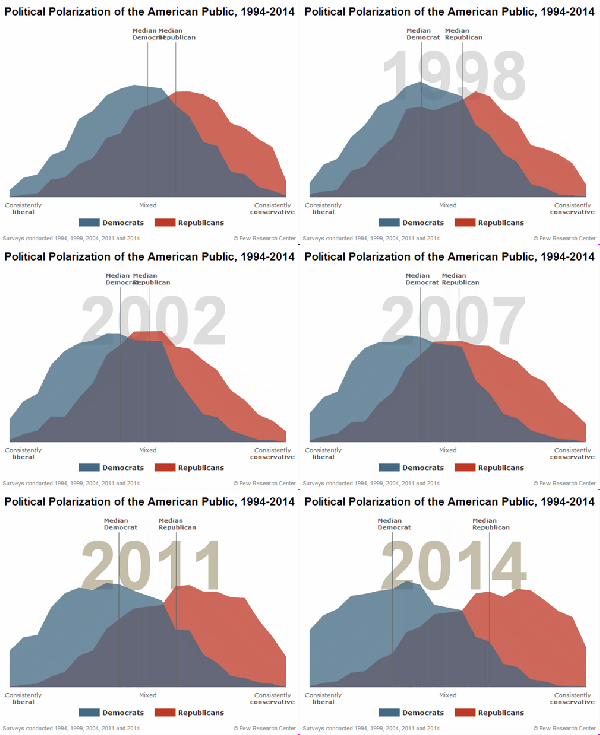
The late 1990s sees a shift by both parties to the relative left, and in the early Bush years, there’s a shift by the GOP to the left as well. Since this is a measure of consistently liberal or conservative positions, it may be scrambled by the response to 9/11. The only three years in which the parties showed signs of moving toward each other were 2000 – 2003. From 2004 on, the GOP moves relentlessly rightward, while the Democrats move to the left more firmly from 2010 onward. Yes the two seem to reinforce each other in their mutual alienation.

But what’s truly depressing is how ideology now trumps virtually everything else in American politics. Geography matters less and less in sustaining mixed and moderate electoral districts; gerrymandering has intensified the process; but deeper cultural shifts help explain a lot of the rest. The urban/rural divide is a chasm; as is the racial one. And ideology seeps deep into everyday life. So inter-marriage between the Union and the Confederacy the consistent Democrats and the consistent Republicans is becoming rarer:

Three-out-of-ten (30%) consistent conservatives say they would be unhappy if an immediate family member married a Democrat and about a quarter (23%) of across-the-board liberals say the same about the prospect of a Republican in-law.

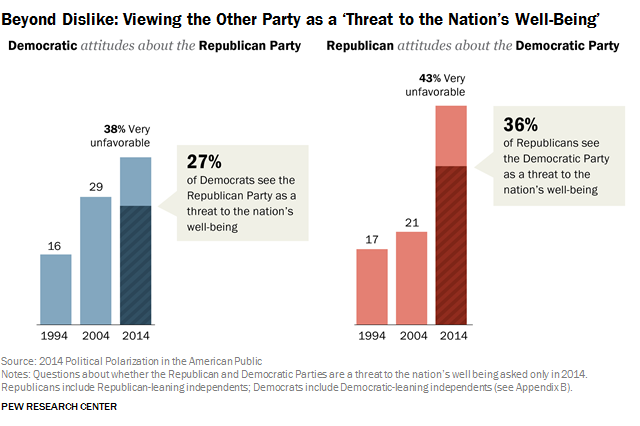
The reason that I don’t think a cold civil war is too hyperbolic is the following chart. It doesn’t just show increased differences between the two parties; it reveals profound and growing antipathy, with each of the respective partisans believing the other is a threat to the country as a whole:
PP-2014-06-12-polarization-0-02

The GOP is more hostile to the Dems today than in the Gingrich revolution year of 1994. What that tells me is that polarization and radicalism can simply create their own mutually reinforcing vortexes of intensity. There’s one kinda bright side to this picture of two nations somehow entangled with one another. And that’s that there is a middle of the country that is not so extreme:

The majority do not have uniformly conservative or liberal views. Most do not see either party as a threat to the nation. And more believe their representatives in government should meet halfway to resolve contentious disputes rather than hold out for more of what they want.

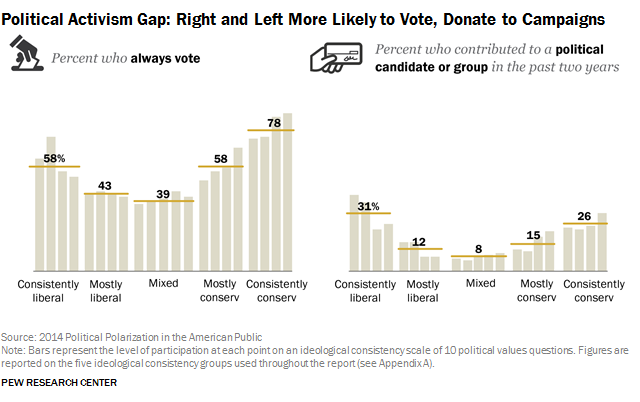
The trouble is: this group is the least likely to vote or participate in the political process:
PP-2014-06-12-polarization-0-03

Christopher Ingraham puts it succinctly:

Because of their sheer numbers this group of mixed-preference voters could – should! – be the core of a centrist coalition. But because of their disengagement, their influence on the political process is diminished relative to the more partisan voices in the mix. This tells me that polarization may be driven as much by apathy at the middle of the political spectrum as it is by energy at the more raucous ideological ends. Instead of a silent majority we have a silent plurality – and as Washington goes to war with itself, it’s not paying attention.

And you wonder why cable news is now so shrill. It’s not just the fault of Roger Ailes. It’s also us.
The Kurds Dig In

Unrest in Mosul

Today in Kirkuk, the Iraqi army fled and Kurdish forces took their place to try and hold the city against the ISIS onslaught. The fall of Mosul might actually end up benefiting the Kurds:

Ironically, ISIL’s takeover of Mosul may now present a “golden opportunity” to advance long term Kurdish objectives, according to some Iraqi Kurdish politicians. With Baghdad’s request for military backup in a campaign the Iraqi army alone is almost sure to lose, Erbil now has the green light to send its troops into disputed territories and stake its claim. …

Unsurprisingly, the fall of Mosul has raised alarms in Ankara; the Turkish press is rife with fears that the involvement of Peshmerga troops would embolden Kurds to further their secessionist ambitions, or worse yet, that the PKK may be invited to join the fight as a counterweight to ISIL.

Juan Cole expects Shiite militias to soon come into play as well:

Grand Ayatollah Ali Sistani and his colleagues in Najaf, the seat of Shiite religious authority, issued a statement roundly condemning the Iraqi political class for its divisions and wrangling and calling on them to unite to protect Iraqi citizens from the terrorist groups that had taken over Ninevah Province (i.e. Mosul and environs). Sistani also expressed condolences for the Iraqi troops killed by ISIS fighters and pledged the religious authority’s support to the Iraqi army in this struggle. It is more or less a declaration of Shiite jihad on ISIS.

In a penetrating analysis of the situation, Mushreq Abbas explains why the Iraqi forces in Mosul collapsed:

The best explanation of the collapse of the Iraqi military — which spilled over on the same day to the cities of Siniya and Beiji in Salahuddin province, as well as Hawija, Sulaiman Bek and Rashad in Kirkuk — is a fundamental flaw in planning, leadership and training. These have been defects in the Iraqi security forces over the past few years, despite their receiving sophisticated equipment and weapons.

Throughout the years, Baghdad has failed to produce a professional army or provide efficient training programs, hence the clear hostility between the population in Sunni areas in general and the army, whose members mostly hail from Shiite areas in central and southern Iraq. This failure is definitely linked to the inability to represent all demographics within the military, something the Sunnis have complained about for years. Meanwhile, the pressures to which the army and police forces were subject in the months that followed the outbreak of fighting in Anbar since late 2013 have in turn affected the efficiency of the security establishment.

Fred Kaplan is more succinct, blaming Maliki’s divisive approach to governance:

One problem always was, and still is, that Maliki had no interest in conciliatory politics on a national level. And that’s why he’s now facing a monumental, even terrifying armed insurgency. His troops in Nineveh province simply folded when they came under attack, not because they weren’t equipped or trained to fight back but because, in many cases, they felt no allegiance to Maliki’s government; they had no desire to risk their lives for the sake of its survival.

Omar al-Jaffal solicits the perspective of one of the soldiers who fled, which illustrates the confused and leaderless state of affairs:

At 3 a.m. on June 10, Twitter users affiliated with the Islamic State of Iraq and al-Sham (ISIS) began tweeting that ISIS had control of security centers in Ninevah. An officer from the army’s 2nd division in Ninevah province, who spoke to Al-Monitor by phone on condition of anonymity, said, “It was during these hours exactly that the army was without leadership.”

“We received messages stating that parts [of the city], that were under our control, had fallen. But we were without leaders and had no orders to act,” the officer said. “The soldiers were perplexed,” he noted, adding, “We put the options in front of them and said: ‘Whoever wants to fight, fight; whoever wants to flee, flee.'” He continued, “At 4 a.m., another officer and I decided to change out of our military uniforms. We took a civilian car and headed to the Kurdistan Region [of Iraq].” Speaking from Erbil, the officer said, “No one understands exactly what happened.”

Wladimir van Wilgenburg talks to Mosulites who claim that ISIS was welcomed there:

“The Iraqi army oppressed the people, they stole their money,” said Ali Ahmed, a driver, who was shot while fleeing Mosul. According to Ahmed, the local population in Mosul welcomed ISIS. “The people in Mosul do not like Daash [an acronym for ISIS’s Arabic name: Dawlat Islamiyya fi al-Iraq wa al-Sham], or Maliki, but they now feel better under Daash, and water and electricity returned.”

Ahmed al-Ghadra, 74, a former resident of Mosul, told Al-Monitor the army mistreated him. “The Arab Iraqi people want Maliki to go to prison. He is a traitor. Fourteen Daash members come, and the whole Iraqi army flees. The people of Mosul do not want the Iraqi army in Mosul. I’m an old man, and they stopped me for one hour at a checkpoint, using bad language.”

More witnesses confirm that ISIS treated the civilian population well, and told them that they would only punish those who work with Maliki.

But Human Rights Watch warns that civilians face threats from both sides:

“I don’t feel safe at all,” the Mosul resident told Human Rights Watch. “I fear ISIS, they might kill me for any reason: because I worked as a government employee … if they noticed that I don’t go to the mosque and pray as they want everyone to, [or] if my beard wasn’t long enough.” He did not know whether ISIS had killed any civilians or soldiers since it took over the western part of the city. Another Mosul resident told Human Rights Watch that as of June 10, he had heard that ISIS had killed “only five or six people” who stole police cars to sell them later or sell them as parts, and killed an army colonel named Rayan, who was a former SWAT officer based in Mosul.

Two other Mosul residents told Human Rights Watch they feared the government’s response. Between June 6 and June 8, according to Mosul residents and local media reports, the government carried out what appeared to have been a series of indiscriminate attacks.

Previous Dish on the Iraq crisis herehere, here, and here.

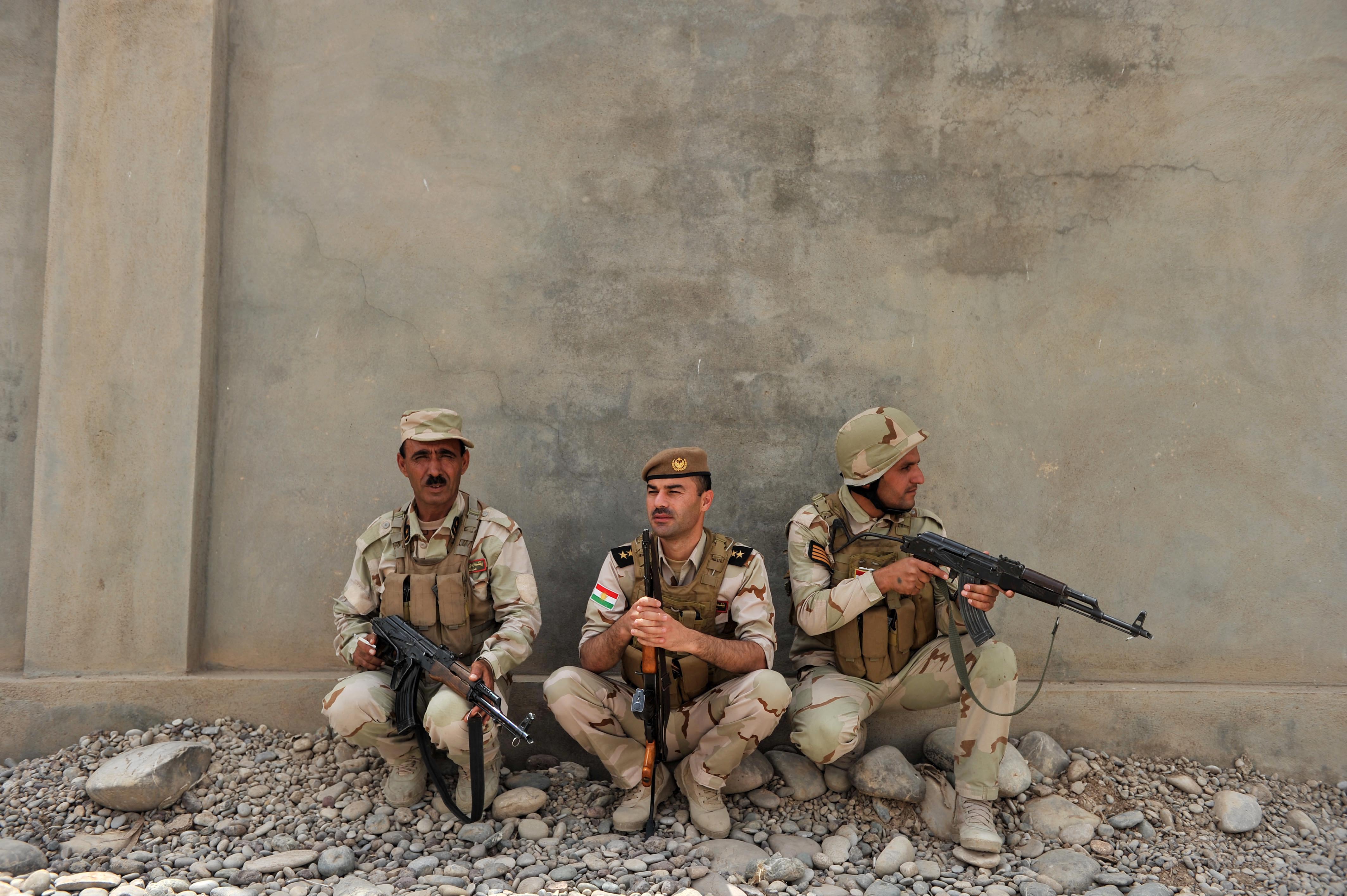
(Photo: Peshmargas of Iraq Kurdistan Regional Government patrol on the region to prevent infiltration of Islamic State in Iraq and the Levant militants who seized Mosul, in Iraq on June 12, 2014. By Onur Coban/Anadolu Agency/Getty Images.)

Our Cold Civil War Intensifies, Ctd

So marriage equality is now either legal or bans on it have been found unconstitutional in 27 states. Has the GOP adjusted? Yes – by lurching even further to the anti-gay position. Rick Perry went to San Francisco yesterday to compare homosexual orientation to alcoholism, and to recommend reparative therapy for gays, even after the ex-gay movement has effectively collapsed. And a budding young Tea Party Republican in Oklahoma is ambivalent about whether gays should be stoned to death or not. The Southern Baptist Convention is also doubling down on reparative therapy for transgender people and for gays, if Al Mohler’s response to Matt Vines is any indicator.

There seems to be no middle ground here. And in this case, this has meant that marriage equality is winning. I wonder if the Republicans have yet grappled with that fact – and worry about its broader ramifications. They could have championed civil unions a long time ago and defused the issue; but they couldn’t for fundamentalist religious reasons – so we now have the prospect of full marriage rights for gays across the country far sooner than might otherwise have been the case. The same with healthcare reform.

In Obama they had a president who would have dearly loved some Republican buy-in, and could have drafted a reform bill that would have included many more conservative proposals (not including the Romneycare blueprint). Ditto on immigration: the path to citizenship could be more onerous and border security even more draconian than even Obama’s deportation-fest. Yet the absolutist principle of nothing close to any amnesty of any kind means their only effective policy is the impossible attempt to find and deport eleven million people.

They better hope their populist revolt can win the presidency. If it doesn’t, it’s the GOP right who will have cemented a far more liberal future for America than any Democrat could have hoped for.

Where The Parties Are At On Pot

Party Pot

Seth Masket charts it:

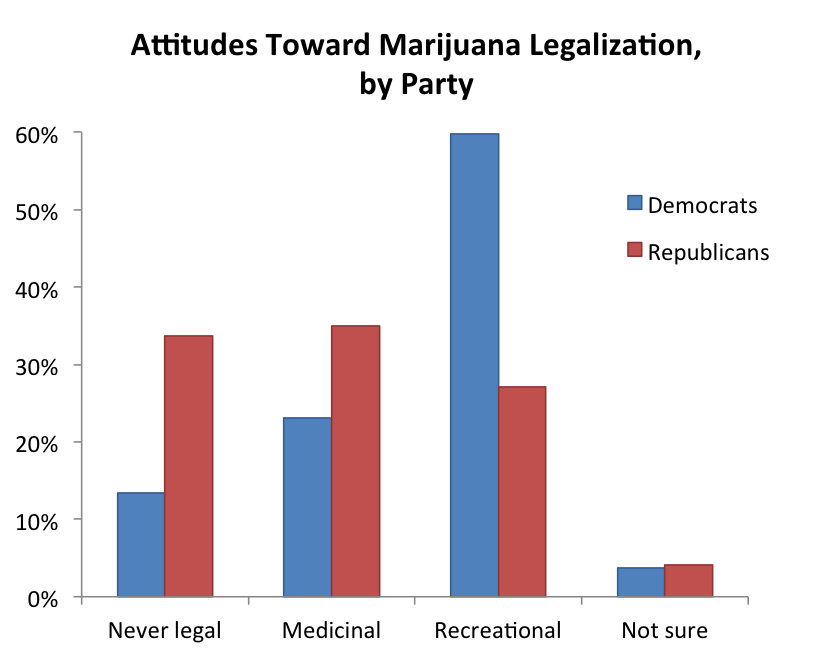
Peter Hanson and I directed a University of Denver survey back in the fall of 2012 that addressed this issue, among others. We asked respondents whether they thought marijuana should be illegal for all purposes, legal for medicinal use only, or available recreationally. [Above is] how the answers broke down by party …

These are pretty sharp differences. Notably, nearly all Democrats favor some sort of marijuana legality, with 60 percent supporting full recreational availability. Republicans are much more divided on the matter, with about a third taking each position. As Hanson notes, the divisions fall along predictable lines, with frequent church attenders opposing legalization and self-described libertarians supporting it.

Josh Voorhees also examines support for recreational and medical marijuana:

Some pot opponents warn that medical marijuana serves as a Trojan Horse for the larger legalization movement, but that argument relies on Americans believing that the dangers of possibly legalizing recreational weed tomorrow outweigh the benefits of actually prescribing it to cancer patients and others in need today—a viewpoint shared by a diminishing number of Americans. While 54 percent of respondents told Pew they thought “the use of marijuana” should be made legal, things were more complicated when the question changed from a simple yes-or-no to one where people were asked to pick between three choices: 39 percent said that pot “should be legal for personal use”; 44 percent said it “should be legal only for medicinal use”; and 16 percent said it “should not be legal.” Still, the answers to the original question—“Do you think the use of marijuana should be made legal, or not?”—suggests in an all-or-nothing environment, most Americans choose the former.

Our Cold Civil War Intensifies

Maybe it’s the sea air up here on the Cape but I spent last night again watching Fox News. It was like slipping into an alternative universe. Sure. I expected criticism of the president and a few outrageous zingers – but not the picture of reality that seemed to undergird the entire enterprise. But here’s the gist: the president is a lawless dictator, abetting America’s Islamist foes around the world, releasing Taliban prisoners to aid in his own jihad on America, fomenting a new caliphate in Iraq, and encouraging children to rush the Mexican border to up his vote-count, while effectively leaving those borders open to achieve his “fundamental transformation of America.”

I watched Megyn Kelly, who is regarded as more centrist than Sean Hannity. You could have fooled me. The guests were Brent Bozell, far right veteran, and Andy McCarthy, pro-torture activist touting his book calling for Obama’s impeachment. The only pushback Kelly provided to a relentless stream of hysteria was to ask whether the president sincerely wanted another terror attack on America – since it would hurt his approval ratings. And that provided the only qualification to the picture of a Jihadist in the White House determined to destroy the America he loathes. The “chaos” at the border and the emerging caliphate in Iraq may have been merely the unintended consequences of fecklessness rather than a deliberate attempt to destroy everything valuable in the United States.

At no point was any context provided to make sense of any of this. So, for example, it is axiomatic for Fox viewers that Obama has presided over a massive wave of illegals flooding the country. The truth is quite different:

If you compare [Bush’s and Obama’s] monthly averages [for deportations], it works out to 32,886 for Obama and 20,964 for Bush, putting Obama clearly in the lead. Bill Clinton is far behind with 869,676 total and 9,059 per month. All previous occupants of the White House going back to 1892 fell well short of the level of the three most recent presidents.

We wondered whether there might have been a surge of undocumented immigrants that explained the increase, but there wasn’t. During the first two years of Obama’s tenure, the Pew Hispanic Center estimated the illegal immigrant population nationwide at 11.2 million, compared to an average during Bush’s eight-year tenure of 10.6 million. And illegal immigration actually peaked late in Bush’s second term, at which point the recession hit and the numbers declined under Obama. Such patterns do not explain the 57 percent bump in monthly deportations that we found under Obama.

That data simply refutes the notion that we are somehow living in an era of lawlessness and massive illegal immigration. If a Republican president had done as much, he’d be a hero on Fox.

Look: I know I may be a total sucker for even hoping to see some semblance of fairness and balance on Fox. But it’s still shocking to see programming designed not to uncover reality, but to create a reality in which no counter-arguments are ever considered, and in which hysteria is the constant norm. MSNBC is almost as bad, of course, but with CNN as the new Discovery Channel, the entire possibility of a balanced newscast has disappeared from cable – and from the lives of most Americans. Again, this is not new. But as it continues, it intensifies. And as it intensifies, the possibility of governing all of the country recedes into the distance.

This is a civil war without violence. And we are two countries now.

The Gluttony Games

Gabriel Muller isn’t convinced that competitive eaters count as athletes:

A good eater, according to [William “Wild Bill”] Myers, needs to be strategic about which bites to take, how often to chew, and when to maneuver between swallowing and eating more food. This is especially tricky with chicken wings, which are irregularly shaped and have bones. The winner is determined by weighing the bowl before and after the competition, in order to establish the total weight eaten.

With this kind of focus from participants, it might seem reasonable to place competitive eating among the ranks of other legitimate sports; a strong audience base, highly organized league structure, and meticulous training regimen add an element of validity, and Major League Eating considers competitive eating a demanding athletic undertaking. But what kind of well-founded sport, I wondered, calls attention to such brazen gluttony and the revolting digestive processes of the human body? Instead of zeroing in on an athlete’s physiological vigor and agility, competitive eating plays an antithetical role – a sort of sport in reverse.

But competitive eating surely demands discipline; in Errol Morris’ 2012 short documentary El Wingador, the titular chicken-eater described a training regimen that included eating 15 pounds of food and drinking three gallons of water each day.

Leave The Laptops At Home, Kids

Computer scientist Dan Rockmore won’t allow them in his classroom:

When I created my “electronic etiquette policy” (as I call it in my syllabus), I was acting on a gut feeling based on personal experience. … Over time, a wealth of studies on students’ use of computers in the classroom has accumulated to support this intuition. Among the most famous is a landmark Cornell University study from 2003 called “The Laptop and the Lecture,” wherein half of a class was allowed unfettered access to their computers during a lecture while the other half was asked to keep their laptops closed. The experiment showed that, regardless of the kind or duration of the computer use, the disconnected students performed better on a post-lecture quiz. The message of the study aligns pretty well with the evidence that multitasking degrades task performance across the board.

And a recent study suggests that disconnecting from the Internet isn’t enough:

According to this study, it’s precisely when laptops are used as one might hope – for note-taking – that they are a problem. Most people can type significantly faster than they can take notes by hand, and the natural tendency of most computer users is to take more notes – perhaps even to transcribe – at the expense of memory and comprehension. If you don’t have to think about what you are hearing and what is or is not worth writing down, you are not likely to listen as intently and actively.

America’s Hiring Freeze

casselman-datalab-jolts-1

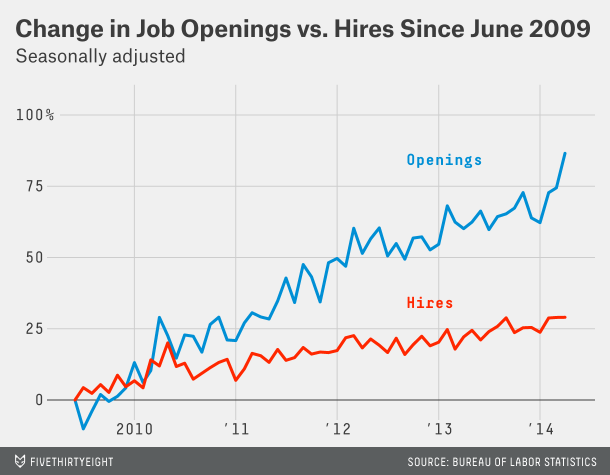
The number of job openings has increased significantly since the recession ended, but companies aren’t filling them:

There were 4.5 million jobs available in the U.S. at the end of April, the most since August 2007, the Bureau of Labor Statistics (BLS) reported Tuesday. Job postings are up 16.5 percent over the past year and have more than doubled since their 2009 low. Actual hiring, however, is a different story. Hires were essentially flat in April and are up less than 6 percent over the past year. This has been a persistent pattern in the recovery, as the above chart shows. …

The most likely explanation remains the simplest: the weak recovery. Companies are seeing more demand for their products, so they’re posting job openings, but that demand isn’t yet strong enough for them to fill those positions quickly. They’re content to wait for the perfect candidate to show up. (In economics jargon, companies’ “recruiting intensity” remains low, as it has been throughout the recovery.) The good news for the unemployed is that more openings means more chances to land a job. There were 2.2 jobseekers for every available position in April, the best ratio since before the recession began. But those openings don’t mean much if companies won’t fill them.

Danielle Kurtzleben looks over the possible reasons for this divergence:

That could mean that there’s a skills mismatch, [Gad Levanon, director of macroeconomic research at the Conference Board] says. That is, it could mean that employers can’t find people qualified enough for the openings they’re posting. But it could also mean that employers are, for whatever reason, deciding to take their time in hiring. One theory here, as Catherine Rampell wrote in the Times last year, is that employers are still feeling cautious from the downturn — don’t make a mistake in hiring, the idea goes, because it could be costly to pick the wrong person.

The flipside of that theory is that employers are not only nervous but spoiled — there are lots of unemployed people out there, so employers have lots of candidates to pick from and aren’t trying too hard to seek out the best candidates themselves.

Eating The Fish That Eat Our Emissions

The oceans play a major role in capturing carbon from the atmosphere. Recent research shows that deep-sea fish are a key part of this process:

Though we used to think that phytoplankton near the surface of the ocean did all the work of sequestration on their own, by taking their carbon with them when they died, it it now clear that the process is a little more vigorous than that. Instead of just waiting for carbon-laden plankton to get on their level, certain deep-dwelling, nightmare-inducing predators actually hunt down the tasty upper-level nibbles before swimming back into the extreme depths where all that carbon is effectively trapped for good.

And scientists recently learned that there are 10 to 30 times more of these mid- to deep-sea fish than they thought (and I made sushi jokes about them). Since these elusive fish turn out to make up 95 percent of the biomass in the ocean, they have a lot to do with why the ocean is so good at vacuuming up all our carbon.

But Stephen Leahy flags another recent study warning that as the deep-sea fishing industry becomes more intensive, we’re killing off this important carbon sink, which the report estimates is worth $148 billion a year:

When organisms die in the deep seas, pretty much everybody ends up on the bottom of the ocean, which makes for an effective, natural sequestration process. (It’s also the phenomenon driving ocean fertilization schemes.) The authors estimate that in the high seas, this amounts to taking more than 1.6 billion tonnes of CO2 out of the atmosphere and burying it in the seabed every year.

The thing is, with fisheries impacted worldwide, more governments are subsidizing fishing operations on the high seas. More fishing activity could put a dent in the ocean’s sequestration effect, co-author Rashid Sumaila of the University of British Columbia’s Fisheries Center said. … In the new report, the authors argue that a ban on fishing in the high seas, which represent 58 percent of the world’s oceans, would be valuable just for protecting and enhancing their role as a carbon sponge, Sumaila said. But that is just one of 14 other valuable services the high seas provide humanity, according to the study.