Our Contribution To The Fossil Record

i1052-5173-24-6-4-f04

Mother Earth has turned our plastic trash into a new type of stone:

Most plastic in the ocean disintegrates into small pieces (which don’t go away, either), but some of it melts into “molten” plastic, and it fuses with all the regular, organic materials below it, forming a super-hard monolithic stone. It was first observed in Hawaii in 2006 by an oceanographer, but geologists didn’t collect the stones until 2012. According to the new study, even though most of the plastic is molten, you can often still identify specific objects within the stone, including “netting/ropes, pellets, partial containers/packaging, lids, tubes/pipes, and ‘confetti.'”

Unsurprisingly, these superhard “plastiglomerate” stones are sticking around:

The resulting materials, researchers report in the journal GSA Today, will probably be long-lived and could even become permanent markers in the planet’s geologic record. “Most conventional plastic is relatively thin and fragments quickly,” said Richard Thompson, a marine biologist at Plymouth University in England, who was not involved in the research. “But what’s being described here is something that’s going to be even more resistant to the aging process.”

(Image: Rocks made from molten plastic, rope, netting, plastic pellets, “confetti,” and other plastic debris found on Hawaii’s Kamilo Beach. Via GSA Today.)

A Computer That Codes Itself

Gary Marcus and Ernest Davis detail attempts to invent one:

What [the Defense Advanced Research Projects Agency (DARPA)] and [programmer Charles] Simonyi are hoping for is a complete paradigm shift. A programmer—and this could be anyone—would simply tell the computer what he needed in plain English, and the computer would figure out the rest. Anyone would be able to program, not just highly trained specialists, and, at least in principle, computers might ultimately produce much more reliable code than their human counterparts.

One big problem with this dream is “that computers still have too little understanding of how the external world works, and therefore too little understanding of how the programs they create will actually work”:

Consider, for example, this seemingly simple, hypothetical programming task: “Add a feature to Google Maps that allows a user to place a simulated boat on a river and have it float downstream.” To do this, you need to know what a river is, what a boat is, and what it means for a boat to float downstream. Any human programmer knows that, but no computer system has the real-world understanding of an average human being. As Tom Dean, a researcher at Google, told us, “Programming is [challenging for artificial intelligence] not because it requires concentration and attention to detail but because the path from the conception of what you want to accomplish to the realization of code that actually accomplishes it requires artistry, insight, and creativity as well as incredible mental dexterity.”

One day computers may have that kind of dexterity and intuition; the DARPA program is a good first step in that direction. But the path to the automated, thinking computer will also require a shift in research priorities, from the currently popular focus on the question “What you can do with Big Data?” back to A.I.’s original, driving one: “How do you build machines that are broadly intelligent?”

Passing The Turing Test, Ctd

With the last weekend’s breakthrough being called into question, Brian Barrett argues that these days, the Turing test “isn’t so much a test of computer intelligence as it is human gullibility”:

A bad chatbot might luck its way to victory if the judges aren’t familiar with tell-tale signs of chatbot-ness. That’s usually of less importance when your panel includes experts in the field of computer science. In this case, it included an actor from Red Dwarf and a member of the House of Lords, both of whom are incredibly accomplished and by all indications brilliant minds, but not specifically trained in this field.

David Auerbach argues that “Eugene Goostman” did in fact pass the Turing test – but that the test itself has a fatal flaw:

Trashing the Reading results, Hunch CEO Chris Dixon tweeted, “The point of the Turing Test is that you pass it when you’ve built machines that can fully simulate human thinking.” No, that is precisely not how you pass the Turing test. You pass the Turing test by convincing judges that a computer program is human. That’s it. Turing was interested in one black-box metric for how we might gauge “human intelligence,” precisely because it has been so difficult to establish what it is to “simulate human thinking.” Turing’s test is only one measure.

So the Reading contest was not the travesty of the Turing test that Dixon claims. Dixon’s problem isn’t with the Reading contest – it’s with the Turing test itself. People are arguing over whether the test was conducted fairly and whether the metrics were right, but the problem is more fundamental than that.”Intelligence” is a notoriously difficult concept to pin down. Statistician Cosma Shalizi has debunked the idea of any measurable general factor of intelligence like IQ. Nonetheless, the word exists, and so we search for some way to measure it. … The Turing test, famous as it is, is only one possible concrete measure of human intelligence, and by no means the best one.

Elizabeth Lopatto offers some background about how Turing turned imitating a conversation into a proxy for intelligence:

The strength of the test is obvious: “intelligence” and “thinking” are fuzzy words, and no definition from psychology or neuroscience has been sufficiently general and precise to apply to machines. The Turing test side steps the messy bits to provide a pragmatic framework for testing.

But this strength is also the test’s weakness. Turing at no point explicitly says that his test is meant to provide a measure of intelligence. For instance: human behavior isn’t necessarily intelligent behavior—take responding to an insult with anger. Or typos: normal and human, but intelligent?

Joseph Stromberg still believes the episode was noteworthy:

This announcement certainly doesn’t mean that self-aware robots are about to take over the world – and it doesn’t even mean that there’s one out there capable of consistently fooling people into thinking its a human. It does, however, mean that one has crossed the threshold Turing predicted would be passed by 2000, a meaningful milestone on the way to artificial intelligence.

That said, there are plenty more milestones that still need to be passed — even in terms of the Turing test. The Loebner prize, for instance, will award a silver medal for the first program to pass a text-only test, but a gold medal for one that passes an audio test — something that’s probably still a long way off.

But a less-charitable George Dvorsky makes the case that it’s time to abandon the “bullshit” Turing test:

Turing had no way of knowing that human conversation – or the appearance of it  – could be simulated by natural language processing (NLP) software and the rise of chatterbots. Yes, these programs exhibit intelligence — but they’re intelligent in the same way that calculators are intelligent. Which isn’t really very intelligent at all. More crucially, the introduction of these programs to Turing Test competitions fail to answer the ultimate question posed by the test: Can machines think?

Though impressive, and despite their apparent ability to fool human judges, these machines – or more accurately, software programs – do not think in the same way humans do. … It’s all smoke and mirrors, folks. There’s no thinking going on here – just quasi pre-programmed responses spouted out by sophisticated algorithms. But because Turing’s conjecture was directed at assessing the presence of human-like cognition in a machine, his test falls flat.

Israel’s 10th President

…is Reuven Rivlin. The former Knesset speaker and Likud party stalwart was elected yesterday. Dimi Reider, writing before the election, called Rivlin “the best president for the Left, for whom the Left will never vote”:

As a staunch right-winger, Rivlin is opposed to partition but is emphatically opposed to racism, coupling his opposition to a Palestinian state with support for offering Israeli citizenship to all Palestinians. While this is a stance being taken up by a number of right-wing politicians in recent years, Rivlin, as a democrat, goes one step further. When I interviewed him for Foreign Policy four years ago, for instance, he spoke nostalgically of a rotation-based executive espoused by Revisionist Zionists like Ze’ev Jabotinsky  – and held up by Belfast as one possible inspiration for a future of power-sharing. It’s a far cry from nationalist self-determination, or from the one state advocated by Palestinians and the pro-Palestinian Left. But it still offers infinitely more room for maneuver than anything ever plausibly offered or actually given to Palestinians by the centrist two-state Left.

What I take from this is that the two-state solution is dead and the project for Greater Israel continues apace. At some point, the Palestinian Arabs who would end the existence of a Jewish-majority state will be expelled, as they were in 1948. It’s hard to see any other outcome from the logic of one unitary Jewish state across the entire area that Israel has now controlled for the majority of its existence.  “But Rivlin is more than his opposition to a two-state solution,” Raphael Ahren stresses:

During his two terms as Knesset Speaker, he wasn’t afraid to confront the right wing — for example by opposing legislation he deemed as discriminatory and undemocratic, which won him many friends even among Israeli left-wingers. MKs Ilan Gilon (Meretz) and Shelly Yachimovich (Labor) voted for Rivlin, as did all four MKs from the Arab-Israeli Ra’am-Ta’al faction.

“He has an opinion on the two-state solution, but he is not widely seen as an ultra-nationalist,” said Mitchell Barak, a pollster and political analyst. “He’s one of voices of reason in Likud; he’s not a hothead like Danny Danon.” The president-elect’s views on the peace process are not born of hatred for Arabs, as his voting record and his statements as Knesset speaker attest, and the Arabs and the world at large know that, he said.

Comparing Rivlin to his predecessor Shimon Peres, Jonathan Tobin argues that his election indicates how Israeli public opinion on the peace process has shifted:

Rivlin’s win is one more demonstration that the center of Israeli politics is well to the right of where Americans would like it to be. While liberals and others who deride Netanyahu think the views of the popular Peres represent what most Israelis think, the experience of the last 20 years of the peace process have created a new political alignment that means Rivlin’s opinions don’t place him outside of the mainstream.

This is disconcerting for those who would like to believe that Peres, the architect of Oslo process, speaks for Israel in a way that Netanyahu cannot. But even if most Israelis think a two-state solution would be ideal, they know that in the absence of a true peace partner it isn’t going to happen anytime soon.

A little background on the Rivlins: The new president comes from a large and influential family who were among the first Jews to settle in Ottoman Palestine in the 19th century, making them, as Eetta Prince-Gibson calls them, “the closest thing to a Jewish aristocracy Israel has ever had”:

On their website (www.rivlinfamily.com), the clan claims to number today more than 50,000, of whom more than 35,000 are thought to live in Israel. The website lists some 195 people of note, including Yosef Yoel Rivlin, the author of the first Hebrew edition of the Koran (and father of Rueven Rivlin); Eliezer Rivlin, the deputy president of the Supreme Court of Israel from 2006 to 2012; Ranan R. Lurie, an American-Israeli political cartoonist and journalist; Rivka Michaeli, the doyenne of Israeli comedy; Sefi Rivlin, a wild-cat comedian and admired satirist, who died last year; Lilly Rivlin, an American feminist filmmaker and left-wing peace activist; Leora Rivlin, an award-winning actress, and Muki Tzur, from Kibbutz Ein Gev, a well-regarded historian of the period of the Second Aliyah.

The Best Of The Dish Today

Now that the drive-by media, to borrow a term from Rush Limbaugh, has moved on, new documents that reveal the inner life of Bowe Bergdahl paint an utterly different picture of him than the traitor/deserter/Islamist/anti-American profile broadcast by Fox News. Instead, you find a deeply troubled and mentally unstable character, clearly prone to deep depression, and struggling to find a way to live in the world. We learn that he was discharged from the Coast Guard for psychological reasons, for example. And then there are simply painful passages of juvenile prose that reveal just a lost soul:

“I’m worried,” he wrote in one journal entry before he deployed. “The closer I get to ship day, the calmer the voices are. I’m reverting. I’m getting colder. My feelings are being flushed with the frozen logic and the training, all the unfeeling cold judgment of the darkness.” A few pages later, he wrote: “I will not lose this mind, this world I have deep inside. I will not lose this passion of beauty.”

At another point, using his often un­or­tho­dox spelling, he wrote: “Trying to keep my self togeather. I’m so tired of the blackness, but what will happen to me without it. Bloody hell why do I keep thinking of this over and over.”

As for his intellectual influences, he has this in common with Dave Brat and every other adolescent who cannot quite find a way to live in a complicated, social world: Ayn Rand. The one novel in his possession when he walked off the base was Atlas Shrugged. And scene.

Today, we grappled with the fallout from the Cantor earthquake – and I attempted to gauge the power of right-wing populism in this volatile political environment. We also tackled the inevitable disintegration of Iraq, as the sectarian forces unleashed and only barely contained by the US invasion gradually resurfaced, aided and abetted by Maliki’s Shiite sectarianism. Plus: George Will’s blind spot; the Clintons’ fabulous Hamptons mansion; and the near-miraculous slowdown in Medicare costs – perhaps the most important factor for our future fiscal health, and what may well be another part of Obama’s broadening legacy.

The most popular post of the day was The Cantor Shocker: Blog Reax, our trademarked round-up of online commentary; followed by Engaging the T, Ctd., where I defend Dan Savage from the language police.

Many of today’s posts were updated with your emails – read them all here.  You can always leave your unfiltered comments at our Facebook page and @sullydish. 30 more readers became subscribers today. You can join them here for a little as $1.99 month.

See you in the morning.

The Nader-Chomsky Of The Right?

Eric Cantor Holds Press Conference At Capitol One Day After Primary Defeat

That’s Ryan Lizza’s take on Brat – and he largely shares my view that this new form of Republican populism is a lot more potent than the Romney campaign’s 47 percent message. Why? Because Brat is targeting the 1 percent. Money quote:

Instead of lecturing the most vulnerable about the moral beauty of the marketplace, Brat targets the most well off. “Free markets!” he declared in Hanover, like a teacher about to reveal the essence of the lesson. “In a nutshell, what does it mean? It means no one is shown favoritism. Everyone is treated equally. Every firm, every business, and you compete fairly. And no one, if you’re big or small, is shown special attention. And we’re losing that.”

If this sounds familiar, it’s because it’s the kind of rhetoric that Ralph Nader, and even Noam Chomsky, have used for many years to pillory the government for protecting the rich and the well connected from the vagaries of the free market.

And that’s why, in my view, it is not to be under-estimated. The K Street-Wall Street nexus is a scandal; as is our absurdly complex tax code (largely devised for corporate welfare and for those with expensive tax lawyers). Put that together with a left-sounding defense of the American middle-class against millions of undocumented, low-wage immigrants, and you’re beginning to get somewhere.

Given where the country now is, I expected Obama’s likeliest successor to be to his populist left, someone able to corral anger at the one percent and Washington, someone urging radical change on behalf of the little guy. But the Clinton machine has managed to choke off that possibility – while the GOP is fast rushing into the gap.

(Photo: Mark Wilson/Getty)

The Scientific Case For AA

Keith Humphreys traces how addiction scientists came around to the idea that Alcoholics Anonymous works:

A watershed in scientist’s views of the value of AA occurred in the 1990s with Project MATCH, the largest study of alcohol dependence treatment ever undertaken.  Two well-validated professionally-developed psychotherapies were evaluated head to head against “twelve-step facilitation counselling.”  This counselling approach adapted AA ideas and goals into a 3-month long psychotherapist-delivered outpatient treatment protocol and also strongly encouraged involvement in community-based AA groups.

AA skeptics were confident that by putting AA up against the best professional psychotherapies in a highly rigorous study, Project MATCH would prove beyond doubt that the 12-steps were mumbo jumbo.  The skeptics were humbled: Twelve-step facilitation was as effective as the best psychotherapies professionals had developed.

subsequent randomized clinical trial eliminated the twelve-step counselling component and simply evaluated the effect of a brief, structured introduction to AA (as well as Narcotics Anonymous, if appropriate).  Those connected by researchers to 12-step groups had substantially lower rates of using alcohol and other drugs over time.  This proved that the groups themselves have a positive impact, even when they are not coupled with extended professionally-provided twelve-step facilitation counselling.

Previous Dish on the effectiveness of AA here, here, here, and here.

Assad The Invulnerable

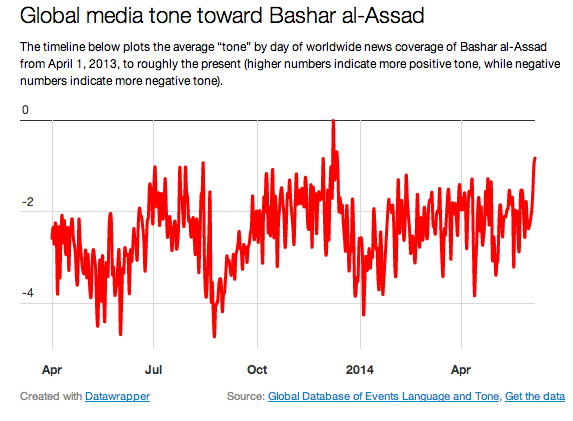
Screen-Shot-2014-06-10-at-9.18.16-AM

That’s the sense one gets from international media coverage of the Syrian dictator:

Immediately visible is the sharp negative trajectory of global media tone towards Assad in the lead-up to the August 21, 2013, Ghouta chemical weapons attack, as Assad was rapidly losing global credibility.  In the days immediately following, as the world’s headlines were captivated both by the attack itself and the continued clashes over the following days, tone towards Assad continues to become sharply more negative. However, something extraordinary begins to happen on August 28 – the tone of news coverage across the world about Assad begins to turn sharply positive, containing a high density of language regarding invulnerability.

A review of news coverage from this time period reveals a world anticipating U.S. military action in the first few days after Ghouta, with substantial reference to President Barack Obama’s “red line” policy towards chemical weapons. But as the Obama administration wavered, and it became increasingly clear that not even a symbolic missile strike would occur, the discourse around Assad began to change dramatically — from a vanquished has-been in his last days, to a resurrected and invulnerable leader. … Of course, the world’s media wasn’t applauding Assad for gassing children to death, but it’s clear that, as a group, it contextualized the lack of response to those horrific actions as an indicator of new-found impunity.

Scarcity Breeds Racism

That’s what new research suggests:

David Amodio, a psychology professor at New York University and Amy Krosch, a graduate student, performed a series of experiments that showed that their predominantly white study subjects tended to view biracial people as “more black” when they were primed with economic scarcity, and that the subjects were stingier toward darker-complexioned people overall. …

Of course, past studies have also shown that scarcity and resource competition fosters distrust between groups. The ingroup/outgroup cognitive bias theory holds that we prefer people who resemble us. But this research suggests that financial strain can cause the very definition of the “out” group to change, as well, by nudging us to view people of other races as even more dissimilar to ourselves.

Maya Rhodan elaborates:

[P]articipants were asked to identify whether select images depicted black people or white people, while researchers manipulated select economic conditions. In one study, participants were first asked to express agreement or disagreement with “zero-sum” beliefs like “When blacks make economic gains, whites lose out economically,” and then asked to identify the race of the people featured in 110 images – people whose skin color varied greatly. The study’s results showed that those with stronger “zero sum” beliefs were more likely to consider the images of mixed-face subjects as “blacker” than they actually were.

[Krosch and Amodio] found similar results when participants were asked to identify whether someone was black or white after being shown words related to scarcity like “limited” and “resource.” The remaining studies threw economics into the mix – asking subjects how they would divide $15 between people represented by two images – and not only were images of darker-skinned people deemed “blacker” than they actually were relative to the average skin color, they were allocated fewer funds.

Jesse Singal adds:

The standard caveats apply: This was a lab setting; in real life people make these sorts of decisions differently; and so on. But given previous research on race, scarcity, and bias, it’s a useful data point, and a useful reminder that scarcity has a lot of negative effects on human behavior – some of them a bit surprising.