Between Iraq And A Hard Choice

Unrest in Iraq

In her campaign book Hard Choices, Hillary Clinton offers a mea kinda culpa on her vote in favor of the Iraq War:

According to CBS News, which obtained a copy of her book, she says: “I wasn’t alone in getting it wrong. But I still got it wrong. Plain and simple.”

Note the lack of an outright apology – or a broader statement about the appalling human cost of that wrong call. And that’s particularly worth pondering as Iraq returns to the entropy of endless, sectarian warfare in the wake of the US invasion and occupation. Civilian deaths doubled in 2013 and show no signs of abating. Larison looks at Clinton’s broader instincts in foreign policy and remains unimpressed:

One might think that a supposedly chastened Iraq war supporter would be considerably more skeptical about pursuing regime change overseas or more reluctant to support the use of force after having erred so badly on the biggest foreign policy vote of her Senate career, but that hasn’t happened. In every internal administration debate, Clinton sided with the hawks that wanted the more aggressive policy, and this also conveniently aligned her with whatever the purveyors of conventional wisdom in Washington thought ought to be done.

Her explanation that she cast that vote “in good faith” troubles Beinart, who interprets that to mean that she probably didn’t read the National Intelligence Estimate on Iraq’s WMDs:

Would reading the classified NIE have changed Clinton’s vote? Maybe not. Even after reading the classified version, Rockefeller and Dianne Feinstein still voted to authorize war. And some intelligence analysts familiar with the classified NIE claim it was a biased, shoddy document that, like its unclassified cousin, bent over backward to prove that Iraq was pursuing WMD. Perhaps most importantly of all, Clinton’s own national-security confidantes—including Iraq expert Kenneth Pollack—believed the WMD claims. It’s hard to imagine she would have overruled them, even if the classified NIE had given her pause.

Still, Clinton’s failure to read the document means her book’s claim that she “made the best decision I could with the information I had” is probably untrue. … How could someone renowned for doing her homework have failed to do so on the most important vote of her Senate career? Clinton’s Iraq apology notwithstanding, it’s a question worth asking if she runs for president again

To which Larison drily replies:

For someone in Clinton’s position in 2002, there was nothing easier than to fall in line with other liberal hawks and vote yes. There was no incentive for her to “do her homework” and probably not much interest, because it was taken for granted among all “serious” people in Washington that Iraq still had WMD programs and that Hussein had to be removed from power. This is what makes Clinton’s preferred phrase of “hard choices” so laughable: on the most significant foreign policy vote she cast as a member of Congress, Clinton took the easiest way out.

PM Carpenter asks what took her so long to admit this:

To this day I’m perplexed at how such a mighty political machine as Clinton’s could have got so much so wrong.

Hillary’s Iraq war vote was not, politically speaking, what she got wrong. It’s a sad reality–always has been, always will be–that all too many pols are willing to sell others’ lives for an ephemeral bit of a jingoistic self-bump. Hillary scarcely invented cold-heartedness. No, politically speaking, what she got wrong, what she utterly misread, was 1) the potential power of the opposition (Obama) and 2) the deep current of antiwar temperament in her own party and 3) the price she’d pay for refusing to admit error, as, it seems, she’ll do next week upon release of her memoirs.

That’s a lot to get wrong, which is worrisome. The long delay in getting it right is also worrisome. But at least it’s a start.

(Photo: According the spokesperson of Fallujah General Hospital, Wissam al-Issawi (not seen), 4 bodies and 5 people, injured in an operation staged by Iraqi forces to the civilian targets, are taken to the hospital in Fallujah, Iraq on June 8, 2014. A view of the attacked area is seen. By Stringer/Anadolu Agency/Getty Images.)

Is Big Online Media Doomed?

You only have to observe the painful and austere transition of Time Inc. to see the grim portents of a much leaner future. And a lot of this has to do with a double problem: how to get revenue from readers and from advertisers in sufficient amounts to sustain the kind of outfit that was once so dominant. Right now, most big sites have no purely online subscribers and the ad rates are leagues below what they once were for print – and declining. In so far, as digital advertising is growing, the lion’s share goes to new media companies like Google and Facebook rather than general interest media sites. Derek Thompson faces some grim facts:

It’s not a coincidence that the most successful big digital media property, BuzzFeed, isn’t really in the old-fashioned adjacent advertising business at all. It’s a website where original stories live next to “promoted” ads engineered by an in-house laboratory for building advertising that will go viral. That’s not like Time Inc going into digital journalism. It’s more like Mad Men going into digital journalism … Maybe someone like Vox Media will figure out how to build the Time Inc. of the Internet. I hope so … But I don’t see a thriving future for the largest digital journalism enterprises as businesses, even though the web offers sensational opportunities for digital journalism as a product.

My bet is that small, niche, and premium digital journalism survives with high CPMs and light costs, while big, broad, and everything-for-everyone journalism struggles with low CPMs and heavy ambitions.

That’s good news for the future of the Dish, but pretty rough for those with ambitions to equal the media giants of the past. And even here, with 29,000 subscribers, we have a budget for just ten staffers, and no office. Which is why we’ll be dipping our toe into the ad market for non-subscribers soon – while keeping our premium product ad-free for those who are fully part of the Dish subscriber community. Kilgore uses the occasion to pour a big bucket of frozen water over the recent uptick in hiring for journalists:

This should operate as a corrective to the under-warranted optimism associated with a few new journalistic enterprises that have snapped up a handful of familiar names and created a brief churn in opportunities for small fry as a declining number of job openings ripple through the industry. Niche markets will remain, of course, and some magazines and websites (including, I trust, WaMo) will be able to chug along by shining brighter against a darker background. But the brief sense of a Klondike Gold Rush upon the intrusion of some tech money into the news-and-views biz will likely subside, and soon become as anachronistic as the liquor carts that once trundled through the halls at TIME.

Liquor carts! Now those were the days. A small promise: if the Dish ever gets an actual, you know, office (instead of a weekly meeting at a local diner), then we’ll find one.

The View From Your Window Contest: Winner #208

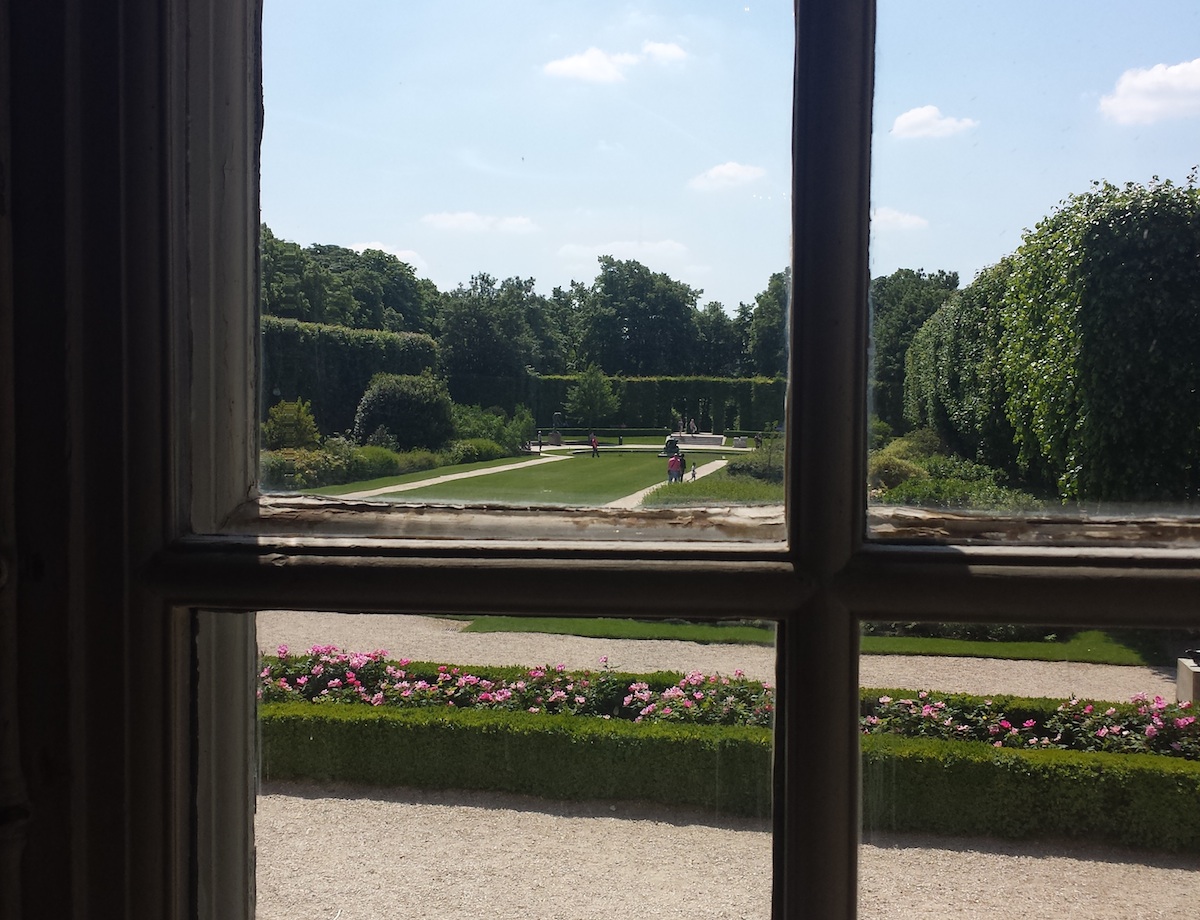
VFYWC-208

A reader writes:

Unlikely is one thing, impossible another. If someone gets a correct answer to this, there is devilry at work.

Another sees himself in the photo:

I think that’s me in the pink shirt.  Wish I could remember where I was.

Another:

Because no European would dress like that guy in the pink shirt, this must be America and not France (Versailles) or Austria (Schonbrunn). Thus, I go with the one European-style palace in America: The Vanderbilt’s Biltmore Estate, in Asheville, North Carolina.

Another surges into first place:

I knew right off the bat where this was, since I’ve spent many hours racing around the topiary bushes here with Mario and Luigi. This is obviously the garden at Princess Peach’s Castle in the Mushroom Kingdom (Mario Kart Wii). I can even point out the window from which the photo was taken:

PPG

Another looks to cinema:

I’ve never actively participated before, but when I saw this picture I immediately was reminded of Kenneth Branagh’s film version of Much Ado About Nothing. I am probably wrong – but in case I’m not, my guess is Villa Vignamaggio in Tuscany, Italy.

Another gets the right country:

The window in need of repair, with the garden looking immaculate, brings back memories of Versailles, France, and the righteous anger rising inside at the excessive opulence, which no doubt contributed to the unrest and eventual revolution. Yes, I say Versailles! Now let me calm down and foster thoughts of Jean Valjean.

Another makes an important discovery:

pandaI’m pretty sure that this will be the most popular wrong answer this week. After a weekend learning about formal gardens, I couldn’t find the location in the picture, but while glancing at the screen, my wife noticed that a section of the gardens at Versailles looks like a panda from the air. So there’s that.

Another reader, although far too brief, nails the city:

Paris, France

Another gets the right location in Paris:

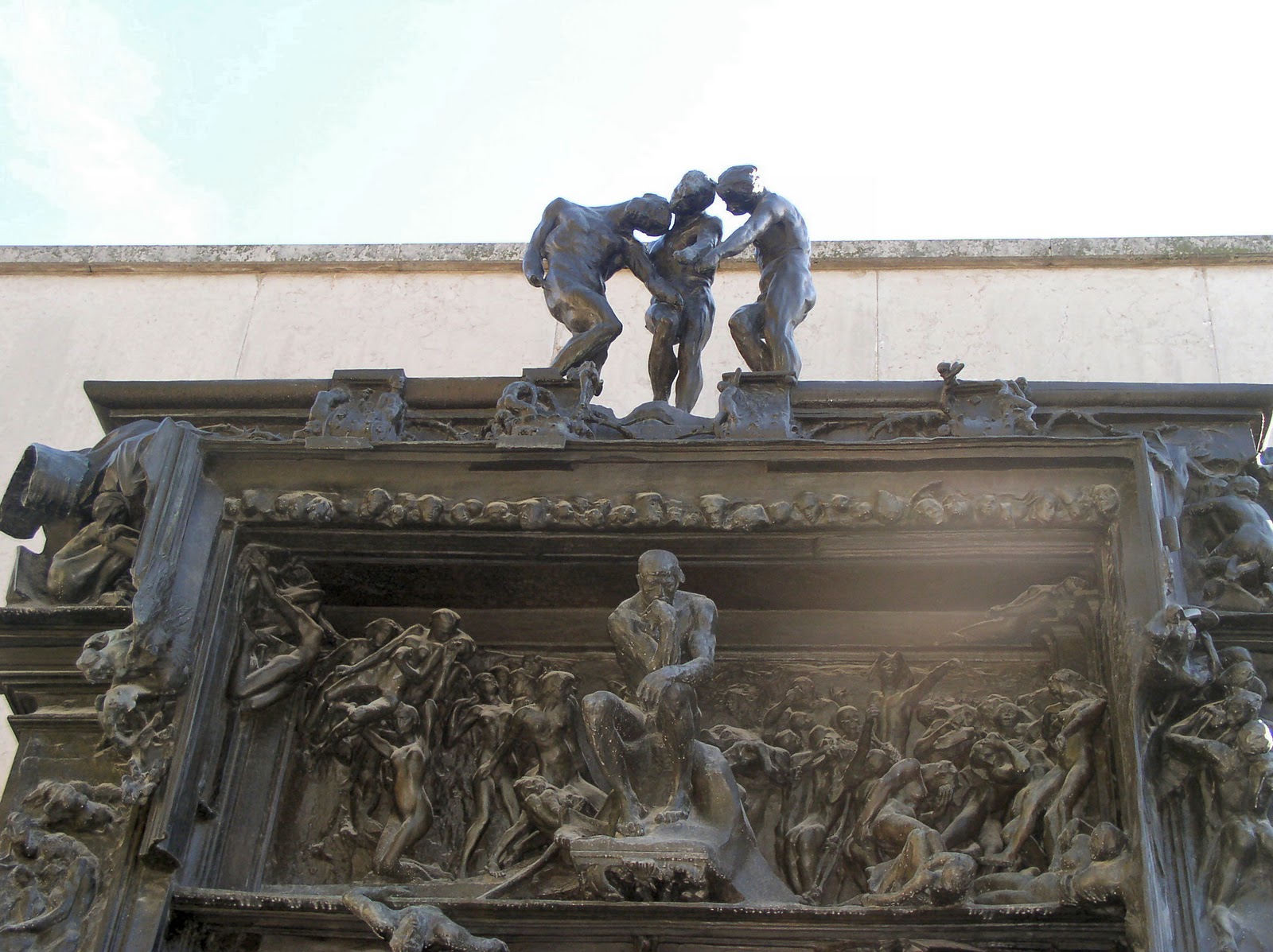
thinker

I’ll make this short and sweet because I’m leaving to take my wife in for spinal surgery:

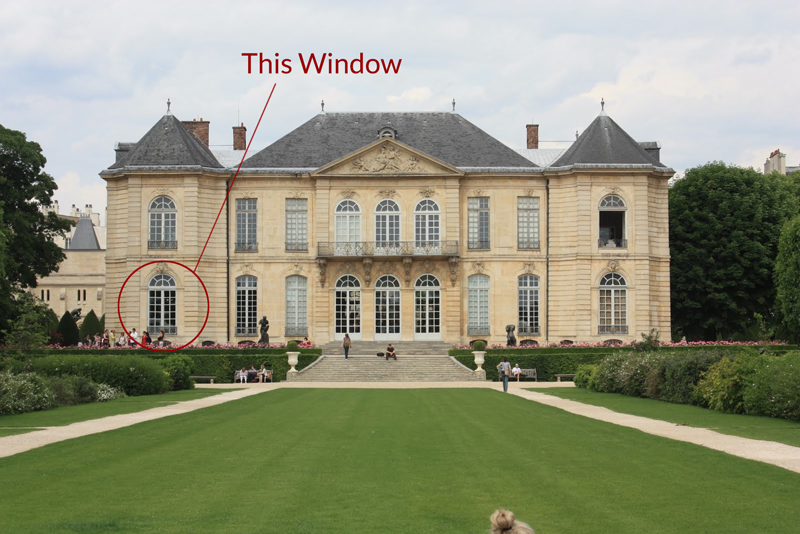
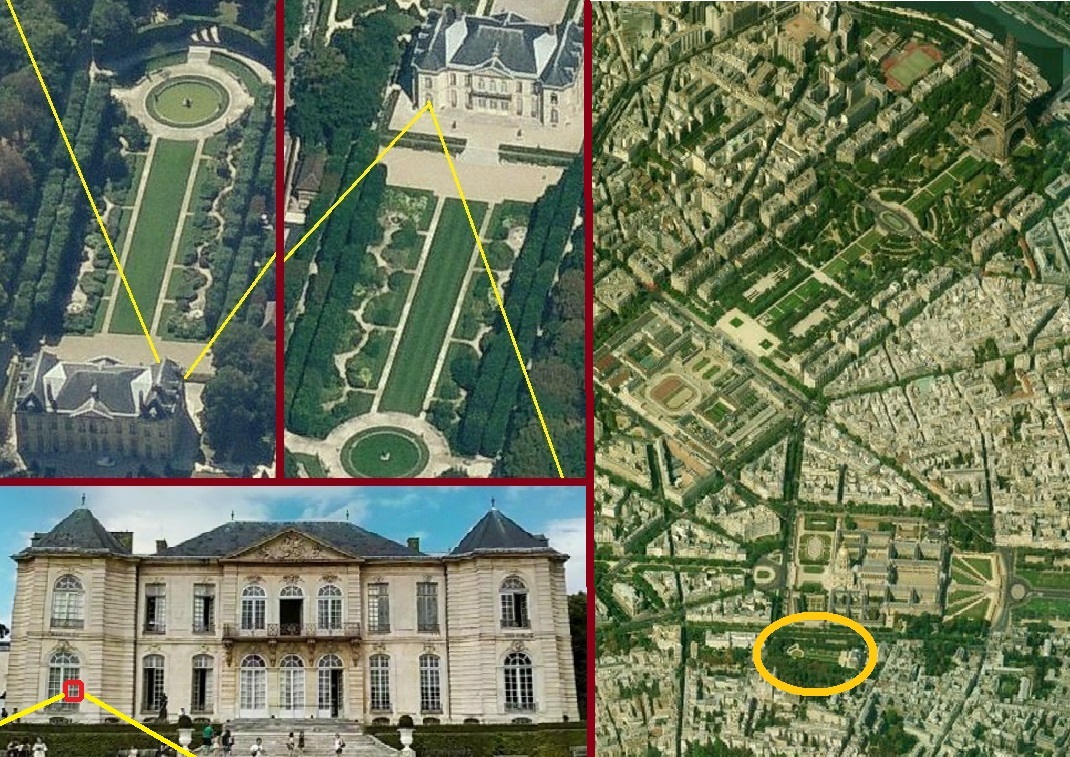
The photo was taken from the far left window overlooking the gardens at the Musée Rodin in Paris. 79 Rue de Varenne, 75007 Paris, France. More specifically:
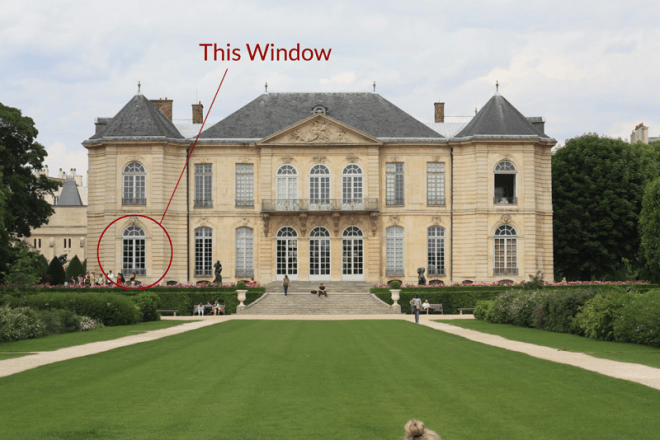
musee

That’s also the right window, which most of our correct guessers picked this week. Below is an OpenHeatMap of all of the entries (zoom in by double-clicking an area of interest, or drag your cursor up and down the slide):

This embed is invalid


Another reader goes into greater detail:

This is definitely France, given the particular kind of molding on the window frames, the fact they are French windows and not sash windows, and the way the roses are surrounded by trimmed box hedges. This could be any one of many 18th century manoirs/hotels particuliers/chateaux, but I would bet it’s the formal gardens in back of the Hotel Biron in the 7th arrondissement of Paris, aka the Musee Rodin.

Another walks us through the garden:

It contains characters from Dante’s Inferno, each depicted in a separate sculpture that Rodin brought together in his Gates of Hell.  In the contest picture, for example, sitting in the fountain is Rodin’s Ugolino before he devours his children:

IMG_9092

I bet the family walking down the path in the contest photo will have a great time discussing that sculpture over dinner.  Also, one of the Shades which Rodin later combined with two others to create The Three Shades is off on the left of the fountain. Rodin placed a small version of The Three Shades at the top of his Gates of Hell above The Thinker.

Another:

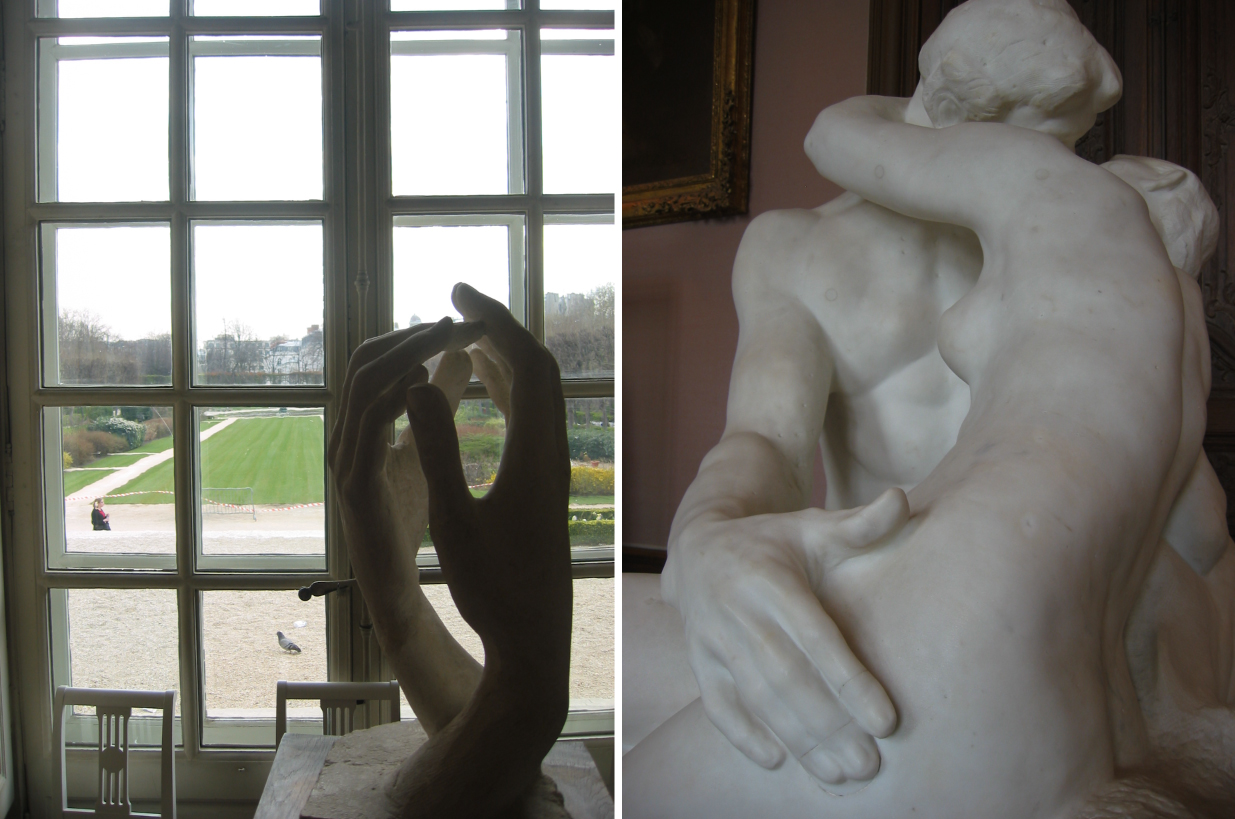
I went to the Rodin museum in my stumbling early twenties and it absolutely transformed the way I thought and felt about art. Rodin had such a unique and powerful gift for capturing emotion and form, and to be surrounded by so much of his work was simply overwhelming in a way no previous museum or gallery had ever been for me. In particular there was something about the raw, eros-charged physicality of Rodin’s pieces that I practically had to restrain myself from reaching out and touching them:
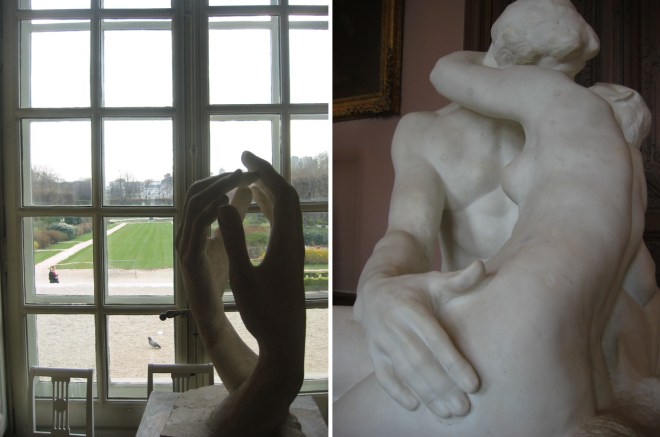
IMG_0534

His impressive private art collection is housed there as well, as is some of the work of his lover and muse Camille Claudel, which truly emphasizes the intimacy of the place. What an incredible, unforgettable experience. Everyone should go.

Along those lines, a few people mentioned the museum was on their bucket list, but none more movingly than this reader:

I immediately recognized the surroundings, as this is, along with Musée image208d’Orsay and Musée du Louvre, among my very favorite places in the world. Rodin’s most famous works are found in the elegant surroundings of the Hôtel Biron  where from inside this photo was taken  and the surrounding gardens.
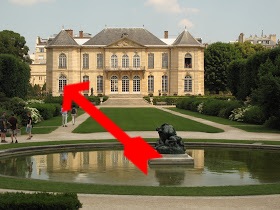
On a personal note: You’ve detailed my health situation in the past, as I deal with an eventually terminal illness. My “bucket list” trip while I could still travel was to Paris with my wife last year, to visit these places one more time  and the first time with her.

This contest gives me something to fill my time and look forward to each week, and I would be lying to say that this week hasn’t been a little more special. The memories that seeing this window evokes have made this week’s contest a trip outside of my everyday reality. I’ve been hoping for a win, but this is (almost) just as good. Thanks.

On a very different note:

In the course of investigating this view on Google Streetview, I found what appears to be a lesser known Rodin work. Looks like Jared from Subway:
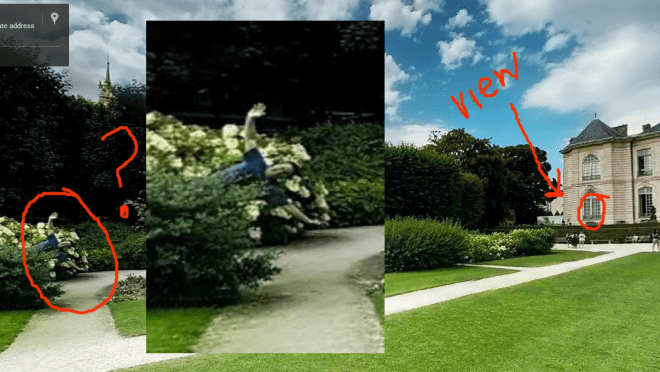
jared-rodin

Another examines the image for more useful clues:

It’s not much past midday, judging from the shadows, a beautiful temperate day, the quality of light, the flowers, and the tourists’ choices of attire, yet very few tourists have chosen to spend this lovely day in this garden. Might that suggest that the garden has lots of competition for tourists’ attention just beyond the hedges?

Therefore we have a garden attached to a museum, probably a museum of statuary, which is probably in a great city. Since it isn’t the Galleria Borghese in Rome, because I’ve been to it, then it must be the Musée Rodin, 79 rue de Varenne, Paris. And the three statues visible in the frame are “Adam” to the left, “The Meditation” to the right, and between them, just above mister pinkshirt, is “Ugolino [kneeling over] and [about to chow down on] his children” in the center of a difficult-to-discern pool.

Tourists avoiding this garden may be a mile to the east perched at a table outside Café de Flore, nursing un p’tit rouge and trying to be existentialists. Or a mile and change to the west at the top of the Eiffel Tower, gazing east toward Les Invalides (and so, incidentally, over the hedge into this very jardin).

2014-06-07_1041

I only wish that was how I identified this window. But no. I Googled “sculpture garden hedges” and the 134th image looked remarkably similar to that tri-arch hedge in the background. It took seconds. After that it was just a matter of picking out the panes of the window (not the window itself, because that’s obvious). Ground floor, west wing, south side, second and third pair of panes up from the bottom, on the right half of the window when viewed from the garden.

2014-06-07_1236

A reader living in Paris:

I bet this one will get plenty of correct answers. Or, at least I hope so! The tiny bronze forms on the horizon are unmistakeable: Rodin. I recognized them at first sight.

Six months out of every year, I teach drawing from 16th – 18th c. sculpture at the Musee du Louvre, to art students from all over the world, in a private program that I founded myself. I’m American but have lived in France for the last 13 years, and in Paris for the last 4.5 years. My wife and I are both artists, and the gardens of the Musee Rodin are a favorite place to visit. The museum has been in renovations for years, and the last time I visited there was last winter. The first time I went was as a student, in 1994 as seen in this embarrassingly earnest pic:

tws.rodin.museum.feb.1994

They are currently hosting a fine exhibition on the influence of Rodin’s sculpture on the photography of Robert Mapplethorpe. I hope to go this weekend.

Another:

How I WISH I could be one of the Dishheads who goes scouting the location of the VFYW this week. This is not just a sculpture garden, it is the sculpture garden. (If you want to mess with all the NSFW-phobic folks, you can post this image, which the museum is using to promote the current Mappelthorpe/Rodin exhibit. It’s effing culture, people!)

Personal story? I first visited the Rodin Garden in 1998 after a term studying in England; my mother and I spent a week touring Paris and climbing all the stairs we could find in the city. Not too many stairs in the Musée Rodin, but I thought it was the most romantic place I’d ever been and dreamed of proposing to a girl there one day. Fast forward fifteen years and … my brother proposed to his girlfriend there. Younger brothers always steal your best ideas.

Another:

As an architect I’ve taken my kids – they would say dragged – to many of the worlds great kidsmuseums and buildings. Since I never got a chance to go anywhere when I was a kid, I hoped they would appreciate it and enjoy learning about Art & Architecture as I did during my studies.
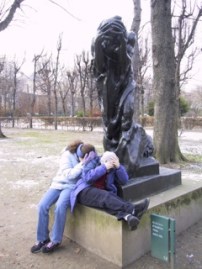
More often than than not, though, they would just melt down. We visited the Musee Rodin over the holiday break in 2005. To express their displeasure with having to walk through another museum in Paris they decided to reenact the pained pose of Andrieus d’Andre Vetu, one of Rodin’s Burghers of Calais. Oh well, what’s a dad to do?

Another learns to never doubt the spouse when it comes to Paris:

I spent several hours yesterday sifting through approximately one jillion pictures of formal gardens. No luck, although I did learn some gardening jargon (have you ever wondered what a parterre or a pelouse is?).  Just when I was losing all hope, my wife walked over and said “Hey, isn’t that a Rodin?”  I took a closer look at the sculpture near the left side of the circular walkway, but it just looked like a little gray smudge.  I told her she was crazy, we could barely tell that it was a sculpture, let alone who the artist was. Oops.

Chini yawns:

Some of these VFYW searches would take forever to explain, but my thought process this week was pretty short: “Hmm, hedges, looks like it’s gonna be a garden hunt … hey, that statue looks like a Rodin … kinda like The Burghers at the Met, but in a garden … oh wait, it can’t be … <google searches> … oh darnit, it is. And I didn’t even get started on my latte … ”

Another reader owes Rodin a beer:

I’ve never visited here, nor do I have any particular interest in gardens or sculpture. BUT I did once have a framed print of Rodin’s The Kiss in my apartment when I was in college, and the air of worldly sophistication that it afforded me certainly helped with the ladies. Maybe. But it definitely helped tonight, when I realized that those fuzzy globs sort of looked Rodin-esque.

A former winner shows how it’s done:

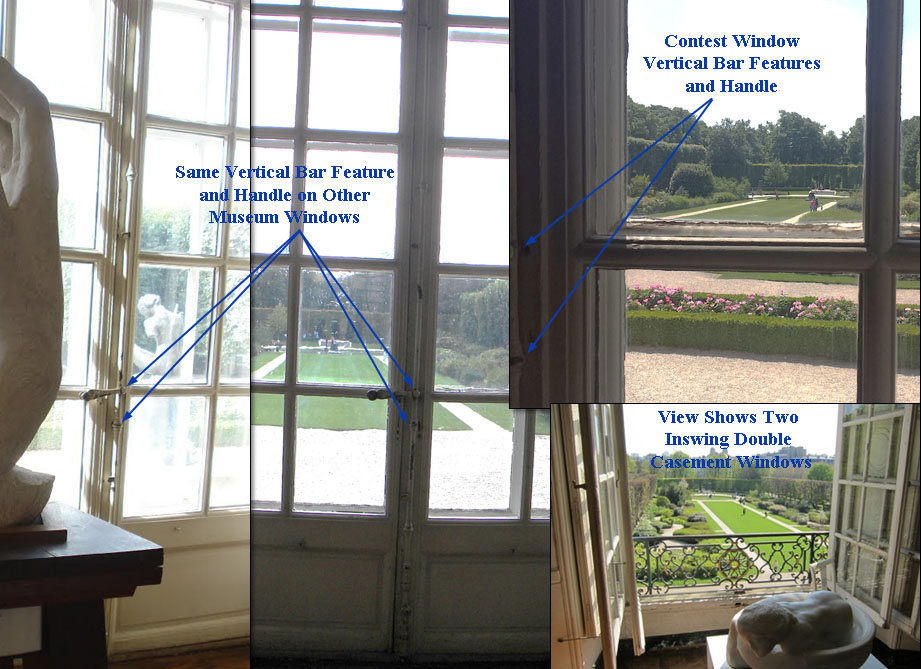
vfyw_Rodin_collagetext_6-7-2014

Attempts to identify the window panes in the photograph assumed that they were above the decorative wrought iron window grill (because it is not in the photograph) and at the height of someone standing. The window hardware barely visible in the darkened left side of the contest photograph places the panes on the western casement of the double casement window (actually two double casement inswing windows as found throughout the museum). The visible hardware includes components of the vertical rod and locking device that hold the two casements shut and is therefore located where the two join when closed. The round component is probably the handle connected to the locking device and vertical rod. Attached is a collage comparing hardware found on other museum windows with that visible in the contest window.

Speaking of collages, here’s another Dish original:

vfywc-208-guess-collage

This week’s tiebreaker goes to a reader on our list of previous contestants who have correctly guessed difficult contests but never won. A process walkthrough:

No buildings? No skyline? You’ve got to be kidding me. Google Earth isn’t going to be a help on this one. So what do we know? Looks like it could be the gardens at Versailles, couple of sculptures can be seen but its hard to make out what they are. Since there doesn’t seem to be a lot of other clues, what the heck, let’s just Google: “Sculpture Garden”. For some reason, when you do, you come up with an inordinate number of images for this Spoon with a Cherry in the Minneapolis Sculpture Garden:

208-ar1

But the window really doesn’t look like it is in Minneapolis, so what else do I know? There really isn’t a lot there. I guess there are a bunch of hedges. So why not, I’m feeling lucky, let’s unleash the power of Google: “Sculpture Garden Hedge”. And Boom! Just like that. By the magic of the internet there it is. On the first page of image results … it’s the hedge with three arches from the from the back of the photo along with a caption specifying Gardens of Rodin! And so, the Musée Rodin in Paris.

With a three-word Google search, this week’s window goes from completely impossible to getting my weekend back in the span of just 10 minutes! My guess:
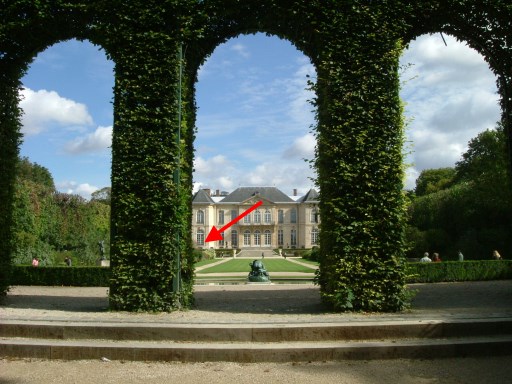
Paris_Musée_Rodin_Gartenaansicht

Congrats, and with a cherry on top! From the submitter of the window view, an artist:

It’s one of my favorite places in Paris, though nothing like it was in Rodin’s time, when it was more of a pastural paradise in the city. What an amazing place it must have been to have had a studio.

(Archive: Text|Gallery)

That Time The Clintons Ran Out Of Money

wealth2

In her interview with Diane Sawyer last night to plug her new book Hard Choices, Hillary claimed that she and Bill were “not only dead broke but in debt” when they moved out of the White House, and that the couple needed the millions of dollars they accrued in speaking fees to pay down those debts. Philip Bump fact-checks:

Clinton left the White House to head to the Capitol as New York’s junior senator in 2000, meaning that she had to file annual disclosures of how much she and her husband earned, owned, and owed. We took a look at those filings, via Open Secrets. And this is what the Clinton’s wealth looked like for the first four years after they left office in early 2001. We considered three things: what the Clintons reported as income on their taxes, what they reported as assets in Hillary Clinton’s mandated disclosures, and what was listed as being owed. The disclosures only give broad boundaries for the value of the assets owned, so the true value of their assets lies somewhere within the dark-red bar.

So, yes, it is technically true the Clintons left office in debt. But, a year later, the couple’s assets had soared. And, as was reported at the time, the Clintons’ debt was entirely gone by the end of 2004 — well before Hillary Clinton left the Senate and well before she left her position as secretary of state.

Indeed, Zeke Miller adds, by the time she left the Obama administration last year, Hillary was a wealthy woman even without her husband’s millions:

While the former first family’s precarious financial situation in 2001 was well known, the situation was very different when Clinton stepped down as Secretary of State in early 2013. She had reported on an government financial disclosure form assets in the millions, including between $5 million and $25 million in cash—meaning she left the State Department with at least $5 million in the bank, before her speaking gigs started and before she made millions more from her new book Hard Choices. Last year CNN calculated that the former President has taken in more than $106 million on the speaking circuit since leaving office in 2001. In fact, in their first year after leaving the White House, the Clintons earned a combined $16.1 million—the bulk of it coming from the former president’s speaking and author fees.

The inevitable walk-back arrived this morning:

“Let me just clarify that I fully appreciate how hard life is for so many Americans today,” Clinton said in a live interview on ABC’s “Good Morning America.” “I want to use the talents and resources I have to make sure people get the same chances.” Host Robin Roberts asked Clinton if she can understand why people are questioning why she’d describe her family’s finances as a struggle.

“Yes, I can, but everything in life has to be put into context. As I recall, we were something like in $12 million in debt,” said Clinton, adding that she soon entered the Senate and couldn’t do much to help reverse that at the time.

The Bonnie And Clyde Of The Far Far Right

Caroline Bankoff reviews what we know about Sunday’s bizarre shooting spree in Las Vegas:

Late Sunday morning, a man and a woman identified as Jerad and Amanda Miller barged into a Las Vegas restaurant called CiCi’s Pizza, shouted “This is a revolution!” and fatally shot two police officers who were having lunch. The pair stripped the officers of their weapons and ammunition and covered their bodies with a swastika and a Gadsden flag (that’s the one with the coiled snake and the words “Don’t Tread On Me”). They then took off for a nearby Walmart, where they shot and killed Joseph Robert Wilcox as he attempted to confront them with his own gun. After exchanging gunfire with the police, the Amanda shot her Jerad and then herself in what was described as “an apparent suicide pact.”

“What precipitated this event, we do not know,” Sheriff Douglas Gillespie told reporters after the attack. However, neighbors told the Las Vegas Sun and the Las Vegas Review-Journal that the couple was known for talking about their racist and anti-government views, and bragging about their  ties to libertarian hero and fellow racist Cliven Bundy.

Jesse Walker observes how the media narrative is coalescing around the Millers’ ties to Bundy and the militia movement, noting how the distinction between the Millers’ beliefs and those of most militia members gets lost in the fray:

As I’ve noted before when writing about the militia movement, violence on the far right often comes from hotheads who have been kicked out of the more mainstream militias. (Is “mainstream” the right word? It’s all relative, I suppose.) When actual organizations talk up non-defensive violence, they are often isolated and despised within the larger militia milieu. Yet these divisions are frequently missed in public discussions of the issue, which often lump all the “extremists” together—and, as a result, look in the wrong places for terrorist threats. Even when analysts argue that lone wolves acting on their own are a more likely source of violence than militias acting as groups, there’s a mistaken tendency to treat “radicalization” as the problem and to ignore all the cross-currents within a particular radical community. (J.M. Berger offers some strong arguments against that habit here.)

Paul Waldman makes the inevitable connection with the over-the-top rhetoric of the right:

The most obvious component is the fetishization of firearms and the constant warnings that government will soon be coming to take your guns. But that’s only part of it. Just as meaningful is the conspiracy theorizing that became utterly mainstream once Barack Obama took office. If you tuned into one of many national television and radio programs on the right, you heard over and over that Obama was imposing a totalitarian state upon us. …

To take just one of an innumerable number of examples, when GOP Senator Ron Johnson says that the Affordable Care Act is “the greatest assault on freedom in our lifetime,” and hopes that the Supreme Court will intervene to preserve our “last shred of freedom,” is it at all surprising that some people might be tempted to take up arms?

David Harsanyi  this argument away:

Yes, of course it would be surprising. Fortunately, despite the active imagination of pundits, no one has taken up arms to repeal Obamacare — ever.

Now, some of you would-be enablers of terrorism might argue that an individual mandate that allows government to coerce all citizen to purchase a product on the open market is, as far as policy goes, unprecedented. So it could be argued, reasonably, that it constitutes one of the most serious “assaults” on individual freedom in recent memory. Nothing in that statement, though, intimates that Americans should ambush their local police officers. Nothing in that statement implies that that you “harbor anti-government ideology.” We’re just debating the size of government. Harboring a desire to cut the budget to 2008 levels does not, despite what you may have heard, make you an anarchist.

Dissents Of The Day

Collier may have missed our airing of dissents from transgender readers here. The Dish doesn’t duck from strong criticism. Another reader:

I disagree with your view on language as being harmless and that people should just get over being offended by the use of “tranny,” “faggot,” or whatever. We could have an interesting back-and-forth discussion about the power of language and it wouldn’t bother me if we vehemently disagreed.

What does bother me, and the reason I’m writing, is your use of your blog as a bludgeon against a college student who represents not the antithesis to your argument, but simply a young, naive strawman used to convey your disgust. Here’s how you describe them: “What I am interested is condemning this pathetic excuse for a student.” What I think is pathetic is your savaging of a random, young college student who embarrassed themselves rather than representing an honestly defensible position. If you’re going to attack and rant against a position, take on someone who can strongly defend it. Instead of boosting the strength of your argument, it makes you come off as a bully.

I think that’s condescending to the student. If you want an example of bullying, check out the petition organized by the student and their allies:

On Thursday May 22, The Institute of Politics hosted a seminar with Dan Savage, a gay advice columnist who has a history of making numerous misogynstic, biphobic, transphobic, and racist comments.

Note that these students have absolutely no compunction about accusing someone of being a racist and misogynist, but cower and complain that they don’t live in a safe space if someone neutrally uses a term they have decided is now verboten. I don’t have much sympathy for this kind of hypocrisy, intimidation and cant. Another reader:

I am with you when you say that trans folks (and lesbians, gays and everyone else) should get over the over-sensitive word policing. Yes, it is appalling that a student ran crying out of a lecture. I too dislike the idea of trigger warnings in lectures. And yes, Savage seems to be using this in an appropriate context. That being said, let me remind of your posts against one Alec Baldwin. You seem to argue that trans folks should just get over themselves when being presented with language that they don’t much like at the same time that you take Baldwin to task for deploying homophobic language. Want to explain that? Are you not living up the same standard that you expect of trans people?

You can read the blog for many years and find my position on free speech, including offensive speech, clearly and consistently applied. The Baldwin case was about the double standards of liberals. If you are going to present yourself as a crusading gay rights activist, then it’s perfectly legit for me to call someone out when he uses terms like “cocksucker” and “faggot”. Baldwin’s outbursts were also linked to physical threats, using the term “faggot” and “toxic little queen” to directly intimidate gay people. (Even then, as in the Jonah Hill case, I’m totally cool if someone acknowledges what they said and offers a clear apology – which Baldwin refused to do.) But none of that is the same as being able to use terms freely in a non-aggressive form, not directed as a slur at someone, but as part of a lively or challenging discussion. As I wrote yesterday:

I’m not talking about deliberate demonizing of others or threats of violence; I’m not talking about prejudice or bigotry. I’m talking about being able to say words freely in order to think more freely.

The student was engaged in an attempt to prevent that, to dictate by emotional blackmail which words can and cannot be used in a university. And its [sic] confreres tried to get Dan Savage indicted for a hate crime because he refused to obey. I’m sorry but this tendency is anathema to a liberal society. Another reader goes into greater detail on the college student and trigger warnings in general:

Wasn’t there some sort of famous quote from James Madison or John Adams or something, that he studied politics so that his descendants might study poetry? I’m glad the Stonewall Rioters did what they did, but it might also be that our ethical conversation about what can and cannot be done within the world of LGBT rights has progressed to the point where there is at long last some space for a new generation of campaigners to give thoughts to our emotions and our human selves. Human selves that are sometimes traumatized and re-traumatized by sloppy language – human selves which are thankfully now free enough of the oppressions of a world before Stonewall, but are still subject to the bare difficulties of living psychically in a world arrayed against us, even if only in subtle and often-invisible ways.

I don’t mean to defend this particular student – the description of the situation does seem to suggest Savage has the right way of it in this context – but your blanket condemnation of any respect given to the concept of a trigger warning itself is silly. Not only that, but it assumes that a trigger warning is given so that people can avoid ever having to see something that offends them.

For instance, I can get triggered by fat hatred. But you know what? This doesn’t mean that I don’t read things that contain it! If I’m reading a post that says “(TW: fat hatred)”, I steel myself. I know that I may get bothered; I know that my anxiety levels might jump through the roof; I know that I might feel my heart start to beat faster as memories of my abuse flood my psyche. But I read on anyway. And quite often I find that material that would have drained my emotional reservoirs had it come upon me as a surprise is actually easier to manage and sort through because I had just a moment or two to prepare myself.

Your idea about what a trigger warning is and why people want them is abject caricature. Very few people ask for them because we want to wall ourselves off from all possibility of taking offense. We ask for them because sometimes, just sometimes, going into a difficult situation knowing it will be difficult gives us the mental and emotional space to make fruitful contributions to the discussion and explore the subject matter with the correct distance required for academic, dispassionate perspective. While I lack any sort of study to prove this is the case, I know from my own anecdotal experience that no one in my wide circle of TW-savvy acquaintances and friends actively avoids all posts that contain their triggers. They might sometimes skip one because they’ve already engaged 10 that day and don’t have the energy for another one, but the idea that trigger warnings exist to wall off academic or critical inquiry is absurd. Trigger warnings exist because they often give people the mental and emotional space to actually engage in such inquiry with aplomb.

Previous Dish on trigger warnings here.

Putin Still Has Time To Persecute Gay People

His machinations in Ukraine may have stolen the spotlight, but Jay Michaelson reminds us that things are still very bad and getting even worse for Russia’s gays:

According to [Tatiana] Vinnichenko, [director of the LGBT organization Rakurs,] Russian authorities are putting pressure on all United Russia Party Congress Conveneskinds of institutions—banks, landlords, employers—not to do business with LGBT people and LGBT organizations. Because licenses are required for just about everything in Russia, this “pressure” is existential. Banks are being told, “Dump your LGBT customers, or we’ll shut you down,” she said.

In Vinnichenko’s case, the threat is immediate and personal. A mother of two, she works for the Northern Federal University. Her employers have been pressured from above and have in turn demanded that she stop her advocacy work. “I am going on leave, because you cannot be fired while on leave, but as soon as I return, I expect to be fired,” she said. How she will replace her lost income, especially as she is publicly blacklisted, she has no idea.

Rakurs’s bank and landlord have come under similar pressure.

This is a form of eliminationism, further evidence that Putin’s regime is effectively a fascist one.

Previous Dish on Putin’s anti-gay crackdown here and here.

(Photo: Sasha Mordovets/Getty Images)

Catholicism’s Crimes Against Humanity, Ctd

OLYMPUS DIGITAL CAMERA

Further reporting has somewhat taken the most appalling edges off the story of the 796 dead children, buried without markers in one of the 20th Century Irish gulags for the sexually sinful and their children. No one is disputing the missing 796 toddler corpses, nor that they were probably buried in a mass grave. But the septic tank where some children were buried may only have had a couple dozen corpses, with the rest buried elsewhere:

Barry Sweeney, now 48, who was questioned by detectives about what he saw when he was 10 years old, said: “People are making out we saw a mass grave. But we can only say what we seen: maybe 15 to 20 small skeletons.”

The historian who uncovered the tragedy also insists that she never used the word “dumped” to describe the bodies. What we obviously need right now is a full and objective investigation into the former home and grounds, and a much wider inquiry into all the other institutions where young women and their babies were made invisible and often ended up dead. Mercifully, that will now happen:

Irish Minister for Children Charlie Flanagan has announced a statutory Commission of Investigation into mother and baby homes in Ireland … Mr Flanagan told Irish state broadcaster RTÉ that the government will receive an initial report from the investigating team by 30 June. On Sunday, one of the most senior figures in the Catholic Church in Ireland said a full inquiry was needed. Archbishop of Dublin Diarmuid Martin said the truth must come out.

With any luck, we will get more clarity on the nature of the entire ghastly enterprise. Meanwhile, Fintan O’Toole has a must-read on the broader cultural context for the atrocities. In the Catholic mindset of the time, illegitimate children were regarded as physically and mentally weaker than other “virtuous” toddlers:

In 1943, the Joint Committee of Women’s Societies and Social Workers compiled a well-meaning memorandum on children in institutions. It noted of those in mother-and-baby homes that “These illegitimate children start with a handicap. Owing to the circumstances of their birth, their heredity, the state of mind of the mother before birth, their liability to hereditary disease and mental weakness, we do not get, and we should not expect to get, the large percentage of healthy vigorous babies we get in normal circumstances. This was noticeable in the institutions we visited.”

So the children were blamed for the consequences of their own mistreatment. It’s an insight into how Christianity’s sex-phobia so distorted the faith that it actually demonized children and excused their early deaths. And that, of course, was the reason for their not being buried individually, with markers. They were regarded as subhuman.

I repeat my view that when a doctrine begets this evil, there is something deeply wrong with the doctrine itself. When it leads to an inversion of Christianity’s deeper call to empathy, care for the vulnerable and love of children, it is objectively disordered.

(Photo: headpiece of the High Cross in Tuam, Ireland, by Clint Malpaso via Wiki)

Clinton’s Other Apology

It’s more emphatic, more convincing and less tortured than her pirouetting on the Iraq war – and it’s on her 2008 campaign:

[I lost] I think because I really didn’t have a good strategy for my campaign. I didn’t plan it the right way … As a candidate who was already so well known … I don’t think I ever said, ‘Yes, you may have known me for eight years, but I don’t take anything for granted. I have to earn your support.’

It’s a pretty clear admission that she expected to be coronated last time around. Which means she might not be so cocky this time around. Might.